 MiG-23MLD
nothing wrong with the British designs, as long as they went into production and became operational. i find the Lightning very beautiful design, very ‘British-ish.”
love the cover pic from the special issue of Farborough Air Show Magazine (100th Anniversary Farborough) because the Lightning is on it.
Do not take me wrong, if you like it it`s okay with me in fact i am not trying to impose my views, if you love the Lighting of course is like food or women is a very subjetive matter and there are many different tastes.
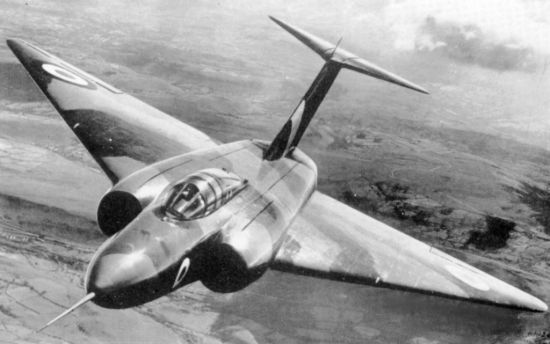
The reason why i personally do not like the Lighting is because i think it looks bizarre, lacks symmetry, looks unusual and it is not a trend setter.
In fact its engine arragement of one engine on top of the other i feel is too complex and limits its design potential
Why? for example the wing-fuselage blending is easier on a side by side twin engine arragement, also two lateral air intakes are easier to fit into a side by side twin engine arragement than into one such as that of the Lighting where one engine is on top of the other.
This is very clear because of i can not recall another jet that has the same twin engine arragement of one engine on top of the other except the Lighting, i feel there is something disadvantageous in such engine arragement that has provoked that all the aircraft makers have not used it for their designs
The cabin bulge also is less aerodynamicaly complex on a side by side engine arragement because simplier fairings bulges can be design.
The Lighting also gas a horrible fuel ventral tank bulge in fact looks like if it was pregnant 😀 , its wings are unusual and have had few followers ever since.
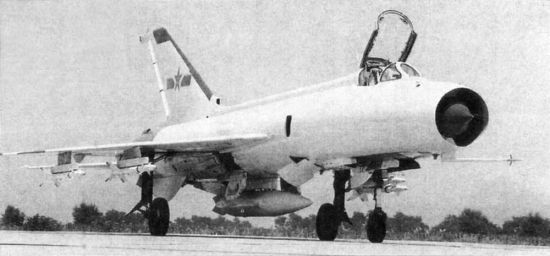
If you look at the MiG-21 and J-8, these aircraft are more aesthetically pleasing aircraft in that sense and have better development potential
The J-8 for example also is a twin engine aircraft with a nose inlet with a shock wave cone but its design has better symmetry due to a smoother integration of all its parts and therefore a less draggy design
MiG-23MLDOn the subject of Brittish jets, what about the Lightening? Wow.
My top 5
BaC Lightening
Lockheed A-12
M-50 Bounder
Draken
Mig-15
Man if you ask me to choose between the Lighting and the MiG-21 i will choose right away the MiG-21, but to tell the truth i found them both ugly, i feel only from that time the Mirage III sticks out as a truly beautiful and well balanced aircraft
I like more the old He-111 than the Lighting, camberra or any other british aircraft except by the Harrier and Tornado ADV, their WWII bombers i think frankly were quit ugly
i would rather think the americans have a really beautiful WWII bomber in the nice looking B-29 than all those aerodynamically draggy bombers seen every where except by a few that were quit smooth in lines

However the GermanAR-234 jet aircraft of WWII are my favorite bombers in all their versions but specially in this one 


MiG-23MLDBrits have made some of the most atractive airplanes of all time…….Hunter, Sea Hawk, Vulcan, Victor, Spitfire, Lancaster……now……what happened with Typhoon? BOTH of them! The French have made some REALLY elegant jets too!
Sorry i did not mean the British made ugly aircraft, no do not take me wrong, i just said Personally i do not like their designs but if some one likes the british design well is okay the ranking to me is personally i just wanted to know which aircraft every body likes
Personally for example i do not like 1950s aircraft except perhaps by the Mirage III and F-4

I rather think the Americans made more constantly beautiful aircraft than the british
For example personally i do not like british aircraft because they look rather too old fashion and with little innovative aerodynamic trends
MiG-23MLDThe read out for acc. shows ~16,875 seconds, but still a good value!
Sens how did you arrive to that value?
In the chart you can see the acceleration characteristics displayed by the MiG-23ML at 12700 kg of weight, armed with two R-23 air to air missiles and accelerating from 600 km/h to 1100 km/h at different wing settings and altitudes.
For example at 1000 meters of altitude and a wing setting of 45 degrees, it will accelerate from 600 km/h to 1100 km/h in 22 seconds, it will burn 179 kg of fuel to do that feat; also it will fly the distance of 5.5 km to accelerate to 1100 km/h from the initial speed of 600 kmh
We need to notice the R-35 will be at full afterburner
MiG-23MLDMiG-21 and F-14
MiG-23MLDI was reading it off babelfish, and while it did not say that the wing is the same it said the leading edge wing surfaces are like the Lavi’s. And yes the Lavi and the J-10 has forward edge slats but so does a lot of other planes like the Mirage 2000 and the F-106 Delta Dart. But the length of the slat differs significantly between the two planes.
Also the first trial J-10 regiment was commissioned in 2003, and the first operational regiment was commissined in 2004, not 2005.
The article has many points but it still is a collage of different internet and magazine articles put together into one inheriting some of the flaws and myths.
And yes, the article did say the first flight was in 1996 which is dead wrong. Likewise, failed to mention 1002.
Первый полет опытного образца состоялся в середине 1996 года. Было построено девять машин: пять для летных испытаний (N1003-1007), две для проведения наземных испытаний и две серийные (N1008-1009). В ходе испытаний машина N1002 была потеряна из-за отказа системы управления самолетом.
В феврале 2003 года на вооружение национальных ВВС была поставлена первая партия новых самолетов, состоящая из семи (N1010-1016) или, возможно, десяти предсерийных самолетов стандартной конфигурации. Некоторые из этих машин используются для проведения войсковых оценочных испытаний в составе боевых подразделений, а другие остались в центре испытательных полетов и обучения ВВС НОАК, где они участвуют в завершающем этапе испытаний. В декабре 2003 года программы испытаний и сертификации самолета были завершены. В настоящее время начато производство первой партии из 50 J-10A.
Let`s go by parts they do not say the wings are the same, they say the wings were built under a very similar platform, but they mention very well the differences.
In fact it says the first experimental model was first flew in mid 1996, however the first production model was flown in 1998 same as the T-10 and T-10S program differences.
The one flown in 1996 was like the Su-27 experimental version T-10 that had to be improved and first flown in the definitive configuration in 1998. like the T-10S
Машина была построена в 1996 году, но первый полет.был совершен лишь два года спустя в 1998
What the Chinese official statement is saying is the definitive J-10 configuration first flight did not take place in 1996 but in 1998 same like the T-10 that flew in 1977 and the T-10S that flew in 1981
был совершен this means was improved or perfected
So in few words the 1998 aircraft really was the definitive version and did have its first flight in 1998, the experimental aircraft like the first six T-10s were flown in 1996 though.
Машина была построена в 1996 году, но первый полет.был совершен лишь два года спустя в 1998this can be traslate like the first J-10 were built in 1996 but the improved J-10 first flight took place in 1998
This is what the article is saying
In fact check this two articles
http://www.globalsecurity.org/military/world/china/j-10.htm both have different first flights http://www.sinodefence.com/airforce/fighter/j10.asp
as a result of that J-10 redesign
but however sino defense states the following HISTORY Oct 1986 J-10 project started
1998 Maiden flight successful
1999 Six prototypes produced
MiG-23MLDThere are many holes indeed.
– For example it mentions that the wing surfaces are like the Lavi’s. Nonsense. The leading edge slats of the Lavi extend on the entire wing, but on the J-10 it only extends from the half, much more similar in design to the Gripen. When the slats on the J-10 extend it creates a saw tooth edge in the middile of the wing and changes its front geometry. We all know that mid wing notches, siimilar to what appears in the Grippen, Russian MiG-23MLDs, and F-14s, improve angle of attack performance.
Another is that the Lavi only has elevons, one single control surface in the rear. The J-10 is in an uncommon club of deltas that actually has two control surfaces in the rear of the wing.
– Specs are all copied from Hui Tong’s website. Nothing original. Some of the specs I suspect are wrong, like the empty weight. No way that the J-10 with single engine, shorter length, smaller wing area and composite construction be heavier than the first generation J-8I.
– First flight of J-10 occured in March 23, 1998. That’s official.
– Second prototype crashing is completely false and is an internet myth. The J-10 has no crashes during its prototype stage except for a near mishap on June 2000. The pilot was awarded a medal for rescuing the plane and this was shown in CCTV many years later. There is a photograph of Prototype 1002 fitted with PL-11s and weapons testing occured only from late 2001 and above.
– AL-41 isn’t being proposed for J-10. Only the Salyut invented variants.
– It’s way too obvious that the J-10 has a variable inlet ramp with its obvious advantages and I have mentioned that for years in this forum and others. Of course it’s going to be faster with that inlet. That’s not new or unique information. Furthermore, the J-10 has a lower drag canopy then either the F-16’s or Lavi’s.
– Radar information is wrong. Neither the Zhuk aka Beetle, or the ELM-2032 or 2035 is used on the J-10 although they may have been proposed. Jane’s reported that the name of the Zhuk proposed is Zhemchug aka “Jewel”, which the article also failed to mention. This is basically the Zhuk-ME with lightened electronics. In the final selection, the J-10 uses a home grown radar that is compatible with home grown missiles. No R-73s, R-77s and R-27s whatever. The KLJ-3 or Type 1473 radar developed by NRIET is descended from the KLJ-1 or Type 1471 slotted planar radar which is China’s first operational slotted array radar and is used on the J-8IIs. This radar may have benefited from studying the ELM-2032, 2035, the APG-66, the Thales RDY and the Zhuks.
There are a lot of things the article doesn’t mention. For example, canard delta designs tend to be very unstable—the need for space for canards tend to push wings back further down the fuselage. This means so does the structure supporting making up the wings, plus the fuel and stores attached to the wing. This throws the CG to the rear making the plane unstable and extremely sensitive to directional changes. Ergo you need a big tail stabilizer, which also apparent in the EF2000s, Rafale and Gripen. Somehow I didn’t think that the Lavi’s F-16 derived stabiizer is enough, and the J-10 certainly has a bigger stabilizer than the Lavi.
Furthermore, to reduce the interference drag from the canards to the wing, the wing has to go down further. The Lavi has a concept flaw where the canard is quite close above the wing. The J-10 has greater seperation between canard and wing, and the EF2000 takes the seperation even further by putting the canards on the nose.
Crobato
The Article never mentions the wing is the same, in fact if you read it carefully it mentions the root leading edge is fixed while the outer wing leading edges are moveable:
возросла площадь его поверхности). Таким образом, изменился общий вид самолета в плане, поскольку у «Лави» крыло имело стреловидную заднюю кромку. С другой стороны, компоновка подвижных поверхностей крыла J-10 осталась такой же, как и у «Лави»; передние кромки консольной части крыла могут отклоняться. Это позволяет создавать различные варианты кривизны профиля крыла, что оптимизирует аэродинамическую эффективность и маневренность во всех диапазонах эксплуатационных режимов полета. В то же время корневая часть крыла, подвергающаяся воздействию скошенных потоков подвижных поверхностей переднего горизонтального оперения (ПГО), имеет фиксированные передние кромки.
В то же время корневая часть крыла means at the same time the wing root and the sentence имеет фиксированные передние кромки has a fixed leading edge
At no moment they claimed the Wing is the same
Россия предлагает ряд систем, часть которых Китай уже выбрал для эксплуатации на других самолетах. Рассматривается также РЛС китайского производства JL-10A, но пока не ясно, будет ли закончена ее разработка к моменту принятия на вооружение нового истребителя. До начала его серийного производства китайские специалисты должны определиться с БРЛС.
Here they said Russia proposed the radar they are not affirming they selected the Russian radar. Россия предлагает This means in Russian Russia proposes so as you can see they never said it was already chosen
Машина была построена в 1996 году, но первый полет был совершен лишь два года спустя в 1998. В 1999 при проведении летных испытаний был потерян второй летный экземпляр, пилот погиб.
They never said the aircraft had it`s first flight in 1996
Машина была построена в 1996 году, this means in Russian the machine was built in 1996 at no moment they said the first flight was in 1996 in fact they said the J-10 first flew in 1998
первый полет был совершен лишь два года спустя в 1998.
MiG-23MLDYou don’t need a raked intake to fly at supersonic speeds. Look at the F-16 or the F-4, or even the MiG-23 (how did you miss that one? 😀 ). It’s also claimed that the EF-2000 can supercruise, and it also lacks a raked intake, so you don’t need one for supercruise either.
Of all those aircraft you mention only the F-16 has a fixed geometry inlet and it is not a fighter that goes beyong mach two both the F-4 and MiG-23 go beyond Mach 2.2 thaks to the fact it has variable geometry inlets.
The Eurofighter has excellent agility however to tell you the truth i do not know if it has a variable geometry inlet but i guess i does
MiG-23MLDSome interesting material but plenty of holes and mistakes. Need extensive working and correction.
I would like to know what mistakes and holes, i mean the article sounds more logic in what respects the air intake that many other sources.
Why does need the J-10 a highly racked air inlet if it is not to fly supersonic?
Another thing that shocked me is that this is the Second Russian article i have read that mentions the Israeli involment and input.
I think since the Russians had direct involment in the J-10 they have good sources of information.
MiG-23MLDSomeone please confirm or correct as required.
Крейсерская скорость дозвуковая this is subsonic cruising speed it does not mention at any moment supercruise, дозвуковая =subsonic
MiG-23MLDRecently i read a Russian J-10 article where they said its max speed is Mach 2.2, making it it superior to the F-16 and Mirage 2000 in the fact it has a variable geometry inlet ramp, but i wonder why in the vast majority of western articles it`s speed is usually Mach 2 or less?
http://paralay.narod.ru/j10.html
Технические характеристики J-10.
Размах крыла 8.78 м
Длина 14.57 м
Высота 4.78 м
Площадь крыла 33.1 кв.м
Площадь ПГО 5.45 кв.м
Вес максимальный 18500 кг
Вес пустого 9750 кг
Вес топлива 4500 кг
Вес нагрузки 4250 кг
Двигатель АЛ-31ФН
1 * 12500 кгс
WS-10A с УВТ
1 * 15000 кгс (?)
Максимальная скорость M 2.2
Крейсерская скорость дозвуковая
Практический потолок 18.000 м.
Радиус действия 463 – 555 км
Дальность перегоночная 1850 км
Максимальная скорость M 2.2 means max speed Mach 2.2
MiG-23MLDSchorsch this is the R-35 specifications chart
Наименование параметра= parameter designation
полный форсаж=full afterburner
Минимальный форсаж=Minimum afterburner
максимал=maximum
номинал=nominal rating
крейсерский режим=cruise setting
частота вращения=RPM
Тяга=thrust
удельный расход топлива=specific fuel compsumtion
температура газов перед турбиной =temperature of the gases before the turbine
температура газов за турбиной=temperature of gases behind the turbine
степень повышения давления в компрессоре=air pressure increase rate at the compressor
расход воздуха =air flow rate
Тумблер полный форсаж в кабине самолета включен= full afterburner switch included in the MiG-23 cockpit instruments panel.
Тумблер полный форсаж в кабине самолета отключен= full afterburner switch in the MiG-23 cockpit instruments panel on
MiG-23MLDActually .., fairly easy. 😀
And:
A clean F-18C with F404 -GE-400 at 26.000lbs at 4.000ft needs 11 seconds to accelerate from 360 kts to 550 kts, that is 666 km/h to 1020 km/h. Both speeds indicated airspeed.While the claim that the F-18 is the “draggiest” 4th generation fighter in transonic regime is true. On the other hand, it is quite agile and very versatile. Everything comes with a price-tag.
Schorsch
The MiG-23ML/MLA/P/MLD have the Tumansky R-35-300 engine, in the MiG-23ML manual there is an entire chapter dealing with the R-35 including the air intake operational features, in fact in Page 59 they have all the technical characteristics of the engine.
I will translate it very soon for you just give me some time.
The MiG-23 accelerates from 600km/h to 1000km/h in around 15 seconds, however notice the aircraft carries at least 2000 liters of fuel and two R-23 air to air missiles
I attached the MiG-23ML rate of climb graph, in it you can see the rate of climb at a given speed, altitude and sweep angle; for example at 1000 meters of altitude and at a wing setting of 45 degrees the MiG-23ML has a rate of climb 220 meters per second when its speed is in the vecinity of Mach 0.9, nevertheless as speed increases it will drop the rate of climb and at around 1400km/h its rate of climb is close to 120m/s.
Something different happens at 5km of altitude where the rate of climb remains around 120 m/s-140m/s independently of the the wing setting at speeds beyond Mach 0.9.
At 10km of altitude the reverse happens and beyond speeds of Mach 0.9 the rate of climb improves drastically, in fact at a speed of Mach 2 the rate of climb is 160m/s, it doubles the rate of climb at the speed of Mach 0.9 which is around 70m/s
Let`s notice the MiG-23 is carring two R-23 and weights 12000kg.
With respect accleration
MiG-23MLDWe can see that the MiG-23ML will accelerate from 600km/h to 1100km/h in just 22 secs with its wings set at 45 degrees and at 1 km of altitude.
So both are similar. What is missing in that comparison is, we do not know what F-18 it was and what engines were fitted?
It is an F-18C, the F-18C is the worst of all medium size fourth generation fighters in what respects acceleration according to the books “MiG-29 Fulcrum” by Gordon and “Su-27” by Fomin.
The Graph shows basicly that the MiG-23ML with its wings set up at 45 degrees accelerates from 600km/h to 900km/h in around 15 seconds or 14 seconds check by your self however since it is not very clear it is possible the MiG-23ML takes around 16 seconds to get from 600km/h to 1000km/h but it does not seem 18 seconds
MiG-23MLDNice camuflage


 Sign In







