 MiG-23MLD
All of this “this airplane can do maneuver X and that means it is better” is completely and totally irrelevant without all of the facts. Unless you have the sustained and instantaneous turn rates to get an idea of how much airspeed and energy they are bleeding off doing high AOA maneuvers, all of your commentary has absolutely no relevance to actual air combat.
All this aerodynamic data has been corroborated with instantaneous turn rates and sustained turn rates.
The Gripen for example has an intantaneous turn rate of 30 deg/s and a sustained of 21 deg/s, the Mirage 2000 has a lower instantaneous turn rate of 24 deg/s, this gives you more or less the agility of other fighters since the Mirage 2000 has slower turn rates than the F-16 at most ranges of its flight envelope
the F-16 has the following numbers
Maximum instantenous turn rate: 26 degrees/second
Maximum sustained turn rate: 18 degrees/second some reports say 21 deg/s sustained turn rate
The MiG-29 has even better numbers 28 deg/s for its instantaneous turn rate and 23.5 deg/s for its sustained turn rate. this goes very well with the fact delta-canard designs have better ITR but worst STR than LERXed aircraft tailed aircraft
There is no way that the first 40 aircraft will have any other engine than the GE 404. The engine gives a power of 80-85 Kilo Newton while the IAF requires them to have a capability of 95-100 Kilo Newton,” a top MoD source said, adding that the current thrust provided by the engine limits the angle of attack — a measure of the maneouverability of the aircraft—to 17 degrees against the IAF’s minimum requirement of 21 degrees. This makes the fighter unsuitable for aerial combat, especially given that neighbouring countries already possess more agile fighter planes.
http://www.indianexpress.com/story/319117.html
The main reason is because it is an underpowered engine and more important the LCA has limited control surfaces.
here is some data for the Eurofighter and Rafale
Rafale C main data for Turn performance at sea level are:– Maximum Turn Rate (CAT-I AoA limit) 30.00 deg/s at M=0.50– Maximum sustained Turn Rate (Ps=0) 23.9 deg/s at M=0.60•
Typhoon main data for Turn performance at sea level are:– Maximum Turn Rate (CAT-I AoA limit) 29.33 deg/s at M=0.50– Maximum sustained Turn Rate (Ps=0) 23.4 deg/s at M=0.60•
Very small, quite un-significant, advantage to the Rafale in turn performance in such configuration.Horizontal evolution capabilities of the two planes are very similar.RafaleTyphoon
http://topolo.free.fr/Compare/Rafale%20vs%20Typhoon.pdf
So as you can see the MiG-29 is more or less competitive with the Rafale and Eurofighter
see the 23.5 deg/s is for old veriosn of MiG-29s newer versions such as the MiG-35 should be better since they boast a better thrust to weight ratio
MiG-23MLDIt is generally accepted that Tejas has 2 control surfaces i.e. rudder and one pair of elevons. However in my view, as both the elevons are mutually independent surfaces, they must be counted as 2 individual surfaces and not counted together as one surface.
As discussed earlier, Tejas can perform all manouevers with equal agility as any fighter plane. In the video posted by 21Ankush, it is seen performing various manoeuvers including simultaneous pitch and roll.
I agree that European and Chinese aircraft companies found canards to be advantageous, however definite determination of manoueverability comparison can now only be done by visual comparison, instead of theoretical speculation. Canards are advantageous, especially if they are able to utilize the elevons in a double-moment about the lift point. But I don’t think conventional tailed or tailless delta designs will be “abandoned” soon.
Other points to be mentioned may be that Su-30 MKI’s canards are NOT under the pilot’s control and are not the lift authority at all (tail is the lift authority). They are automatically deflected for small vortices only.
Another point is that Tejas is NOT a simple delta like Mirage-2000, but a compounded and cranked delta.See, Su-30 MKI is advantaged with TVC which Mirage and Tejas do not have.
Abhimanyu
Please do not fantasize any more, let us go by parts.
A) the Viggen, F-16, MiG-29, Drakken and Su-27 as many other fighters have compounded wings . The LCA is not the first aircraft having a compounded wing, the Concord has a compounded wing too, even the F-14 and MiG-23 have compounded wings when they have their wings at minimal and medium sweeps.
B) the Su-27 is a very agile fighter, still can do the cobra; the Su-35 still can do the cobra turn. this means controlability up to 120deg of AoA. So we conclude the Su-27 and Su-35 can do maneouvres that are not done by many fighters, the F-15 and F-16 can not make the Cobra without thrust vectoring nozzles for example and the Su-35 and Su-27 still can outfly an F-15 or a Mirage 2000 and do the cobra and the cobra turn without thrust vectoring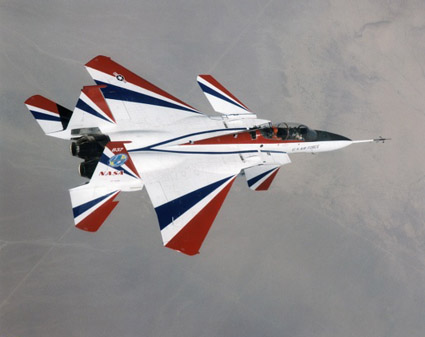
http://www.globalaircraft.org/photos/planephotos/F-15_active_1.jpg
The americans also did study the canards in the triplane arrangement with tailplanes and with delta wings and they fitted still tailplanes to the F-22.
the americans came to a conclusion that thrust vectoring can enhance a fighter agility as the Russians did.
In europe under budget considerations thrust vectoring has not been applied to the Eurofighter and other european programs since already the existance of missiles like the IRIS-T or AIM-132 render thrust vectoring up to a level obsolete
Now any canard deflection will change pitch, yes it is true a canard deflection always changes pitch and also can change the center of lift position, for this reason the Su-35 has canards, they are also pitch authority controls but they are working in conjuction with tailplanes, consider the Su-35 still have very complex LERXes with canards, this combination of LERXes and canards uses the canards as pitch devices and as a more complex control of the vortices generated by the LERX
Now do not misunderstand me i am not belittling the LCA, the aircraft is fine if it is as good as the Mirage 2000 and even if it is better well that is a great achievement, but i do not think it is as good as the Rafale or Eurofighter
MiG-23MLDIf the triplane configuration is so good then why did MiG choose a canard delta for the 1.42…
have you noticed the MiG-144 has elevons offset the main trailing edge? are not they working as tailplanes?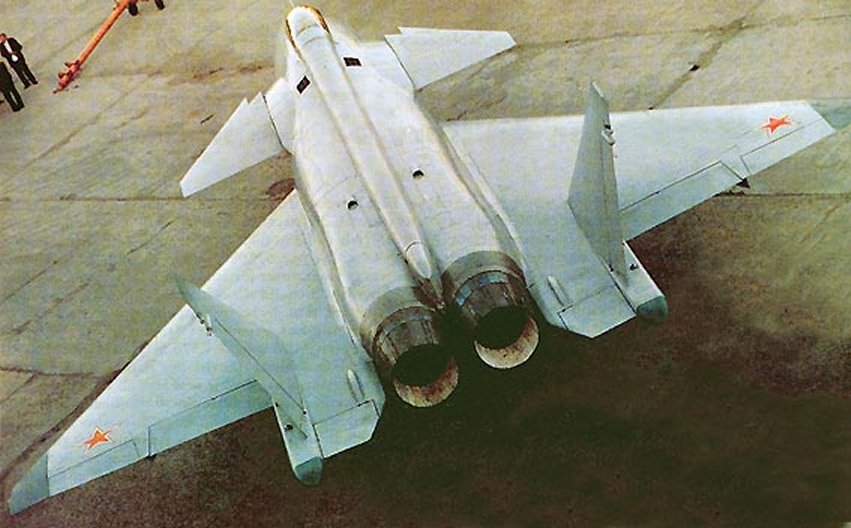
http://www.fas.org/man/dod-101/sys/ac/row/i42-002.jpg
MiG-23MLDMLD,
You keep ascribing nationalistic tendencies to me when I have said nothing to that effect. All I have been saying is that it is not possible to characterize the relative performance of two different aircraft by inspection.
To wit, it may very well be that Gripen, JF-17, Typhoon, Rafale, J-10 and B-1B (eight fowler flaps, fourteen slats, eight spoiler sections, two all-moving tails and three rudder sections _and_ two canards!) can out-turn the LCA, bring their weapons to bear and convert it into a smoking hole in the ground. But it is not possible to know this for the fact that you claim it to be. An aircraft A that can out maneuver B at one airspeed and altitude may be out maneuvered by B at another airspeed and altitude.
Since you want to bring things down to fundamentals, consider the following: any acceleration of an aircraft along any axis (linear or rotational) involves two basics: force and mass. In the case of rotational accelerations, the additional factor is the moment arm. For example, for longitudinal rotations you need to consider:
a) the magnitude of the aerodynamic force being generated, which is dependent not only on sizing of the surface but also local airflow considerations
b) static margin
c) effect of airfoil pitching moments
d) inertial mass about the longitudinal axis
e) specific excess power
f) airspeed/altitude effects on the above
g) moment arm of the forcesYou claim that you account for all these variables by:
1) counting the number of control surfaces
2) inspection of configurationIf this were possible, could you please enunciate why do aircraft designers:
– need CFD codes to verify the core aerodynamic parameters that define aircraft performance
– having done the above, still need wind-tunnel studies to refine their conclusions
– having done the above, still need flight tests to refine their conclusionsThis has nothing to do with who can or cannot do integral calculus (although that definitely helps).
Since you are genuinely interested in these topics, I suggest the following books (which I think you will enjoy):
– Aircraft Design: A Conceptual Approach (By Dan Raymer); this book has a lot of discussion about configuration choices and their impications
– Mechanics of Flight (by Warren Philips); you can peruse the mechanical equations in this book to get a feel of the number of parameters that effect aircraft performance.That is about as much as I can meaningfully add to the conversation, so it will be my last post.
Funny your last post never explained in detail why the Russians opted for the tripalne configuration as they have done in the Su-35, Su-34, Su-33, S-47
if you see the S-37 (now Su-47)
it has tailplanes, canards, leading edge control devices, trailing edge control devices and a strake above the inlet.
Besides having twin fins and a vortex generator nose to eliminate assymetric yaw movement.

If the tailess design is so good why then Russia made an aircraft with the triplane configuration and France the Rafale with canards?

Can the Mirage 2000 and LCA emulate the same manuevres the Su-30MKI can perform? why the Su-37 and Su-30MKI still need canards to do the the culbit or the Cobra turn?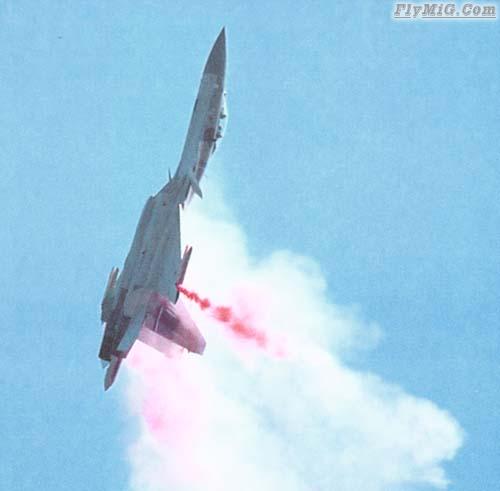
why the F-22 still has tailplanes even having 2D thrust vectoring nozzles?

In this picture you can see very well the elevons between the tail booms and fuselage, basicly even it is not a real triplane makes the MiG-1.44 a semi triplane since these elevons are offset from the main trailing edge
MiG-23MLDMLD,
You keep ascribing nationalistic tendencies to me when I have said nothing to that effect. All I have been saying is that it is not possible to characterize the relative performance of two different aircraft by inspection.
To wit, it may very well be that Gripen, JF-17, Typhoon, Rafale, J-10 and B-1B (eight fowler flaps, fourteen slats, eight spoiler sections, two all-moving tails and three rudder sections _and_ two canards!) can out-turn the LCA, bring their weapons to bear and convert it into a smoking hole in the ground. But it is not possible to know this for the fact that you claim it to be. An aircraft A that can out maneuver B at one airspeed and altitude may be out maneuvered by B at another airspeed and altitude.
Since you want to bring things down to fundamentals, consider the following: any acceleration of an aircraft along any axis (linear or rotational) involves two basics: force and mass. In the case of rotational accelerations, the additional factor is the moment arm. For example, for longitudinal rotations you need to consider:
a) the magnitude of the aerodynamic force being generated, which is dependent not only on sizing of the surface but also local airflow considerations
b) static margin
c) effect of airfoil pitching moments
d) inertial mass about the longitudinal axis
e) specific excess power
f) airspeed/altitude effects on the above
g) moment arm of the forcesYou claim that you account for all these variables by:
1) counting the number of control surfaces
2) inspection of configurationIf this were possible, could you please enunciate why do aircraft designers:
– need CFD codes to verify the core aerodynamic parameters that define aircraft performance
– having done the above, still need wind-tunnel studies to refine their conclusions
– having done the above, still need flight tests to refine their conclusionsThis has nothing to do with who can or cannot do integral calculus (although that definitely helps).
Since you are genuinely interested in these topics, I suggest the following books (which I think you will enjoy):
– Aircraft Design: A Conceptual Approach (By Dan Raymer); this book has a lot of discussion about configuration choices and their impications
– Mechanics of Flight (by Warren Philips); you can peruse the mechanical equations in this book to get a feel of the number of parameters that effect aircraft performance.That is about as much as I can meaningfully add to the conversation, so it will be my last post.
Samudragupta
man it makes me laugh the way you claim my last reply to the topic like saying you the stubborn and me the real knowledgable person.
let us say some things i have not claimed that a design automatically yields all its performance since an aircraft is a matching of an engine with an airframe, why? simply because as the Su-27 exemplifies, any design always has room for improvement and any aircraft is a result of airframe-engine integration.
Test are ways of perfectionate a design but before doing it aerodynamic models are tested.
NASA has published several results of some studies carried out, these studies clearly say the following the results are mission dependant, depending in the mission a configuration is better or in few words aircraft have compromises.
the only thing i said is the LCA is not as agile as the J-10 and you are arguing that the LCA will out fly a fighter like the J-10, this is just a dream, the J-10 has one of the best configurations for a fighter, and is recurrent in several aircraft, Eurofighter, MiG-29, F-16, Gripen and Lavi, just to mention a few.
It is obvious the LCA won`t outfly a fighter like the J-10 or Gripen to say the least, you think the canards were deleted out of the LCA because it is so agile that it does not need them, its secret design has all a fighter needs.
There is a sad reality and the LCA configuration has been studied by the main aircraft manufactures and has been rejected in favour of either canards or thrust vectoring, the simple delta wing was studied by SAAB in the Draken and Viggen; and France, in the Mirage III/V/50 family and in the Mirage 2000, and today their products have canards, the Russians also have made studies and concluded the best aircraft is the one with thrust vectoring.
The US did also studies and concluded the same thrust vectoring and tailplanes are the best configuration see both the F-22 and Su-35BM have tailplanes and thrust vectoring .
Probably you think India has more experience than SAAB or British aerospace but the reality is the LCA was chosen as it is just because it needs the least weight and adding canards adds to much weight and it is more economical to design the LCA as it is now.
The F-16XL has basicly the LCA configuration, it only increased range but the other F-16 derivative has canards the IAI Lavi and the Chinese J-10 opter for the IAI lavi configuration as the best one and the same we can say about the Eurofighter
MiG-23MLDSo the aircraft with the most cotrol surfaces is best? Wow, I hope the Mig-1.44 never runs into a Fokker Triplane or Sopwith Camel.
If you know the agility a Me-109 has at 150 km/h you will be surprise to see it is more agile than any modern fighter at that speed, most of fighters can not fly at really low speeds and take off at the speeds WWI or WWII fighters did
Modern fighters are agile at very high speeds and not as agile as their forebears were, however you have two options in an aircraft, either you fit it with thrust vectoring nozzles to eliminate control surfaces or you add more control surfaces to control the aircraft at different axis.
see it in the Flanker
The Su-27 Flanker B has no Thrust vectoring nozzles and canards it is the least agile version of all the Flanker familiy

later the Russians needed an aircraft with lower speed landings and better handling at those speeds enter the Su-33, however this aircraft has early technology so it is not as agile as it looks
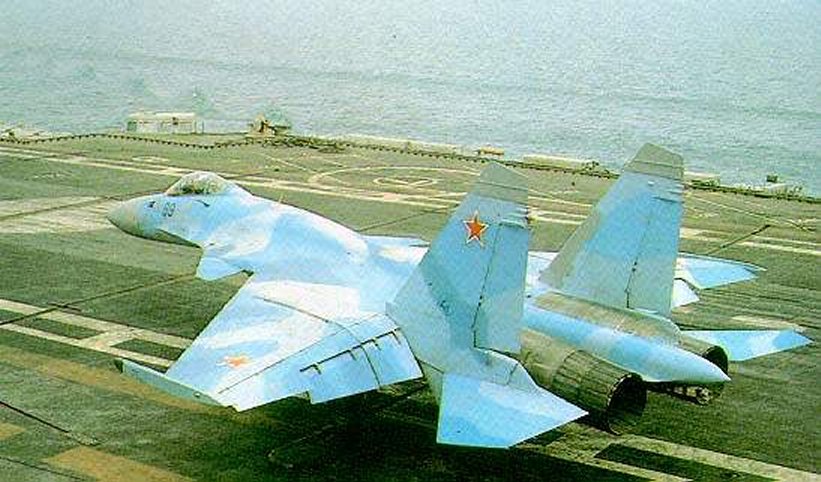
with better fly by wire systems they created the ultimate Flanker the first Su-27M or Su-35
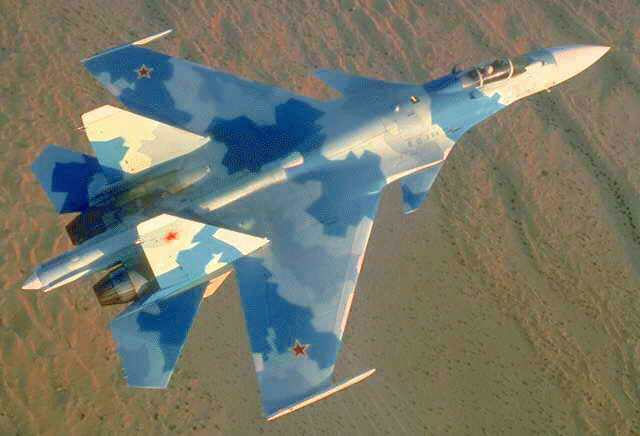
See already to make it more agile they incresed the number of controls surfaces by adding canards
The Su-37 has 2D thrust vectoring nozzles so still the canards were deemed usuful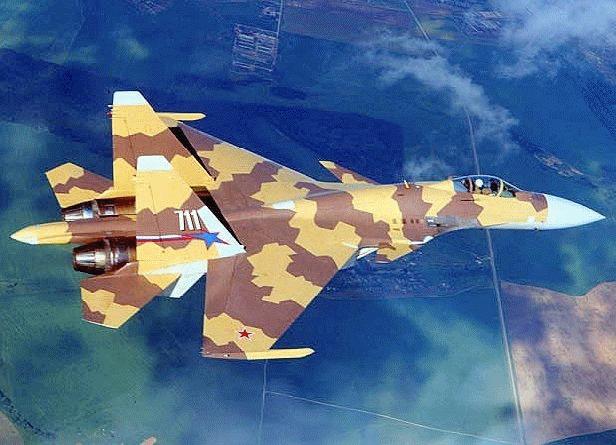
the Su-30MKI and Su-30MKM are basicly twin seaters variants of the Su-37
However the canards add drag so the perfection of thrust vectoring allowed to the Flanker to eliminated them in the Su-35BM since it has 3D thrust vectoring nozzles
now the F-15, F-16 and F-18 can not compete with the Su-35 either the early Su-35 or Su-35BM because they lack more control surfaces or thrust vectoring.
The F-14 has as many control surfaces as the Su-27 but has the wrong wing, the Mirage 2000 is not match to the Su-27 and this have been proven, the Eurofighter is a match thanks to new technologies.
In the F-22 you have thrust vectoring replacing the canards and eliminating the need for more control surfaces making it more stealthy and less draggy
MiG-23MLDRunning with the hares and hunting with the hounds doesnt go down too well, anyplace & anytime Kaduna. Similarly, generic spiel intended for “everyone” about insults and what not, when one of your chaps has been trolling for a long time and you guys have been silently watching isnt very subtle either. If you had taken a honest stand today, it would have been to your credit. Unfortunately, you didnt. No matter,no biggie, its always better to know what the reality is instead of having unreasonable expectations.
Nick_76
Man i have to disagree, with you in this too, i feel the moderators are doing a fine job, what happens is sometimes people are too demanding, you can not expect everyone to have the same opinion even if not praising an aircraft means disagreeing with the opinions others hold dear.
In the last thread of new and emerging asian fighters i found many people who like the LCA to be excessively sensitive about what other members can write or write about the LCA.
Insults as personal attacks, racism or threats should not be allowed in the forum but i find having different opinions about aircraft does not constitute an infringement of the forum rules, if some one thinks let us say the LCA is not as good as X plane, that does not make him a troll, what makes a person a troll are insults which have a racist remark, threats of violance and agression with a criminal intent, however if a person`s disgreeing that is not trolling and as SOC mentioned before every one is entitled to his or her opinion
All of you should accept people disagreeing with matters about indian aviation, and only when a person passes the real threshold of civility and passes to the liabilities of racism or criminal intent we should report them, but when a person is just bothering in a thread by trying to belittle an aircraft with different data or opinions if we do not agree we should only ignore that person and that is it.
And believe me Nick_76, i do like the LCA, i found it a very nice design and India a very interesting country ( i do like a lot indian food and music) but honestly i do not see the LCA as many other forum members do, they see the LCA as a something it is not, in my opinion i see the LCA as it is with its good points and bad points
MiG-23MLDMiG-23MLDHahahahaha, you two are just so cute. 😀
Well i do not think so
But still look at the LCA flaps and elevons


MiG-23MLDWhy dont you get a simple point, while you are so eager to jump into any arguement seeking a fight, which is a waste of time?
The person whom you so berated, Samudragupta knows more about aerodynamics than 9/10ths of us amateurs on the board. Ask him about specific things and he would have gladly told you. Read his post again, and he mentions the exact things which are unknown which make this comparison so hard to model.
A little politeness goes a long way MLD.
ALL he pointed out was the obvious, that without the actual windtunnel data, the detailed Cd estimates AND modelling, and even with all that, theres still no hard and fast way to calculate the reality.
The LCA may be the best aero design, far superior to the J-10 or it may be far worse. How can you be certain? Instead all you are doing is berating others for pointing out the obvious, copy pasting reams of stuff from the internet about random portions of aerodynamics and then you accuse us of “pride first ignorance later” and “nationalistic justification”.
Errmm…huh?
I mean seriously, did you even understand what Samudra & I said?
If you want to keep going in circles, please be our guest.
But the reality is that the LCA performance will vary from block to block, and all internet copy paste apart, the superiority or inferiority of the LCA vs the J-10 remains speculation.
Have a good day.
Just by logic tell me why the MiG-1.44 has so many aerodynamic controls? a simple look at it will show it that it has more aerodynamic controls than even the Eurofighter

from this view it is apparent even the ventral fins are hinged and are control surfaces

This other view shows you even more control surfaces, it has an type of elevon not seen in other jet fighter ( between the engine and vertical fin there is a type of elevon) and remember the J-10 is more or less very similar to this jet, why do you think it has so much aerodynamic controls even when it uses thrust vectoring?
I can assure you the J-10 is a very agile fighter, by aerodynamic basis and by simple empirical analogies with the MiG 144 or Eurofighter.
Your speculation can not even prove the tailess Mirage 2000 can be better than the Eurofighter or Rafale, of course you are afraid to say the obvious that the LCA is not match for the Eurofighter, Rafale and Gripen your reasoning leaves no explanation to why the french abandoned the tailess configuration seen on the Mirage 2000 and used the canard-delta configuration on the Rafale.
Now compare the J-10 with the MiG-1.44


MiG-23MLDWhy dont you get a simple point, while you are so eager to jump into any arguement seeking a fight, which is a waste of time?
The person whom you so berated, Samudragupta knows more about aerodynamics than 9/10ths of us amateurs on the board. Ask him about specific things and he would have gladly told you. Read his post again, and he mentions the exact things which are unknown which make this comparison so hard to model.
A little politeness goes a long way MLD.
ALL he pointed out was the obvious, that without the actual windtunnel data, the detailed Cd estimates AND modelling, and even with all that, theres still no hard and fast way to calculate the reality.
The LCA may be the best aero design, far superior to the J-10 or it may be far worse. How can you be certain? Instead all you are doing is berating others for pointing out the obvious, copy pasting reams of stuff from the internet about random portions of aerodynamics and then you accuse us of “pride first ignorance later” and “nationalistic justification”.
Errmm…huh?
I mean seriously, did you even understand what Samudra & I said?
If you want to keep going in circles, please be our guest.
But the reality is that the LCA performance will vary from block to block, and all internet copy paste apart, the superiority or inferiority of the LCA vs the J-10 remains speculation.
Have a good day.
I am not eager to fight, niether jumping into conclusions but i really dislike when people guess and do not support their point with valid arguments.
The if, perhaps, maybe at least has to be supported by some valid base, not the unknown wonderful expeculation of the aliens or Gods know better than us without a valid theory that`s what you are doing, its obvious your statement is not supported upon specific aerodynamic principles if not you would had quoted them.
The only thing you are doing is trying to live in the mystery of the gods ( in this case aerodynamists who know better than us) without even trying to know why an aircraft has an specific aerodynamic shape.
It`s like trying to say integral calculus is an untouchable matter leave it to the Gods who are vastly superior than us and who are only authorized to emmit statements without doing a minimal attempt to read and understand calculus ( and this is a typical third world mentality, and not offense since i am from a third world country).
My statements do not come from nationalistic feelings, but by simple basic aerodynamic reasonings based upon what i have read.
Your statemenst and his come from the mystery of the gods without even a small attempt to base your statements upon basic and known principles of aerodynamics.
I can tell you by simple aerodynamic principles that the J-10 up to my knowledge and understanding is better than the LCA in agility, and i can see it by the fact Europe, Russia and the US do not build and manufacture tailess fighter aircraft without thrust vectoring, and the only tailess aircraft known to flown operationaly is the B-2 in the US.
France built the tailess Mirage 2000 (which has strakes) and was replaced by the vastly superior canarded Rafale
You are really speculating and worst than me, at least my speculations are based upon several NASA or other aerodynamic papers, yours and his only upon a desire to leave the LCA as better than the J-10 however no aerodynamic principles are used to justify such reasoning.
MiG-23MLDNobody here has made that claim. On the other hand you are the one that keeps claiming that canards are the greatest thing since sliced bread and since the LCA does not have canards it must be a piece of crap. Give us all a break and talk about something else, but do continue to regale us with your vast knowledge of aerodynamics and cut and paste skills.
I never said canards are the best solution however they have advantages that can not be matched by a tailess design and in some cases even by the tailed designs, however tailess designs have only elevons to counter balance the aerodynamic center of lift shift and flap deployment.
Lift and CG forces for cambered airfoils are also equal and opposite but are offset horizontally from one another. That horizontal separation develops a moment equal in magnitude but opposite in direction to the camber line induced moment. As a consequence, the CG position offset from ac is linked to the airfoil camber line characteristics. If the CG is forward of ac, the airfoil is stable, has a positive cm, and a reflex camber line. If the CG is aft of ac, the airfoil is unstable, has a negative cm, and a positive camber line. If the CG is at the ac, the airfoil is symmetrical, has a zero cm, and a straight camber line.
With CG position remaining fixed, the wing pitching moment can simply be manipulated with control of airfoil camber line or cm and the elevon is the obvious control surface to use. Proportional nose up and down pitching moments can be produced with up and down elevon deflections of measured magnitude. This then provides a convenient means to control the wing pitch attitude with respect to wing trim attitude or wing angle of attack.
As with conventional tailed airplanes, the flying wing plank can be trimmed over a range of angles of attack. But fixing the trim angle of attack also fixes the CG position in a way which is dependent on the cm for the selected airfoil. The relationship between the three variables, the angle of attack (in terms of cl), the airfoil camber line (in terms of cm), and the CG position (in terms of xn) is defined by the following simple but interesting equation.
cm/cl = xn (1)
http://www.charlesriverrc.org/articles/asfwpp/lelke_trimattitude.htm
MiG-23MLDIf you know all this, why are you berating him and eating all of our heads in the process? He told you something which you should have realised a long time back. That despite ALL your copy paste from different sites, from all sorts of dodgy reports and this FARCICAL back and forth, the only people who can decide the performance, need umpteen wind tunnel tests, a decade of modelling experience to even come to partial results, and then they need another five years of flight testing to confirm the same.
And you come, copy paste some dozen pics and make all sorts of assumptions and berate Samudra when he points out the obvious?
Who ARE you? How many years have you spent in the field? What gives you the arrogance and hubris to make such assertions and respond in the manner you have?
Copy paste impresses noone.
The LCA is NOT the Mirage 2000. Its better than the Mirage 2000 AND worse than the Mirage 2000 depending on which cherry picked parameter you choose!!
Understand this.
Nonsense. There is no concept. Its ALL about the ASRs. The LCA is designed around a specific set of IAF requirements. THAT IS IT.
I am not even going to BOTHER with the rest. Please give your useless speculation a rest. The LCA performance will be known a decade from now, when the definitive variants are in bulk service. That is ALL that is required.
Stop comparing it to the J-10 and this, and that and what not. Spare us.
Yeah yeah more nationalistic justifications and none aerodynamic reasoning, this what i called the pride first ignorance later.
Prove your argument with physics and prove your argument with aerodynamics not with the hidden grail of indian aviation.
All the aerodynamics studies proved that the aerodynamic center of lift shift in a wing flying at supersonic speed will be more difficult to control in a tailess aircraft.
http://selair.selkirk.bc.ca/aerodynamics1/High-Speed/Page6.html
when you deflect down a flap you create a down force in a tailess aircraft is more difficult to use flaps and at the same time trim the aircraft therefore because the pitch down force is not counter balance by a tailplane or canard the use of flaps is much more limited.
Relaxing the stability will help the tailess design since there is a pitch up force acting on the unstable aircraft.
Longitudinal Stability Increases in Supersonic Flight
We know that the longitudinal stability of the aircraft depends upon the center of gravity being ahead of the aerodynamic center. But, as the aircraft moves into supersonic flight the aerodynamic center suddenly moves back. This will have two effects. It will produce a tendency for the nose to pitch down. It will also increase the longitudinal stability of the aircraft making it harder for the pilot to make pitch changes.
The above phenomenon was first encountered during the second world war when some P-51 and Spitfire pilots got too close to the speed of sound, usually in a dive to catch, or escape from, the enemy. The pilots experienced a tendency for the nose to pitch down even more and reported that it took all his strength to pull the nose back up. Some did not make it and dove into the ground, or broke up, as their aircraft exceeded the maximum design speed.
Trim Changes Upon Entering Supersonic Flight
Modern supersonic aircraft have little difficulty passing through the sound barrier because they are designed with very large and powerful elevators (or Elevons) with “Fly by Wire” to help the pilot move them. However the nose up trim change which is always required on transition to supersonic flight will result in an increase in trim drag (because the down force on the tail will require more lift from the wing.) One solution to this problem is to use forward located strakes, or a canard to offset the pitch change. We can see strakes on most third generation jet fighters such as the F-18, or Canards on most fourth generation jet fighters such as Euro Fighter.
The designers of Concorde, in the 1960s took a more obvious approach. They equipped the aircraft with a second fuel tank and high speed pumps which allow the center of gravity to be shifted back for supersonic flight.
http://selair.selkirk.bc.ca/aerodynamics1/High-Speed/Page6.html
The main advantage of a tailess design is in drag/lift ratio and therefore in range, the F-16XL increased the range of the original tailed F-16, advantages in agility were relative since no F-16XL was ever purchased by the USAF as fighters.
In Europe they came to the same conclusion, Canards make a delta design better, same was the conclusions of the Russians canards or triplanes are better and in the US tailplanes reign supreme.
All this taklk of you do know know the secret knowledge the alchemy of aerodynamics and so and so, is based upon national pride not aerodynamics
MiG-23MLDMLD,
Thanks for your fantastic rant (suitably illustrated, as always) — please also accept my congratulations for your keen ability to point out my inherent propensity for self-delusion and ignorance.
Now go back and read my post and point out exactly where I made any claims about the relative performances of LCA, Rafale, etc.
Let me repeat my claims:
a) The LCA designers fixed the current configuration by performing trade studies that established that it is better than a canard configuration at that design point.
b) The relative performance of any two aircraft (be they LCA/EF/Rafale/J10/F22 whatever) cannot be judged by just looking at configurations. You need a lot more data than that — data that we don’t have access to.
Samudragupta
All this speech i know it, first you have to tell why an aircraft has some advantages having canards or tailplanes or simply being tailess.
If you read the thread you will find some articles taken from NASA which explain what each configuration offers and what are the trade offs.
Now you can guess more or less just by seeing the configuration and knowing the thrust to weight ratio that the LCA is not very different from the Mirage 2000.
yes it has differences but its basicly the same concept, the J-10 is more in line with the F-16.
Let us start with its basic design, the inlets seem very similar to those fitted to the F-18, also the wing works and interacts with the inlet similarly to what the F-18`s LERXes do at AoA.
Since both aircraft have the same engine we have to guess the inlets have similar performance in the F-18 and LCA, with its simple fixed vertical ramp however they are smaller since it uses only one engine instead of two

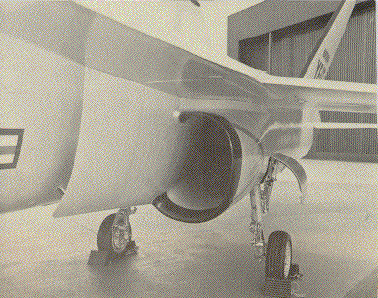
If the LCA does not use canards it does not mean canards are not good or it has not trade offs by being a tailess design, for its specifications being a tailess aircraft makes it more practical than using canards however the trade offs of being a tailess design are in stability. specially longitudinal stability
MiG-23MLDCan we please give this canard vs non-canard thing a rest?
None of us have the data needed to make even reasoned speculations on this topic: just because designs W, X and Y use canards doesn’t mean that it is suitable for design Z.
We have no idea about LCA’s inertial tensor, wing performance (pitching moments, vortex formation), effects of elevon sizing, wetted area/parasitic drag, etc. Presumably, the people who designed the LCA had access to this data. We know that they evaluated canards and rejected the idea.
So, the debate comes down to:
a) the designers are incapable idiots, because all 4’th gen fighters after 1980 must have tails or canards, and performance will suck otherwise. (Gee — maybe we should get them a subscription to AFM so they can keep up with the times.)
b) we take the designers on their word that they performed the trade studies and concluded that the canards weren’t necessary for meeting the aircraft’s requirements
Samudragupta
All your argument is a total desire to remain ignorant, the vast majority of statements here are based upon studies by NASA and if you go a read the whole thread, you will see that all the studies by NASA posted here point out the advantages of Tailplanes and Canards versus tailess in most areas except drag.
Of course you will say but we do not have this and that information, that is just a way to deny a reality, to claim the secret data makes the LCA better than the Eurofighter or Rafale, that is just plain trash.
The LCA was designed with a set of specifications and compromises, this means the following by choosing the tailess configuration, the LCA gained in some areas but gave up other advantages, this trade off has been balanced by its weapons system and avionics.
Of course your secret data for you makes the LCA the super agile fighter, its Viggen style delta wing makes it good at everything for you, but saddly man it is not true, the LCA lost some advantages that canards give but in other ways it gained, the reason you make a tailess aircraft is simple.
The Mirage 2000 like the LCA have lower thrust to weight ratios than the F-16 or MiG-29, however they have lower drag than the tailed or canard designs and that is the reason why they are still competitive, however. in the case of India some design limits made them choose the tailess configuration however those who dream their national fighter has not trade off imagine the LCA as the super secret aircraft, with secret data that makes it better than the Eurofighter and of course just not to stay behind the J-10.
Realities are realities and the LCA is a good aircraft but it has limits and those who prefer being ignorant just to keep their national pride have chosen that by their own will, in my case i can tell you i prefer to believe NASA
why do you think the Mirage 2000 has no canards but strakes? see that strakes more or less are mini canards, answer because the strake generates also a vortex but generates less drag, the low thrust to weight ratio of the Mirage 2000 made canards excesively draggy and strakes were choesen instead
claim:
1. An apparatus attached to an aircraft that has a fuselage, a pair or wings extending from the fuselage and a pair of nacelles interposed between the fuselage and the wings, comprising:
a pair of strakes each rigidly attached to an engine nacelle forward and above the wing, said strakes having an area aspect ratio such that vortices are created along the wing roots on the aircraft to increase the lift of the wings when the aircraft is flying at an angle of attack.
4. An apparatus attached to a T-38 aircraft that has a fuselage, a pair of wings extending from the fuselage and a pair of engine nacelles interposed between the fuselage and the wings, comprising:
a pair of strakes each rigidly attached to an engine nacelle forward and above the wing, said strakes having an area aspect ratio such that vortices are created along the wing roots of the aircraft to increase the lift of the wings when the aircraft is flying at an angle of attack.
Prior Art
A modern high performance jet aircraft of simple configuration typically is comprised of a fuselage, swept back wings of a delta or trapezoidal configuration, and horizontal and vertical tail surfaces. Typically such basic configurations perform relatively well, though frequently it is desired to improve certain aspects of operation or performance thereof. Two aspects frequently sought to be improved are operation at lower speeds and higher angles of attack, and the enhancement of the stability and control of the aircraft.
Wing lift has also been increased in the past by adding a leading edge extension to the wings in the root area. While this somewhat increases the wing area, it also allows operation of the aircraft at higher angles of attack, thereby primarily increasing the coefficient of lift for the wing through an increase in the angle of attack. Such leading edge extensions typically are in the plane of the wing, and simply extend the wing forward in the root area thereof.
In still other situations, strakes have been used for various purposes, sometimes only fully appreciated by the designers that added the same to the basic aircraft configuration, the strakes correcting some undesired local flow or somehow controlling the flow to obtain some desired effect not otherwise inherent in the basic aircraft configuration. By way of specific example, the Mirage 2000, a French delta wing aircraft, has a small strake above and just forward of the wing root, the purpose of which is not apparent as the same is too small for any meaningful lift enhancement. A similar small strake appears on an Israeli modification of the Mirage, a delta wing aircraft as well. Similar strakes have heretofore not been used on trapezoidal wing aircraft. On the other hand, on the McDonnell Douglas MD-80 commercial airliner, small wing-like strakes are positioned well forward on the fuselage, much like a Canard configuration. On the DC-10, strakes are used on the engine housings under the wings thereof.
http://www.freepatentsonline.com/5249762.html

Overall Configuration
The Mirage 2000 first flew on 10. March,1978. It was designed to fulfill a requirement for a high flying interceptor. The Mirage 2000 strongly resembles the Mirage 3 in most respects. One visible addition to the airframe are the small strakes attached to the air-intakes. They create vortices that energise the airflow over the wing
http://www.mirage-jet.com/AIRFRAME/airframe.htm
As part of a combined experimental and analytical study of vortex shedding at sharp edges characteristic of strakes on fighter aircraft, numerical simulations were made of a two-dimensional and a three-dimensional case. The former is a sharp-edge flat plate normal to the flow, for which some experimental data were taken earlier in this program. http://stinet.dtic.mil/oai/oai?verb=getRecord&metadataPrefix=html&identifier=ADA125882
Vertical nose strake for aircraft stability and control Document Type and Number:United States Patent 5449131
Abstract:A pivotal strake located at the nose section of an aircraft forebody. The strake pivots about an axis that is essentially perpendicular to the surface of the nose section
http://www.freepatentsonline.com/5449131.html
this is for an aircraft like the X-29
http://www.nasa.gov/centers/dryden/images/content/106373main_X-29_330.jpg


 Sign In








