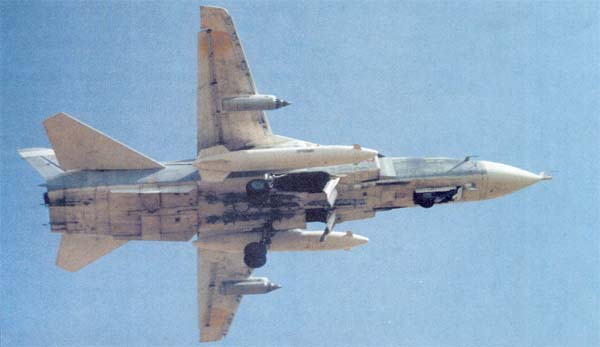
MiG-23MLD
My fault to try to discuss with you in a logical way.
The specific weight of JP-4 is ~0,78 per litre in metric or 6.5 lb/US gallon.
So the internal fuel load is well below 19 tons as you like to claim, by ignoring the important details as always.
A thumb-rule about external fuel is the same specific weight + the weight of the ET. In most cases it translates into ~0,9 per every litre carried it ETs.
You can cheat yourself as long as you want, but do not so to the others.
So more fuzzy logic eh?
The Australian air force claims the F-111 carries at least 27000kg and of that will get you a minimun of 16000kg of only internal fuel however global security claims the following:
Weight F-111F, empty 47,481 pounds (21,367 kilograms).
Maximum Takeoff Weight F-111F, 100,000 pounds (45,000 kilograms)
EF-111A 89,000 pounds (40,050 kilograms)
Armament Up to four nuclear bombs on four pivoting wing pylons, and two in internal weapons bay. Wing pylons carry total external load of 25,000 pounds (11,250 kilograms) of bombs, rockets, missiles, or fuel tanks.
.
So according to you if the max weight is 45000kg-11250kg max external load-empty weight 21367kg=12383kg the F-111 will have a max fuel of this is according to calculation using tha global security however the Australians say 51800kg max weight 51800kg-11250kg-24000kg=16500kg internal fuel however the F-111 carries a minimun of two external or a maximun of six external fuel tanks, and by simple calculations the F-111 carries in internal fuel what the Su-24 carries in internal and external fuel tanks, by simple logic you can know that of those 11250kg of payload at least of external fuel the F-111 carries a minimun of 5000kg in fuel leaving only 6000kg in weapons, so more or less still the relation range fuel is the same because the Su-24 carries around 16000kg of fuel and the F-111 around 21500kg of fuel.
However the Australians say basic weight and not empty weight:Weight 24,000kg basic
If that is the case and the empty weight is 21367kg and 27000 liter is multiply by 0.78 will equal 21060kg it will mean either the Australian aircraft weigh 24000kg totally empty or we have 3000kg missing and your fuel weight calculation is wrong
now if you see the relation range fuel it is more o less the relation:
21060kg/16000kg=1.31 and the range relation will be 5500km/2777km=1.98 or 2 against 1 1/3 or the Su-24 spends around 40% more fuel per kilometer
However this is only true if the Australian F-111 do carry only 7000 gallons of fuel and do not carry more since the 7000 gallons is a information based upon aircraft weighing 45000kg
however to be this to be true the specific fuel fraction of the TF-30 should be less than that of the Al-21F
here is data
AL-21F specific fuel fraction
удельный расход топлива – 1.86 и 0.86 кг/(кгс-ч) (0.19 и 0.09 кг/(Н-ч)) соответственно; минимальный удельный расход топлива – 0.76 кг/(кгс-ч) (0.08 кг/(Н-ч)). Расход воздуха через двигатель – до 104 кг/с при степени сжатия компрессора 14.5 и диаметре входа 885 мм. Температура газов перед турбиной достигает 1100″С
specific fuel – 1.86 and 0.86 kg / (kg/hr) (0.19 and 0.09 kg / ( N/hr)), respectively; minimum specific fuel-0.76 kg / (kg/hr) (0.08 kg / (N/hr)).
source http://www.airwar.ru/enc/bomber/su24.html
TSFC (lb/hr) /lbf
TF30-P-111
TSFC (lb/hr) /lbf
2.450
0.686
F-111F
source
MiG-23MLDUnable to read the empty equipped of the Su-24MK?
The MTOW is 43755 kg
The empty equipped is 23940 kg
Max intern is 11100 kg = 35355 kg
Normal ordonance is 3000 kg = 38040 kg
2 PTB-3000 = 5715 kg = 43755 kg MTOW
Without the PTBs max ordonance 8000 kg = 43040 kgThe internal fuel load of the Su-24MK is 11100 kg and of the F-111F including bomb-bay ~14890 kg, which is 1/3 more.
A F-111F with max int. can still lift over 9 tons of load.
A Su-24 MK with max int. and max PTBs can go 2775 km without ordonance.
A F-111F can go on max. intern over 4000 km or over more 40 % distance and still have ~9 tons for external weapons or fuel.
The Su-24MK can carry 3 tons for ext. weapons, but the range is reduced accordingly.
The F-111F can carry double the weaponsload over the double distance compared to the Su-24MK to cut a longer story short.
making fuzzy math eh Sens?
F-111
Manufacturer General Dynamics
Role Long-range strike fighter
Crew Pilot and navigator, who also operates the weapons systems
Engine Two Pratt and Whitney TF-30 turbofans (9,500 kg thrust each)
Airframe Length: 23m, height: 5.3m
Wingspan 21.3m extended, 10.3m swept
Weight 24,000kg basic, 51,846kg fully loaded
http://www.defence.gov.au/Raaf/aircraft/f111.htm
The F-111 has a max weight of 51846kg according to the RAAF and they give you a minimun weight of 24000kg now if you rest 51846kg-24000kg= 27846kg, however other sources estimate a minimun weight of 20987kgs for the F-111F
Weights: 46,172 pounds empty, 82,819 pounds gross, 98,950 pounds maximum takeoff
http://home.att.net/~jbaugher1/f111_8.html
Weight F-111F, empty 47,481 pounds (21,367 kilograms).
Maximum Takeoff Weight F-111F, 100,000 pounds (45,000 kilograms)
EF-111A 89,000 pounds (40,050 kilograms)
Armament Up to four nuclear bombs on four pivoting wing pylons, and two in internal weapons bay. Wing pylons carry total external load of 25,000 pounds (11,250 kilograms) of bombs, rockets, missiles, or fuel tanks.
http://www.globalsecurity.org/military/systems/aircraft/f-111-specs.htm
If those are correct weights the F-111 you can calculate the fuel carried, it says it can carry around 5000 US gallons more or less 19000 liters and 7000 gallons or 27000 liters this give you a max of 19 tons of internal fuel and 27000kg of max total fuel carried internally and in external fuel tanks, that adds up because even in a light configuration and F-111 has this weight composition: 21000kg + 19000kg + 5000kg of weapons load or external fuel tanks, the minimun weight is 45000kg, so a F-111 on internal fuel alone won`t carry its max warload, the RAAF claims it can lift up to 51800kgs so it will carry a minimun of 17000kg of fuel and 11000kg in external payload, however many sources report an empty weight of around 21000kg this gives you a very realistic load of 19000kg internal fuel + 21000kg F-111 empty weight + 11000kg external payload=51846kg so as you can see the F-111 must carry at least 8 tonnes more fuel internally and see this detail if 7000 gallons equal 27000 liters and the F-111 weights a max of 51800kg if you rest 51800-24000=27800kg or around 7000 gallons of fuel in six tanks and full internal fuel😉
Now the Su-24 is much much narrower than the F-111 and you can see that despite the aircraft looks chunkier but the F-111 in fact has a wider cross section because its inlets are quit big and have a very big frontal area, while the Su-24 has a very narrow inlets despite it has a blunt nose radome


Now according to Sukhoi the Su-24 weights 43755kg and http://www.airwar.ru claims that the Su-24 can carry a max of 6596 kg in external fuel
http://www.airwar.ru/enc/bomber/su24m.html
Топливо, кг
внутренние топливо 9800
ПТБ 6590
it will give you a relation like this 43755kg -11100kg – 8000kg=24655kg, around the same weight claimed by the RAAF for Australian F-111s because the RAAF says the Australian F-111s weigh 24000kg empty weight in this case the F-111 carries 10 tons more fuel or 40% more fuel
The Max range for the Su-24 at this condition with fuel tanks and full internal fuel is 2777km and the claimed max range for the F-111 is 5580km and see that the F-111 is claimed to have a max range of 3100 nautical miles with external fuel tanks
Range 3,565 miles (3,100 nautical miles) with external fuel tanks
http://www.globalsecurity.org/military/systems/aircraft/f-111-specs.htm
http://www.sukhoi.org/eng/planes/military/su24mk/lth/
see that the RAAF has the same figure Range Ferry range in excess of 5,500km
http://www.defence.gov.au/Raaf/aircraft/f111.htm
so as you can see the difference in fuel is reflected in range;)
MiG-23MLDAnd I never said it was. But only Soviet militarism is relevant to the context of the point I was making. Talking about third-world poverty changes none of that.
I am not saying the Soviet Union did not collapse in part by the military build up it was engaged, it is true, militarism can not be kept when the economy is not growing or is in crisis, however my point was that militarism by it self won`t explain the collapse of the Soviet Union, and the former Soviet Union collapsed when they did reach a degree of technological achievements beyond even what the Western counterparts achieved in aviation to give you an example however these technological achievements demanded too more freedom for their people.
True the Soviets limited freedom and also did bad things, true but also did good things a nation that put the first man into space can not be considered an evil nation, the Soviet Union was like any other nation in History it had good things and bad things but in terms of technology they did achieve great feats for all humanity and in many ways helped the cause of freedom since they defeated Hitler and helped with the liberation of Africa and Asia from the European colonial powers.
In few words technologically speaking the Su-24 is a good example of a great technological feat, however, the Soviet people could not eat weapons so in some aspects it was just vanity.
But in general shows the level of science and technology in the former Soviet Union
MiG-23MLDYour summurise about Su-24 has some missing details.
First it was not even less range, but less related payload capability too.
Second, the internal fuelload was similar, but empty equipped was higher.
Third the AL-31 did become available in the 80s and the demand in production capability was reserved for the Su-27.
The first T-10s were flown with AL-21s.
The bypath-ratio of the AL-31F is still lower than that of the TF-30. For optimum close to ground-level it has to be ~1:1.
The Su-34 has an amoured cockpit and is heavy empty equipped compared to the F-111F f.e.
The Su-34 has not the weight penalty of VG, but not the less drag related to that too. So it has not the weight-range capabilities of the F-111F it is sturdy built and offers higher G-loads. To ease some temper, the follow-on of the F-111F the F-15E does not reach the weight-range capabilities of the F-111F either.
So some aircraft built in the 60s, like the A-6 too, were close to optimum for a given mission.
The Su-24 and F-111 have not the same fuel capability, the Su-24 and F-111 have similar empty weights, around 22000kgs and different warloads, also the F-111 can fly with six external fuel tanks, the max number of external fuel tanks in a Su-24 is two.
Example
Su-24 weighs 22000kg plus 11000kg internal fuel plus 8000kg gives and equal of 41000kg max weight claimed by Sukhoi it self 43000kg
Now the F-111 weighs around 21000kg plus 11000kg of warload and 5000 gallons of internal fuel around 19000 liters, max fuel with internal and external fuel is 7000 US gallons around 27000 liters that gives a max weight of 51800kg as the RAAF claims however at max fuel capacity the F-111 will not carry its wax warload;)
these is the data for the Su-24M
Aircraft performance
Takeoff weight:
– normal, kg 38,040
– maximum, kg 43,755
Maximum landing weight, kg 27,900
Maximum internal fuel, kg 11,100
Normal ordnance load, kg 3,000
Maximum ordnance load, kg 8,000
Service ceiling (without external ordnance and stores), km 11
Maximum flight speed at sea level (without external ordnance and stores), km/h 1,315
Max Mach (without external ordnance and stores) 1.35
G-limit (operational) 6
Operational radius of action at sea level in mixed mode (Vcr in the 200-km area, V=900 km/h in other areas) with PTB external fuel tanks and 6x FAB -500M-62 bombs, km 615
Ferry flight range with 2xPTB-3000 external fuel tanks, km:
– with PTB external fuel tanks dropped 2,775
– with one in-flight refuelling
http://www.sukhoi.org/eng/planes/military/su24mk/lth/
F-111
Manufacturer General Dynamics
Role Long-range strike fighter
Crew Pilot and navigator, who also operates the weapons systems
Engine Two Pratt and Whitney TF-30 turbofans (9,500 kg thrust each)
Airframe Length: 23m, height: 5.3m
Wingspan 21.3m extended, 10.3m swept
Weight 24,000kg basic, 51,846kg fully loaded
Speed Supersonic at sea level, Mach 2.5 at altitude
Range Ferry range in excess of 5,500km
Ceiling Above 50,000 feet
Weapons Harpoon anti-ship missiles
Sidewinder air-to-air missiles
Laser-guided bombs
Conventional bombs
Avionics Digital flight controls
Terrain-following radar
Attack radar
Pave Tack target system
Inertial navigation and integrated weapons system
http://www.defence.gov.au/Raaf/aircraft/f111.htm
Specification of F-111F:
Engines: Two Pratt & Whitney TF30-P-100 turbofans, 25,100 lb.s.t. with afterburning. Performance: Maximum speed: 1453 mph at 53,450 feet, 914 mph as sea level. Initial climb rate 25,550 feet per minute (clean). Service ceiling 56,650 feet. Combat radius 1330 miles. Maximum ferry range 3634 miles with external fuel. Dimensions: wingspan 63 feet 0 inches (maximum), 32 feet 0 inches (minimum), length 73 feet 6 inches, height 17 feet 0 inches, wing area 525 square feet. Weights: 46,172 pounds empty, 82,819 pounds gross, 98,950 pounds maximum takeoff. Internal fuel capacity was 5043 US gallons, with a total capacity of 7443 US
MiG-23MLDDid I ever say that people lived in caves in the Soviet Union ? Buran was more of a propaganda tool than anything, by the way (or they’d be using it today). They were just usually lagging 10 years behind.
It didn’t only become a bureaucracy, it was a totalitarian dictatorship, focused on the military, and repressing whoever wasn’t agreeing, instread of focusing on bringing comfort to its people. That shows you didn’t understand my comment about ignoring people for “THE people’s republic”.
See it as different priorities maybe, but I wouldn’t judge a country by its ability to build a space shuttle, or 1400 bombers, but by its ability to enable its population to live freely, and give them the opportunity to work towards a better life.
So?
The F-111 programme was shoved ot the US military as a “joint” aircraft for all services. The specs for it meant it would at least fail in one role. Which it did (The naval one).
No, it shows that their factories could produce large amount of airframes.
Man please, your view first is a very over simplistic analisys of communism and the impact of the Soviet military build up in its collapse.
No social system has proven to be a paradise and much less perfect, in fact all societies have short comings, however in the original vision communism had internal elections known as Soviets, there was a democratic idea in communism, however in its late years Soviet communism became a corrupt system and like in any economic system a plutocracy and a kleptocracy took over the early democratic idea.
This was predicted by Mikhail Bakunin and even by Lenin, since Bakunin argued the state was the root of all evils in societies and Lenin knew ethnic conflict was one of the more dangerous elements in the Soviet state
However in terms of technology the Su-24 or MiG-21 to put some examples were simple and cheap, Western aircraft were usually more expensive, by the 1980s globalization demanded more intense economic trade the Soviet Union needed therefore a real federal state where economic freedom assured more technological development to grow at faster rates however the old Soviet system created a centralized system that was not the real federal ideal that the early Soviet system was supposed to be.
Today`s Russia is recovering and the CIS has allowed to its members to persue an independent path, modern Russian aircraft show they are globalizing, aircraft like the Yak-130. Sukhoi RRJ, Tu-204, An-124, PAK FA and Su-30MKI are becoming globalized products.
The Su-24 was simply much cheaper than the F-111 because it was a simplier design, the Russians and Soviets knew that their aircraft needed to be practical, not complex machines that demanded complex construction methods and maintainance or too sophisticated that demanded too many surplus systems.
The Soviet philosophy was always get basic and rugged equipment.
Look at the Su-24 cockpit it was only a very simple one but almost equivalent to early F-111s cockpits
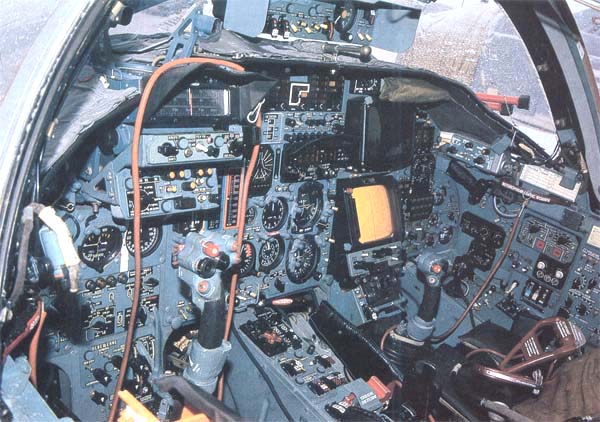
and an early F-111 cockpit

MiG-23MLDThe F-111 had serious problems and probably always suffered from reliability issues. But in terms of avionic capability it was the hottest machine in the 1970s. Most of the problems including the engine were fixed when E and F entered service.
I can agree that in the early 1970s it was a very advanced machine but in the second half of the 1970s, the F-14, MiG-31, Panavia Tornado, B-1A or even Su-24 got advanced radars and avionics..
It was anyw ay one of the most beautiful and powerful designs to come out from the 1960s.
MiG-23MLDOr, that they paid more attention to military buildup than, say, unscrewing their agricultural issues…
And before you go on any more about the Su-24’s IFR capability, it is only the Su-24M that enjoys that feature.
probably you have not seen poverty in the third world, the day you see it your eyes will be open, militarism was not only a Soviet sin, and there are many reasons to explain the Soviet collapse some are well known however until the day you see poverty in the developing world you will understand many facts about History.
In terms of technology the Soviet Union built a good piece of engineering, the Su-24 was affordable, was built in large numbers and assured a credible defense.
MiG-23MLDBesides the fact that you are finally admitting some shortcomings in previous Soviet types, and that one plane finally possessed one of the necessary abilities to be used as a lov level penetrator, you are contradicting yourseld: you tell us that the Soviets usually built planes in high numbers, and that yet, the Fencer was built in large numbers ?
Oh, yes, it was “very advanced” for 1970’s Soviet airplane. In other words, they were lagging behind. Ever heard of DIANE ? 😉Is that why the Soviets downgraded all the planes they sold?
Should I remind you that they mostly sold them to middle eastern countries, which paid for development I guess. As for most developping countries, they shouldn’t even get sold AK.47s. Water wells would be much more useful.Also, why are you saying here the plane isn’t very complex, when a couple of likes before, you described it as “very advanced” ?
The US (and the West in general) maybe didn’t build more because they didn’t *need* more ? That also enabled them not to end up totally brankrupt, with near to non existent infrastructures. Money can be better spent than on 1000+ aircraft of each type. But of course communist countries have never really cared about people. They just cared about THE people’s republic, and how to keep people within the rules established for the good of “THE people”, mainly thanks to extensive military and police forces.
As for the in flight refuelling bit… that stuff was reserved for strategic bombers …
The Soviet Union collapsed for many things, but the most important was not the lack of advances, to the contrary, they had enough technology to create the Buran or develop computers, no you won`t understand why the Soviet Union collapsed until you read History and understand that the main mistake Russia did is try to get into the financial system that was created by Western countries.
Militarism was one of the reason the Soviet Union collapsed, but not the main reason, the main reason was comerce, Russia became a burocracy while its technological level demanded more room to continue advancing.
A nation that can build Space shuttles was by no means behind the West however they needed an infrastructure to trade and profit and this demanded getting rid of the infrastructure that was highly burocratic and ineffecient.
Russia is again becoming an economic power and still has enough technology to remain among the first economies in the world.
The Su-24 was a practical design, easy to build compared to the F-111 and this was not because of lack of technological expertise, it was simply because Sukhoi had a different philosophy of design, they wanted an aircraft with more down to earth capabilities, all through its carreer the F-111 changed from long range fighter a work that later was passed to the F-14, to long range bomber a work later given to the B-1B, no one says the F-111 was not an impressive piece of technology, however it was not a better aircraft it was simply tailored to exploit different potencialities in the design.
In fact re-engineering the Su-24 was possible, they could had fitted turbofans to the Su-24, for example the MiG-23 can be fitted with AL-31s, and even build them again with VG ramp inlets and they would had had an FB-111 type bomber but for what? the americans saw too the FB-111 and F-111B were useless and at the end getting F-14s and B-1Bs was far more practical and Russia has already Tu-22Ms 😉
The F-14 took over the task given to the F-111B
The B-1B took over the mission given to the FB-111
Building 1400 Su-24s shows you that the Soviet and Russian engineering was very adaptable and practical
MiG-23MLDSu-24: 1400
F-111: 554
Tornado: 992The “exportability” is because most other aircraft were unsuitable as fighter bombers. Whereas an F-4 Phantom can be used as such, MiG-23BN/-27 and Su-17 are not really payload haulers.
The export version is downgraded. The production started in 1988 and surely all were paid in desperately needed hard currency.
The Soviets built many aircraft of each type, they always had plenty of aircraft but the Su-24 is special, it had very advanced avionics for a 1970s aircraft in the Soviet Union, it had terrain following radar, something the Su-17, MiG-23BN and MiG-27 did not have, and even despite that it was a highly produced aircraft.
Some aircraft are either too secretive or too expensive to be bought by many nations, and in Europe the Panavia Tornado eliminated the export market for the F-111.
Some developing nations are banned of having long range interdictors or need simply more defensive weapons.
In that sense the Su-24 is not very complex and it has a range that is not a threat, the Tu-22M to the contrary is a really potent weapon.
Even if the americans built around 600 F-111s it is not a large number and it shows it was difficult to build and operate besides expensive.
The Su-24 flew several years after the F-111 but even so, it was able to surpass it in the production numbers and export succes because the aircraft never was over designed to meet requirements that demanded too much from its design, in fact the Russians were content with a reduced capability meanwhile it was able to fly low and fast at sea level and deliver its warload, if they needed extra range well the aircraft has in flight refuelling capability but for longer missions and heavier loads they had the Tu-22M
MiG-23MLDAnd what did you learn from that?!
The Su-24 has half the range capability and half warload, due to wrong engines for that mission.
It does not even reach the range-warload capability of the much smaller Tornado IDS!
Despite that shortcoming the Su-24 did fill a mission gap, when it comes to the allweather-low-level capability.
It is of note that the cheaper Su-22M4 did offers a similar range capability to the Su-24 too.The second lesson you can learn from that is, that the installed thrust says little about the flying envelope (speed!) without the related propulsion-system (inlet+outlet) and the drag-thrust-ratio.
When intrested in an important detail like empty equipped of the late Su-24MK, you can figure it out with ease from data given by Sukhoi!
yeah yeah sens.
let us see this, first not all the F-111 variants have the same max take off weight, second the F-111 production total is slightly more than 550 aircraft while the Su-24 total production is around 1400, so the Soviets built slightly more than 2.5 times more Su-24s than the americans F-111s, in fact the total production of Su-24s equals almost the total combined production of Panavia Tornados and F-111s.
Third the Su-24 with VG ramp inlets can achieve a speed of Mach 2.1, however it does not need to fly fast at high altitude but fast at sea level or low altitude and its max speed at low altitude is more than enough.
The terrain following radar is what it is needed to fly low.
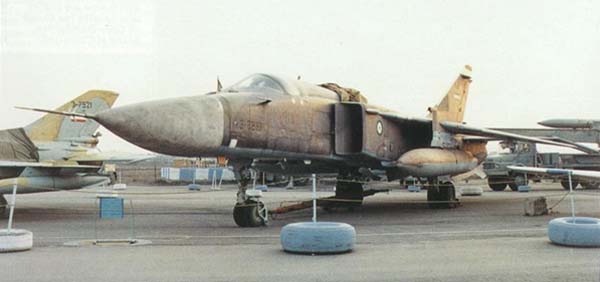
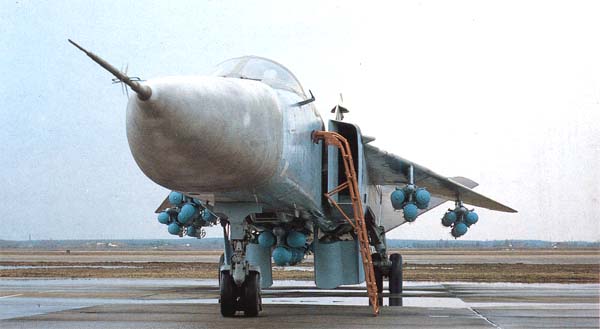
Another thing where the Su-24 scores higher than the F-111 is exportability, more countries adopted the Su-24 than the F-111, in fact the US only bought 76 of the FB-111s and only 24 F-111s were exported to Australia.
MiG-23MLDThere is a good reason, why you do not give the link in English.
http://www.sukhoi.org/eng/planes/military/su24mk/history/
When there is no shortage of reports about maturing troubles with the F-111 system, there did something similar surface about the Su-24 during Glasnost.
Who do you know about that?
Despite the external similarity the Su-24 is not in the same class as the F-111 really.
Now we have a conspiracy theory:rolleyes: , there is something you do not want to see about both aircraft, both aircraft have similar empty weights and similar max take off weights.
here is the data for the Su-24M
Aircraft performance
Takeoff weight:
– normal, kg 38,040
– maximum, kg 43,755
Maximum landing weight, kg 27,900
Maximum internal fuel, kg 11,100
Normal ordnance load, kg 3,000
Maximum ordnance load, kg 8,000
Service ceiling (without external ordnance and stores), km 11
Maximum flight speed at sea level (without external ordnance and stores), km/h 1,315
Max Mach (without external ordnance and stores) 1.35
G-limit (operational) 6
Operational radius of action at sea level in mixed mode (Vcr in the 200-km area, V=900 km/h in other areas) with PTB external fuel tanks and 6x FAB -500M-62 bombs, km 615
Ferry flight range with 2xPTB-3000 external fuel tanks, km:
– with PTB external fuel tanks dropped 2,775
– with one in-flight refuelling
http://www.sukhoi.org/eng/planes/military/su24mk/lth/
F-111
Manufacturer General Dynamics
Role Long-range strike fighter
Crew Pilot and navigator, who also operates the weapons systems
Engine Two Pratt and Whitney TF-30 turbofans (9,500 kg thrust each)
Airframe Length: 23m, height: 5.3m
Wingspan 21.3m extended, 10.3m swept
Weight 24,000kg basic, 51,846kg fully loaded
Speed Supersonic at sea level, Mach 2.5 at altitude
Range Ferry range in excess of 5,500km
Ceiling Above 50,000 feet
Weapons Harpoon anti-ship missiles
Sidewinder air-to-air missiles
Laser-guided bombs
Conventional bombs
Avionics Digital flight controls
Terrain-following radar
Attack radar
Pave Tack target system
Inertial navigation and integrated weapons system
http://www.defence.gov.au/Raaf/aircraft/f111.htm
See that basicly the F-111 weights around the same at empty weight but has a larger take off weight, both have the same thrust available, see that the Su-24 carries only two fuel tanks.
If you see that you will understand both aircraft are in the same class and you will understand that despite the Su-24 is a slower aircraft and carries less fuel both aircraft have the almost the same thrust and empty weights and the reason the Sukhoi has less range is because it carries less fuel
Note that the sources are the Sukhoi company it self and the Australian air force
Now let us see empty weights
F-111
Weight F-111F, empty 47,481 pounds (21,367 kilograms).
Maximum Takeoff Weight F-111F, 100,000 pounds (45,000 kilograms).
sourcehttp://www.fas.org/man/dod-101/sys/ac/f-111.htm
and max thrust
Power Plant F-111A/E, two Pratt & Whitney TF30-P103 turbofans.
Thrust F-111A/E, 18,500 pounds (8,325 kilograms) each with afterburners;
F-111D, 19,600 pounds (8,820 kilograms) with afterburners;
F-111F, 25,000 pounds (11,250 kilograms) with afterburners.
now the Su-24
Масса, кг
пустого самолета/Empty weight 22300kg
нормальная взлетная/normal take off 33500kg
максимальная взлетная/max take off weight 39700kg
максимальная посадочная/Max landing weight 28000kg
now let us see thrust
Тип двигателя 2 ТРДФ НПО Сатурн АЛ-21Ф-3А
Тяга, кН
нефорсированная/military power 2 х 76.49 kilo newtons
форсированная/afterburner 2 х 110.32 kilo newtons
ДВИГАТЕЛИ. Два ТРДФ АЛ-21Ф-3А НПО “Сатурн”/Two Saturn Al-21F (2 х 11200 кгс/kg).
source
http://www.aviaport.ru/directory/aviation/458.html
http://www.airwar.ru/enc/bomber/su24m.html

MiG-23MLDHe said it was the product support (spares and the like) that was inferior, not the products themselves. You have purposely misread what was probably the most sensible post in this thread.
You really do not want to go there, lest we get into false Eastern reporting of MiG-29s downing F-117s or phantom B-2 shootdowns.
That had nothing to do with the quality of the 1970’s design.
A lot of them were accidents. There have been confirmed instances of insurgents in Iraq even filming terrorists near crashed helicopters and claiming that they were shot down. At any rate the Apache was shown to have had a number of issues in Yugoslavia, but it had no problems in 1991 in the Middle East as far as I recall.
The first R-73s were earmarked for Su-27 units, so in 1985 your average MiG-29 unit may or may not have had any of them on hand. And the MiG-29 was never an F-15 equivalent, it was not a long-range air superiority fighter. That was the Su-27. The MiG-29 was an F-16 type aircraft that had the early advantage over the Lawn Dart of that pair of BVR weapons.
The Il-78 wasn’t a factor. Neither the MiG-29 nor the Su-27 had IFR capability. The A-50 was not a serious factor either, as the Soviets were using a GCI structured air defense network.
SOC
Russian products do exihibit good crafmanship in terms of durability, the myth i am refering is the myth that the Russians do not produce any thing with quality, that they are copycats, that they are sloppy building things, that their products are shabby and have terrible after sales service.
The design philosophy behind many Soviet/Russian products was reliability in war time, in war low maintainance service .
Aircraft like the MiG-21 were simple. easy to maintain in war time.
That is why the Russians built so many MiG-21s and MiG-23s.
Many aircraft suffer from problems in their service carreer, the F-111 had its share of problems too, the Su-24 had excellent producibility, it is not a copy of the F-111, in fact it started as a STOL aircraft with direct lift, it had shoulder mounted wings.
Its fixed inlet design was more practical than the F-111`s, the aircraft was optimized to frontal aviation units, it was part of the army first line of attack.
It was more or less a fighter bomber in the class of early F-111s.
The F-111 was a troubled aircraft, it was niether an air superiority niether a long range bomber, the Russians were practical, they built more Su-24s than the americans F-111s, so at the end having more aircraft they had larger payloads in combat, they did not force the Su-24 to be a tactical long range bomber as the americans did niether forced it to be a very fast aircraft there was no need to do that.
Суммарный серийный выпуск самолетов типа Су-24 составил около 1400 самолетов
The acumulative production of the mass produced aircraft Su-24 was about 1400 aircraft
http://www.sukhoi.org/planes/military/su24mk/history/
It carries less fuel internally in fact it carries only 57% of the internal fuel an F-111 can carry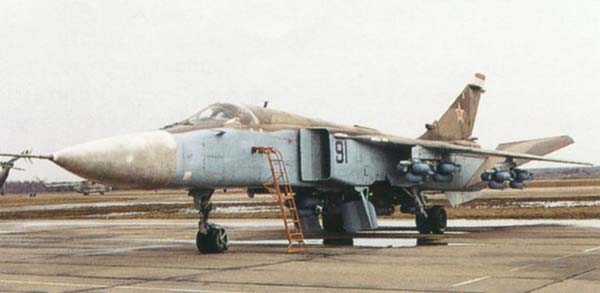
The early F-111As had extremely bad engine problems, suffering from compressor surge and stalls. NASA pilots and engineers wrung out the airplane in an attempt to solve its problems, studying the engine inlet dynamics of the plane to determine the nature of inlet pressure fluctuations that led to compressor surge and stall. Eventually, as a result of NASA, Air Force, and General Dynamics studies, the engine problems were solved by a major inlet redesign
http://www.globalsecurity.org/military/systems/aircraft/f-111-variants.htm
MiG-23MLDYou’re all waving your attributes about, claiming to be biggest.
Mig-23MLD: You have no need here to remind us of the scope and skill of FSU men and material. As soon as the Bundeswehr was integrated into NATO, we were reminded that it would be a bad idea to under-estimate your fighting men and your equipment. NATO relied on quality, to offset our inferior quantity, but maybe we sensed we were whistling a happy tune whenever we felt afraid. What Germany learnt on the Eastern Front was your kit might seem, ah, rugged, but it just kept on coming, bouncing back repaired overnight. And Ivan never seemed to know when he was beaten.The answer to the Thread Q was Su-24 (depending on which F-111, in which role). The premise of USSR’s reliance on “copying” was dealt with on the first page: it’s like “influences” on musicians, and we all do it (Blue Danube: Fat Man). Stalin’s munitions programme would have been dearer/slower if he had not got his hands on B-29, Nene, Sidewinder, German rocketry. All of which you improved.
Now we have a Final Settlement, Open Skies, Russian Federation Liaison staff at SHAPE, all to ensure we do not, again, misunderstand each other. All, good.
In only one sense could FSU teams still feel their work to be inferior: Product Support, enabling Users to bounce back overnight. Do not declare AOG on any Eastern kit and expect FedEx to deliver spares this week/month…year. Address that, and you will fill your factories with export work, because your products are fine.
That is just a myth, the myth that Soviet and Russian technology was inferior and still is inferior, this also has been propagated even more with the combat records acknowledged by the west.
However reality is not like that, for example in WWII Soviet technology was simplier but many times better suited for real war conditions, in war reliability is the most important aspect, when in the West their weapons fail, something that many times happens too, it is hidden and never claimed to be a result of poor vision and lack of good design suited for real life conditions, either they claimed mysterious accidents in war time, but they always try to hide poor craftmanship.
The Economic chaos that rulled over Russia in the 1990s even increased that idea that Russian products were not reliable.
The reality is contemporary Western and Russian products have almost the same quality, western products sometimes are complex and do have their share of bugs and failures, the Russians build products thinking in more real life conditions, thinking in production mishaps, in operational war service lack of adequate maintainance.
The MiG-29M and the F-18C are in the same level of technology, the F-15A and the MiG-29A were in the same level of technology, however the West always get information outdated and many think that Russian products are less capable than in reality they are
The F-111 also had its share of bugs and problems in fact in the early years of its carreer they recalled them from the Vietnam war because the so called superior Western technology was being destroyed by its lack of good quality, this was even more evident when a 1960s SAM destroyed an F-117, or when they claimed the AH-64 Apache losses in combat conditions were accidents and the machine showed its good share of bugs and unsuitability for combat use
MiG-23MLDYemeni MiGs
http://spotters.net.ua/file/?id=1217
Yemeni air force
http://spotters.net.ua/search/?airline=Yemen+Air+Force&
MiG-23MLDFrom the top of my head:
F-15 first flight: 1972
F-15A entry in service: 1977So, the F-15 was in service when the soviet prototypes first flew…
The MiG29 isn’t a F-15 equivalent. It is the “low” part of the mix. It would be in the F/A-18 / F-16 equivalent. And thanks to its range, and the non availability af AAR assets, it basically was a point defence interceptor.
While I agree it would have the edge in WVR thanks to the HMS / R73 combo, I’m not sure it would have made it that far.
С момента начала серийного производства МиГ-29, в мае 1982 г., главным конструктором самолета был назначен М.Р.Вальденберг
Since the start of MiG-29 mass production , in May in 1982, R. M. Waldenberg was appointed as head designer
Новый фронтовой истребитель МиГ-29 начали осваивать в строевых частях ВВС еще за несколько месяцев до подписания Акта о завершении Государственных совместных испытаний. В июле 1983 г. два десятка первых серийных самолетов были торжественно переданы 234-му гвардейскому Проскуровскому истребительному авиационному полку,
The new frontal aviation fighter MiG-29 began deployment in the Air Force units a few months before the signing of the Act on the completion of the joint acceptance state tests. In July 1983, two dozen of the first mass produced aircraft were solemnly handed over to the 234th fighter Aircraft Regiment
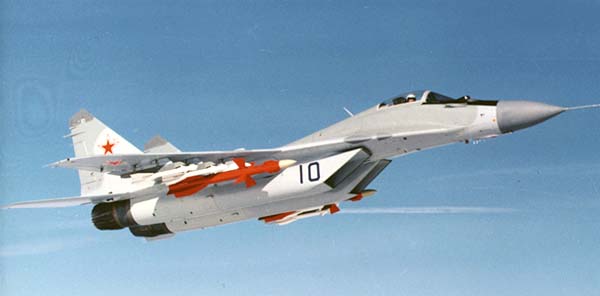
К концу 1990 г., согласно опубликованным материалам из Протокола обмена информацией по численности боевых самолетов и вертолетов в рамках Договора по ограничению вооруженных сил в Европе, СССР располагал уже 648 истребителями МиГ-29 в частях
By the end of 1990, according to published material reported by the exchange of information on the Protocol about the numbers of combat aircraft and helicopters in the framework of the Treaty on the limitation of military forces in Europe, the USSR had already 648 combat fighter aircraft MiG-29
http://www.airwar.ru/enc/fighter/mig29.html
Поскольку к концу 1986 г. истребители Су-27 уже широко эксплуатировались в авиации ПВО и ВВС Советского Союза и начали привлекаться к выполнению патрульных полетов над нейтральными водами
Since the end of 1986, fighters Su-27 was widely deployed in the air force and air defense aviation units, and the Soviet Union began to perform patrol flights over neutral waters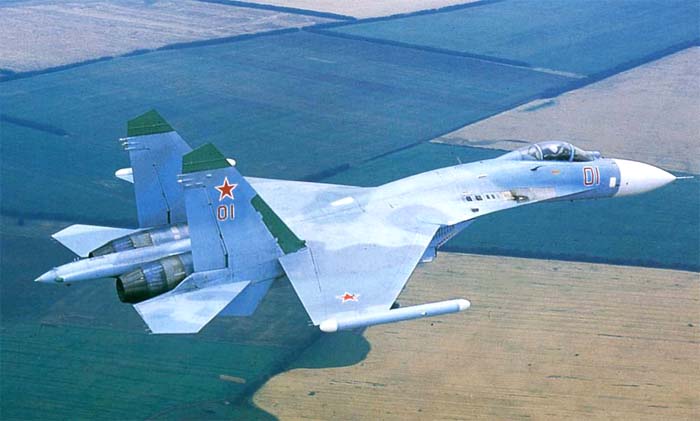


 Sign In