 MiG-23MLD
And they did not need that information to perform their tasks. It was not mandatory.
But they don’t have to have that information, which is what you asserted above. Go back and read what you wrote. Fighters can use BVR weapons solely by using their own on-board sensors. What you posted above does not agree with that statement.
Really, why don’t you answer the satellite and MiG-31 questions I posed? If you’re right, then you must have answers to them.
So do you think satellites do not have nothing to do? Satellites are part of communications and defence network and provide navigation aids and GPS.
No modern military can work without their aids and certainly fighters need them
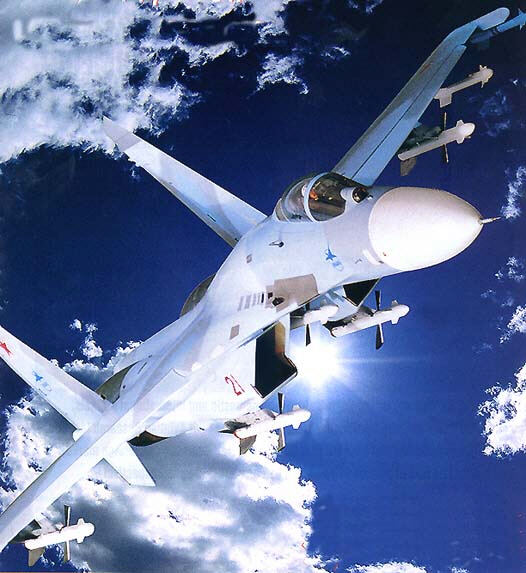
There are also some novelties in the aircraft avionics. For example, the cockpit indication system uses four liquid-crystal color displays provided by France’s Sextant. These are widescope color displays assuring good readability of the information even in bright sun light. The aircraft is fitted with a satellite navigation system and laser attitude and heading reference system.
http://www.sci.fi/~fta/Su-35.htm
The Gripen’s superior handling and manoeuvring qualities are obtained through a state of the art digital fly by wire flight control system. The aircraft is equipped with a very modern, ring laser gyro inertial navigation system, augmented by a satellite navigation system (GPS) as well as a radio navigation system.
http://www.info.gov.za/issues/procurement/background/new_equipment.htm
All of this systems for part of a modern net centric defence system
MiG-23MLDRead what you wrote; yes, BVR systems can employ off-board sensors in certain cases, but that’s not what you said. Your statement was that a BVR engagement won’t work without an off-board sensor. And you’re wrong. Let’s examine:
No, they don’t. It is a force multiplier and will give you an advantage in certain cases, but you do not have to have off-board sensor inputs to perform your mission, which is exactly what you just asserted.
What off-board sensor inputs are sent to the F-117A?
No, you do not have to have off-board sensor inputs to employ BVR weapons. Some aircraft like the MiG-31 can take advantage of certain aspects of off-board sensor integration, but they can function without it.
The MiG-31’s FCS, if we are to believe what you were directly quoted as having stated regarding BVR AAM operations, must have some sort of off-board sensor that it cannot operate without. That system must interact directly with the R-33 AAMs, cueing them to targets and locking the seeker onto said targets, and as such, the system must be the one providing the terminal SARH illumination, or else it cannot be an off-board system locking the SARH R-33 missile onto the target. What is the name of that system? And if you are to be believed, why bother carrying the added weight of the Zaslon FCS in the first place, since you cannot cue and lock on a BVR AAM without this off-board system anyway? Is the Zaslon simply some massive ROR supplying ranging information for cannon and R-60 shots?
And what satellite is going to cue and lock on a BVR AAM, anyway? What are the designations and types of satellites that can target BVR AAMs fired by other aircraft? FYI, a satellite passing data-linked information from one source to another is most assuredly not performing any actual targeting task, so please do feel free to explain this one.
Putting target track and position data into the FCS using a data-link does not equate to an off-board sensor actually activating the AIM-120’s internal electronics and locking that weapon onto a target, does it?
SOC
You are first modifying what i meant, perhaps it is not intentional however any aircraft from the 1940s onwards used off board sensors to locate the enemy, since the battle of England, radar ground stations conveyed information to fighter aircraft to find the intruding enemy aircraft.
By the 1960s there was enough technology to start the development of fighters like the MiG-23P and JA-37, aircraft like the Hawkeye and Moss incremented the ability of the defending fighters to find the enemy with airborned radars that worked like GCI units with the main task of early warning and control of the battlefield.
Modern aircraft cue the enemy aircraft with information conveyed by even other friendly aircraft`s sensors, even of their own type.
MiG-23MLDYes, IFF is important (and many combat aircraft do have IFF interrogators for that reason), but you are missing the point: he said that BVR weapons are both cued and locked-on by remote sensors. That is completely false, they are both cued and locked-on by the onboard radar system in the launching aircraft.
Certainly not all the aircraft rely a lot in offboard systems, however many aircraft do it, and the best data link systems can share enough information to cue weapons with remote sensors even of other aircraft.
The F-16 is not the best example of that but who says that is the best example, Sweden and Russia have better examples than the F-16.
the MiG-23P, the JA-37, the MiG-31 and the JAS-39 use extensive data link sharing even to lock on their targets, that is one stealthy approach .
The JAS-39 uses a lot data link systems to locate and down aircraft, the F-22 does it too
An F-22 pilot can leave his home base, locate, cue in on and destroy all of his targets, receive the locations of all possible threats, receive landing instructions and come home safely without being seen or heard. This capability is possible through the use of communication links that allow air battle managers to send text messages to the pilot without using the radio.
source the very own USAF webpage
http://www.af.mil/news/story.asp?id=123024639
The Gripen is fitted with the “Tactical Information Datalink System (TIDLS)”, which gives the fighter four high-bandwidth, two-way datalinks with a range of about 500 kilometers and very high resistance to jamming. The datalinks allow the Gripen to engage in combat using another aircraft’s sensors or from targeting data provided by other defense systems. Data acquired from remote sources is fused and displayed on the fighter’s main MFD. The link is fully operational when the aircraft is on the ground, allowing a pilot on standby to have high situational awareness of the battle environment
source http://www.faqs.org/docs/air/avgrpn.html#m2
In 1987 Svenska Flyvapnet (Swedish Air Force) added a datalink from GCI to its JA 37 Jaktviggen. With this the ground based air defence system can provide target detection. The JA 37 can share information with other JA 37 such as which target each aircraft is attacking, fuel and weapons state and so on. In 1995 the ability to transmit simple text messages was added. The JAS 39 Gripen has increased capability with information shared between fighters, S100B Argus AEW, GCI radars, naval warships and SAM positions. 4-6 fighters would be spread over a distance of 120-150 km and share the same view.
sourcehttp://www.users.globalnet.co.uk/~dheb/2300/Articles/PG/PGSA.htm
As with other Viggens, the JA 37 interceptor Viggens have been continuously upgraded, in particular by being fitted with a datalink system in the mid-1980s. The Flygvapnet had developed the sophisticated STRIC ground-based defense datalink system, and STRIC allowed Viggens to be vectored onto targets without using their own radar, giving them an element of surprise. STRIC also allowed ground controllers to read simple aircraft status, and let pilots trade simple messages through the ground network. Other useful upgrades added multiple-target tracking to the PS-46A radar, and a automatic gunsight for the Oerlikon cannon that allowed it to be used in collision-course, as opposed to simple tail-chase, attacks.
http://www.airtoaircombat.com/background.asp?id=64&bg=303
Gripen’s datalink has two elements – an air-to-ground connection and an air-to-air link with other aircraft. Up to four aircraft can be active (transmitting) on the datalink at any one time and an unlimited number can be passive, receiving data from other sources. The datalink net is effective over many hundreds of miles and extensive testing has shown the system to be un-jammable. After his first encounter with Gripen and its datalink, one 25-year Saab Viggen veteran remarked, “I have been blind for 25 years.”
The uses of the datalink are limited only by one’s imagination. As its most basic function the link can transmit radar, sensor and aircraft status data to anywhere on the current command and control chain, or to any other Gripen. Data can be exchanged with an AWACS aircraft, and by using an AWACS radar a much large air picture can be datalinked to a Gripen or a formation of Gripens, greatly increasing their combat reach. An airborne Gripen can datalink real-time combat information straight into the cockpit of another aircraft being re-armed and refuelled on the ground. The pilot of that aircraft will thus be fully-briefed on the current tactical situation, and the status of the rest of his squadron, before he ever leaves the ground to re-join the fight.
In air-to-air combat, the datalink allows aircraft to take advantage of Gripen’s excellent radar and its inherent stealthiness. Nowhere is this more apparent than in the BVR arena. With air battles being fought at longer and longer ranges, the concept of ‘first look, first shot, first kill’ applies to everyone. Gripen’s datalink allows teams of defending aircraft to categorise, prioritise and allocate their targets with speed and efficiency – but beyond this essential capability, the datalink allows Gripen to do much more. For example, by using the link, teams of aircraft can conduct stealthy long-range engagements, killing targets without ever betraying their own presence. Using target data from its own radar, or another source such as an AWACS, one Gripen can datalink that information to a second aircraft with its own radar and active sensors shut down. With no emitting radar the second Gripen is less likely to be detected by an enemy aircraft, giving it an overwhelming surprise advantage. Even more elaborate tactics call for one Gripen to provide mid-course guidance for another aircraft’s missiles, using the datalink to set up the shot. This allows a ‘stealthy’ shooter to engage targets far beyond its own radar range, and keeps the defenders out of range of a return shot.
http://www.sovereign-publications.com/gripen.htm
MiG-23MLDNobody said F-5’s were MiG-23’s main threat, in fact nobody even said anything remotely to that fact.
Second, Vietnam inherited some F-5A’s, F-5B’s, and just under a dozen converted F-5A’s that were given temporary F-5C designations. The difference from the A- to C- model was an inflight refuelling probe, armor on the underside, a targeting sight for help in aiming freefall bombs, and the ability to drop external fuel tanks. The F-5E missed the Vietnam war, not entering service until it was too late.
edit: In F-5 Tigers Over Vietnam by Anthony J. Tambini, he said that F-5E’s were actually being used in Vietnam, 27 captured, and nine later used for the defense of the capital city of Hanoi because they were the most sophisticated aircraft they could muster.
Some captured F-5s in the former USSR source
http://www.strizhi.ru/cgi-bin/yabb/YaBB.pl?num=1188479278/0
MiG-23MLDThe F-5 series would have required GCI anyway, given the lack of longer ranged radar.
Still it’s probably better for third world forces because it was simpler to fly, operate and maintain than a MiG-23.
I don’t think the F-5E can stop MiG-27s or MiG-23BNs in a low altitude attack mode.
Any combat aircraft needs outboard information, but this is even more necesary if you are going to use BVR air to air missiles, because the cueing and locking on is done by remote sensors such as AWACS, GCI units or satellites.
The MiG-23P was even designed as an almost manned flying robot, where the pilots was only needed for take off and landings and firing the missiles when that was needed. Such aircraft need an extensive use of GCI units or other aircraft to guide them to their targets
MiG-23MLDYes, but for three-times the fuel-bill alone.
Sens
The MiG-23 was never in the class of the F-5, the americans knew it, the closest equivalent in the western world in that time frame is the IAI Kfir, that is the reason the IAI Kfir was used to simulate the MiG-23 type of threat.
Both aircraft are fast, quick climbing single engine aircraft, if it is true the MiG-23 is heavier and was armed with BVR weapons from the start, however in overall performance both aircraft were in the same class.
In price also the MiG-23 and Kfir were similar around USD $5 million dollars a piece in the 1980s.
The F-4 offers something similar but it is heavier and it is more suited for the attack role than the MiG-23 or Kfir.
The F-5 was probably good in some way as schorsch says because the MiG-23 needed extensive use of GCI guidance and that implies a very expensive network of ground radar units, specially in the MiG-23P version.
The F-5 was a simple aircraft and cheap more suited for third world nations that lacked an extensive network or GCI units, in fact the Soviets knew that in part the Syrians did not operate the needed system to guide the MiG-23s.
However in terms of its analogues, the F-4 and Mirage F1, the MiG-23 was more or less updated, in fact the F-15s shot down F-4s and Mirage F1 with the same ease as they did MiG-23s.
So i find hard to advocate the F-5 would had been better if it would had faced the same adversaries the MiG-23 faced in its operational carreer.
MiG-23MLDThe F-5s were purchased due to simplicity and cost. Actually, had nations like Iraq and Syria purchased F-5E instead of MiG-23MS/MF, I guess they had more success. BVR weapons are a waste of money for third world air forces, just give them something less crappy than an early AA-13 Atoll.
They had MiG-21s an equivalent why would they buy F-5s when basicly they had MiG-21s?
The MiG-23 were niether the best machine in the 1980s niether the worst, certainly it was not an F-15 or F-16 equivalent but as a third generation aircraft was a good example of the technology of its time and with a fair point of view, a really good third generation aircraft
MiG-23MLDActually, the USAF had to admit that with lots of aircraft in the air the kill-loss ratio of the F-5 against BVR-missile equipped fighters (= F-4, F-15) came close to unity. In one exercise 4 F-15 were virtually shot down by 4 F-5, which were also all shot down. In the 1970s the F-5E offered best bang for buck.
Schorsch
There are several reasons why i can say to you the F-5 was not the main threat a MiG-23 had in 1974.
The MiG-23 was first the equivalent of the F-5 aggressor squadrons in the Soviet air force from the late 1970s to the mid 1980s, or for around 10 years.
the Soviet agressor squadron flew MiG-23Ms and MiG-23MLDs at marii in Turkmenistan as a part of Soviet fighter weapons school training, or in few words the Soviet TOP GUN equivalent
Обновлялась со временем и техника. Уже осенью 1975 г. вторая эскадрилья перевооружилась на МиГ-23М и МиГ-23УБ. И в первой, и во второй эскадрильях самолеты имели стандартную для того времени светло-серо-голубую окраску всего планера и синие, с белой окантовкой, бортовые номера.
An upgrade and modernization took place and by the fall of 1975 the second Agressor squadron was re-armed with MiG-23M and MiG-23UB. Both agressor squadrons had standard for that time light sulfur blue painting overthe entire fuselage and dark blue, with the white edging, identification numbers.
В 1984 г. вместо МиГ-23М на вооружение второй эскадрильи поступили МиГ-23МЛД
In 1984, MiG-23M were replaced into service by MiG-23MLD in the second squadron
source http://www.airforce.ru/awm/agressor/index.htm
The Russians had F-5Es capture from Vietnam, so a direct comparassion was available, and they did it.
Third the MiG-23 did fight the F-5E in air combat over the Persian Gulf and even according to western sources it bagged F-5Es, in fact many Iraqi aces did shot down F-5Es flying MiG-23s.
And four and last, at BVR combat the early agressor MiG-23 defeated the early MiG-29s with favorable kill rates of 2:1.
So if by the mid 1970s the MiG-23 mostly trained for BVR it is obvious they were well prepared for that main mission.
I know that the MiG-23M and MiG-23ML were tested by the USAF and US navy as part of their soviet evaluation equipment and i know the F-5 could match easily the MiG-23`s agility, but certainly to simulate the MiG-23 the USAF flew Kfirs and not F-5s.
I know too that the MiG-23 can out accelerate the F-5 because at 1000 the MiG-23ML will reach mach 0.9 from mach 0.5 in just 12 seconds, while the F-5E will do it in just 27 seconds, the MiG-23M has also good acceleration
MiG-23MLDThe detection range is directly related to the size of the eye, Just because a 5″ diameter missile has a relative detection range of 7-8 klicks, one should not limit larger missiles to the same conventional wisdom. I would of thought the R-73 to detect at better than 7-8 km.
It doesn’t mean that the MiG-23M is invulnerable to the F-5. The R-23T might of had a good chance to bag an F-5, but the R-23R had such a touchy minimum range it probably wouldn’t be very useful. Trying to get inside of the minimum and maximum of the R-23R would of put the MiG-23M into a vulnerable position relative to an F-5.
i never said the MiG-23M was invulnerable. any weapon can be destroyed, there are no such things as super weapons, of course the MiG-23M could had been shot down by an F-5 or an F-4E i mean when you have fighters of the same generation there is no such things as air dominance, having the same level of technology and same numbers there are no such things as invulnerability.
The only way the MiG-23M was going to be invulnerable perhaps was against a C-130, a Boeing 747 or a P-51 but against an F-5 or F-4E there is no way it could have not been shot down
However with the right tactics a MiG-23M was going to be able of reducing the odds of being shot down by the F-5E Tiger II.
the MiG-23ML had quicker accelation even than the F-4E and the MiG-23M was just slightly less capable, it was faster than the F-5, had an IRST system that can be used to cue R-23Ts or R-60s, if it is true in 1974 probably some units or some models needed reinforcement of their swing wing mechanisms newer models did not need that since these modifications were also applied to new build aircraft.
However its reliability was as good as the MiG-21`s
Using fast attack dives against F-5s, the MiG-23Ms were going to be very effective.
The main trouble of the F-4E in Vietnam was it was not designed to be a dogfighter and did not have any fixed weapon. it did not use the right tactics against more agile fighters than it.
The MiG-23M was to the contrary a fighter that was going to be mainly as a fast attack fighter like the hellcat did against the more agile Zero, not because it was less agile than its contemporary but mostly because swing wing fighters usually suffer from their swing wing mechanisms and in its early years the MiG-23M did suffer from them, but later on once the latest batches and newer variants were introduced it could dog fight with its main contemporary rivals
MiG-23MLDSens just supplied the handbook figures vs a website that doesn’t give a source!
– The missile has an effective range of 20 km but this is largely dictated by the performance of the MK-80 seeker. The R-73 has a ballistic range of 30 km.
– Against a head-on target the MK-80 has a effective detection range of 300 m to 15 km. According to Vympel the R-73E will lock onto a (non afterburning) fighter-sized target at between 7 and 8 km.
JALW 30 Dec 2005Forget the 30 or 20 km range when the seeker will only lock on to a fighter at 7-8 km…..
The sources are given and many other Russian sources give that data, what happens is you think just by saying that the AIM-9L will become a better missile, but it won`t
MiG-23MLDAlexander Mladenov disagrees with you on the MiG-23M issues. His article in International Air Power Review 14, page 96:
“The initial mass production of the wing pivots and no.2 centre-fuselage steel tank – was of low quality, and cracks occurred often on the MiG-23S/M/UB produced in the early and mid-1970s. In addition, there were many wing sweep failures, which prompted VVS to impose a temporary 5-G restriction that effectively prevented combat squadrons from practicing BFM until 1977”.They did rebuilds which fixed the wing pivots and strength issues. He also mentioned serious engine surge problems with msls fired from fuselage in 1976, which had to be sorted.
The US had similar wing pivot problems with early F-111, so nothing new here.
But the F-4 was getting spanked by the ‘much superior’ MiG-17 in turning in the 1960s and 1970s – the US response was to use the vertical. I’m not saying using the vertical would work against the MiG-23M, but I lack stats on which aircraft can reverse faster (useful in rolling scissors) which could climb faster and which had the least AoA restrictions – all are important in the dogfight.
The russian source i gave you mentions that, it is of common knowledge in Russia those things, it is nothing new, however it is mostly part of the initial problems the MiG-23M had once it entered operational units, still they were flying and doing BVR combat training, part of the problem was training and the fact the MiG-23 was more complex
Уже в начале эксплуатации МиГ-23М в строевых частях было подтверждено значительное превосходство его боевых возможностей по сравнению с основным истребителем советских ВВС – МиГ-21. Так, использование РСБН-6С существенно облегчило навигацию, а наличие мощной РЛС в сочетании с теплопеленгатором и новыми ракетами повысило эффективность перехватов воздушных целей.
At the beginning of its operational service, it was demostrated that the MiG-23M held a significant combat advantage in comparison to the main Soviet Air Force fighter aircraft of that time, the MiG-21. Thus, the use of the RSBN-6S significantly made easier to navigate, and the powerful radar, combined with the IRST system and the new missiles, improved air interceptions of aerial targets.
this will show you part was the complexity of the aircraft
одновременно предъявило повышенные требования к подготовке летчиков. Недостаточный уровень знаний нередко приводил к невыполнению учебных задач, неполному использованию возможностей навигационных и прицельных систем. К примеру, практические пуски УР Р-13М с подфюзеляжных точек подвески требовали от пилота четких и грамотных действий из-за угрозы помпажа двигателя.
However this simultaneously presented demands to prepare pilots. Inadequate knowledge often led to the failure to implement educational goals and the incomplete use of the navigation and targeting systems. For example, the practical launches of R-13M air to air missiles with under fuselage hardpoints demanded clear and competent actions by the pilots because of the threat of an engine surge
later on it is written that the MiG-23 had some G load restriccions and in that you are right, its max G limits were limited however it still was used as a BVR fighter and from 1977 was again used as a close combat dogfighter
На первоначальном этапе освоения МиГ-23 в строевых частях имели место разрушения механизмов поворота крыла. В результате летную подготовку на МиГ-23 на долгое время ограничили полетами по маршруту и выполнением дальних ракетных боев. После усиления механизма поворота крыла временное ограничение по допустимым перегрузкам опять ввели в 1977-м, а летную подготовку дополнили ближними воздушными боями. Практически при полетах днем в простых метеоусловиях все учебные перехваты заканчивались ближними воздушными боями в составе пар или звеньев.
In the initial development stage of the MiG-23M and operational service, there were failures of the swing wing mechanism. As a result of summer training, the MiG-23 for a long time was limited to non manuevring flights and BVR air to air missile battles training. After strengthening the swing wing mechanism the temporary overload restriction was lifted and it resumed all weather close combat training in 1977
sourcehttp://www.airwar.ru/enc/fighter/mig23m.html
So as you can see the MiG-23M still was a competent BVR fighter in 1974, the initial problems were in part provoked by difficult training and some technological development troubles, however it does not mean it was withdrawn from service or it could not fire the R-23, basicly the F-15 did suffer similiar problems, but in general we can say that a well flown and well trained pilot in a well maintained MiG-23M was able to use R-23s in combat in 1974, the initial problems in the wing swing mechanism was also experienced by the F-14 so it is not a thing to say the F-14 was not ready to be flown in the later years of its carreer when 6.9 Gs restrictions limited the supposedly 9Gs fighter.
Also it does not say how long these restriccions applied and since it says at the begining of its operational carreer, then we can conclude the MiG-23M was used as a dogfighter for a while and these restrictions were not imposed from 1972 to 1977 but they were a temporary limit within that period of time, and that dogfigh training in the early years of the MiG-23M did take place sometimes did result in failures that limited the close combat agility the MiG-23M could execute and its max overload allowed for a long unspecified time even despite it was introduced in 1972 as an 8Gs rated fighter.
The F-5 was too limited to fight the MiG-23M since the R-23s and its accelaration was enough to allow the MiG-23M stay away of any close combat action
see that by 1974 already some Russian MiG-23 were already in the former GDR
В середине 70-х МиГ-23М почти одновременно поступили на вооружение трех истребительных авиационных дивизий 16-й воздушной армии в четыре полка: 31-Гв.иап (Фалькенберг), 35-й иап (Цербст), 85-й Гв.иап (Мерзебург) и 787-й иап (Финов-Эберсвальде). На тот момент это была самая современная и сложная авиатехника Группы советских войск в Германии.
In mid 1970s the MiG-23M was received almost simultaneously by three fighter aircraft divisions of the 16th Air Army regiment in four air regiments: 31st air regiment Falkenberg, the 35th air regiment at Zerbst, 85th air regiment at Merseburg and the 787th air regiment at Finov-Ebersvalde. At that time it was the most modern and sophisticated aircraft Group of Soviet troops in Germany
source http://aviacia.ru/articles/Mig23.htm
and it further says by 1976 despite an increase of accidents due to the larger number of MiG-23M produced and the lack of love by their pilots, the MiG-23 had a production rate of 8 aircraft a month in that year.
It also remarks that the MiG-23 had all its deficiencies eliminated although it was not well accepted by its pilots.
МиГ-23М также не заслужил особой любви у летчиков, хотя в его конструкции и были устранены многие недостатки первой модификации самолета. Однако выпуск МиГ-23М постоянно набирал темпы, достигнув к 1976 г. восьми самолетов в месяц. При массовом поступлении новых истребителей в строевые части резко возросла аварийность.
Although the MiG-23M did not deserve special love from the pilots, even though its structure and many of the deficiencies were corrected on the first modification of the aircraft, nevertheless the MiG-23M production steadily gained momentum and by 1976 it reached a production rate of eight aircraft per month . With this massive flow of new fighters to operational service, accidents did increase too.
MiG-23MLDMichael Scott Speicher and his case was discussed with all known details.
“In the early morning hours of January 17, 1991, Speicher took off to drop bombs over Iraq. He would never make it back. Initial reports said his plane was hit by enemy fire and exploded in mid-air. Joanne Speicher was told her husband was the first casualty of the Gulf War.”
Despite you are well aware about that, you do not hesitate to use that case to create a “new reality” to stay very,very polite.
Yeah yeah yeah, man so reliable the story that early reports were that it was shot by a SAM, yeah History remember is written by the victors and it is written as they wish, be skeptical about any source, remember all men can lie and usually they do, in that i include the Russians to stay fair.
Historians or ameteur historians like me or you just sift among the rubble of reports, but historians usually only choose what they like the most or think it was more probable to had happened……..and even if it was dropping bombs, still an F/A-18 can carry AIM-9 for self defence and they are scorted by other F/A-18s with only air to air weapons 😉

MiG-23MLDSomething like that?
http://www.israeli-weapons.com/weapons/missile_systems/air_missiles/python/Python4.html
I send the nominal performance envelope of the R-73 (none manouvring)
Practical values from the handbook:
Related to height – tail chase or head-onminimum 0,3/0,66 km
maximum 2,8-13 km (low)
maximum 4,5-20 km (high)For the R-27
minimum 0,5 km/1,2-3 km
maximum 3,4-20,4 km (low)
maximum 16-95 km (high)When the AAM has to change direction, that will eat into range.
That details in mind some readers may get an idea, what positioning does mean for modern BVR and WVR combat.
To avoid misunderstandings. The R-73 did outperform the AIM-9L/M and the R-27 is comparable to AIM-7M, when fired from best position each-time.
But in reality every pilot will deny that position to his opponent, when he is informed about that. The best trained, the one with the best SA through avionics and the one with the best EW-suit will have the edge. Add to that the best team and network support and you will get an idea, that the tactical situation is more important than the best fighter at hand.
(At moderate subsonic 900 km/h a fighter goes 250 m per second)
Sens the AA-11 had a range of 30km here is the example
Макс. дальность стрельбы в ППС, км 30
Мин.дальность стрельбы в ЗПС, км 0,3
Максимальная дальность пусков составила до 30 км в передней полусфере
this is translate into max range 30km and minimal range 300 meters
the 30km range is when the target is on a head on collision with the launching aircraft
MiG-23MLDYour typcal claim from the stomach and not supported by seroius sources.
Since the 60s, well before the MiG-25P the new SAMs did force the fighter-bombers and strikers to low level. The F-104G was a prominent example from that time and there were many more like the Jaguar or Buccaneer. Operation Moked from 1967 is a famous example how to outsmart a Russian defence netting. In areas without SAM-threat fighter bombers did operate higher to avoid triple A. But through the bomb-load they were still restricted to medium heights.
The MiG-25P had to fullfill the role as a flying “SAM-carrier” for the PVO and to deal with several hundred B-52s f.e., which had approached over the polar-cap through the SAM-free “backdoor” there. (The idea about escort fighters was aborted since the 50s and all related project cancelled.) The MiG-25 bases in the former SU do give an idea about the role of that. When that bomber went low and did use stand-off weaponary, the MiG-25s became obsolete and were replaced by better suited MiG-31.
The Iraq-Iran war from 1980-89 did show several ways, how to deal with the limited MiG-25RB threat. (big fixed targets) The examples, which did operate with the VVS.
From all European forces, the Bulgarians did operate a few recce examples 3 RBT and 1 RU), which were traded against more usefull MiG-23s after a limited service.
http://en.wikipedia.org/wiki/Dobroslavtsi_Air_Base
“During the Warsaw Pact’s major scale maneuvers in the 1980s the Bulgarian MiG-23s were even able to intercept soviet MiG-25 recon planes, entering Bulgarian airspace from Romania and flying at speeds of Mach=2.5+ and altitudes of 20000+ meters.”
I just look into a pic, where a RAF technican did fit a AIM-7E2 onto a Phantom FGR.2 capable of a similar intercept f.e.
Scort fighters have not become obsolete, the F-18 shot down by the MiG-25 was scorting naval bombers and the F-111s and F-15Es attacked by the MiG-25s were protected by F-15Cs, one of the missions the Su-27 had, it was to scort Su-24s.
So the 1991, F-18 kill by the MiG-25 is a typical example of a scort fighter bagged by an interceptor, to fly low and i mean very low with a confortable ride and safety you need a terrain following radar in 1974 only the F-111 and Su-24 had such systems in operational service other aircraft were forced to use jammers such as the EF-111, wild weasels like the F-4 and scort fighters, in 1973 Israel lost great number of aircraft to SAMs and AAA this forced the creation of the F-117 and B-2
MiG-23MLDEven the Su-27 loses its gloss after scratching the surface.
N-001 radar failed state acceptance trials – range given as 140 km against bomber and 100 km vs MiG-21. N-001 lookdown performance would be as good as the MiG-29.
F-15A APG-63 is rated as 75 km vs Mirage IIIE and possibly 90 km; the later F-15C APG-70 could detect the MiG-23 at at least 130 km and the MiG-29 at 135 km+. The F-15C also had a NCTR mode added in 1987, which was hugely useful in 1991.
OEPS-27 optics are pretty cool – ranges claimed as 40 km against rear aspect non-reheat target. The laser rangefinder has a range of 8 km.
The radar is nothing special and again lacks a TWS mode – locking onto a target with R-27 means the radar display loses all other contacts. It does have a GCI and an AEW datalink. Pretty sure also has a fighter to fighter datalink.
Su-27 entered service in November 1986 (PVO) and VVS in mid-1988 – delayed by flight control and radar issues. Due to the radar issues, it officially entered service in August 1990, basically because the radar had to do. The Sorbtsiya jammer entered service at roughly this time.
Range looks impressive to start with at 3720 km clean, but this is reduced to 2800 km with 10 AAM fitted. This isn’t a huge improvement over the F-15 or similar types which can be refueled inflight and the countries usually have tankers available.
Typically AAM is 4 R-73, 2 R-27ET or 2 R-27P (R-27EP didn’t enter service till 1996) and 4 R-27ER. In 1987 it could be 6 R-27ER and 4 R-73. This is ‘only’ two more missiles than the Tornado F.3 or F-15.
R-73 is better than AIM-9L/M but by how much?
R-27ET is really low altitude chase, R-27P is interesting and was probably unknown to the West in 1987 – it has a lower Pk than the radar version but would have been a nasty surprise.
R-27ER has better kinetics than Sky Flash or AIM-7E/F. So much so the Russian Air Force wasn’t that excited about the R-77. Missile range would be limited by radar range than kinetics.
EW was only 24 decoys for early series, increasing to 96 later. Although fitted with internal Pallad jammer, this could only be used in aft arc with the radar in use.
Agility is pretty impressive, but only achievable with 2/3rd fuel load – max fuel is 9400 kg, but 3400 kg is considered ‘auxiliary tankage’ with some agility restrictions. They either have to launch with decreased fuel for initial high agility, burn the fuel on the way to the fight, or possibly dump the fuel (does the Su-27 have a fuel dump system?)
Some of the airshow stuff is cool, but how much fuel are they carrying even with the impressive weapons loads?
How useful is the cobra, etc? Slowing down in a dogfight might work 1v1, but what about that unseen aircraft – the Su-27 is essentially ‘dead in the water’.
Man take the aircraft in their respective timeframe, for example the Su-27 in the late 1980s and early 1990s had the best short range weapon in the world the AA-11, it allowed with HMS to kill targets without pointing the nose simply by looking at the target, this was absent in the 1980s and early 1990s in the F-15, the turning ability was also a better quality in favour of the Su-27.
A Su-27 had a weapon with 31km of range and 60+ and 60- degrees of off bored sight capability totally absent in the AIM-9L/M.
The Su-27 had 6 long range missiles to fire at the target it meant the fighter did not need to get in close combat right away, it meant it was burning fuel and staying away of close combat for a longer time than the F-15 and it also had longer range AA-11s allowing a longer distance separation from the intended target and a different off bore sight angle, so in few words the Su-27 always fired its weapons at longer distances.
In a gun doghfight it had the advantage too due to its better agility.


 Sign In







