 MiG-23MLD
The ‘Word best fighters’ is no longer a topic for the Flogger in the 1972-76 timescale. A good one, but not outstanding for that timescale.
It is first very difficult to define the best, for example i find the F-15 not as good as many here affirm for example i find these clashes important to determine that there is not a supreme machine, for example in 1984 a MiG-31 versus a F-15 is an interesting clash like the F-14D versus F-15C in 1987
In 2003 Eurofighter versus F-15 i favour the Eurofighter
In 1999 Gripen versus F-15, in this i favour the Gripen
In 1994 F-15C versus F-16, i favour none
in 1988 Su-27 versus F-15, i favour the Su-27
In 1985 MiG-31 versus F-15, i feel the MiG-31 is better at BVR and the F-15 at close range too close to call a winner
In 1978 a F-14A versus F-15A, the F-14 is on par with the F-15 and i favour the F-14 a bit
In 1975 Mirage F-1 versus F-4E, the Mirage F1 is a better dogfighter
in 1974 MiG-23M versus F-4E. this clash is too close to call but i favour the MiG-23M
In 1972 MiG-25 versus F-4E, i favour the MiG-25
in 1965 MiG-21 versus F-4D, the MiG-21 is a better dogfighter
i mean all of these clashes are not always a sure victory for the F-4 and F-15
MiG-23MLDBut when MiG-23MLD promotes the superior radar of the MiG-23MLD, then I would like to know if any relevance was given to improve the man-machine interface. The F-15A was up to my knowledge the first aircraft where one single pilot could handle a BVR fight without close guidance (means: acquiring target, locking, firing). Of course, ability is very depending on training and workload may easily exceed the limit, especially when under attack. On an F-16A (although the aircraft lacks MR-AAM support) the radar allows the pilot to have a quite useful awareness of the situation 50km in front of him, possibly even plan his tactical maneuvers ahead (f.e. a bracket maneuver).
I have never said the MiG-23ML was better the Russians never say that, they only say the detection range was almost the same but they admit the APG-63 was a better radar
MiG-23MLDI have:
Sapfir-23D-III (MiG-23M):
55 km vs MiG-21, although also mentioned as:
55 km vs bomber (probably Il-28) and 45 km vs ‘fighter’ (probably MiG-21, see below)
Look-down aspect only 6°, so very limited lookdown capability.Sapfir-23E (MiG-23MF and basically exportSapfir-23D-III)
50 km vs Tu-16
45 km vs MiG-21.N-003 Sapfir-23ML [High Lark II] on MiG-23ML
Max 85 km
72 km vs Tu-16
65 km vs ‘bomber’
50 km vs MiG-21
25 km look-down range against ????N-006 Sapfir-23P (MiG-23P)
Had improved LD/SD capability against cruise missiles, low level strike aircraftN-008 Sapfir-23MLAE-II (MiG-23MLD)
75 km vs bomber, although also have 90 km (which is more likely)
50 km vs fighter. also have 55 km+ vs fighter (again more likely)
Said to be superior to APQ-120, equal to APG-66, inferior to APG-63 with LD/SD performance (AFM from a few years back)
In the Russian pages i posted they say
The Saphir 23ML has a range of detection for a MiG-21 sized target of 85km and 55km tracking range so it basicly says it will detect the MiG-21 at 85km and won`t be able to fire a missile at it until the MiG-21 is at 55km from the MiG-23ML, this is logic since the R-24R has a max range of 50km.
The MiG-23-98 has an increase tracking capability since it can fire the AA-10 and AA-12
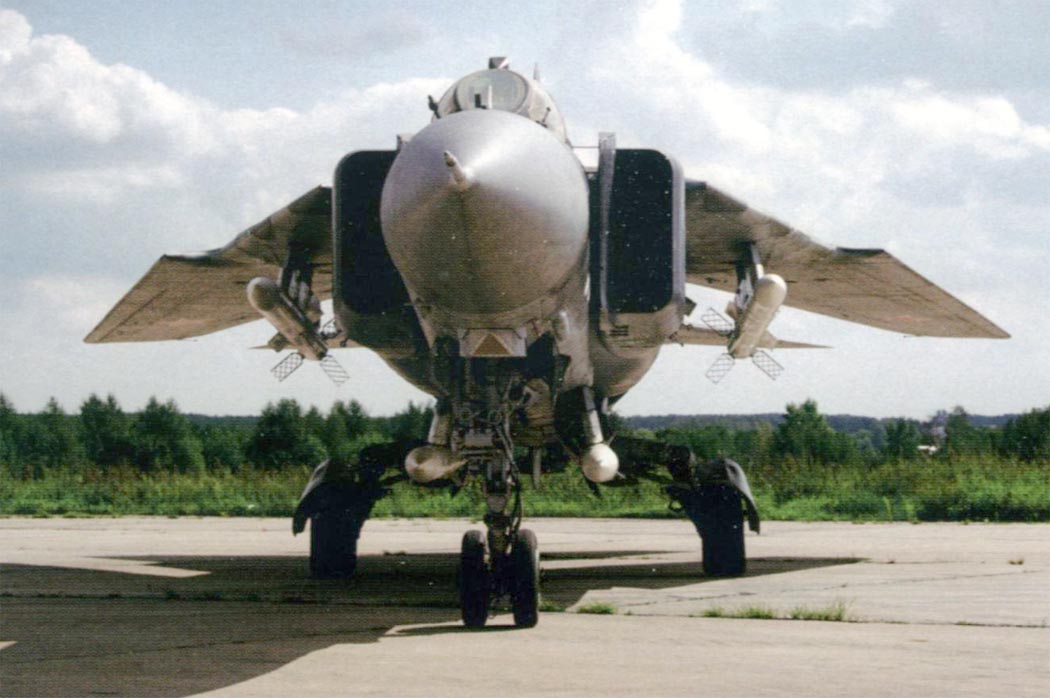
MiG-23MLDThe Saphir MLa-2 N 008 was the most advanced. Did you give the variant of the Saphir you claim the data for? Did you give an official source about that?
I am well aware where your nonsense did come from.The best joke is, that the Flogger did get its SA data from GCI with much greater range. The limited search mode did allow the Flogger to close in to the preselected target. Aquire the target till a lock can be established and the R-23 or R-24 be fired. Low and in mountainius terrain with a lot of ground-clutter that is in WVR-conditions already. Here the TP-23 does help the R-23T or R-24T, when a short pulse from the radar is still in need to give the distance. The name of the game was to cut the Flogger from CGI.
To restore the lost combat capability of the Flogger, it was in need of a secure data-link and more remote sensors, which were much more difficult to jam. The smartest solution is, to force your opponent to jam that frequencies he is in need himself and does limit his ability to do so at wish.
The first task of the Russian experts was to bring back the GCI in a working order.
Relax buddy, i know you can not admit the Saphir ML has a range in the range of 80-95km and that is what is usually is reported, of course you insists in 70km or less range overlapping data of the Saphir carried by the MiG-23M with that seen on the MiG-23ML.
The most likely range for a MiG-21 target size is 85km, so a bigger aircraft like the F-15 will have a larger RCS and the Russians say the MiG-23 can detect it within a range of 90-95km.
Who is illogic, you that only has presented a page where they even not mention what saphir variant or me who can present you more independently created pages that show a minimun range of 80km and a max of 95km?
see that basicly they claim 85km for a target with a RCS of a MiG-21
состав оборудования входят: РЛС “Сапфир-21” (МиГ-23С и МиГ-23МС), импульсно-доплеровская РЛС “Сапфир-23Д” (МиГ-23М и МиГ-23МФ, дальность обнаружения воздушной цели класса МиГ-21 — 55 км, дальность захвата 35 км), “Сапфир-23МЛ” (Ми Г-23МЛ, дальность обнаружения воздушной цели 85 км, дальность захвата 55 км) или “Сапфир-23МЛА” (МиГ-23МЛА);
MiG-23MLDI did ask for an official confirmation like:
Anatoly Kanashchenkov
Director General and General Designer of Phazotron-NIIR JSC
Yuri Guskov
Technical Characteristics of Phazotron-NIIR JSC-developed Airborne Radars Used
in Versions of Modernization of MiG-23 Fighterand not for internet reality from fanboys mixing facts with fiction to create a more pleasing view.
You have gotten enough information, you are the only one who is not saying what Saphir variant he is talking about, Since the MiG-23 uses 5 versions and 2 of them are basicly variants of the MiG-23ML`s version
Of course if some one gives you data that is logic you want to claim to be an expert in order to dismiss other sources that contradict you as simple fanboys Yeah Sens, yeah you can deny what ever it does not please your desires
any way against a MiG-21 size target, it has a range of 85km and againts a F-15 size target a range of detection of 90-95km
MiG-23MLDThank you for confirmation. As I quoted before, well below 90 km.
Радиолокационный комплекс американского самолета обладал определенными преимуществами перед РЛС МиГ-23МФ, и особенно МиГ-23МС. Однако возможности усовершенствованных МиГ-23МЛ и F-15A оказались примерно равными. Установленная на “Игле” РЛС AN/APG-63 была в состоянии обнаружить МиГ-23 на максимальной дальности до 100-110 км (при курсовом угле 90°), а МиГ-23МЛ “видел” противника при тех же условиях на удалении 90-95 км. Радары обоих самолетов имели возможность обнаруживать цели на фоне земли. Хотя зона обзора AN/APG-63 по азимуту вдвое превосходила зону обзора РП-23 (соответственно, +/-60 и +/-30°), разрешение по угловым координатам у советской станции было в 1,5 раза лучше, чем у американской, что позволяло, в частности, скрывать от противника истинное число самолетов, летящих в плотном строю.
The F-15`s radar range has certain advantages over the MiG-23MF`s radar, especially MiG-23MS`. However, the possibility of improved MiG-23ML and F-15A were roughly equal. 95 km. Both aircraft radars were able to detect the target against the backdrop of the earth. Although zone review AN/APG-63 on azimuth zone twice exceeded review RP-23 (respectively + / -60 and + / -30 °), permission to bend the coordinates of a Soviet station was 1.5 times better than that of American that allowed, in particular, to conceal the true number of enemy aircraft, flying in a tight strictly.
Радиолокационный комплекс американского самолета обладал определенными преимуществами перед РЛС МиГ-23МФ, и особенно МиГ-23МС. Однако возможности усовершенствованных МиГ-23МЛ и F-15A оказались примерно равными. Установленная на “Игле” РЛС AN/APG-63 была в состоянии обнаружить МиГ-23 на максимальной дальности до 100-110 км (при курсовом угле 90°), а МиГ-23МЛ “видел” противника при тех же условиях на удалении 90-95 км. Радары обоих самолетов имели возможность обнаруживать цели на фоне земли. Хотя зона обзора AN/APG-63 по азимуту вдвое превосходила зону обзора РП-23 (соответственно, +/-60 и +/-30°), разрешение по угловым координатам у советской станции было в 1,5 раза лучше, чем у американской, что позволяло, в частности, скрывать от противника истинное число самолетов, летящих в плотном строю.
The radar complex of American aircraft possessed the definite advantages over RLS MiG-23MF, and especially MiG-23MS. However, the possibilities of detection MiG-23ML and F-15 proved to be approximately equal. The F-15`s radar An/apg-63 was able to detect a MiG-23 at maximum range to 100-110 km (with heading angle of 90°), and MiG-23ML “detected ” the enemy with the same conditions at the range of 90-95 km, the radars of both aircraft they had the capability to detect purposes against the background of the earth. Although the zone of survey An/apg-63 along the azimuth twice exceeded the zone of survey RP-И (respectively, + -60 and + -30°), permission in the angular coordinates in Soviet station was 1,5 times better than in American, which made it possible, in particular, to hide from the enemy the true number of aircraft, which fly in the dense system.
http://www.airwar.ru/history/locwar/…/mig23liv.html
__________________
MiG-23MLDWrong, because all Saphir radars for the different Floggers are well below 90 km detection range! That has something to do with way that were operated and the related specifications. Non does prevent you to show us another official source about that.
состав оборудования входят:
– РЛС “Сапфир-21” (МиГ-23С и МиГ-23МС),
– импульсно-доплеровская РЛС “Сапфир-23Д” (МиГ-23М и МиГ-23МФ, дальность обнаружения воздушной цели класса МиГ-21 – 55 км, дальность захвата 35 км), “Сапфир-23МЛ” (Ми Г-23МЛ, дальность обнаружения воздушной цели 85 км, дальность захвата 55 км) или “Сапфир-23МЛА” (МиГ-23МЛА);
the composition of the equipment are:
– radar “Sapphire – 21” (MiG-23S and MiG-23MS)
doppler radar “Sapfir-23D (MiG-23M and MiG-23MF, range of detection of an air target in the class of a MiG-21, 55 km search range, the tracking of 35 km range),” Sapfir-23ML “(My G-23ML, range of detection of air targets is 85 km range of radar tracking is 55 km) or “Sapfir-23MLA (MiG-23MLA);
source
http://worldweapon.ru/sam/mig23.php
http://www.airwar.ru says not a MiG-21 class target but a F-15 will be detected at a range of 90 km
Радиолокационный комплекс американского самолета обладал определенными преимуществами перед РЛС МиГ-23МФ, и особенно МиГ-23МС. Однако возможности усовершенствованных МиГ-23МЛ и F-15A оказались примерно равными. Установленная на “Игле” РЛС AN/APG-63 была в состоянии обнаружить МиГ-23 на максимальной дальности до 100-110 км (при курсовом угле 90°), а МиГ-23МЛ “видел” противника при тех же условиях на удалении 90-95 км. Радары обоих самолетов имели возможность обнаруживать цели на фоне земли. Хотя зона обзора AN/APG-63 по азимуту вдвое превосходила зону обзора РП-23 (соответственно, +/-60 и +/-30°), разрешение по угловым координатам у советской станции было в 1,5 раза лучше, чем у американской, что позволяло, в частности, скрывать от противника истинное число самолетов, летящих в плотном строю.
The F-15`s radar range has certain advantages over the MiG-23MF`s radar, especially MiG-23MS`. However, the possibility of improved MiG-23ML and F-15A were roughly equal. 95 km. Both aircraft radars were able to detect the target against the backdrop of the earth. Although zone review AN/APG-63 on azimuth zone twice exceeded review RP-23 (respectively + / -60 and + / -30 °), permission to bend the coordinates of a Soviet station was 1.5 times better than that of American that allowed, in particular, to conceal the true number of enemy aircraft, flying in a tight strictly.
http://www.airwar.ru/history/locwar/bv/mig23liv/mig23liv.html
MiG-23MLDUnable to read carefully. My quote about the detection range of the latest Saphir was up to 70 km, when an unknown poster did claim 90 km for the ML at all. But with the help of the link, you may like to ignore that nonsense and find it out yourself. It is even a preferred Russian source and not a “questionable” Western one.
http://www.milparade.com/security/28/026x.htm“increase of an air target detection range up to 90 km”
Increase does mean, that the Saphir does offers less detection range.
For the Moskit it is up to 90 km.
The Saphir radar is a family of radars not all the radars have the same specifications, therefore your generalization is unacurate, the MiG-23M has a radar with different detection range than the MiG-23ML for example
MiG-23MLDhttp://www.seeninside.net/sapfir23_radar.html
The furnishing of the fighter with the Moskit-23 multifunctional airborne radar will enable to increase its efficiency due to:
increase of an air target detection range up to 90 km;To claim an increase, the original set had a lower detection range!!!
No sens you are wrong the MiG-23-98 upgrade is not only for MiG-23MLs and MiG-23MLAs or even MiG-23MLDs but to any MiG-23 variant including the MiG-23MF and MiG-23MS because the Moskit is a new radar and can be fitted to any MiG-23 variant
MiG-23MLDThe difference may be between the RCS of the target. Are you trying to detect an F-16 or a B-52?
Up to what i have read it is an F-15 RCS
MiG-23MLDWhat could they actually do against NATO in 60’s, 70’s, 80’s?
Deep analysis would be appreciated.
There is no possible way to know it, it belongs to the realm of alternate realities or parallel universes.
Any opinion any answer is going to be bias because with nuclear weapons any side losing would had retaliated with a nuclear strike.
Analisys of weapons are also bias here, every one favoring a weapon system will claim to be right.
The most likely event is there was not going to be winners but only loosers.
If there was never a total war is because total war meant mutal destruction.
Now if you want to compare weapon systems i feel by 1988 both sides were pretty even, no side had a real advantage, however a beautiful dream was at the end of its carrer it was shown to be as evil as capitalism, yeah communism never worked, it was not that capitalism was better simply it was more practical in terms of technology development, however as communism before it has not achieved at any one time social justice at global level and planetary abundance and fair dsitribution among all humans, in fact it is another utopy as irreal as communism was.
in few words buddy the only weapons that matter in such war were nukes but that war was won by the west thanks to a more practical and free economic system that allowed more advancements in technology and therefore quicker globalization they did not need B-2s but money to win
MiG-23MLD“Production of the MiG-23 seems to have run ahead of the development of the new missiles. When the type was first observed in East Germany, in the course of 1973, it was seen to be carrying launch rails for K-13-type missiles. The new weapons probably entered service in Soviet Union in the mid-1970s and were kept away from less secure areas of Eastern Europe and the Baltic until the early 1980s. ..”
“The factors behind individual Soviet planning decisions are kept secret. It is no secret, however, that Soviet industry’s forte is the production of mechanical devices: airframes, engines, tanks and the like. In the case of almost any weapon system, it is found that the production of electronics and electronic-based sub-systemslags behind that of the platform itself. In the case of the MiG-23M, the most likely components to present such a problem would be the ‘High Lark’ radar and the new missiles.
In the case of a Western aircraft in the same position, production would probably not be started until the radar production rate could match that of the airframe. The Soviet front commander, though, would rather have the faster, more powerfull aircraft as soon as possible. It is possible that considerations of this sort underlay the development of new versions of the MiG-23, the first of it which appeared quite suddenly on the scene in mid-1975. The simplest adaptation, and possibly the first to be developed was basically a MiG-23M with ‘High Lark’ radar……”If someone claim performances of a radar, he has to give the right designation. There were built different lots of that basic design, which did differ in specification and reability related to age.
A TV-set built in 1975 does differ from one built in 1980 or in 1985, just to find a very simple example to show what development does mean.
I agree with you in many points, i feel in many ways the MiG-23 lagged behind in several areas and the MiG-23S Flogger A is a good example, later MiG-23s did recieve the R-23s and R-60 in the mid 1970s.
The MiG-23 as any design never was found totally satisfactory, it is true the MiG-23M was found deficient in agility and weaponry, however i feel for a few years perhaps one or two probably in 1975 it was regarded as a good design, but it was never regarded as a very powerful opponent, in fact i believe the only reason it was regarded a threat was because it was very numerous and was inducted into service relatively quickly and in such a large number
MiG-23MLDAVIONICS
The MiG-23 Flogger was designed to shoot down targets beyond visual range. To achieve this capability the MiG-23 was fitted with the Saphir-23 J-band multi-mode radar known as the ‘High Lark’ in NATO. The radar possesses a search range of 70 kms and a track range of 55 kms. However, the analogue radar was prone to a lot of problems. The detection ranges were unpredictable and would vary from 5kms in one set to 40 kms in some other. The liquid cooling system of the radar would stop working after 2 yrs due to anti-freeze depositions. When the radar detected a target, it did not use a scope to display the target, but instead used the brand new HUD (Heads-up Display) to create the radar picture.(Safir-23ML)
Your information is wrong that is not the radar even of the MiG-23ML, the MiG-23ML has a much longer radar range, 90km to be exact, now even if the radar had its short comings, that is possible since all technologies have those, what you are trying to protrait is a general assesment into all the MiG-23 fleet.
That is not believeable since the MiG-23 with saphir radars achieved the production number of more than 2500 aircraft including MiG-23ML and MS.
Such things can not be generalizations, it is probable some aircraft suffered maintainace problems others even were not reliable, yes it is possible, however a well maintained MiG-23 would not have such troubles.
In general the MiG-23 was like any soviet weapon reliable, practical but not perfect.
You are trying to give a false idea that the MiG-23 was a machine not ready for production and totally unreliable, that is not correct, because the main aircraft built in the former Soviet Union in the 1970s was the MiG-23, almost 5000 were built, so if you try to say the aircraft was not good simply becasue it experienced some troubles, well it is a generalization to slander a design that probably in terms of producibility and performance was better than any aircraft built in the west, and i can assure that any advanced design in Western Europe sufferes similar problems but they never built such large numbers.
Air Defence Variant (ADV)
Tornado F2: The first ADV version of the RAF. This versions’ AI24 Foxhunter radar encountered numerous problems in the beginning. This even led to the first Tornado F2s being delivered with concrete and lead ballast instead of the actual radar
The F3’s primary weapons when it entered service were the AIM-9 Sidewinder and Skyflash, a Britsh upgrade of the American AIM-7 Sparrow missile. Its radar is the Foxhunter, which is still somewhat troublesome to this day.
http://www.battle-fleet.com/pw/his/tornadof3.htm
The first batch of 18 Tornado F2s were delivered without radars, and had to be fitted with ballast in the nose to compensate for the weight of the missing radar. This lead to the now famous “Blue Circle radar” joke (Blue Circle being a British manufacturer of cement, and handily following the pattern of British radar designations like Blue Fox, Blue Vixen etc). Foxhunter did not enter service until 1985 and then only an interim standard version that didn’t meet requirements, despite a 63% increase in development costs. Not all the problems were of Marconi’smaking. Part of the problem was the
MiG-23MLDTake your time and verify your guesses.
The Mirage F1C did enter full production and service in the AdlA from 1973.
The full combat capability was reached with the Super 530D in 1979. Just three years later the more capable Mirage 2000 did enter service.
The Safir radar based on the technology of the AWG-10 was not very reliable at first to stay polite. I had some thoughts, when I presented the link about the F-4J from 1972.A fighter has to fullfill a task or it is a waste of money and a failure by that.
The Syrians were unable to defend their AD-net over the Bekaa and their ground troops in a adequate way. Neither the MiG-21s, MiG-23s nor MiG-25s were able to do so. Both parties had 400-500 fighters at hand to send in and to fullfill the related tasks.
The exchange ratio alone is no yardstick. Air-warfare does not mean to bring down hostile fighters at first, but to exercise own firepower in need and deny that to your opponent.Midway 1942 is a classical example, what I mean about that. The USA had lost more fighters there, when they were able to sink the much more important CVs. You can loose an air-battle but win a war by air-power. (just for the benefit of the others, because someone will not understand the deeper sense related to that claim)
The Flogger was intended as successor of the MiG-21 and it did so in the SU only.
For the other WP countries it was a limited interim fighter to bridge the time for the MiG-29 to come. When did the first WP-countries receive their Floggers?!
For the GDR just one Wing was equipped from 1978, when the other 6 had to be equipped with MiG-29s. At first there was the idea and wish of the SU, that the GDR may purchase more of that, like the ML in 1982 to bring JG-9 to strength [12 MF + 32 ML + 10 UB]. But 1982 did end that thought and all WP countries did start to receive their MiG-29s from 1987/88. From 1989 the system did start to crumble and production of the MiG-29 came to an unforseen stop. The MiG-23 was the first fighter to end its service after 1990.
In the GDR air force it is easy to explain why the stop using the Flogger and other russian fighters simple economics the vast majority of Easter european air forces retired the MiG-23 in the late 1990s or even early 2001 mostly for economics and the need to buy Western fighters .
Now let us analize other air forces: India did not retire the MiG-23 in the 1990s but just few years ago.
The vast majority of Arab nations that were MiG-23 users still fly their MiG-23s even some ex soviet republics still have some MiG-23s or retired it after the year 2000.
Now your theory is the Saphir technology was unreliable all the time so then why the Saphir was modified to be used on the MiG-25PD and was proposed for the MiG-29?
here is the Saphir-25 used on the MiG-25

here is the saphir used on the MiG-23

source
http://www.missiles.ru/foto_MuzeyFAZOTRON-2005.htm
Now if the Saphir was not a mature radar by the mid 1970s they would had not done that, the Saphir was a radar that like any new technology was difficult to handle when it was inducted but eventualy it was perfected and by the time the MiG-23M was being mass manufactured in the mid 1970s it was totally debugged
MiG-23MLD????????
Your knowledge of geography is impressive, but YOU were writing about Iraq.
man probably you have watched too much movies where a single weapon or hero can defeat an entire army, the real life is not like that, 12 MiG-25s even if they were good weapons could not defeat 20 times more F-15 and F-14s, they were doomed as Germany was doomed even with He-176s and Me-262s, few weapons can not change by themselves the outcome of a war.


 Sign In







