 MiG-23MLD
Mig23,
Here is something the F-15 doesn’t have problems with nor even the F-16…. powering through the vertical with a combat load. Also the contempt of engagement thing. Super wont’ be contempt of engaging anything. I.E. deciding when and how to enter a fight because one possesses the power/energy to do so. Super Hornet is a very nice strike fighter. However the power/acceleration just isn’t there to do sustained power games.
http://www.safetycenter.navy.mil/media/approach/vault/articles/2003/0606.htm
BFM Is Always a Good Deal … Isn’t It?
by Lcdr. Frank “Salami” Silebi/ FA-18
I have never said the F-18 is a miracle fighter, it is simply an aircraft that can fight as the F-18C did before but with more weapons and reduced RCS with an enlarged fuselage and wing.
see
In the course of time the F/A-18E/F will also replace the maintenance intensive F-14 Tomcat in service, for example, with squadrons VF-14 and VF-41. An air wing consisting only of Hornets and Super Hornets is to be established by 2003 (probably CVW-11).
The US Navy will thus be totally reliant on the Super Hornet for the foreseeable future. As far as the programme office is concerned, the following characteristics of the Super Hornet constitute the key to successful handling of the new operational scenarios:
Range and mission duration. According to the US Navy the operational radius on attack missions has increased by some 40 %. With two auxiliary tanks, the single-seater has a range of 822 km or 855 km as a fighter escort.
Payload. The Super Hornet can carry some 8,030 kg of weapons, tanks or similar from eleven stores stations. Interestingly, one of the missions envisaged is as a tanker. The F/18E can carry 13,610 kg of fuel and escort the fighter-bombers through to the target area, something not possible with the S-3 Viking that is currently deployed.
Survivability. Although not a stealth aircraft in the true sense, the radar cross-section (RCS) of the F/A-18E/F has been significantly reduced, especially frontal aspect RCS, for example as a result of modifications to the air intakes. There is also a comprehensive electronic warfare suite.
Bring-back capability. With the F-18C/D there is the problem that apart from the necessary fuel reserve only a very light weapons payload can be brought back to the carrier. The problems this causes were particularly evident during patrols over the former Yugoslavia or Iraq where it was constantly necessary to make compromises as regards range and weapons fit. The Super Hornet on the other hand can return 4,310kg of valuable unexpended ordnance and unused fuel to the carrier
MiG-23MLDI don’t speak about costs, but combat performance. In BVR combat the F-15 is more effective than the F/A-18A-D or F-16. It offers a more powerful radar and superior performance in the relevant areas and that is what matters. There is a reason why the F-15 is or was the USAFs primary air superiority fighter and not the F-16.
The points you stress out have nothing to do with what I said.
I have never said the F-15 was not a good BVR fighter, niether that for more than 20 years it reigned supreme as the top dog in BVR combat, however by 2007 the F-15 is not the top dog, already its stable mate the F-18E has achieve parity for less dollars, the fact the F-18E has evolved into something that can replace the F-14 shows the F-18 is a great aircraft.
Enjoy the Rafale power, basicly the F-18 is a rafale equivalent
.
MiG-23MLDThe difference in agility is not that big that it can’t be compensated with a good pilot. And please drop your crappy “the MiG-29C…”. The MiG-29 “9.13” (C is the NATO code letter) is not more maneuvrable than the stock MiG-29 “9.12”.
The Su-27 carries 10 AAM, but only 8 when jammers are used. The F-15 jas inbuilt jammers.
The maximum load of the Hornet is no practical configuration and it is more than unlikely to see any Hornet in such a configuration for a real combat mission.
The F-15 is not the best american fighter niether the worst, however it is not as agile as the F-16, yeah you can equip an F-18E with AIM-9X and AIM-120 and you have a fighter that basicly will be as good as any fourth generation aircraft ncluding the F-15 and F-14.
But you have to see that price plays a very important part in the game of buying an aircraft, in general terms the F-18 is a very good aircraft and for its price an excellent purchase
Defense Minister Director General Ilan Biran says that the Defence Budget is shrinking. He points out that the F-15s bought in 1976 cost Israel $26 million each while the current F-15s cost $86 million per aircraft. “The new aircraft are a much more capable aircraft (longer range, more sophisticated missiles, advanced avionics and improved onboard systems) but the price is two to three times more.”
Lockheed Martin executives said the F-16 price tag will be the most attractive feature of their offer. They say the new version of the fighter jet, the Block 60, will feature a conformal fuel tank and similar range to that of the F-15I. This would allow the F-16 to reach the long-range targets such as Iran and Iraq that the Israel Air Force feels might be required in any future Middle East war.
A senior L-M executive says the Israeli Air Force will not need a new support and training structure for the new F-16 as that required for the F-15I. “The Block 60 has new capabilities but it is, in structure, the same type of plane,” the executive said. “We want to keep the F-16 at $30 million, fly-away.”
Predicably, McDonnell Douglas executives disagree with this position but say that the next batch of F-15Is will be considerably cheaper those already ordered. They are talking a stripped-down version of the F-15I for about $50 million
Boeing’s F-18E/F Offer: Lower Price, Higher Volume
Aug 13, 2007
Aviation Week & Space Technology
Boeing is offering the Navy what one Pentagon source calls a “tempting” deal for an all-time-low flyaway price of $49.9 million for new F/A-18E/F Super Hornets. The cost is guaranteed for a third multi-year buy of 170 aircraft, but this is nearly double the Navy’s stated commitment for 92 more. Still, the deal “is going to be pretty tough for the Navy to turn down,” says a Pentagon official. The proposal comes as Defense Dept. leaders worry that the cost of Lockheed Martin’s Joint Strike Fighter will continue to grow. The Navy has told Congress it has a shortfall of 50 fighters, due in part to two factors–an accelerated burn rate of fighter hours combined with decreased projections of the design life of existing aircraft. Boeing could begin delivering the first aircraft from this deal two years after the award date. The offer would carry the production line to 2013; current work ends in 2009.
MiG-23MLDYou have to differ between the F-15 fighter and the F-15 bomber. The A-D models are fighters with no AG capability. Todays F-15s can carry up to 8 AMRAAMs, though a typical configuration comprises 6 + 2 Sidewinder.
The F-15C is not that less agile at all. Low production? 1600 F-15 is more than Flankers currently around. As much as MiG-29s are around and more than F-18A-D are around.
Up to six BVR missiles is not really “limited”. Which fighter carries more?
The F-15C can not match the sustained turn rate 23 deg/s or 28 deg/sec instantaneous turn rate of a MiG-29C, the only american fourth generation fighter than gets closer is the F-16 with 21 deg/sec and 26 deg/sec
The F-15C can not match the Su-27 number of BVR and WVR air to air missiles.
The F-18E can carry more missiles than the F-15C even the f-18 can carry the same number of missiles


The F-15 total production numbers are equal to the Mig-29 but lesser than the 4000 F-16s and more than 2000 F-18 Hornets in service or built
MiG-23MLD@MiG-23MLD,
honestly I don’t know what you want to tell me, because your entire answer doesn’t reflect anything I said and seems to be a misinterpretation.
i just meant this
F-14 strong points: wide range of air to air missiles from ranges of 150km to 500 meters, long range radar fast speed an realtively good agility however less agile than the F-15, F-16 and F-18, early multi engagement capability
F-14 weaknesses: expensive, slow rate of climb, 6.5G overload limit, barely better than the Mig-23 and F-4, maintainance demand intensive and low production
F-15 strong points: high speed, 4 medium range BVR air to air missiles, large weapons load, good agility and multi role capability
F-15 weak points: less agile than MiG-29, Su-27 and F-16, low production rates and expensive price.
F-16 strong poins: very agile single engine fighter, cheap and easy to build, multirole capability
F-16 weak points: slower than MiG-29 and Su-27s, limited number of BVR missiles and late BVR air to air combat capability (it got it only in the 1990s), single engined and limited warload
F-18 strong points: good agility, BVR missiles and WVR weapons good price, twin engine, excellent omnirole capability
F-18 weak points, slow speed, slow accelation, short ranged
MiG-23MLDWhy compare them as strike aircraft???. The F-15C design philosophy was “Not a pound for air to ground.” The F-15E v F-18E is the only sensible comparison, and the F-15E is much better.
The F-15A was too short ranged, so the F-15C carried more fuel. The F-15 can also out-climb the F-16, but most of all, the F-15 can carry a much more powerful radar, which is very important. The F-15 now carries SIX AIM-120. The F-16 is very manuverable, but the F-15 is the superior fighter.
The F-15 is not the superior fighter, it only is better in what it was stressed to be better BVR combat but in dogfights the F-16 is better, in numbers also is better you can have two F-16 for the price of one F-15, with inflight refuelling an F-16 will match the F-15.
Fans of each fighter claim this or that design is better but honestly all fourth generation fighters have strong and weak points
MiG-23MLDThe only known F-15A combat radius is 1800 km with 3 drop tanks in an AA mission. F-16A range was mostly given with 925 km.
The early F-16s were relative limited in comparison to the F-15. They weren’t BVR capable, had to operate at day in good weather, much less powerful radar, no IFF etc.. Newer F-16s are more capable but still lack behind in BVR combat performance. You have to see the missions which both aircraft were designed for.
Though there might be more F-18 customers, the total number of F-15s is about 30% higher. And the F-15 is still in production, the original Hornet is not.
I guess declaring what fighter was better in part is senseless, for example the F-18 is like the MiG-29 has a mediocre combat record, the F-16 and F-15 do have excellent combat records in terms of air to air.
Does it mean the F-18 is worse than the F-15 honestly i do not think so.
Number one each fighter was designed with a mission in mind, the F-18 was a medium range fighter with multirole combat capability.
Now if we hypothetically think which fighter was better it depends in the needs of each air force or armed services.
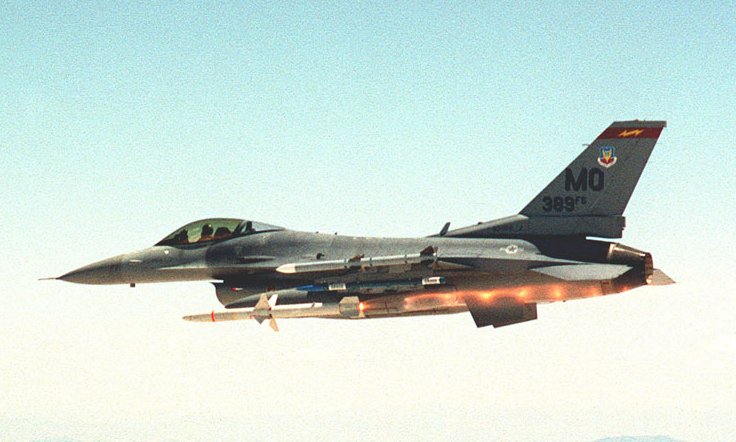
The F-16 is a light weight dogfighter with multirole capability, the F-15 is a heavy weight fighter with BVR and dogfight combat capability, the F-14 was an all range air to air fighter able to fight at any distance thanks to its arsenal of air to air missiles.
Now to say what fighter was better well it always will depend in the mission and budget involved, for small nations with small air spaces to protect the F-16 was excellent.
for nations with needs to beat high flying high altitude fighters at BVR range combat the F-15 and F-14 were excellent.
A nation like the US is wealthy it can afford to buy all these types, however other nations can not even the mighty Soviet Union did not afford some many different types of fighters like the US
MiG-23MLDYeah, I can think of another reason why the F-16 and the J-10 share similar aerodynamic features…
Or, at least not until they got rid of the vertical tail…
I do know that reason too, but independently of if the J-10 is based upon the IAI Lavi and the F-16 or not, both aircraft chose the ventral air intake because of the advantages at high AoA, the ventral inlet reduces the local AoA thanks to the fuselage forebody and this means less disturbance to the jet engine airflow.
However while the Lavi has an almost identical F-16 forebody aerodynamics, the Chinese J-10A does not follow the F-16A/C bulgy canopy and it has a smaller and different shaped nose with a longer inlet duct closer to its ogival radome


http://www.warchina.com/upload/2007_01/07011619597839.gif

In the F-16, the upper intake lip is quit small compared to the J-10`s longer upper intake lip with VG geometry multishock inlet ramp, this type of inlet modified completly the relatively distance between the radome forebody and the air intake
The J-10 follows more the IAI lavi general layout even its ventral twin fins are located farther aft unlike the F-16`s
In the F-16 contray to the J-10, the frontal cross section is almost circular unlike the boxy J-10 cross section, the F-16 designers opted among other reasons for the fixed intake in order to reduce the frontal cross section and blend the forebody and D shaped inlet into an almost circular cross section giving the smiling F-16 image

MiG-23MLDIt was the Enhanced Tactical Fighter (ETF) competition to replace the F-111. The XL was a bit of an ad hoc design and was in need refinement. When the decision was made in 1984 Saint Louis’s line could more readily handle the ETF as F-15C/D production was winding down while Ft. Worth’s was a mess at the time with all the F-16 orders. That being said I still think the XL makes more sense than the extra chunky Vipers of today.
When the Senate Armed Services Committee approved the Air Force’s budget for the 1991 fiscal year, it demanded that the Air Force examine alternatives to the ATF. Various tarted up F-15 and F-16 designs were proposed. If the ATF got the axe we might have seen one of these in production. (Yeah, and maybe I’m Chinese jet pilot)
The F-16XL was a great design, it had several aerodynamic refinements, its cranked wing first had a leading edge notch to reduce Vortex formation and pitch up movement, it had an extended trailing edge to compensate for aerodynamic center of lift shifts reducing too pitch up movement; the cranked leading edge also reduces supersonic aerodyanmic center of lift shift with its reduced leading edge sweep and increases its drag lift ratio at high AoA improving its low speed handling.
Same solution was applied to the LCA up to a level and to the AJ-37 Viggen that do have leading edge wing notches.
However it seems the F-15E represented a lower technical and economic risk and the F-15`s specification are closer to the F-111`s.
MiG-23MLDIt has to do so. Otherwise there is no need for agressor-training!
Partially true, because it also shows how good is dogfighting the F-16, yeah it might not have VG inlets but it has very well designed aerodynamics .
It leaves the F-14 as a lumbering heavy weight fighter in terms of dogfighting combat
MiG-23MLDFuselage Deliveries Increase as MDM Ramps Up Production in Mexico
MESA, Ariz., Feb. 23, 2007 – MD Helicopters’ new production facility in Monterrey, Mexico, (MDM) delivered its first single-engine fuselage in January and is rapidly ramping up to full production of 23 fuselages in 2007.
MD Helicopters Inc. (MDHI) plans to utilize the facility for production of fuselages for its single-engine helicopters, and subassemblies in support of the company’s plan to deliver 48 helicopters this year.
“The Monterrey production facility supports our strategy of vertical integration,” said company President Chuck Vehlow. “It will help us drive down costs and increase deliveries – and that’s good for customers and the company.”
Dedicated last August to national acclaim in Mexico, the production facility houses a climate-controlled manufacturing operation that includes capabilities such as detail part processing, welding, bonding, and mylar reproduction. It is the first aviation fabrication facility in Mexico and government officials have described it as their “prize jewel.”
Working with fuselages from Monterrey, and other components from various providers, MD 500s and MD 600s are assembled in Mesa and completed at MDHI subsidiary Hertiage Aviation in Texas, or in Mesa, depending on the requirements.
A team of 100 employees in Monterrey includes fully trained assembly personnel and experienced manufacturing professionals responsible for the Quality Assurance, Customer Support, and Supplier Quality functions. The assembly team has completed months of classroom, practical and on the-job-training to ensure top quality, and inspectors and Federal Aviation Administration (FAA) officials work on site.
MDHI designed and built the facility to support future expansion.
source http://www.mdhelicopters.com/page.php?cid=4&id=current_news
MiG-23MLDF-16 versus F-14 score: F-16 wins
F-16 versus F-15 score: F-16 wins
MiG-23MLD
Mesa firm works in Mexico
Fuselages for helicopters now made in Monterrey plant; management says Arizona employees are safe
Chris Hawley
Republic Mexico City Bureau
Sept. 30, 2006 12:00 AM
MD Helicopters Inc. of Mesa has begun building helicopter fuselages at its new factory near Monterrey, Mexico, and expects to begin deliveries in December.
The company decided to open a factory in the town of Apodaca in northeastern Mexico after a U.S. supplier decided it no longer wanted to build the fuselages for the MD-500 and MD-600 helicopters, George Bullis, operations manager for the new plant, said Thursday.
“It just made sense to make the leap to Mexico at this time,” he said. advertisement
The new plant has 42 employees and eventually will employ 53, Bullis said. Final assembly of the helicopters will be done in Mesa, and Bullis said there would be no cuts to the company’s 325-member Arizona workforce.
Several Arizona aerospace companies recently have set up shop in Mexico to cut costs.
Phoenix-based Honeywell Aerospace is building a $40 million systems integration laboratory in Mexicali. AviPro Aircraft Ltd., which has its sales office in Phoenix, is building light-aircraft kits in Atlixco.
Also, several aerospace suppliers have opened shops in Guaymas and in Nuevo León state.
source http://www.azcentral.com/arizonarepublic/business/articles/0930biz-choppers0930.html
MD Helicopters invests US$15 million in Apodaca
/11/2006
Monterrey, Mexico – The American company MD Helicopters will “land” at Apodaca with a new plant, where US$15 million will be invested to produce helicopters fuselages to be exported to several countries. Gustavo Alarcon, State Minister of Economic Development, said that this company, which counts the US Army among its customers, will hire between 25 and 50 people for qualified labor. According to Samuel Peсa, responsible for Foreign Investment in the Ministry of Economic Development, MD Helicopters’ officers said that plans are to triple the plant’s size in the future. “In the first stage only fuselages will be assembled, but plans are developing parts suppliers in the State to later add more production processes”, Mr. Peсa said. The plant will occupy a 5,381.933 square feet building and will be built in Millennium Industrial Park, from where fuselages for six and eight seats helicopters will be supplied to North and South America, according
http://www.maquilaportal.com/cgi-bin/public/hist/hist.pl?Klein=2006-07-11&Klein2=7788
On the picture the first helicopter fuselage built in Mexico, this first Helicopter will become an US army helicopter
sourcehttp://www.industrialcommunity.com.mx/01/01ENE/ed_ene-01.htm
MiG-23MLD
Truly? Each carrier only had limited number of Phoenix available. To have 24hr screen, you cannot have much more than 4 Tomcat in the air at station, another 4 on their way to or from station. At least 2 or 4 on short alert. So if each Tomcat carries 4 AIM-54 and needs to sink at least 2 before landing, they carrier force would run out of Phoenix within a week (4 Tomcats at station, 2hr each, makes 24/2*4=48 sorties a day, or 96 AIM-54 sinking each day).
Maybe under wartime conditions they can come home with 4.
In 2007 there are no US F-14s but plenty of F-18s, there are no AIM-54 in stocks to be used by F-14s, in few words the real winner of this battle has been the F-18 and as a Boeing or Mc Donnell Douglas product well even it has defeated the F-15
Though technology improved, the wing design remained basically the same, but Grumman replaced parts of the wing assembly with composite materials better able to handle heat and stress. The airplane’s role changed from chasing fast Soviet interceptors to supporting U.S. ground forces with bombing runs, and the Tomcat began showing its age.
“Back in the 1960s there was a need to vary the airplane’s geometry,” says Captain Don Gaddis of Naval Air Systems Command, a former Tomcat pilot and current program manager for its replacement, Northrop Grumman’s F/A-18 Hornet. On the F/A-18, “we’ve learned how to optimize the wing design so that the aircraft can carry out its functions” without changing geometry.
http://www.airspacemag.com/issues/2006/august-september/howthingswork.php?page=2
During the 1970s, an Israeli Air Force (IAF) pilot evaluated the Navy F-14 and the Air Force F-15 Eagle for service in the IAF. He walked around both airplanes and counted their control surfaces such as ailerons, flaps, slats, and speed brakes. The F-14 had more control surfaces and the pilot determined that this would make it more difficult and expensive to maintain; for this and many other reasons, the IAF subsequently purchased the F-15 Eagle. In many ways this was an omen, for the variable-sweep wing, the largest moving part ever developed for an aircraft, proved to be more trouble than it was worth for many aircraft.
By the 1980s, however, no one was designing variable-sweep aircraft and no new work on this technology has been incorporated into any new production military aircraft in at least the last 15 years, although work is still being carried out on wings that move in other ways. The technology of variable-sweep wings lasted little more than 20 years before being phased out, although hundreds of the aircraft continued to fly for years more.
There were several reasons for the move away from this technology, but the primary reason was that the large metal gearbox needed to move the wings was complicated and heavy. This increased maintenance requirements and decreased fuel performance. An aircraft capable of moving its wing forward for fuel-efficient flight could never be as efficient as an airplane equipped with a straight wing. The same was true for aircraft with swept-back wings; they would always be more efficient than aircraft with swing-wings. The B-1B Lancer, for example, has never been able to achieve its original range requirements and has to refuel in the air more often than planned. It also rarely flew at the high speeds that sweeping back the wings allowed it to do. Ultimately, aircraft designers decided that the flexibility of the variable-sweep wing was not worth the compromises it demanded.
http://www.centennialofflight.gov/essay/Evolution_of_Technology/variable_sweep_wings/Tech11.htm
During validation of the existing NATOPS rolling G envelope, the primary F-14 test asset sustained extensive structural damage to the starboard engine weekly doors and aft fixed cowl when certain structural limits were exceeded. As it turned out, the problem was not due to DFCS but was related to a NATOP’s operational envelope which had not been previously verified. This resulted in the fleet-wide rolling G restrictions from NAVAIR. The impact to the program is going to be felt in an initial envelope for DFCS with reduced rolling g above and beyond the cutbacks for AFCS roll SAS-on, simply because the Navy cannot support any further structural testing until the F-14 test aircraft is repaired. Data is still being analyzed and the restrictions haven’t been fully defined yet, but it was anticipated that the initial envelope would still include 6.5 g’s symmetric throughout for gross weights of 49.5K or less. For the clean configuration: 4 g’s rolling to 570 KCAS, 3 g rolling to 700, and 1 g rolls/no abrupt stick inputs above 700/1.4 For external tanks or Pylon mounted AIM-54s: the “region 3” from NATOPS will begin above 570 KCAS/1.15 TMN at low alt, or 500 KCAS above 25K.
MiG-23MLDThe AIM-120 was 15 years away! The AIM-7F is a big improvement over the -7E, but its no Phoenix.
In almost every picture of the F-14 that I have, the F-14 has Phoenix pylons mounted. The F-14 can bring back four Phoenix plus four other missiles. Its not six Phoenix, but its a lot. The AIM-7 was not the main BVR weapon until the Phoenix was retired. The F-14D would even lug a Phoenix under one wing on bombing missions over Iraq.
I wouldn’t want to count on the target always being head on. Its also always better to shoot down the target sooner, and farther out, so more speed means you have more chance of hitting the target before he has a chance to launch his missiles.
There will be a need for the F-14 until the last Backfire is melted down. Even after that, the F-14 has better range and payload than any flavor of F-18, and it is a better fleet defence intercepter.
The AIM-120 is sophisticated, but it does not have the range and hitting power of an AIM-54. And the argument that you can operate more of a cheaper fighter only works for the Air Force. A carrier can only fit so many planes, so they better be the best you can get.
Rocky
There is some few things you forget about the F-14, swing wing fighters do have structural troubles because the swing wing are prone to structural weakness in the moveable part joint of their wings and a max G load of 9Gs do complicate things
If you analize the max overload of swing fighters and attack aircraft you will find they usually have Max overloads limits of 7Gs or 6Gs.
see
A)Su-24M it has a max overload or 6Gs
B)F-111 also has a max overload of 6Gs
C) Panavia Tornado has a max overload of 7.5Gs
When you look at the F-18 and F-15 these aircraft eliminated those troubles with fixed wings with aspect ratios of an average of 3.5 and LERXes.
The Russians did experience troubles with the MiG-23 and the americans did too in fact this limited the F-14 to overloads of 6.4Gs in order to increase operational life,
In fact this fact and its price at the end defeated the F-14 while the F-15 and F-18 are still in production the F-14 has not been in production since more than a decade


 Sign In







