 MiG-23MLD
The MiG-25P was developed as a counter to the perceived overflight threat posed by the A-12, so yes, it was in some way influenced by the Blackbird program.
Uh, no, the two projects had absolutely nothing at all to do with one another. Why can’t you grasp that simple fact? The F-15 was conceived as an air superiority tactical fighter to take over the air combat mission from the F-4. It had nothing to do with the development or cancellation of NORAD and Air Defense Command interceptor aircraft.
They wouldn’t have ever considered a MiG-25 vs. F-12B encounter. That’s the whole point. The class of aircraft the F-12 belonged to was outside the scope of Boyd’s concepts. If that was not the case, then it would have been the F-106 program that was affected!
At any rate, the RFP process for the FX (F-15) program began in 1965. The F-12B wasn’t cancelled until 1967. If the FX was to supercede the F-12B as you seem to want to believe, then the timeline would have been different.
As it stands, the F-12B program and the F-15 program were not related. Boyd’s cadre influenced the latter, but had absolutely nothing to do with the former.
SOC
The fact one program was cancelled and other was started shows very well that the US was unwilling to finance projects with up to a degree lack of technical advantages.
The YF-12 was cancelled mainly because it was extremely expensive and incredibly specialized, the MiG-25 in the other hand was more affordable.
The F-15 was designed as a result of the void left by the YF-12, the YF-12 was consider uncapable of tackling the MiG-25 and MiG-23 threat.
Why? well the F-15 was designed with the idea the MiG-25 was agile and the MiG-23 was more than a match to the F-4.
Boyd did indeed influence but also other factors and the YF-12 proved to be not what the logic of 1965 considered a good fighter to tackle the MiG-25..
The F-4 for example was a multiservice aircraft, the F-15 and F-16 also served with the ANG and the F-16 even with the Navy albeit as an agressor.
In the US when an aircraft is capable and the right policies are followed some fighters can take other roles, but in this case the YF-12 did not simply because as an USAF fighter was deemed a very limited aircraft as a bomber and as a fighter and ended up as a very low production surveillance aircraft
MiG-23MLDThe USAF’s F-110A/F-4C Phantom II was not seen as an interceptor, it was immediately trialled with all manner of A/S weaponry, and USAF F-4s performed numerous strike missions ovre Vietnam. The USN’s Phantom II was primarily used as an interceptor and later a tactical fighter for CAP and escort duties as carrier air wings already possessed A-6 and A-7 strike aircraft.
The F-12B and F-15 were NOT RELATED PROGRAMS! The F-15 was the FX air superiority fighter program, the F-12B was the AMI Advanced Manned Interceptor program. Two separate programs; the in-service”follow-on” to the F-12B was the F-106, NOT the F-15! The F-15 was to take the air combat role from the F-4.
The F-12B was perfectly suited for the role in which it was designed, but F-12B vs. MiG-25 is a whole different story for a different time and place.
SOC
There is a phrase in spanish that says, lo que sucede conviene, that roughly translated means what does happen is what is best, that applies to the YF-12
Here you have a Mach 3 plus aircraft armed with long range missiles against another Mach 3 aircraft armed with medium range missiles, both aircraft were developed as interceptors of Mach 3 bombers and the MiG-25 in part influenced by the YF-12 program.
If the MiG-25 succeed is first because the US thought it was an agile aircraft, for Boyd`s followers it was another reason to develop the F-15 and not the YF-12, it was too obvious that the YF-12 was not a match, an agile Mach 3 fighter as they thought the MiG-25 was, proved to be more than a match for an sluggish YF-12 and another factor was the F-4 was much more slower and uncapable of beating the agile Boyd`s type super fighter the MiG-25 was thought.;) besides the real fact the MiG-25 was reported to be an fighter easy to build and unlike the YF-12 cheap to build in large numbers
MiG-23MLDOh really, the F-4 was only an interceptor? What in the world is it doing carrying bombs in that picture then? The point was that the next tactical fighter for the USAF and USN in 1964 was the F-4. That has nothing to do with its carriage of an internal cannon. Neither the F-12B nor the F-111B were going to be used as tactical fighters.
Explain to me why a bomber interceptor like the F-12B was going to need any serious level of agility.
The F-111B was neither a fighter nor a bomber, it was a dedicated interceptor.
And for the record, the F-4s did carry cannon pods.
SOC
In 1961 when the F-4 was fielded it was only another interceptor and did not have a gun, however it evolved by need into a dogfighter and bomber was it suited for this? no, it was a simple interceptor rushed into production as a multirole fighter and the proof is many were shot down and the same was with the F-111 that in its initial debut over Vietnam turned to be a fiasco
It was not until late 1964 that the need for a F-4 with gun emerged and by 1967 that it flew as a prototype with an internal gun
What created the conditions for the F-15 were Boyd`s theories, losses in Vietnam, cancellation of the YF-12 and the idea MiG-25 was superior to the YF-12.
The MiG-25 showed it could take the task of an interceptor and it was cheaper, the YF-12 was ill designed and unsuited for the task that prompted the design of the F-15;) and the retasking of the YF-12 into the Sr-71
MiG-23MLDThere’s the central flaw in your argument: the F-111B was NOT going to replace the F-4! The F-4 would have served as the primary tactical fighter for the USN, with the F-111B serving as the interceptor. Now, mix the two of them together, take out a good deal of the air-to-surface capability, and you get what? The F-14!
From a 1964 perspective the F-4 was the next USAF and USN fighter to see widespread frontline use. The F-111 was a tactical, low-level strike aircraft, never intended to serve as any sort of fighter until McNamara directed the Navy to use it as the basis for the Fleet Air Defence aircraft replacing the then-cancelled Missileer.
As far as the USAF goes, you are confusing tactical fighters such as the F-100 or F-4 with strategic interceptors such as the F-89, F-101B, or F-106. Boyd’s theories apply to the former, but not the latter; the F-12B would have been part of the latter.
And the MiG-25 was no dogfighter either, I’m starting to think that all of this is just some veiled attempt to “prove” that the MiG-25 was superior to the Blackbird…
The MiG-23 did make use of VG wings, perhaps in part due to analysis of American work on the F-111, but the Soviet answer to the F-111 was the Su-24.
They may well have been threats to those older Soviet aircraft, but the fact of the matter was that their operational employment would have meant they never encountered them.
The F-12B was an Air Defense Command interceptor designed solely to intercept incoming supersonic bombers. The supersonic bomber threat never materialized and due in part to McNamara’s preference of the cheaper F-106, the F-12B was cancelled. The F-12B was never going to be fielded in large numbers and sent all over the world hunting MiGs, it was a purpose-designed aircraft, in that fashion no different from, say, an AEW&C platform.
The F-111B was the USN’s Fleet Air Defense aircraft, designed to use the AWG-9/AIM-54 combination to do one thing and one thing only: protect the carrier from incoming missiles. Again, a purpose-built aircraft.
The USAF’s F-111 was a strike aircraft, not a fighter.
Where is the problem.
SOC
You are not using a 1964 perspective because in 1964 The F-4 did not have an internal gun and was basicly another interceptor like the F-111B however the F-111B did have a gun😉

you are using 1968 perspective when it was too clear the F-4 needed a gun, the YF-12 was too expensive and lacked agility so it was better suited for surveillance and the F-111B was not a fighter but a bomber.
MiG-23MLDThe F-12B was NEVER GOING TO ENCOUNTER FIGHTERS. How many fighters did the F-101B or F-106 encounter during ADC serivce? The F-111B was purely a fleet defense interceptor and did not have the ability to fire any AAM other than the AIM-54 at the time it was cancelled. These two aircraft were NOT INTENDED FOR FIGHTER-FIGHTER COMBAT.
WHY IS THAT SO HARD FOR YOU TO UNDERSTAND.
They certainly tried real hard to get it to work for a while. The only reason the F-111B even existed at all was due to the commonality fetishes of McNamara. And at that time they didn’t want a fighter AT ALL, they wanted the Fleet Defense interceptor to replace the Missileer.
And the F-117A “has the F and not the B of bomber” as well, where is it’s air to air weapons package? The F-105 “has the F and not the B of bomber” as well, and it was designed as a nuclear strike aircraft. That is an absurdly stupid point to use in your argument.
The F-111B was originally conceived as more than just a fleet air defense interceptor, which is where the cannon pod carriage comes from.
Irrelevant.
The F-111B was cancelled because it was overweight, underpowered, and because the prospects of a new aircraft looked better and better all the time, as Grumman had been looking at alternatives. The F-111B was never intended to be a fighter at any rate, and as such was not designed for nor was intended to be in dogfights; the USN had the F-4 for that, the F-111B being intended to mount patrols and take out inbound targets, specifically AS-4 type weapons and their launchers, at long range.
That “specialized navy fighter” was to have been the VFAX. Not the F-111B; VFAX initially did not have the Fleet Defense interceptor role attached to it.
SOC
It makes me laugh the fact you are hiding a very important fact If the Navy ordered Grumman a study of the F-111B combat capabilities versus the MiG-23 and MiG-25 and the F-111B was going to replace the F-4 in few words do what the F-14 did why you can not see that is the reason Mc Namara was defeated by Boyd in the design philosophy to be follow by the US
In 1964 there was no MiG-23, and the YF-12 first flew in 1962, the MiG-21 was the main soviet fighter aircraft and it lacked BVR combat air to air missiles, from a 1964 perspective there was no F-15, F-16, F-14 or even F-18, these fighters were a result of Boyd`s theories and the experience of the Vietnam war.
From an 1964 perspective the F-12 and the F-111 were going to be the next generation of US fighters, if the F-14 and F-15 appeared is because the USAF and US navy thought that despite the YF-12 was a Mach 3 fighter it was not a dogfighter like the new MiG-25 and the F-111 was not better.
Another factor was the YF-12 was extremely expensive and in that sense the F-111 made more sense than the YF-12
The MiG-23 was designed using the american experience in the F-111.
From a 1964 perspective a Mach 3, AIM-47 armed aircraft or a Mach 2.5, AIM-54 armed aircraft were very powerful threats to the simple and slower MiG-21 and Su-9s even to the Tu-28
MiG-23MLDOK.
I think the YF-111A’s first flight was a few months after that of the Ye-166, for the record.
Yeah, we started sending combat troops in more than just an advisory role in 1965. The F-12 and F-111 had already flown by then, so how exactly were MiG engagements in Vietnam having any bearing whatsoever on their design.
Oh wait, they didn’t, as neither aircraft was ever intended to get into a turning fight with anything. They were pure interceptors outside the scope of Boyd’s concepts as they dealt with mission types that he was not talking about.
It was a USAF low-level strike fighter, and a USN interceptor.
The F-111A et. al. was intended to penetrate Soviet airspace at high speed and LOW level. The F-111B wasn’t intended to speed around at Mach 2.5 all the time; the high-speed was a by-product of some of the USAF’s requirements. It would have mounted CAPs and conducted intercepts of inbound weapons like the AS-4. Where you are getting the idea that the F-111B was intended to be a high-speed, high-altitude interceptor in the vein of the F-12B is beyond me, but you are dead wrong. In fact, the concept for the naval interceptor was to provide a platform with long loiter capability (there goes your high-speed argument) and longer-range weapons than were available on the F-4.
Hell, USAF F-111’s didn’t even get a self-defense AIM-9 capability until the early 1980’s. Prior to that, it was a 100% pure strike aircraft, so explain to me just what Boyd’s ACM tactics and doctrine would have had to do with a strike aircraft that had no air to air capability anyway.
No, it doesn’t.
Which again has absolutely not a single thing to do with the Navy’s F-111B, as the USAF’s F-111A (etc) was not an aerial combat machine, but a tactical low-level strike aircraft.
And it also had not a thing to do with the F-12B, as that was not an aerial combat machine either, but a straight-line interceptor for strategic air defense.
No they wouldn’t. By that logic the interceptor which ended up filling the F-12B’s role, the F-106A, would have ended up as a fighter. It didn’t, it remained a bomber interceptor its entire career.
Get real, there is absolutely no way that either the F-12B or the F-111 were ever going to be used as dogfighters. There were other programs and other aircraft for those tasks, the F-111B and F-12B programs had absolutely and unequivocally nothing to do with them. The F-15 for example was spawned out of a requirement to counter the MiG-25, which was believed to be a maneuverable air superiority aircraft, not as part of the TFX program (the F-111). It was the result of the FX program.
You need to actually figure out what Boyd is talking about before you come back with more untruths and unsubstantiated statements.
And for the record, there is a book available on the F-111B that details the TFX program, the F-111B program, and the design and nature of the F-111B itself.
SOC
Let us imagine what the F-111 and YF-12 represented, first these aircraft were aircraft that relied on long range missiles, now i want to ask you a question can the AIM-54 and AIM-47 kill fighters? the answer is yes, they can and basicly these two aircraft and specially the F-111B would had to meddle with enemy fighters simply because the US navy fighters are the spear head of any US offensive or defensive military reponse.
Of course you are hiding a very important factor, the Navy did not want a fighter that in reality was a bomber that is the reason they designed the F-14.
in fact the F-111 has the F and not the B of bomber and it is not called B-111, the F-111B was Armed with six Hughes AIM-54A Phoenix air-to-air missiles, four underneath the wings and two inside the fuselage weapons bay. In addition, a 20-mm M61A1 cannon could be fitted
The idea of a VFAX multirole fighter was conceived during the early sixties, this aircraft was to replace the F-4 and A-7 in the air superiority and strike roles. The collapse of the F-111B program however left the Navy without a fleet defence missile platform, as a result the VFAX acquired the F-111B’s massive AWG-9 fire control system and payload of associated AIM-54 Phoenix SARH/ARH AAMs.
source http://www.ausairpower.net/Analysis-USN-95.html

Why the F-111B was to be armed with a gun unlike the F-4B?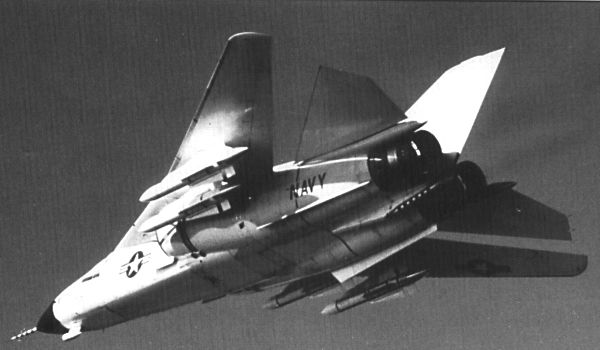
In fact the reason the US navy cancelled the F-111B is because Grumman was ordered by the US Navy to study the F-111B combat capabilities against the new MiG-23 and MiG-25 and the conclusion was it would not had stand a chance against them, and it was inferior in dogfights, this helped Boyd`s theories
http://www.rand.org/pubs/monograph_reports/MR939/MR939.ch5.pdf
the revelation of new Soviet fighters at the Moscow Air Show in July 1967. The existence of new generation Russian fighters, combined with the renewed appreciation for the importance of maneuverability and dogfighting gained from air combat experience over Vietnam, led the Navy to argue convincingly for the need for a specialized Navy fighter optimized for carrier-based fleet air defense. The Navy soon awarded a contract to Grumman for a study evaluating the F-111B’s capabilities in combatagainst the new Soviet fighters. In October, Grumman reported that the F-111B would not be able to cope with the new Russian fighters in a dogfight. More importantly, Grumman submitted an unsolicited design proposal, based on company design studies under way since 1966, for a totally new fighter that could meet the Navy’s fleet air defense needs. Shortly thereafter, two other historic Navy fighter developers LTV (Vought) and McDonnell-Douglas also submitted design proposals, as did a seasoned Air Force fighter developer, North American Rockwell. All these companies, with the exception of LTV,were also active participants in the Air Force F-X design studies. At around the same time, the Navy informed General Dynamics that the F-111B did not meet requirements and initiated a new study of alternatives.The Navy campaign to cancel the F-111B and develop its own fighter gainedmomentum at the end of 1967 when OSD appointed the Air Force as the executive agent for the development of a single new engine for a joint F-X/VFAX. By this time, both the Navy and Air Force were fully committed to developing their own fighters uncompromised by mission requirements from the other service, and the Navy now saw the Air Force as getting the upper hand in the OSD-supported F-X/VFAX program. The Navy campaign finally succeeded sixmonths later in July 1968 when Congress agreed to terminate the F-111B program. That same month, the Navy sent out RFPs to industry for a new VFXfighter, developed solely under Navy auspices and optimized for the fleet air defense mission. In addition to Grumman, North American, LTV, and McDonnell-Douglas, General Dynamics also submitted design proposals.As noted earlier, by late 1967 when Navy officials had ratcheted up their campaign to cancel the F-111B, the lighter, more maneuverable Blue Bird F-X hadgained widespread acceptance in the Air Force. At this time, however, Boyd, Sprey, and other members of the Fighter Mafia intensified their efforts to influence the F-X configuration toward an even smaller, less complicated, moremaneuverable LWF. By the spring of 1968, they had formulated a new “RedBird” F-X concept, which called for a lower-cost, even lighter fighter with lower However, Grumman proposed retention of a swing-wing design and many F-111B systems.
MiG-23MLDThe key word there is USAF…the F-111B was a USN aircraft. Also the F-12B would have technically been an Air Defense Command interceptor. Again, not a fighter, and not what Boyd was talking about.
McNamara CANCELLED the F-12B.
The F-111B wasn’t intended to mix it up with MiG-21s. It was a pure fleet defense interceptor, a follow-on to the Missileer project. Nobody intended to use that thing to dogfight, and if anything the USN did learn a few things and made the F-14 a far more maneuverable aircraft than the F-111B, incorporating weapons like the AIM-9 and the AIM-7, and an internal cannon, that to my knowledge the F-111B was never going to handle as it was strictly an interceptor.
Irrelevant.
ICBMs and SAMs had absolutely nothing to do with the F-12B program. It wasn’t a nuclear bomber, and it wasn’t going to ever come near a SAM, except for a NORAD BOMARC.
You are correct here, a very fast aircraft moving at speed is by definition not going ot be maneuverable in that flight regime. I think the turn radius of the F-12 was around 80 miles at Mach 3. But that is completely irrelevant as the F-12B was to have one purpose: to serve as the new interceptor replacing the F-101B/F-102/F-106. None of which were ever intended for use in normal air combat, the asinine experiment with the F-102 over Vietnam notwithstanding.
Wrong. The S-300PT was accepted for service in 1979, and the MiG-31 was in the early 1980s. The Blackbird was retired in 1990. And there have been multiple occasions where MiG-25s or MiG-31s were scrambled to approach SR-71s. The Blackbirds didn’t turn back, and on at least one ocassion a MiG-31 got within visual range of the aircraft even.
And?
They wouldn’t have been the USAF fighters. The F-111B was a USN-only project, and the F-12B was going to be a 93-aircraft fleet to serve as an interceptor, not a tactical fighter. Why is this so hard for you to understand?
Totally irrelevant, as the F-111B wouldn’t have been dogfighting with anything.
Totally irrelevant, as the F-12B wouldn;t have been deployed outside NORAD and certainly was never intended to dogfight with anything.
You need to take a step back and reexamine your train of thought here, you are getting all sorts of things confused.
SOC
The F-111 and YF-12 are early 1960s aircraft in fact when they made their respective first flights the4 Soviets did not have any MiG-23 or MiG-25, the USAF was fighting MiG-21s and MiG-17 in Vietnam, the F-111 was considered a fighter bomber and an Inteceptor, both the YF-12 and F-111 represented the concept where a manned high flying fast flying aircraft armed with long range missiles would have been a real success killing targets at long distance, the F-4 has the same philosophy, however when the USAF started seeing the need for a dedicated fighter, the unreliability of guided missiles at the time and scalating cost were menacing both programs that the USAF changed its policies and the F-15 was borned
If the idea of a fast aircraft armed with missiles would had not been replaced by Boyd`s theories and the F-111 and YF-12 would had ended as fighters as planned i can assure you they would had fought as the F-4 did, yeah as medium range and short range dogfighters, however science and technology defeated politics
MiG-23MLDThen why bring up the Navy’s F-111B?
The F-111 was a perfectly fine attack aircraft. It was the Navy who screwed up by making it too heavy with the Phoenix system, basically making it very nearly carrier incapable in the process.
Weapon system testing showed it would have been very successful as an interceptor in the role chosen for it.
What missiles were Soviet bombers going to be firing at F-12s? It was never going to meet any fighters as it was not going to be a fighter itself. It was a pure interceptor, outside the scope of Boyd’s concepts.
SOC
Boyd was against aircraft like the F-111B and the YF-12, Why? simple Boyd was a voice in the desert claiming a light fighter like the F-16 was what the USAF needed, Mc Namara was the political and technological trend behind the YF-12 and the F-111, this was in part a by product of rising costs and improved electronics.
The whole idea behind the F-111 was a fast aircraft according to what the USAF tacticians thought (see the that the F-111 is a Mach 2.5 aircraft) the F-111B armed with AIM-54 would had been a real menace to the short range MiG-21s armed with short range AAMs AA-2 Atolls, the Russians knew it they designed a similar aircraft the MiG-25 and the Sukhoi T-4, the Mach 3 barrier was a concept that aircraft engineers thought was going to be the next barrier to break, enters the YF-12 and the F-107 Rapier, however the Firefox design concept in the 1960s was unachieveable why? well thirsty engines and rising costs were one reason and the other were SAMs and ICBMs.
Boyd`s ideas are not coincidence, are practical solutions to the uncapability of building cheap mach 3 fighters with excellent agility, a SAM kill fast aircraft even a SR-71 and the MiG-25 and MiG-31 can also do it.
If the americans never lost one is simply they never really put the SR-71 in such chance and they retired them when the MiG-31s and S-300 appeared on the scene.
however an F-16 can kill a MiG-25 with AIM-120, a fast aircraft is not a good dog fighter good and mediun range AAMs can kill an slugish MiG-25.
try to think what would had happened if the F-111 and YF-12 would had been the 1970s USAF fighters and the F-15 and F-16 would not had enter production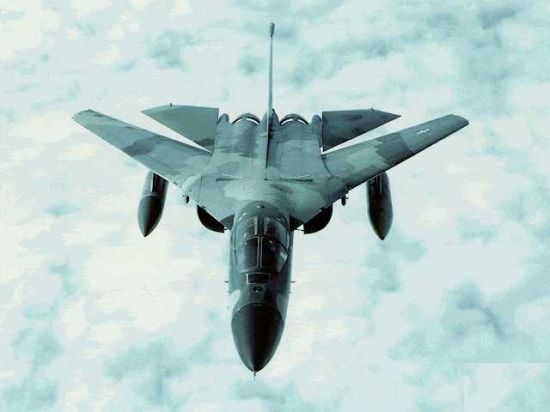
Versus
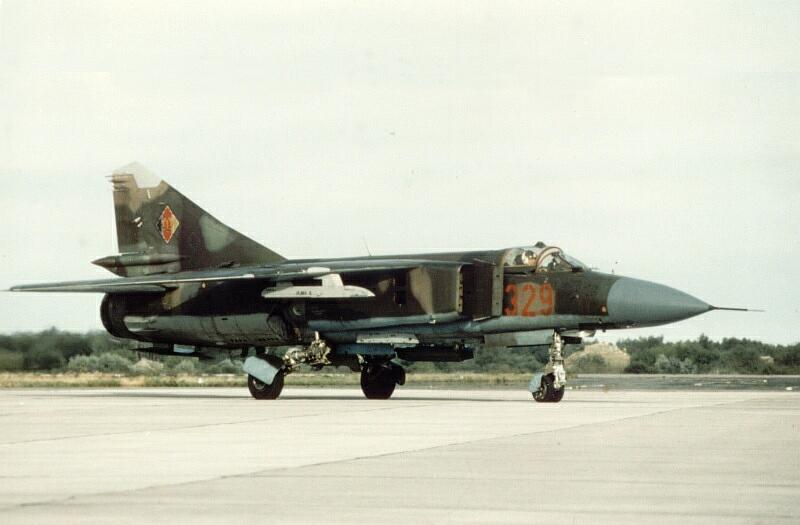
Outcome:if the MiG-23 would had had fought the F-111 over the bekka Valley or over the Sidra Gulf the MiG-23s would had ruled over the F-111s even armed with AIM-54s specially in dogfights reasons the Max overload in a F-111 is 6Gs, has practically no rear view vision and would had relied in ambush attacks limiting practically any success at medium or short range combat

versus

outcome over the gulf war: the YF-12 would had been outnumbered by the MiG-25s even otclassed in dogfights, reason well the YF-12 would had turned worst than any known fighter, limited numbers would had been available
MiG-23MLDThe F-111B naval variant was to carry the dedicated AIM-54 weapon system to function as a fleet defense interceptor. Although, there was supposed to be an AIM-7 variant matched to the F-111, but that never happened.
The YF-12 was never intended to be anything more than a high-speed intercpetor targeting bombers. No need to maneuver a-la Boyd there either.
The F-14 was never intended to rely on the TF-30, re-engining was always in the plans, but it never came to pass until much later with the F-14A+ and F-14D.
Man i am just saying that the USAF had different philosophies about what was the best fighter in the 1960s, the F-111 was supposed to be a long range killer armed with AIM-54s and at the same time a good attack aircraft similar to what the Panavia Tornado is, the F-111 showed that Boyd was right and Mc Namara wrong,
The YF-12 also was another MiG-25 type concept a fast long range interceptor however the aircraft showed it would not had been very successful, the SR-71 is an aircraft not designed to clash with missiles having a turn radius of several dozen miles, the YF-12 would not had standed a chance as a fighter however as a fleeing SR-71 was a good option.
Boyd`s theories showed the USAF and the US politicans that Physics count and not only economics
MiG-23MLDmartinez,
thanks for the comments. I think the drag will be lower for the F-16, however, I cannot prove it. The MiG-23 will definitely lose speed much quicker, so drag is higher for anything going beyond 1g flight. The example of the MiG-23 was not to make any pointless comparison, but to show the different design decisions taken on two very focussed aircraft: the MiG-23 as a very supersonic aircraft with remarkable top speed, and the F-16 with remarkable acceleration. I think the MiG-23 still is one of the fastest tactical aircraft when it comes to top speed (considering practically achievable top speeds, not the often quoted M2.5 of an F-15, which are more theoretical).The different inlet system on the MiG is known to me. I tried to have a useful installed thrust over Mach model, which is not easy even with data available.
I think Boyd’s E-M focussed on restoring lost energy. And SEP is exactly that: the ability of an aircraft to restore its energy level. If one uses this for climbing or acceleration is not important: energy is energy, kinetic or potential.
The SEP at 1g unveils some information, even more important is sometimes to compare 3 or 5g SEP. In this regime one can compare the energy loss in a maneuver. Here difference between two different design approaches, for example MiG-23 and F-16, become even more apparent.
@michelf
Nice post.
Shorsch
The MiG-23 never was intended to be a super agile aircraft, first because despite the MiG-23 was continuously re-engine with more powerful engines from the early R-29 to the R-35, all the weight penalty produced by the VG wing and the limited vision from the cockpit are typical features of an interceptor
The MiG-23 was designed as a fighter but in 1964 terms, agile yes but not to the level intended in the MiG-29 or earlier MiG-21s, the aircraft was to be a jack of all trades, relatively agile, nevertheless a medium range interceptor.
The F-16 to the contrary was designed primarily as a dogfighter armed with AIM-9s and without any BVR missiles.
The MiG-23 had a wing designed as a compromised, it was a wing to give limited success in all speed ranges and high speed and long range missiles.
As a fighter the MiG-23 surpassed the concept embodied in the F-111 and F-4, it was a light version of a F-111 with the same solutions that had the F-4 and the MiG-21 lacked.
The MiG-23 in fact is not much different to the Panavia Tornado in concept.
MiG-23MLDTo read something and grasp it is not the same sometimes.
Weight is related to lift. The more weight = the more lift. To generate lift you are in need of a wing-system and speed. After several postings we are aware, that this is not a linear affair. Lift can be produced in several ways and so I write about a “wing-system” as there is a “propulsion-system”.
Every wing-system generates drag, what you have to overcome. Related to the wing-system the lift does rise with speed. Trim goes down and with it the related drag. F-104 f.e. or a FBW-aircraft. At take-off every aircraft is at maximum weight and most draggy configuration. Best drag-thrust conditions for aircraft are above 36000 feet. For a jet-engine the thrust rises with speed, when it drops with height. The wing-system {frontal area in short}and inlet-outlet-system are the limiting factors for speed. But now it becomes complicated, when the interactions in a fluid medium do start.It was just a decade from <1>10 tons (~1940-1951 – 004>XJ53) The last one was a bomber engine, but the AL-7 did start in 1954 f.e. The 018 from 1944 did deliver 3,4 tons
The R-11 from 1956 was enough for Mach 2. Small enough frontal area, axial and 3,2:1 dry-thrust-weight-ratio.
The F-15 was the first fighter, which got a close 8:1 thrust-weight-ratio fighter-engine with the F-100. When the fraction of AB is ~50 % of Tj, the fraction is higher in a TF related to bypath-ratio >60%
We keep in mind that the dry thrust drops with air-pressure.
6000 kp dry at s.l. static is down to 1500 kp or 25% at ~37000 feet.
The extra 3000 kp from AB is down to 1500 kp only at the same conditions.
When at s.l. the AB ratio is 50%, it has risen to ~100%.
Just to get an idea about the importance of an AB. The TF with higher AB ratio does get even more. In reality much more complicated and parameters, but enough for basic understanding.
The Me-262 was a subsonic design, which was limited to Mach 0,8 by wing-system similar to the Meteor. Even when you double the thrust, you will not get more speed from such a fighter. Better accelleration or climb, before you run into the drag limit.
The piston-engine fighters were limited to Mach 0,7. Those run into two limits, the wing-system and propeller efficiency. You can double the engine power and will not get more speed from that f.e.
Related to the wing-system and propulsion-system, there are some aerodynamic limits for jets.
subsonic range ~ Mach 0,8 (Me 262, Meteor)
subsonic to transonic ~ Mach 0,9 (MiG-15bis)
transonic = can pass Mach related to wing-system (F-86, MiG-17F)
transonic = can stay supersonic related to wing-system and thrust. (F-100, MiG-19)
supersonic = can leave the transonic range below ~Mach 1,3 (F-5E, Draken)
supersonic speeds above Mach 2 are in need of a regulated inlet-system. (MiG-21, Mirage)
Sensy sensy you always claiming things i did not say, the only thing i have said is early jet aircraft did not have the technology to achieve a 1:1 thrust to weight ratio, it is not that aerodinamists and aircraft engineers did not comprehend that an agile fighter needs extra thrust to generate enough centripetal force or climb fast, eairly aircraft niether had the materials niether had engines with good thrust to weight ratio, another factor was that in the USAF thinking of the early 1960s dogfights were relagated to a last ditch resource.
Boyd only re-educated the USAF about of the importance of dogfighters and re educated the USAF pilots about the need of aircraft that could out perform their rivals with better dynamics.
Why the USAF needed to be re-educated? well simply guided missiles misguided the USAF tacticians about the realities and limitations BVR combat and US politicians demanded multi role fighters cheaper than dedicated single mission fighters and up to a degree with contradictory specifications this resulted in aircraft like the multirole F-4 or the fiasco of the F-111 fighter that ended as a heavy tactical bomber.
In fact remember the F-111 was an aircraft that was going to be armed with the AIM-54, another fighter was the YF-12 that was also going to be a super fast aircraft but both aircraft never bacame fighters but one a bomber and another a surveillance aircraft, in fact the F-14 inherited some of the deficiencies of the F-111 with the TF-30 engines
MiG-23MLDA lot of nonsense to stay polite.
You have to learn something about propulsion at first.
At take-off and low speed a prop-fighter outperforms a first generation jet-fighter easily, when it is the other way around at height and speed.
When the propulsion-effiency drops of the first and it will rise by the second.
Thrust-weight ratio becomes interesting only, when you compare two fighters from the same generation and propulsion system.
Otherwise a MiG-21 did outperform a MiG-25 with ease.
Speed is not related to weight and installed thrust. It sounds strange at first, but physics is not linear in several cases. For simple minded the t-w-ratio give s a first clue, when comparing something in the same class.
Available t-d-ratio differs with height and speed. The best t-w-ratio will not safe a careless pilot from wrong power-management. Surplus energy does allow to last longer or regain it quicker, when staying too long in inst.!
The Vietnam example showed, that BVR was not allowed in limited conflicts.
The AAMs did achieve maturity in the 70s. Till the 80s high agile fighters could reduce hit-probality from AAMs, when from the 90s it is not enough any longer. In the meanwhile more pilots were killed by G-lock than hostile AAMs.
Avoiding Gs does give your own AAM an easier task to hit something.
Sens
Speed in an aircraft is related to thrust to weight ratio that is correct simple physics simply F=M x A however you have to consider aircraft have two factors more affecting speed one is drag the other is weight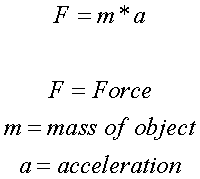


http://regentsprep.org/Regents/physics/phys06/bcentrif/default.htm
Also everything is not so straight jet aircraft also are affected by the inlet design and the jet engine efficiency in it self.
The beautiful Me-262 was rather simple than advanced compared to a MiG-25.
What i have said is correct it took almost 30 years to jet technology to create engines of more than 10000 kg of thrust, the early Jumo only could deliver 900 kg of thrust and consider that since the early Me-262 that weighted more than 6000 kg to the MiG-25 that weighted more than 36000kg aircraft gained weight as their engines gained power, only the F-15 started the trend where the engines gave enough thrust to surpass the unity.
MiG-23MLDHello folks!
I am just reading a book about John Boyd, the inventor of the so-called E-M theory (E-M for Energy Maneuverability), which is said to change the whole fighter business of the USAF in the 1960 and was basis for fighters like the F-15 and F-16.
The thing is, I don’t really understand what this theory is about. As the book is rather narrative than scientific it is more guesswork to understand.
What I learned so far is that Boyd used SEP (Specific Excess Power) to evaluate aircraft performance.
SEP = [(Thrust – Drag)/Weight] * (inertial)SpeedAnother element of his theory seems to be total energy management, this thing that says you have to go nose-down shortly to have the the quickest climb.
Can anybody enlighten me:
- What exactly is the core of Boyd’s theory
- What exactly was revolutionary about that? SEP was unknown before?
- Is it true that all USAF aircraft were inferior to Russian at that time (mid 1960s)?
Thanks for information.
Schorsch
History is written by the winners or written according what historians prefer to tell in order to glorify their own people
Boyd`s was not the first person knowing that you need thrust and excess thrust to build a more agile fighter that is simple physics, any engineer knows that.
History has been written to glorify Boyd as the so called creator of the Energy-maneouvrability theory, however even the Japanese knew that a light airplane with a good engine would give them an excellent dogfighter in the form of the A6M Zero.
However to understand his merits you have to see that there are several factors influencing the development of the F-15 and F-16, some are political and others are simply technological, in the US the idea of the pure agile fighter was compromised by limited budgets and political intervension in aircraft programs, besides that the jet engine technology of the 1960s was still uncapable of giving more than the unity in thrust to weight ratio
The F-14 and F-111 are to good example both aircraft were basicly quit underpower, to be fast you do not need to have more than the unity, the MiG-25 is an example it is faster than the F-16 and F-15 and still has a thrust to weigh ratio of less than 0.7:1, so what Boyd proposed was an increase in jet power and a lightening of the airframe, both technologies were obtained in the late 1960s.
the early Me-262 has a thrust to weight ratio in the region of 0.3:1 (consider the Me-262 had two engines and one engine only provided a thrust to weight ratio of 0.15:1) the Mirage III was not much better with a thrust to weight ratio of aroundd 0.5:1, however the early jet engine technology was not capable of providing better engines and the technology previous to the F-15 advanced so slowly, for example the MiG-19 and MiG-21 achieved better thrust to weight ratios in the region of 0.6:1 than the earlier MiG-15s or MiG-17s however from the late 1930s to the mid 1960s no aircraft manufacture could reduce weight and achieve a better thrust to weight ratio due to technological factors, what Boyd in reality did is just remind the fighter aircraft makers that if they wanted agile fighters they would get better engines and he indeed remind them basic physics, in few words his role as the creator of EM theory is inferior to what Newton did 200 years before😀
MiG-23MLDWell, my speculations are based on a history of success in Stealth by the United States. With the F-117, B-2, F-22, and shortly the F-35 leading the way………So, how do you explain Russia with no such expertise. Is going to easily surpass the F-35? While, I maybe speculating……..you are wildly guessing!:p
Man the Russian are building a fifth generation aircraft, basicly in the same class of the F-22 and F-35 and have deployed a missile S-400 that can destroy stealth aircraft, saying the PAK FA is not a fifth generation when even the engine it will power it is the AL-41 it is simply pure speculation of your part unless you have seen and fought the PAK FA in your F-22 all what you say about the latest Sukhoi is basicly coming from a bias and ill informed speculative position.
only time will tell if the PAK FA is good enough or better than the F-22
MiG-23MLDActually it’s not obvious at all. If an F-35 can come up and club you like a baby seal before you know he’s there it doesn’t matter how cool you look, how many Cobras you can do, or how many missiles you can squeeze under your wings you’re still dead.
And how can you know the PAK FA won`t be stealthy enough to beat the F-35? how do you know it won`t surpass the F-22? all are expeculations and expectations, until the PAK FA is tested in combat versus the F-22 and F-35 you can affirm anything, everything up to now is just wishful thinking or specualation at best


 Sign In







