 VeeOne
The prototype Super VC-10 lifting off at Vickers’ works Wisley Airfield. It has the fifth-engine pod that was used by East African Airways’ fleet of SVC-10 jets.
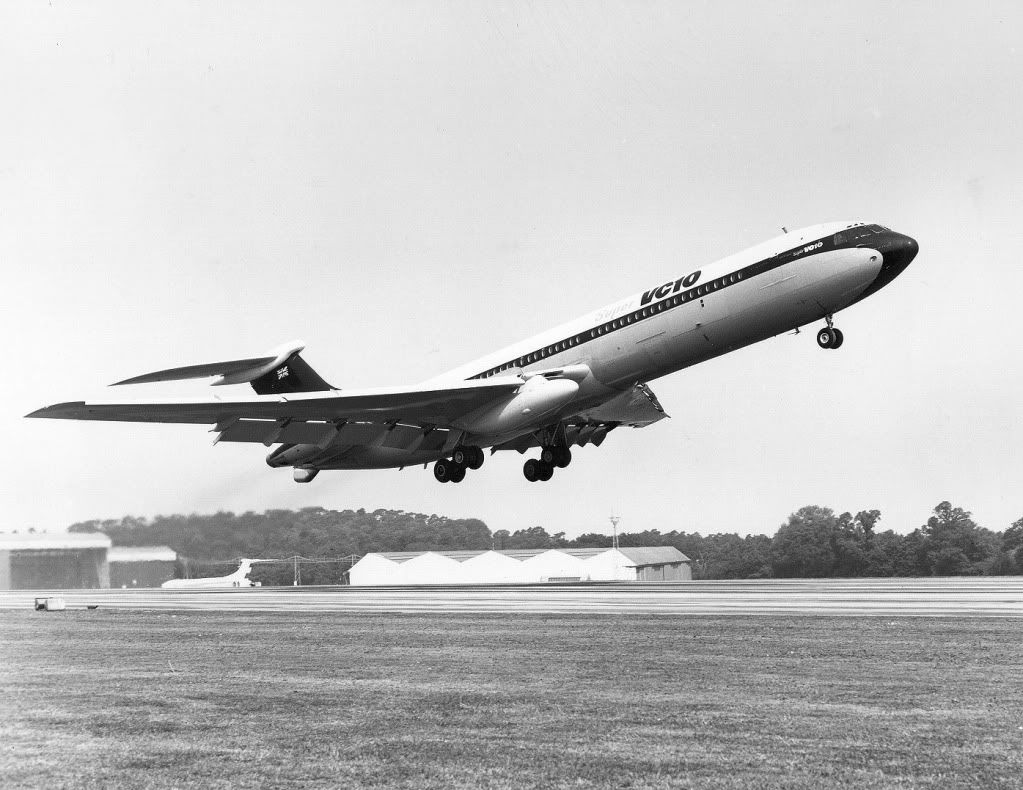
Public release photo copyright Vickers Ltd
VeeOnethanks V
It was interesting that BOAC bought 707s at a similar time to BEA getting Vanguards, around G-AP** reg issueing.
Yes, I believe this was the time BEA also got their first Trident 1c jets. The Vanguards (although these days they seem old) were BEA’s longest haul planes I believe so they served a special purpose. But I am not that knowledgable about registrations, I am just trying to remember stuff from back then.
VeeOneI moved the post myself because I accidently posted it within an existing thread. 🙂
PS. Not a dude, sweetie.
Sarah
VeeOneThey showed the aeroplane on the local news. It was out of Compton. It was a Tiger Moth in Royal Navy silver and yellow WW2 markings. One person interviewed on local TV said it dived into a field. It was aerobating apparently. The TV showed the plane… it was completely demolished from the nose to the trailing edge area – the cockpit area and wings were gone. The tail was ok. So it went in nose first at speed and a steep attitude. Apparently the crew were shouting as it came down. I had a crash in a Tiger once and the only thing I can think a pilot would shout to a passenger about would be to recycle the mag switches. On the tiger each cockpit has a set of mags. I wonder if the engine stalled (inverted?) and the pilot was trying to get the passenger to check the second cockpit mag switches were flipped up?
… report…
One of the two people who were pulled alive from the wreckage of a Tiger Moth biplane which crashed in Dorset has died.
The pilot and the passenger were airlifted to hospital following the accident near Wimborne.
One of the men died overnight from his injuries sustained in the accident, Dorset Police confirmed.
The aircraft, which had set off from Compton Abbas airfield, reportedly had been performing aerobatics shortly before it crashed into a field.
Eyewitness Geoff Hill, 49, said he watched as the plane spiralled down near his home.
“I could hear the crew shouting as it got closer to the ground and then it smashed in.
“I ran up to the crash site. Both crew members were in a bad way with huge cuts. They were in a lot of pain.
“I held one of the men’s head as he had a large gash and waited until the emergency crews arrived.”
After the crash the pilot – a local man – was taken to Salisbury District Hospital by the Dorset Police helicopter.
The passenger, a 26-year-old man from Poole, was flown by air ambulance to Dorset County Hospital.
VeeOneLATEST CUTS TO MILITARY BUDGET – SPECIAL!
Latest cuts in main military forum…
VeeOneOK, I accept the spirit of that. 🙂
Actually in the last ten years I have been paragliding. I have flown maybe 1200 hours and when I see 100 hour pilots acting with over-confidence as though they’ve learned it all it worries me. They are just beginning from my point of view. They buy advanced cross-country paragliders that are much more unstable and problematic – I think it is a male ego thing – and I just know they are no-way experienced enough to be flying these high-aspect wings when things get ugly. And flying these advanced ‘aircraft’ adds to their sense of being pretty damned great pilots – until they meet bad air. That’s when the air ambulance is called out.
I have gotten the same response as I gave you (apologies) when I have called 200 hour paraglider pilots ‘low-hours pilots’. I only say it to try to get across to them they should go slower and not push too hard for experiences beyond their hours. Low-hours pilots of 100+ hours tend to carry an attitude of ‘you can’t tell me anything – I already learned it’ and their situational awareness is pants. So is their self control when things go badly wrong. It is some sort of ‘coming of age’ male thing for many of them. It takes time to learn to remain in control mentally when you are spiralling to your possible death or recovering from a full stall close to the ground. And in these situations not doing the wrong thing through adrenaline and uncontrolled panic is as important as correct recovery.
I feel I will probably never really learn enough to consider myself a good pilot, but I see fliight safety as being in a pilot’s head, if you think your are a great pilot your ability to stay safe goes down but you don’t know it. That’s why regular check rides are good practice. We need to learn how increase our abilities by evolution, not revolution. Anyone with a basic PPL can fly into cloud and stay on instruments for five minutes – it is after that when the accidents usually happen. I have found though, that flying is a grounding experience. Most low-hours pilots have a certain (hidden from view) apprehension about being above the ground. I feel this helps keep pilots grounded in reality as far as their true abilities are concerned, at least until they get talking in the bar!
I used to work in GA for flying clubs and so on. Most ‘club’ PPL holders don’t seem to reach 180 hours without giving up. Those who fly more extensively rarely remain in the flying club system but go shares in an aircraft syndicate. So for a flying club pilot 180 hours makes a fairly experienced pilot, relatively speaking. Having said that, I doubt too many ‘novice’ club pilots could force land *safely* on a busy motorway. It takes good situational awareness to pull that off, I would have said. 😉
Sarah
VeeOneIsn’t this a special operations aircraft for special situations? If the US can justify the cost of developing and introducing these specialist aircraft for their Delta type forces what is wrong with that? We ourselves tried this back in the late 1950s with the Fairey Rotodyne military transport. The idea for fast cruise – compared to a large helicopter – vertical or stol landing at the operations site is what the military special ops guys need.
Military aircraft have always been more dangerous than their civil equivents, haven’t they? I would have thought the troops carried by them would be more concerned by the bullets flying about them as they land, or a sam hitting them when approaching or leaving the hot zone, than some mechanical failure or pilot-related accident?
I have never seen one of these aircraft but I bet they are less noisy and obvious to the bad guys on the final approach segment than a Chinook! We have them where I live now and you can clearly recognise them ten miles away even though they fly a 250 feet agl. Big rotors are unstealthy.
VeeOneHow does that AirNikon thing work, VeeOne? not noticed that before on A.net
I think I know what you mean. The photos posted here are by me but about 12 years ago I realised I could not take proper care of my slide collection of airline liveries so I gave the slides to ‘AirNikon’ to take care of. He has simply loads of slides and I felt he was a good person to keep them for posterity.
You see, I took these ‘airline colours’ slides when I was actively flying and the airline industry mattered to me as I hoped to be flying with them at some stage. I didn’t continue my airline livery collection for very long but it was right at that time when all the older types were about to be replaced by the fan-jet generation of airliners. So at the time the photography was rather interesting and it was a great excuse to get out in the fresh air (well, slightly polluted JP-4 air) and sunshine and do something that didn’t have any pressure on it.
He had one of the first slide-to-digital scanners and he scanned them for me – so it is the best of both worlds for me – I have the digital pictures to look at once in a while and I don’t have to concern myself about keeping them free of mould and damp and all the problems long-term slide care brings.
My only regret is that I didn’t take him up on the offer of scanning them at larger size than the 800×600 they are at now.
Has AirNikon put some of my photos up on airliners.net then? That would be nice as I would be able to get larger versions of the better ones. 🙂
VeeOneVeeOne….re your VC-10 section….it may have been quieter inside (than the 707/DC-8), I don’t know but I doubt it was quieter outside…. It definitely didn’t fly ‘further’…it couldn’t fly a payload UK-US West Coast which the 707-300B (fan-jets) could do from 1962 which was part of the reason BOAC were ‘allowed to purchase some 707-336Bs and Cs (the initial BOAC 707-436 purchase was the larger Intercontinental model but fitted with RR Conways, briefly the most economical engine on the 707, but they were delayed because the ARB insisted on tail mods) ….but the VC-10 was a hit with the American market for BOAC because it was excitingly different. The history of the 707 or VC-10 wrangle at BOAC goes back to the Vickers VC.7 which was stupidly cancelled by the Govt when the prototype was well advanced, but that’s part of a bigger sadder story
The whole concept of a state airline getting the pick of the best routes leaving the independents in the cold is a sad and stupid story. But forcing the state airlines to always purchase British fleets was clearly a political and not a commercial decision. The British government interfered in these dumb ways right from the start of initial independent airline operations within the UK in about 1920-21. The British government of the day refused to give the fledgling airlines operating from London to Paris financial help even though the French operators were getting massive help to fly the opposite way. It took them a while to realise the prestige that was at stake in letting the French have the best service between the two cities.
And then in 1923 the British government went too far the other way and forced the independents to merge to become one state airline to serve the commonwealth (as we now call it), Imperial Airways was formed and just before ww2 it bacame BOAC. At that time they also forced an amalgamation of the many domestic airlines so we lost many possibilities for greatness in the domestic arena. Only in the mid 1970s when it was privatised did British independents have a fair chance at commercial success. And all this lost us some of our most valuable airlines, BUA, Dan-Air London, British Eagle…
Stupid political people making the wrong decisions has blighted the British airline industry as it has blighted everything else in this country.
VeeOne[QUOTE=TRIDENT MAN;1745454]Some nice Tripod’s there btw the Trident 1C was known as the Gripper due to the very low powered Spey 505 engines (not fitted on the 1E,2E and 3B) the 3B also had the additional RB162 booster which added 5,250lb of thrust.
Also..
Incorrect,BEA were refused the 727 as they were told by the goverment to buy british.
QUOTE]
Sorry, what I meant by being the ‘cheaper option’ was that the Trident 3b was the cheaper option against the BAC 3-11 proposed replacement. As you say the 727-200 was never an option for them, the airline was never allowed to even lease non-British jets, unlike the senior state carrier, BOAC, which leased and fell in love with the Boeing 707 (probably about the time I did).
In fact, the only non-British airliner BEA ever used was the Douglas C-47 from Northholt on ‘keyline’ services to Europe from 1946 and only then for the sort time it took to build a fleet of Vikings to replace them. Oh yes, and they also flew a former Luft Hansa Junkers Ju52M on their Scottish Isles services – the aircraft was reparation for the war and it was greatly loved by those who flew on it but once again BEA quickly replaced it.
Also apologies for getting the gripper mark wrong. I always thought it was the 3b for reasons that have long dissapeared. 😉
Love love love your Trident photos! Northeast Airlines is probably my favorite – do you have a BKS photo? I seem to have lost some of my photos including a lot of closeup BEA Trident 2 pics from one of their jets inside BEA base. 🙁
Sarah
VeeOneGood afternoon,
One addition to the Boeing 707 thread. It is a scan of N402PA, a Boeing 707-321 of American Eagle, a short-lived airline. The aircraft was seen at Frankfurt on May 24th, 1980.
Kind regards,
Peter
This is an attractive livery for this old girl. Thanks for sharing it, Peter. 🙂
VeeOneI was born too late! Cursing… 😀 Great posts VeeOne, please keep on posting.
Ok, thanks for the interest. 🙂
VeeOneSome interesting and good photo’s Vee One. 🙂
Again proof that one mans ugly duck is anothers beatiful swan
here are some pictures to display the subject matter
Wow! Sad to see such aeroplanes in such a poor state. Love the An-8 photo. I never heard of that one but it is like a baby An-12. Sweet. 🙂
The An-22 looks like a cargo sister of the passenger Tu-114 – all propellors.
VeeOneThanks for those great pics Sarah. Aviation has been, and always will be, a very big part of my life. Working in it was like being paid a good salary to go out to play every day, in fact, I think I would have paid my employer to employ me;) I forgot to mention in my work history in my previous post that I did 9 months for Monarch in ’83, based at LGW, it was great to have been in with the introduction into service of the black and yellow 757s, I think we, along with Air Europe both got our 757s into service before BA, but I could be wrong on that…was a long time ago. I did a year with Aeroflot at LHR in ’93. I often think back to those glorious days on the Queens Building, and I genuinely feel sorry for the younger generation of LHR photographers who were too late to experience that. BTW, I forgot to mention it, that TAP 707 at the top of the page looks great, I can still remember seeing their 727-100s at LHR…….oh here I go again….enough:)
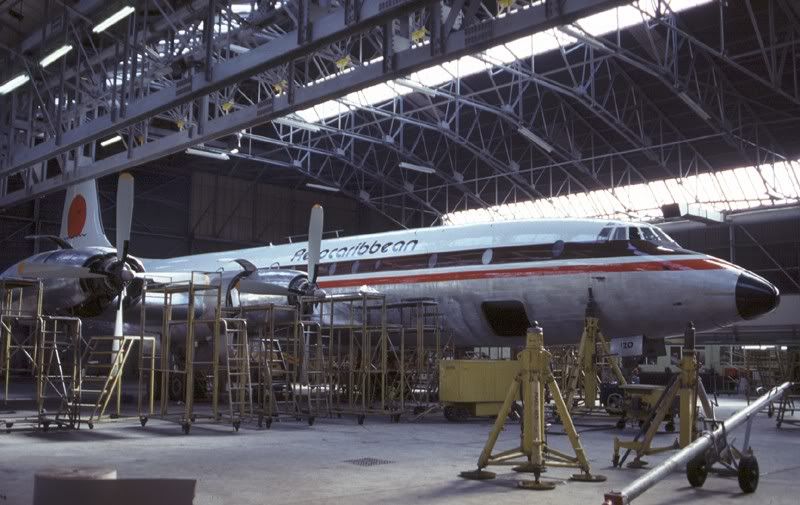
I think I took this Aero Caribbean Britannia being serviced in the Monarch Hanger at Luton in 1983. Remember it?
VeeOneOnce again some lovely and nostalgic pics. There’s another member here who’ll enjoy those Trident shots:) My favourite livery on the VC10, and it has to be a ‘Super’ is the ‘Speedbird’ colours, classy or what. My uncle used to work for BOAC at LHR back in the days of the DC7Cs, Britannias, Strats etc. It was thanks to him, that I caught the aviation ‘bug’, sadly he’s no longer here, but to him I say, “Thanks”.
I agree, the 1968 Speedbird livery was the true classic BOAC one. That gold wasn’t paint but real gold flake! Those days of Boeing 377s and DC7 Seven-Seas were probably the true golden era of London Airport and of airline aviation.


 Sign In








