 BlackArcher
Super Hornet.
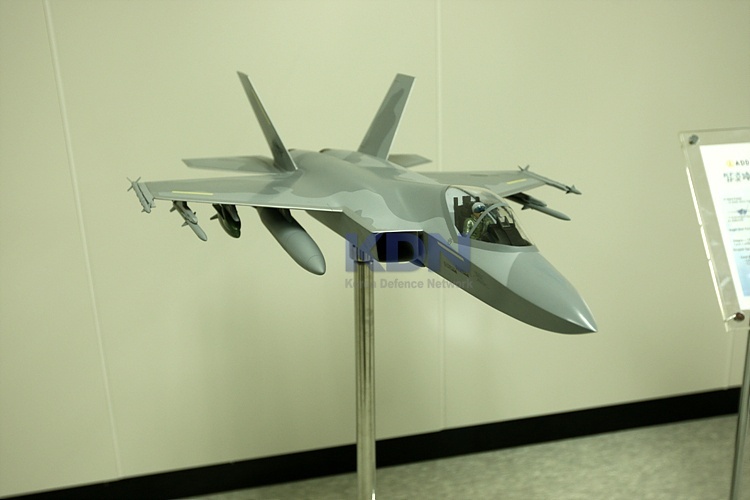
I don’t agree. IMO, it doesn’t share as much with the SHornet as it does with the F-35. The SHornet after all was optimized as a carrier strike fighter with its attendant low speed design characteristics and unless the KF-X is meant to be a strike oriented jet, the SHornet must not be the baseline design. It’s also lacking the huge LERXs that the SHornet has.
The internal weapons bay is located between the intake and the cockpit.
There isn’t enough space when you consider that the nose gear needs to be stowed in flight in the space between the cockpit and the intake. Plus, the model at least doesn’t define the panel gap lines that would clearly indicate where the internal weapons bay is supposed to be located.
Four AMRAAMs in 2 x 2 configuration. Bottom ones are door panel mounted, while top ones swing out on swing arms.
What door panel? Landing gear doors? That would be worst possible location..or did you mean internal weapon bay doors? But then you said that the internal weapons bay was forward of that, between the cockpit and intake.
That’s just Block 1. Block 2 entering service in the late 2020s will be rated full-stealth(Korean standard is something like 0.01m^2 or below).
Meaning a change in the design of the aircraft?
The reason for this phased capability introduction is to minimize program risks and cost overruns that plagued the F-35.
That is no doubt a worthwhile goal, especially for a nation that doesn’t have any experience designing a new generation fighter..I’m saying that because the T-50 was essentially an LM design that KAI worked on and productionised.
BlackArcherseems alot like AMCA, but with one bay
They do seem to be in similar weight and thrust class, being twin engined fighters with either F-414 rated at 90+kN or Kaveri-M88 rated at ~90kN thrust powering them. AMCA’s slenderness ratio (ratio of its overall length to wing span) seems to be higher than that of the KF-X, perhaps a lesson learnt from the Tejas program.
the KF-X seems to be inspired from the F-35, with its canopy and forward fuselage design looking quite similar. And where did you see the single internal weapon bay on the KF-X model? Were those 2 semi-recessed missiles hung on the internal weapons bay doors? The layout shown was a non-stealth mission specific layout, but if those internal weapons bays are under fuselage only, then it may carry 2 AMRAAMs or 2 JDAMs internally. It doesn’t look like the KF-X is intended to be an all-out VLO fighter, with some weapons always carried externally perhaps.
BlackArcherIntercontinental ballistic missiles well within reach: DRDO
Nice article by Ajai Shukla, who was given access to the Advanced Systems Laboratory of the DRDO. They discuss ASL’s focus on getting the Agni-V operationalised with canisterised launch planned for early 2013. Also some discussion on MIRVs for the future.
..
But Business Standard has been allowed an exclusive visit. The erudite, soft-spoken director of ASL, Dr VG Sekharan, describes the technologies that were developed for the DRDO’s new, 5,000-kilometre range Agni-5 missile, which was tested flawlessly in April. He reveals that nothing except restraint stood between India and an intercontinental ballistic missile (ICBM) that could strike a target anywhere on the globe.
…“Going up from 5,000 kilometres to, let us say, 7,500 kilometres requires only incremental changes, which we have already assessed. We would need a more powerful booster, which we could make ourselves at ASL; and we would need to strengthen some of the systems, such as heat shielding, that are already flying on the Agni-5,” says Sekharan.
For now, however, ASL is not developing an ICBM. Instead, its focus is on “operationalising” the Agni-5, which involves putting it into a canister and conducting 3-4 test-launches from the canister. When the Agni-5 enters service with the Strategic Forces Command (SFC), which operates India’s nuclear deterrent, it will be delivered in hermetically sealed canisters that safeguard the road-mobile missiles for over a decade, while they are transported and handled.
..The DRDO has promised the armed forces that the Agni-5 will be test-fired from a canister in early 2013. ASL is on track to achieve that target, says Sekharan. Within a couple of months, a “pop-up test” will be conducted with a canister, in which the gas generator ejects a dummy missile. Meanwhile, the actual missile is being integrated with the canister.
…
BlackArcherIt seems that the Indonesians will call it the IF-X

BlackArcherstop being so obstinate. It doesnt really matters what you take into account.
What matters is the comparing of apples and apples.
that what Janes have done, according to the article.
Same things are included in all the fighters in the comparison.Also why take the total LCC into account? Things like base and A/C investments are allready payed for? the depreciation are still there if it´s sits on the ground or of flying.
Things that costs extra while flying should be the only things that you should take into account, in my opinion.
Otherwise i would never fly exept at war, it would be too darn expensive 😉
And the more you tend to leave the jets on the ground the more expensive the flight hours become (due to less flighthours in total to spread youre investment on).
I’m being obstinate because I choose to believe SAAF figures? And you’re not obstinate for choosing to believe Saab’s figures? Double standards my friend.
Jane’s have used publicly floated figures for most of their comparisons, so its not surprising that they’d come up with similar figures. They have no other better source, since no other operator has gone to them with their hourly operating costs.
And who is taking base infrastructure or other equipment like simulators and ground equipment into account? Those aren’t recurring and are not taken into account for operating costs, even though they are included in LCC.
If those costs were to be counted and then distributed between the number of flight hours done by the fleet over a year, the figure would shoot up significantly.
But one has to account for spares that were to be used up when operating a fighter. That would differentiate between airplanes with costlier spares and those with cheaper ones or those with better quality spares that have higher MTBF and MTBOs over another type. Or between airplanes that require less maintenance man-hours and more time intervals between overhauls and checks and those that are maintenance hogs. Those costs are very much a part of the operating costs for both military and civilian airlines.
BlackArcherNo, it’s not ‘creative’ accounting, & air forces & ministries of defence aren’t buying it lock, stock & barrel. When they ask manufacturers to submit operating cost estimates, they will define what is to be included in those estimates. They won’t ask for crew costs, they’ll ask for ground crew man-hours per hour of flying time, under specific circumstances, & then apply their own pay rates to those hours. They won’t ask for fuel costs, they’ll ask for fuel consumption figures for specific flight profiles, & then apply their own fuel costs to those consumption figures. And so on . . .
I know that. What you’re stating is not new nor something that isn’t understood.
SAAB will tell any potential customers what assumptions (pay rates, fuel prices, spares costs) etc. it has made to arrive at its operating cost estimates. No serious air force would dream of taking published figures at face value: it will always ask for the basis of calculation, just as a commercial airline does.
Exactly- the assumptions that lie behind any such cost calculations will drive the final figures. And when SAAF states that when THEY operate the Gripen, it costs them $10k per hour, that implies that taking into account their pay rates, their fuel prices and the prices for spares that they paid for, it came to that number. Why is everyone so keen on just taking the Saab figure and ignoring a figure that a professional Air Force is giving?
And stop blethering on as if you think there is such a thing as a definitive operating cost per hour. As you’ve repeatedly been told, it depends on accounting conventions, user-specific costs, operating profiles, etc. Only if they are all exactly the same can you reliably compare two quoted figures – and they never are the same.
There is no need to get rude. I haven’t with you and I don’t see why you should, else I have no interest in discussing anything more with you.
I never said that they will be the same- I said that Saab will include only cost items that it feels will work in its favor. All marketing works on that premise and the fine print needs to be looked at to take any such figures at face value. Any serious AF will do its own analysis before buying a jet and when the SAAF is an operator of the type and states a particular operating cost figure, they are most likely to include all the costs they actually have to spend on, as opposed to the minimal items that a manufacturer will include in its calculations. The fact is that if the Swiss get Gripens, they can expect somewhat similar costs per hour, and I’m sure that they’re aware of that. It will still be lower than comparable operating costs for the Typhoon or Rafale, but it is definitely not as low as Saab would have us believe.
BlackArcherPer hour.
Its entirely dependent on what you count, the 5K are direct operating costs per hour, that means fuel costs and minimal suport. The 70K its literaly everything, the cost to develop and acquire the aircraft, upgrades, the entire maintenace chain, fuel, the wages from the pilots to the laundry ladies, the rebuilding of two entire airbases, simulators, etc, etc, all this divided by the number of hours flown till that time. In the end we find two vastly diferent numbers wich are “correct”, it all depends on what you include in the count.
Bager1968 nailed it “To honestly compare operating costs, all parts of the calculation must use exactly the same measures and formulae”.Cheers
I agree that it is dependant on what you count- and being the manufacturer, Saab will naturally count minimal line items to arrive at a per hour operating cost, as opposed to an Air Force that needs to spend on spares, overhaul and maintenance for a fleet of a particular type. Which is why, the $10k figure that the SAAF provided is more likely to be the realistic figure as opposed to the only fuel, oil and lubricants that Saab likely took into account to arrive at $3k or $4k per hour figure.
BlackArcherI am going to give you two numbers, 70000 pounds a year and 5000 pounds a year. Both are “official” and both aplies to the exact same aircraft and the exact same Airforce. The two numbers are the costs for one single hour of flight in the Typhoon for the RAF, the biggest number was released in the UK Parliament Hansard, the smallest number was released by the RAF itself, more precisely by the Air Vice Marshal Stuart David Atha DSO ADC.
Both numbers are correct.
A 12X diference is entirely dependent on what you are counting, and there´s no way in hell that a 6,8 ton aircraft equiped with one single F404 costs has much to operate has a Super Hornet, end of story…
70k pounds per year and 5k pounds per year? Or do you mean per hour?
And what is the cost of operating a Super Hornet per hour that you’ve seen? I’ve seen $18,900 per hour as the operating cost for a SH with Boeing official Chris Chadwick claiming $12200 per hour. The latter is a Boeing official claiming a figure that is a good deal less than other industry officials. Now, even if Chris Chadwick is correct, how is is a twin F-414 engined medium fighter more than 3 times as costly as a single F-414 engined fighter?
There is no end of story- its creative accounting and people are buying it lock, stock and barrel. I’d much rather believe an AF that has no skin in the game for showing a low cost of operating a fighter as opposed to a manufacturer whose primary advantage is lower operating costs, since program acquisition costs (as seen in the latest Swiss program) are almost as high as that of the much heavier fighters. They are most likely counting the true costs of operating the Gripen fleet including possibly costly spares, as opposed to just flying a one-off jet and counting its fuel/oil consumption for marketing purposes.
BlackArcherHmm, i would say exactly opposite, build quality looks bad versus Su-35S and, *gasp*, PAK FA. FOD retracts upwards against the ceiling.
I’m comparing the build quality to earlier MiG-29s. panel gaps are very small and there isn’t much dimpling on the panel surfaces either. To me, it looks good.
BlackArcherWhy do you find it strange? South Africa & Sweden have very different institutional, financial, & military histories. Why should they use similar accounting methods?
The British MoD counts operating costs in a way which makes its figure for Typhoon operating costs several times (not just twice) what SAAB says it is when comparing it with Gripen’s costs. I think SAAB does its own estimate, based on Swedish methodology, to give a comparable figure.
I think Saab does what is called creative accounting- and using those figures for marketing. I know, I’ve seen it at work, where the Operating costs can include upto 50-60 line items. Not including some of them, would get your operating costs down, since you’d be an OEM interested in making your product seem very cheap to operate- but a customer, he has to really spend the money, so he will take into account all line items that contribute to operating costs.
BlackArcherIf you ground an airplane for one year, what is the operating cost for that plane?
Operating cost would be nothing. Since you’d be grounding it, you’d spend nothing on fuel, lubricants, maintenance would be nearly minimal. Crew costs would be constant irrespective of the airplane being grounded.
BlackArcherI don´t! The more than double operating cost suggests to me that other cost are included. Are you implying SAAB are lying about the operating cost?
The SAAF document also qoutes the operating cost of the BAE Hawk as $6000/h. That´s almost as much as the F-16 in the Jane´s diagram!
What “other” costs will the SAAF include that Saab doesn’t? I am implying that Saab are being creative about the operating costs they’re describing as being so low. the SAAF has to pay crew costs irrespective of whether the Gripen is flown or not, so the likeliest costs included are simply those for operating the Gripen per hour.
A direct quote from a SAAF official is not good enough for you, so are you implying that they are lying when they say that the Gripen costs $10k per hour to operate? That in fact, seems very much in line with the kind of operating costs one hears about for twin-engined fighters like the Rafale/F-18 etc.
BlackArcherfinally, a few pics from my external walkaround of the new kid in the town.
thanks..build quality on the MiG-29M2 looks good! Cockpit looks the same as that on the IN’s MiG-29K and KUB’s back seat. On the intake, there is some sort of mesh to prevent FOD, but how is it retracted in flight now?
BlackArcherWhat are your sources? The only information I’ve found about this goes in the opposite direction. Operating costs are even cheaper for the SwAF ($3000/h), but this quote is from the technical director of Gripen, not any SAAF official.
Edit: I’ve read SwAF instead of SAAF (which is what the quote is all about), but I’m still interested in knowing more about the SAAF operating costs. 🙂
The source is SAAF itself. from an article that appeared in an aviation magazine.
But Gripen fans have and will ignore this SAAF figure and continue to quote Saab officials whose figures are less than half that of the SAAF, offering arguments that each AF has a different way of looking at operating costs and hence this figure cannot be used. I somehow find it strange that an Air Force that operates Gripen C/Ds will have so different a way of counting operating costs that leads to a more than two-fold increase in operating costs.
BlackArcherAccording to Jane’s, between 1/3 to 1/4
Not according to the SAAF. the real operating costs are almost $10,000 per hour for the SAAF.


 Sign In








