 BlackArcher
“Omni-Role”…???…
Sorry, I’ll shut the door behind me on my way out.*
:diablo: :diablo: :diablo:
The Buccaneer was a beautiful aircraft but omnirole? Not in the least bit.
It was after all designed to be a maritime strike and nuclear strike aircraft. At best it would be able to self-defend itself with AIM-9s but it would’ve been a lousy fleet defense fighter. You might as well call the Jaguar an omni role aircraft if you consider the Buccaneer to be one.
BlackArcherSome nice airport shots of Qatar’s Mirage 2000s.
http://2.bp.blogspot.com/-6AtLCbWPwlo/T6rYwB7xcyI/AAAAAAAABBk/JsYoas6RWS4/s1600/9-MIRAGE.JPG
http://3.bp.blogspot.com/-r85rj170VUI/T6rYsJmAfgI/AAAAAAAABBc/uNVJPShrXoQ/s1600/8-MIRAGE.JPG
Every time I see the Qatari Mirage 2000-5’s, I regret that the IAF couldn’t acquire these jets when they were offered, thanks to the MoD assessing their value lower than what the Qataris believed they were worth..would’ve allowed the IAF to raise a 4th squadron in no time, and considering the price they’re now paying for upgrading their existing fleet, it wasn’t high at that time at all.
BlackArcherLooks like India will opt for more C-17s before the line closes in late 2014 (as per current orders).
BlackArcherhttp://dmitrydreamer.livejournal.com/29138.html#cutid1
Lots of pictures of MiG-29SMT. This link was also posted on militaryphotos.net couple of weeks back.
one question- I can understand if Su-22 pilots don’t wear anti G-suits, since they’re not expected to pull high Gs. But why is a MiG-29SMT pilot not wearing any anti G-suit?
BlackArcherFinally an agreement has been signed. Now they need to begin work on this program without any additional delays. The workshare agreement terms were the ones that were most contested and caused delays earlier..I hope they have been resolved to the MoD’s satisfaction now.

HAL Statement: Hindustan Aeronautics Ltd has signed a tripartite General Contract with United Aircraft Corporation -Transport Aircraft (UAC-TA), their Russian partner and their JV, Multirole Transport Aircraft Ltd (MTAL) for the Multirole Transport Aircraft (MTA) project.
HAL will carry out the design & development of its workshare of MTA at Aircraft R&D (ARDC) Centre at Bangalore while its Transport Aircraft Division (TAD) at Kanpur will manufacture the prototypes. Serial production will take place at Kanpur where dedicated facilities are being set up. HAL’s other R&D Centres and manufacturing divisions will share development of systems & LRUs and manufacture of components, sub assemblies and composite structure. HAL will showcase its expertise in design of aircraft as well as systems, manufacturing & flight testing while jointly working with the Russian team in Moscow as well as in India.
The Indian and Russian governments had earlier signed an Inter Governmental Agreement for joint design, development & production of MTA on 50:50 sharing basis and had decided to form a JV between HAL, UAC-TA & Rosoboronexport to execute the project. The primary objective is to achieve self-reliance in design & development and production of aircraft of this size and also to manage the programme with international collaboration and a large number of global suppliers.
The aircraft will be designed for the roles of cargo/troop transportation; para-drop /air drop of supplies including Low Altitude Parachute Extraction System (LAPES). The joint effort seeks to meet a requirement of 100 aircraft for the Russian Air Force, 45 aircraft to the IAF and 60 for export. Total requirement for the present is 205.
The MTA project preliminary design will start immediately after signing the follow-up contract on preliminary design on which tripartite discussions have been concluded.
BlackArcherRoughly half the operational cost is fuel, and PAK-FA has almost twice the thrust, – almost twice the fuel burn
the second most costly part is engine maintenance, and here PAK-FA has exactly twice as many engines to service. – exactly twice the maintenanceIn both instances, there is reason to believe that F135 gets the edge in terms of cost, – more efficient & better durability
so in fact the cost is likely even higher for PAK-FA in operational cost
I agree with you here partly. The PAK-FA with its twin engines will naturally have a bit higher costs for maintenance and fuel. Regarding efficiency and durability, it’s too early to say which is better.
BlackArcherSeems likely that HAL will license build another 106 PC-7 MkIIs. HAL is always keen to license build aircraft.
About HTT-40? Well that is a paper plane.
indeed. Am not happy with the state of the situation as regards this particular import. the IAF wouldn’t want to have to support a new type like the HTT-40 which will have its own developmental issues and post induction teething troubles. The IAF simply won’t think it worth the trouble. I don’t have any illusions that the HTT-40 project is going to simply wither away and HAL will end up simply license build PC-7 MkIIs – its the easy way out for them as well.
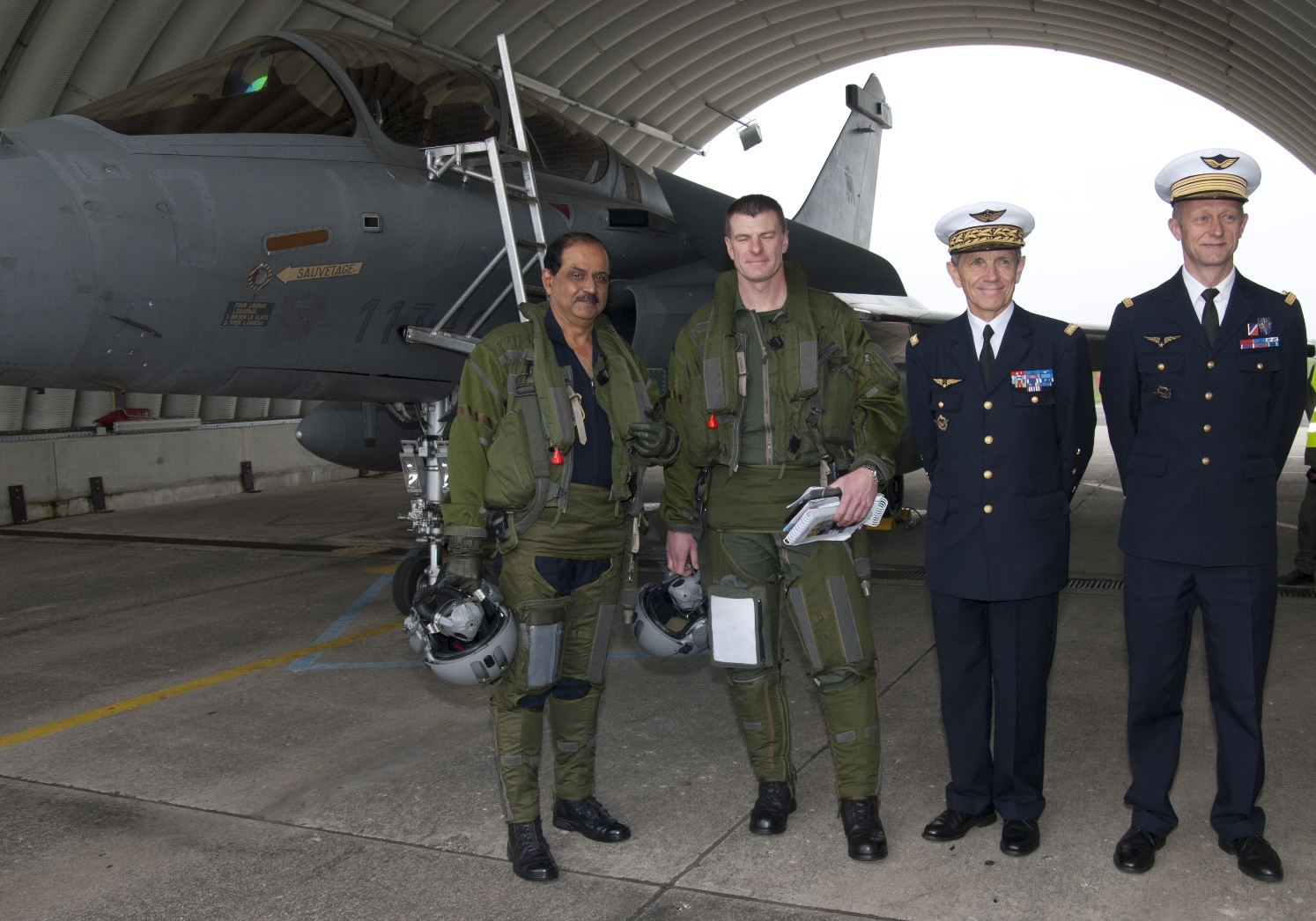
BlackArcherIAF Chief Air Chief Marshal NAK Browne had a flight test of the Rafale at St.Dizier air base.

BlackArcherProbably because the Soviet/Russian AFs are comparing the reliability of the MiG-29 to its predecessors: MiG-21, MiG-23, in which case the MiG-29 (and RD-33) would look very good, reliability and safety wise. The IAF are comparing the MiG-29 to the Mirage 2000 – MiG look not so good…
Not really Levsha. The CAG report that was quoted in the article I posted, simply stated that the engines failed prematurely- meaning earlier than their advertised MTBF figures. The IAF wasn’t comparing the RD-33 to the MP-53 of the Mirage since they have different MTBFs altogether. The issue was simply that the RD-33 didn’t meet the reliability specifications that it supposedly had. This issue was true of the radar as well- premature failure. Something that was later on seen on the MiG-21 Bison’s Kopyo radar too- they failed prematurely and never really met the advertised MTBF of 150 hours.
BlackArcherMay I emphasise that the deal also includes 55 PC-21 trainers 🙂
edit: plus another 25 primary training aircraft, yet to be chosen.
another link: Saudi Arabia signs 102-aircraft military training deal
the future looks cozy for Pilatus with this deal for 55 PC-21s and the IAF deal for 75 PC-7 MkIIs. Will keep their assembly lines humming for several years.
BlackArcherIAF Chief to visit France and take a tour of Rafale production facilities.
Indian Air Force Chief Visits France
Air Chief Marshal NAK Browne, is on a four day goodwill visit to France. During the visit, he is scheduled to call on Mr Jean-Yves Le Drian, the new French Defence Minister, Admiral Édouard Guillaud, French Chief of Defence Staff, Ingenieur Général de l’Armement (IGA) Laurent Collet-Billon, Director-General of the French Defence Technology and Procurement Agency (DGA) and General Jean-Paul Paloméros, Chief of Staff of the French Air Force, to discuss a wide range of bilateral issues on the ongoing defence cooperation between India and France.The visit that aims at expanding the already robust bilateral military to military ties between the two countries, would see the IAF Chief visit, Cognac, Istres and St.Dizier airbases of the French Air Force (FAF). At St.Dizier, he would be visiting the Rafale Squadron to get an first hand impression of the MMRCA, selected by the IAF, as also to see Rafale’s Production facilities at Mérignac, besides overseeing the progress of the various projects being carried forward as joint ventures between the two countries. He would also be interacting with the IAF’s Project Management Team members for the Mirage- 2000 Upgrade Project.
The visit is significant, as it is the first high level official visit from India to France after the new government has taken office.
The Chief of the Staff, French Air Force, General Jean-Paul Paloméros, had been on a Air Force to Air Force visit to India during September last year, where he had also visited some of the IAF’s airbases including Jaisalmer and Gwalior.
BlackArcherThis how a chutia report in news paper:mad:
The sad part is that almost every report I’ve seen in AW&ST on most Indian efforts seem to be laced with negativity. There is a lack of balance that I find disturbing, especially since I read other reports on other programs that mix the good and the bad in some balance at least. The fact that this is India’s first ever naval aircraft effort and that there are almost no other contemporary 4th gen naval fighters that small and light is completely lost on them. Which other naval fighter program can they point out which has no problems? I mean, here we see negativity only on the airframe weight issues, but read reports on the F-35 and you’ll find that they describe the issues, rather than just give some generic statements on delays and not meeting specifications. There is after all much more to the N-LCA than just airframe changes that require EADS consultancy and they don’t even mention those (except a cursory LEVCON sentence)..for e.g. the changes in the FBW, marinisation of the airframe, etc.
My rant won’t change anything of course. Neelam Matthews and the others who write for AW&ST will continue in the same vein.
BlackArcherI don’t recall seeing these issues in Russian service.
Very curious.
Perhaps they weren’t publicised or just didn’t make the news. If you’re implying that these engine and other system failures had anything to do with the customer, then I will disagree.
BlackArcherYou know the MTBO of the engine had to do with the Soviet scheme of aircraft maintenance right?
Not a design weakness.
As my previous post clearly shows, these were design weaknesses and had nothing to do with aircraft maintenance schemes.
BlackArcherAbsolutely wrong there.The Mig 29 had several weaknesses related to servicability of its components.Particularly two – very short mtbo of the RD 33 and short mtbf of its radar. This resulted in overall very poor availability of the Mig 29 fleet.
There were deficiencies in its spare supply chain as well of which the less said the better.
exactly. the RD-33 had problems unrelated to spares and more related to quality control, failure before MTBF and MTBO figures and the poor spares and support only compounded the IAF’s woes with the MiG-29 fleet.
Multiple sources confirmed this and it was our own CAG that put out a report that confirmed this way back in 1993. This article gives the details
There were extensive problems encountered in operational and maintenance due to the large number of pre-mature failures of engines, components, and systems. Of the total of 189 engines in service, 139 engines (74%) failed pre-maturely and had been withdraw from service by July 1992, thus effectively shutting down operations. 62 of these engines had not even accomplished 50% of their 300 hours first overhaul point. Thus the desired serviceability showed a steadily decreasing trend.Engineering reports mainly attribute RD-33 failures to design/material deficiencies causing discolored engine oil (8), cracks in the nozzle guide vanes (31), and surprisingly, foreign object damage (FOD). The eight material deficient engines (discolored oil) were repaired by the contractor under warrantee provisions, but the engines had to be recycled to the manufacturer. The thirty-one engines with cracks in their nozzle guide vanes were fixed in the field by contractor teams and adjustments were made to the entire engine fleet. But even though the incidents reduced the occurrences of the cracks, they continued.
But the FOD situation is the most interesting, especially after the inlet FOD doors received world press coverage, but there were other concerns about production quality control that led to problems.
Since the Indian Air Force received early model Fulcrum A’s, some just after the 200th production article, there were quality control deficiencies that resulted in numerous pieces of FOD (foreign object damage) and tools being left behind after final construction inside of the aircraft. Remember that the Fulcrum skeleton is made first and then the skin is riveted over top, in the way aircraft were made in the fifties and sixties in the West. Nuts, bolts, tools, etc. all made their way to the engine bays and inlet ducts and when they were loosened up after accelerations they damaged engines and equipment.
On top of all this, it was discovered that the unique FOD doors on the MiG-29’s inlets were not stopping material from getting into the engine ducts. Since the doors retracted “up” into the inlet, debris that was kicked up by the nose wheel lodged on or at the bottom of the door seal and then was ingested into the engine when the door opened during the nose gear lifted off the ground during takeoff.
This problem was known from the earliest days. After the first four MiG-29 prototypes were evaluated, the nose gear was moved further back, but nose wheel “mud-flaps” or guards were still required to protect the engine from flying debris. It took until 1988 before all delivered aircraft were so equipped, therefore the initial batch of InAF aircraft had to be locally retro-fitted with mud guards and that activity was not completed until June 1992. All costs were supposed to be re-imbursed by the contractor but Mikoyan reneged and left the InAF with $300,000 in liabilities. In subsequent MiG-29K/M models the FOD doors were replaced by screens that closed “down”, forcing any debris out of the louvers repositioned to the lower side of the inlet duct..
The Indian Air Force procurement contract was concluded in September 1986, and the first engine was expected to go into overhaul in 1989. However, four engines prematurely came up for overhaul and no repair facility had been prepared. As time went on, 115 of the 122 engines (94%) prematurely failed and had to be re-cycled through engine depots in Russia at great cost. Backlogs were created and only 79 (65%) engines returned on schedule. Even when a regional Indian repair facility was completed in August 1994, the high failure rates continued and the majority of broken engines had to be sent back to Russian depots. Self-sufficiency was achieved in 1994, only after the operations tempo was significantly reduced on a permanent basis. In the process of refurbishing failed engines, the total technical life of most of the engine fleet was effectively reduced from 800 hours / 8 years to 400 hours / 4 years, at a minimum.
Non-availability of radar and weapon system components also resulted in the grounding of seven aircraft for a period of six to twenty months. Two may have been damaged for life due to cannibalization. Besides this, a large number of subsystems and computers experienced unpredicted failures in the last four years which adversely effected the operational readiness of the squadrons. Some of the computers were field-repaired by specialists from the manufacturers, others were replaced. These repair costs were all in excess to the initial contract costs. It was noted that the 10 additional computers, which were imported, cost the InAF around $806,000. Two Flight Data Ground Processing Units quickly became unserviceable during their warranty period and have been lying un-utilized and un-repaired for over two years.
The InAF Headquarters also noted in March 1991 report that a severe shortage of product support equipment had resulted in the decline of fleet availability by 15-20%, which in turn, took negative effect on operational readiness and mission requirements.
The last para talks about spares supply problems that grounded a part of the fleet for extended periods. But, the point that JangBogo was making about people maligning the MiG-29 for no reason is not at all true. the IAF in fact would’ve ordered a lot more MiG-29s had their experience with the fighter’s reliability been good. As things stood, the IAF inducted neither the MiG-29 nor the Mirage-2000 in large numbers since the Su-30 came in the picture by 1994.


 Sign In








