Austin
Looking at the range figures RCS of 0.003 sq. m at a distance of over 2 km for Ka band seekers.
I think they have opted for higher frequency MMW seeker of 40 GHz Ka band and focused on Anti-Jamming/Burn through capability , Target Imaging with Ka band and all weather capability over Longer range for seeker.
Using K or Ku band as in R-77 might have its limitations in an era where AC carry DRFM jammers and stand off jamming available , Ka band should also be good against LO Target. and using AESA can provide faster Scan Rates and lower side lobes with perhaps lower power needed.
This would also mean R-77M would depend on AC main radar for LR tracking , Guidance and MC updates.
The RVV-BD carries dual seeker of X/Ku Band , R-77 etc carries Ku band seeker and the one for R-77M is a new AESA seeker with Ka Band

AustinHello Austin, are you sure about this feature?
http://roe.ru/eng/catalog/aerospace-systems/air-to-air-missile/rvv-md/
AustinPicture : Production line of new R-74M ( export RVV-SD ) WVR Missile
Compared to R-73 missile , It offers New Dual Colour IR seeker , Larger Off-Bore Sight and Longer Range , Likely the one we ordered recently.
AustinActive radar seeker with an active phased array antenna 9B-1103М2.
The illustrations show the layout of the GOS exhibited at the exhibition MAKS-2019 and the booklet given by “Agate”.
The latest development of JSC “mnii Agat”
is Designed primarily for advanced missiles “air-air” medium-range missiles, in particular, for the R-77M.
Serial production of the missile already starts, in accordance with the contract signed, the Ministry of defense during the forum Army-2019.
According to the developers, the GOS is also suitable for rockets of class “air-surface”.
Having an antenna diameter of only 100 mm, seeker can detect targets with
RCS of 0.003 sq. m at a distance of over 2 km
with RCS of 0.1 sq m (rocket “air-Air” or stealth fighter) – 5 km
with RCS of 5 sq m (conventional fighter) – more than 12 kmAvailable frequency bands of operation – Ki and Ka.
Weight of GOS is noticeably smaller than its predecessor 9B-1103М (for missiles R-77-1 and RVV-SD) – weight 3.5 kg vs 5.7 kg, 230 mm length 300 mm and diameter 100 mm vs. 150 mm, with comparable characteristics.
However, the main feature of GOS is electronic beam steering antennas and, as a consequence, much more rapid scanning of the airspace in comparison to all predecessors that will be surely helpful for the tasks of missile defense of the carrier, and also in conditions of active electronic countermeasures by the enemy. In creating the AESA seeker for this was also attended by Fazotron-NIIR and NIIP Tikhomirov.
Text and photos: encyclopedia of Military Aircraft
Photos & News Credits : RDF
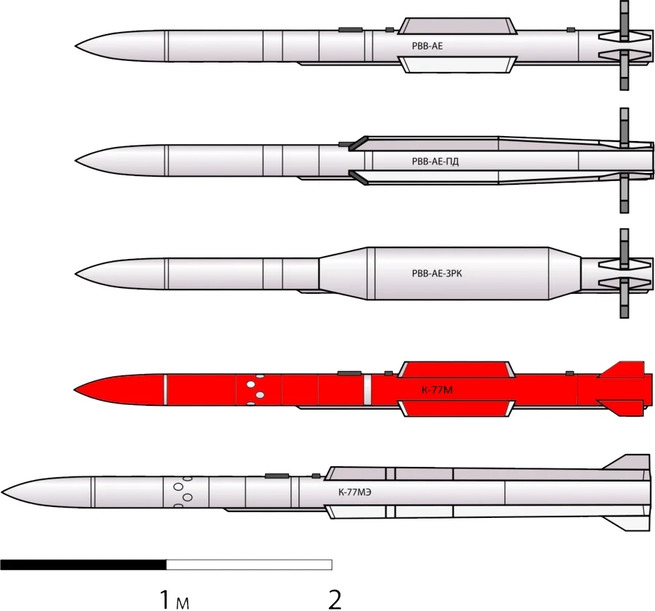
AustinAt ARMY 2019 , design Bureau “Vympel” demonstrated its new development – a missile “air-air” which exceeds in its parameters the existing missiles of this class. “Product 180” is a new missile received index K-77M, which will be initially installed on su-57, and in the future may go for export abroad. https://vladimir-krm.livejournal.com/5950713.html
Key Features:
New Dual Pulse Motor
AESA Radar Seeker for Missile
Range of 190 km+ at High Altitude & High Altitude Manouvering Capability
New aerodynamic scheme with X-shaped wings that reduces drag and as a consequence increased range
In the framework of military-technical forum “Army-2019” design Bureau “Vympel” demonstrated its new development – a missile “air-air” which exceeds in its parameters the existing missiles of this class.
“Product 180” is a new missile received index K-77M, which will be initially installed on su-57, and in the future may go for export abroad.
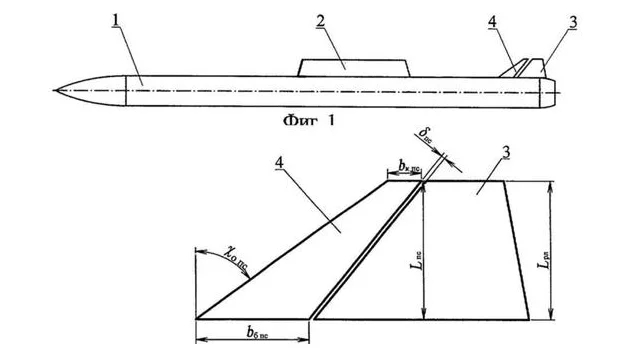
And though the rocket received index K-77M, but it has nothing to do with the missile K-77. The rocket is produced with a new aerodynamic scheme with X-shaped wings that reduces drag and as a consequence increased range.
Rocket in addition to the main wing (2 in diagram below) also added a stationary aerodynamic surface (4) before “driving” (3), which allowed to solve the main problem of all long-range missiles “air-air”, namely the ability to maneuver at subsonic speeds. For example, the famous American missile AIM-120 and its recent modernization the AIM-120D have not been able to maneuver at speeds of less than 1200 km/h (while trying to maneuver increased angle of attack, and the rocket began to disintegrate.)
Also the missile is equipped with a double-pulse solid-propellant engine, which allowes high-altitude maneuvering and enables a range of up to 192 kilometers.
In addition, the missile is equipped with inertial navigation system and active radar homing head.
All these changes make the new missile K-77M a truly unique and a real formidable weapon.
Experts pay attention that apparently the Russian defense Ministry are very serious about the project su-57 and to develop this fighter is really unique weapons that have no analogues in the world. We already know that the su-57 would be installed a shorter version of hypersonic missile “Kinzhal” gliding cluster bomb “Drel”, and now the missile K-77M. All of these types of weapons created recently and is unique in its characteristics.
AustinRSK MiG unveils the flight performance of the MiG-35 fighter
https://aviation21.ru/rsk-mig-obnarodovala-lyotno-texnicheskie-xarakteristiki-istrebitelya-mig-35/
Posted by 09/20/2019 | @AviaRu | 450
The manufacturer of light class 4 ++ fighter aircraft of the MiG RSK published on its website the official basic flight technical characteristics of the MiG-35 aircraft complex.
As stated in the press service of the corporation, this model is the pinnacle of the MiG family of aircraft. Single MiG-35 and double MiG-35D are created with the widespread use of technology of 5th generation fighters.
Pre-production samples of the MiG-35 aircraft were built by order of the Ministry of Defense of the Russian Federation and are being tested in the interests of the Russian Aerospace Forces. For mass production of fighters, the production and technological base has been modernized and successfully operates, providing the ability to produce aircraft at a high pace and with a high level of quality.
The main flight characteristics of the MiG-35 / MiG-35D:
The fighter is designed to destroy air targets day and night, in simple and difficult weather conditions, as well as the defeat of moving and stationary ground (surface) targets.
The main advantages of the MiG-35 fighter in the corporation were reduced radar visibility, 4-fold redundancy on all control channels, an airborne radar station with AFAR, an optical radar station, and a helmet-mounted target designation and indication system. The aircraft has a modern information-control field of the cockpit with a high level of automation, can use all types of guided and unguided missiles, as well as adjustable bombs.
RD-33MK engines develop 9000×2 kgf thrust on the afterburner and accelerate the aircraft to a speed of 2100 km / h. The fighter has the ability to refuel in flight and can itself act as a tanker.
The full unification of single and double versions of the aircraft in terms of airframe design, on-board equipment complex and functions performed in combination with high-precision weapons allows the MiG-35 fighter to solve a wide range of tasks from gaining air supremacy in the confrontation with fourth and fifth generation fighters,
intercepting modern air attack means and striking with precision-guided weapons at ground and surface targets without entering the air defense zone before conducting air reconnaissance using optical electrons and radio equipment. A fighter can participate in group actions and perform the functions of an air control center for aviation groups.
Armament Composition
At nine points of the external suspension, a wide range of weapons can be located: guided air-to-air missiles of short, medium and long ranges, air-to-surface missiles designed to hit ground (surface) targets, adjustable aerial bombs, unguided missiles, bombs and one-time bomb containers of caliber from 100 to 500 kg, built-in automatic 30-mm gun.
Austinhttps://hushkit.net/2019/09/07/the-mig-29-is-a-super-hunter-account-from-a-mig-29-fighter-pilot/
Austinhttps://hushkit.net/2019/09/19/what-is-going-on-with-the-indian-tejas/
AustinUpdated Information on MS-21 Program from MAKS 2019
AustinInterview with UEC Chief on PD-14 , Military and other Engine programs
Austin“Unimaginable acceleration to supersonic”: test pilot about the characteristics of the Su-57
https://tvzvezda.ru/news/forces/cont…218-Xj7eE.html
Rescue for the fifth generation: the developer of the ejection seat Su-57
AustinThat would be waster of Pylon , For aircraft like Su-30 with more space they need to integrate 360 Degree MAWS inside aircraft something Malysia has done with Su-30MKM and Russia with Su-35.
For Tejas too they can integrate it inside why waste a pylon
AustinAustinProspects for the creation of a new generation aviation complex
https://bmpd.livejournal.com/3760814.html
Boris Obnosov on the activities of Tactical Missile Corporation Corporation
AustinAs this is in Russian any thing interesting he states about PD-14 Engine in both these interviews ?


 Sign In