qwerty
I second the Pucara vote. A very capable aircraft that with the proper upgrades, will provide everything needed for a low cost and easy to maintain COIN/CAS aircraft. I believe that back in the late 60’s or early 70’s, they flew one to the Paris airshow (obviously refueled along the way) but nevertheless, it shows its capabilitites. The aircraft is still flying so I don’t think it would be a big deal for FMA to start production again if the interest for a modernized version was there.
—–JT—–
It did only have three hard-points although they could carry upto 1.500kg. I’m assuming the IA 58 can remain airborne on a single engine after jettisoning all unneeded stores. The whole fascination of twin engines is that it lowers the probability of having to punch out of the thing into the open arms of not so merciful guerillas or bands brigands and drug cartel mercenaries. I don’t even want to think about what happens to the pilots flying aircraft like the the Ayres NEDS crop-dusters in S-America or one of those Colombian Tucanos that fly intercept and CAS missions for police commandos against the drug cartels. When they get shot down or have to bail out for some other reason and are caught by the opposition the fate of those pilots is probably not enviable.
qwertyNice post, I basically agree with you.
Now people will argue that –
‘It would be slow’,
No slower than a Mi-35, AH-64, EC-665, etc…
‘It would be vulnerable to MANPADS’
Again, no more so than a Mi-35, AH-64, EC-665, etc…
‘
It doesn’t have stealth’
Now you are being sarcastic. 😀
Well my response will be that it has, and will continue to perform a neglected role, which is unfashionable to air forces the world over that likes and prioritizes high-tech fast movers, at extravagant costs, over what military history has shown and proven as workable.
I see a modernized Skyraider being far more capable of surviving in the sky over a COIN war, than that of the makeshift, limited and very vulnerable modified trainer aircraft that are being marketed as a cheap alternative to a dedicated platform.
In the COIN role, the greatest threat to an airplane is the gun first, and the MANPADS second. For the low-altitude operating nature of COIN, means that MANPADS have very limited firing time at the target, as opposed to a fast and high flying ‘fast mover’
In response to those that think with out stealth in modern warfare you are dead!
The average insurgent armed with an AK-47 rifle on the ground will shot at your aircraft just the same with the intent of killing you with stealth or without stealth features.
I leave you with this question!
How many Post WWII aircraft have been shot down by rifles, machine guns and AAA?
How many Post WWII aircraft have been shot down by SAM’s?
While resurrecting the Skyraider isn’t necessarily feasible, there is a market for a dedicated turboprop COIN aircraft as opposed to the current crop of glorified trainers. I’d like mine with long legs, a selection of internal guns (12.7 and 20mm) and twin engines; I always liked the IA 58. Helicopter gun-ships and Jets are either to expensive for most operators or in case of the jets total overkill. The maintenance/training effort is lower for a dedicated COIN aircraft than than for a helicopter gun-ship and you can operate a turboprop COIN aircraft out of bases you would never dream of flying jets out of.
qwertyIn 50 years from now that advantage has “gone to the dogs” for a long, long, long time (decades).
The aircraft with the smaller RCS will always be at an advantage over one with a larger RCS. Besides, you act as though it is impossible to incorporate more advanced materials and avionics into the F-35 line. The F-35 being produced 30 years from now will be much different than the one being produced today, much as the F-15SK is different than the F-15A.
Actually, if you don’t rip that last sentence of his comment out of context, Sintra said:
The F35A has one single real advantage over the previous generation, a very small RCS based on form, the rest (avionics) can be retrofited.
In 50 years from now that advantage has “gone to the dogs” for a long, long, long time (decades).
That sounds to me like he is admitting the F-35’s avionics are upgradable just like those of any other aircraft. The LOT features of the F-35 are for the most part due to airframe shaping optimised for reflecting and scattering the incoming radar waves in high frequency ranges commonly used in modern radar systems. It does, for example, not help you with Radar devices operating in frequency bands below the ~2 GHz range although those devices aren’t all that accurate so you still get a difficult engagement problem when tracking an F-35. Adding radar absorbing materials can only do so much. Thirty years from now you will only be able to marginally improve the RCS performance of an existing F-35 fleet by using new materials, unless you are willing to extensively rebuild the aircraft’s airframe which won’t be cost effective. You can of course add new materials in new built aircraft but I don’t see how that will help much since it is shaping that adds most to the F-35s LOT characteristics. Adding new materials will be largely limited to better RAM and that won’t make a huge difference. I think Sintra was suggesting that the LOT features of the F-35 will have been eroded by new sensor technology in around in 50 years time to the point where they are of little use other than to render the F-35 ill visible by high frequency radar. I’d say that is a sound hypothesis unless you are a die hard F-22/35 fanboy.
qwertyThe J7 is considered to be 40% better than the Mig 21 and the J7-MG is 80% better in certain flight envelopes than the original Mig 21 so they are improved versions rather than replicas.
Improved Replicas made without respect to IP rights.
Not quite… While the PRC has done a lot of reverse engineering of Soviet equipment, it did obtain a license from the USSR to produce the MiG-21F-13 and the R-11F-300 engine in 1961 before the Sino-Soviet schism. The Soviets also handed over CKD kits and extensive (though allegedly spotty) engineering documentation. The only reverse engineering done by the PRC on the J/F-7 apart from what was needed to fill in the gaps in the documentation had to do with the J-7C/D variant which incorporated features of the MiG-21MF and the WP-13 engine that powers the double delta winged models of the J/F-7. This engine is reportedly a clone of the Soviet R-13-300 engine. From the F-7M onwards J/F-7s have mostly been fitted with avionics either sourced from the West or designed in China. The vast majority of J/F-7 fighters built so far are direct descendants of the MiG-21F-13 for which the PRC got a production license back in 1961.
qwertyGLONASS needs 3 satellites more to become fully operational I think?!
They are finalizing the latest hybrid of the satellites, and will launch them this year AFAIK – then the whole system will be world ready.
Glonass Status: “As of December, 2008, the GLONASS system consists of 19 satellites, of which 16 are operational, two are undergoing maintenance, and one is due to be withdrawn. The system requires 18 satellites for continuous navigation services covering the entire territory of the Russian Federation, and 24 satellites to provide services worldwide.”
The Russians are planning to have a constellation of 30 GLONASS satellites (2nd and 3rd generation?) by 2011 which should then be enough satellites for world wide coverage with some reserves. It remains to be seen what effect the current recession will have on those plans.
qwertyHave a look at the time line.
The MiG-23M was flown first 1972, so the time the F-15 had its first flight…..
I don’t recall denying the MiG-23 was a technological late entry. I also recall pointing out that the Soviets didn’t credit any MiG-23 variant other than the MLD with standing much of a chance against the F-15A and they had their doubts even about the MLD. Especially after the Bekaa Valley incident.
Time line: R-73 entered service in mid 1980ies.
The initial MiG-29 didn’t really change the picture, the Iraqis for example were quite disappointed.
The R-73 went into production from about 1985, the R-27 from about 1983 and the R-77 from about 1994. The MiG-29 began to enter service from 1982-3. You claimed the MiG-29’s armament was crappy:
A MiG-29 with the MiG-23s disadvantages (clumsy cockpit, bad weaponary, bad view, low SA) would fall short of its airframe and engine potential.
I took issue with that. I don’t think the R-73 and the R-27 were that much crappier than the AIM-9 and AIM-7 that armed contemporary F-16s. The Luftwaffe’s record in their dealings with the Americans tends to prove that. As for the Iraqis I don’t think their pilots, brave as they were, were necessarily trained up to US or Luftwaffe standards. The Iraqis had no AWACS and by the time their MiG-29s ran into the USAF the Iraqi GCI network had been turned into scrap metal. The Iraqis, even with their MiG29s, quite frankly didn’t stand much of a chance.
qwertyQuite an achievement considering that the F-4 was flying for 20 years when the MiG-23MLD went into service. The MiG-23 wasn’t aimed the F-4 in maneuvering performance but in the ability to fire medium range forward aspect missiles. At the same time no consideration was given to independent use of weapons, but for better deployability from forward airfields. I hardly see any direct pitch versus the F-4. In my opinion the MiG-23 was build to intercept F-104s, F-105s and other NATO fighter bombers.
I may have phrased that badly. The MiG-23M more or less matched the capabilities of early F-4s and it went into service some 10 years before the MLD. The MLD was an upgrade prepared during the late 70s and quickly applied as a result of the Bekaa Valley incident. The first mass produced MiG-23 was the M variant that went into production in the early 70s which is some 10 years after the F-4. The Russians often limped behind the Americans in the development of high weapons technology so it is hardly a surprise it took them 10 years and a look at components of F-4s shot down in Vietnam to develop a similar capability in the MiG-23. You can find a legion of examples of the Soviets advancing their technology through heavy reliance on reverse engineering. The most famous example is how they had to capture Sidewinders to jump-start local development of truly effective AAMs.
While many disadvantages not are caused by the airframe or the engine, but by specific design decision and weaponary. A MiG-29 with the MiG-23s disadvantages (clumsy cockpit, bad weaponary, bad view, low SA) would fall short of its airframe and engine potential. The whole point is, it doesn’t really matter how much degrees per second the nose can make at 10000m in sustained turn conditions.
Whatever one can say about the MiG-29 it at least had good chance of surviving an engagement with a F-16. It’s biggest enemy was the way the Soviet’s used it and the lousy cockput ergonomics. I don’t think it’s weapons were terribly crappy, IIRC the Vympel R-73 and HMS quite impressed the Americans. The reputation of the MiG-29 has suffered from the fact that whenever it has been engaged by the Americans and Israelis in particular it was hobbled by one or more of the following: badly trained pilots, bad tactics and lack of situational awareness. I remember a US pilot that flew against W-German Luftwaffe MiG-29s calling them a “… worst-case threat …” as far as the MiG-29 was concerned since, and once again his own words: “… because [the German’s] skills are so good”. So when flown in the “western” manner by competent pilots and backed by proper radar assets even the export grade MiG-29 could give contemporary American fighters a hard time. Performance of an aircraft does matter, as does weaponry and cockpit design but you can also compensate for weaknesses by carefully analysing your opponents strengths and not fighting his fight. I have never been a fighter pilot so perhaps I am being naive here but it always impressed me how US F-4 pilots, after the supposedly war winning advantage of the Sparrow didn’t pan out for whatever reason, were relatively successful at dogfighting the MiG-21. I was even more impressed after I saw an F-4 parked next to a MiG-21MF at Schleißheim Museum in Munich. It looked like a medium sized Mercedez Benz truck parked next to a VW Passat even though the MiG is only 3.5m shorter than the F-4. The F-4 pilots handled the MiG-21 by carefully analysing the MiG-21s strengths and exploiting the strengths of the F-4 in a way that neutralised the F-4s weaknesses and exploited those of the MiG.
qwertyBoeing (McDonnell Douglas/Hughes) AH-64 Apache
Estimated Cost – 1996 – $18-million.
That’s for the original AH-64A, the price has gone up since then and not just due to currency fluctuations and inflation. I read that the Greeks bought some AH-64D in Sept. 2003 at $56.2 million per copy. This is assumed to include weapons, spares, support, etc. Keep in mind that these things can significantly increase the price tag.
What prices did you have in mind? The bare bones cost of manufacture? The Cost including weapons, support, spares, airfield equipment and training? The total Lifetime cost?
qwertyNone did claim that the MiG-23 was useless. The Russians did add some capabilities, which could bring success, when clever used.
But the more your opponent does know about your MiG-23/pilots/tactics, the more he will learn to deny you your strongpoints and try to exploit his own. Here the less demanding fighter with a good overall performance will get the edge.
The main problem is, that the Eastern and the Western doctrine were very different. The Israelis did show the need to adapt the weapon-systems from both sides to the specific needs and do not import such without having hammered out the best tactic for that. The MAHAL (foreign pilots from different countries) in 1948/49 and later to be forced to look for weapons everywhere did generate a less dogmatic view.
The MiG-23 was created to match the F-4 Phantom, or so I have been told and the Russians were of the opinion that the MiG-23MLD in particular succeeded and even surpassed the F-4. Having both seen others compare the MiG-23/F-4 and having compared them myself it seems to me the biggest mistake of the MiG-23 designers was to make the MiG-23 a single seater. This generation of fighters with BVR, or should one say BVR-ish capability really benefited from having a pilot and a RIO/WSO or just plain somebody at all to share the workload. If, in the case of the MiG-23, the GCI officer to some extent plaid the part the WSO would have played in the Phantom this would have lessened the effect of dispensing with the WSO on the MiG-23. Without the GCI support the MiG-23 was at a disadvantage compared to the F-4 which at least had the second crew member actually onboard and not on the other end of a radio link.
Basically it seems to me that much of the MiG-23’s bad reputation is based on it’s use in third world conflicts by badly trained pilots. It was often operated outside of the kind of integrated air defence system in which it was expected to operate by the designers. In addition many of the MiG-23s flown during these engagement were either strikers or severely downgraded fighter variants such as the MiG-23MS. Many of the aircraft shot down over the Bekaa Valley were for example the MiG-23MS fighter variant (4 lost) which was downgraded to the point of uselessness and MiG-23BN strikers (14 lost). Only six of the MiG-23s shot down over the Bekaa Valley were the more advanced R-23/24 capable MiG-23MF variant. Mind you this breakdown of losses by variant is according to Russian sources. I’m sure the Israelis have a different story to tell, they always do :D.
According to a Russian report published in AFM 10/2003 (IMHO this article is recommended reading on the MiG-23) even the MiG-23MLD was considered “… definitely inferior to the McDonnell Douglas F-15A and the General Dynamics F-16A”. The MLD variant was also the only MiG-23 variant the Russians considered to have any reasonable chance of surviving an encounter with the F-15/16. I’m assuming this realisation was the single most powerful motivator that spurred the Russians on in the decision to develop the MiG-29 and the Su-27.
qwertyAnd, yes, many MiG-23 were of the version MS, the combination of the shortcomings of the MiG-21 and the MiG-23.
Bad WVR performance married to a WVR only arsenal.
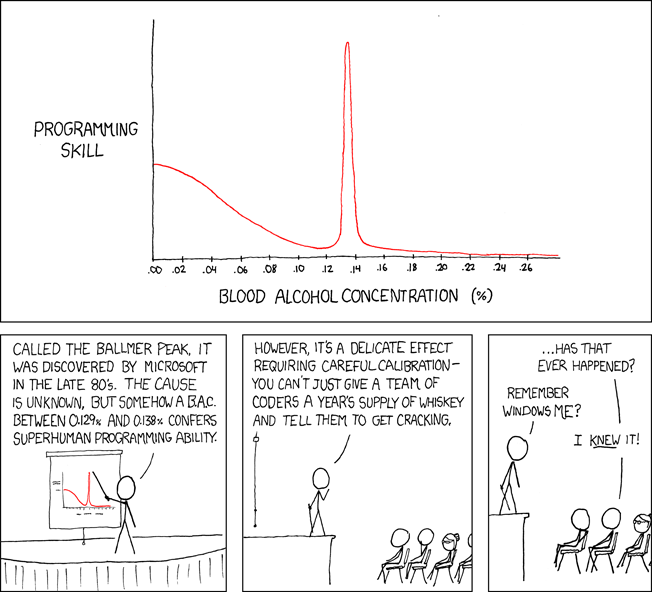
(The MiG-23MS reminds me of Windows ME).
http://imgs.xkcd.com/comics/ballmer_peak.png
I don’t suppose the MiG-23MS came into being in a similar way?
qwertyNot to forget that the Iraqis didn’t have much alternative. The MiG-23 was their primary air defense fighter. When under such conditions the R-23/Mig-23 combination didn’t produce more kills, following reasons are thinkable:
1 missile is crap
2 they didn’t have much of them (missiles are expensive)
3 the target acquisition and firing process wasn’t that easy (my point)
4 the missile was unreliable (many duds, like AIM-7E in Vietnam)
5 “cooperative targets” were of short supply
6 rules of engagement
I guess a mixture primarily of 3,4 and 5.
My initial point was, that the MiG-23 cannot rightfully be called “BVR” just because it possesses radar-guided weapons. These weapons were added to allow forward quarter firing solutions under ground guidance. If McDonald Douglas in 1972 was hard pressed to put a working man-machine interface in place that allowed a single man to do BVR the first time (in the F-15A), I don’t think the Russkies could do it five years earlier.
I generally agree with that which is why I wrote ‘BVR’ and not BVR. Additionally many of the Iraqi MiG-23 WVR victories were scored by the MiG-23MS basic export variant. which apparently didn’t carry the R-23/24. One gets the feeling the Iraqis used the R-23/24 similarly to the way the F-4 used the Sparrow in Vietnam which seems to have been mostly as a radar guided WVR weapon. Unfortunately the Iran-Iraq war engagements using the R-23/24 weren’t of a magnitude to allow us to judge the weapons effectiveness and I am to lazy to rifle through Tom’s book trying to analyse the few R-23/24 victories there were. You made a good point about the one-man BVR UI. If the early MiG-29 variants had a lousy one-man BVR UI I doubt the MiG-23 had one several years earlier.
qwertyI guess the situations were much different.
In Africa the shot opportunities were limited, and probably many were fired outside the effective firing envelope.
Besides, we know they scored kills versus the Iranis (or at least we think we know, I don’t trust ACIG-something),but do we know how many missiles were shot in total, and how the overall success ratio was?
Then we agree on something although I wouldn’t exactly say I don’t trust Acig, I just take their material with a grain of salt. Some of it (by no means all of it) either contains errors or is based on slim evidence. According to Tom Cooper’s (again an Acig connection) Iran-Iraq war book the R550 was something of an improvement over the Aim-9B and the Vympel K-13. The Iraqis had both.
The pictures look more like fired 90° and versus a wildly maneuvering target.
I thought the MiG-23 was supposed to be less maneuverable than an American sports-car? 😀
The MiG-23 was not designed to find and track a target without outside help. That might work with a skilled pilot under favorable conditions, but might at the same time be his last move as he needs to give quite a lot of attention to his radar (and might not see the F-16s wing man while he stares at this magic radar blimb).
The F-16A, though not equipped with MR-AAM, can easily avoid such attacker.
If necessary it would dive and use the ground clutter as hiding. The performance of an R-23 versus a maneuvering small target with background should be miserable, even though the MiG-23 has some look-down capability.
The Iraqis seem to have had some degree of success with the MiG-23 in the ‘BVR’ role. I was told the R-23/24 were utterly useless weapons. I count some nine MiG-23 WVR kills in the Acig list (counting only entries were weapons are identified) and three BVR kills using the R-23/24, the last figure jumps to six BVR kills if you count the unconfirmed ones.
qwertyLooks like the French became aware of these problems and modified their Magics in correspondence, although I have no idea what happened to South African stocked missiles.
Assuming the Acig list: “Iraqi Air-to-Air Victories since 1967” can be trusted the French must have improved the R550s performance. In the period from 1980-87, R.550 armed MiG-21s and Mirage fighters obtained at least 12 confirmed victories with this missile. A sizeable proportion of the victims seem to have been Iranian F-4D/E models which would have been just as capable of pushing the Magic capabilities to the extreme as the MiG-23 was. Quite a few of these F-4s were brought down in 1981. From April to May 1981 alone I count 3*F-4E, 3*F-5E, a Syrian MiG-21R and a Cobra gun-ship.
qwertyLook lets put things into prospective
iran had a good airforce the best in the middle east in 1979 certainly their f-14 crews are very good, the f-14a was a good platform now old even older f-4’s and 5’s all this mombo jumbo is crap saddam tried it and failed instead of waiting money i think iran should seriosly turn to russia for su-33 + technology i know thier mig-29 experience was not good it wasnt good in the iraqi airforce either
my expert advice is to stop waisting money and go for su-33 or rafale/gripen
I don’t think the Rafale/Gripen thing is going to happen unless a lot of things change in Iran over the next few years. IMHO Iran’s best chance of procuring high performance combat aircraft is Russia or perhaps China. I agree with you in that I think there isn’t much of a chance of them being able to produce a truly modern combat aircraft unless they can secure considerable outside assistance. If I was Ahmadinejad I’d try tosuck up to China/Russia for high tech weapons and concentrate on developing a small supply of tactical nuclear weapons.
qwerty…J-7 has less internal fuel (obviously sice it lacks the the spine tank), plus the large centerline tank has only 720 liters, not 800.
On the other hand I have seen the J/F-7 can carry three 720 liter tanks, with two on the outer pylons. AFAIK It’s a ferry configuration only but I am pretty sure that even the Bison can’t carry three 800 liter tanks. I have also been told the J/F-7 handles somewhat better with the 720 liter centre line tank in place than the MiG-21 does with it’s 800 liter unit. I can neither confirm or deny that last claim.


 Sign In