 Flyer
FlyerI have this beast that I bought and derusted/repainted about 6 months ago.
I cannot find an image of the bomb in use in any searches so far.
It is a 50 kg bomb and was supposedly a flammable contents bomb.
A derivative of the FAB 50.
Has anyone any further details of this type of ordnance in use by the Russians?
I know that they should leave been painted a grey/black or rusty steel in original use.
This bomb looks very similar to WW2 Russian ZAB-50tg fire bomb:
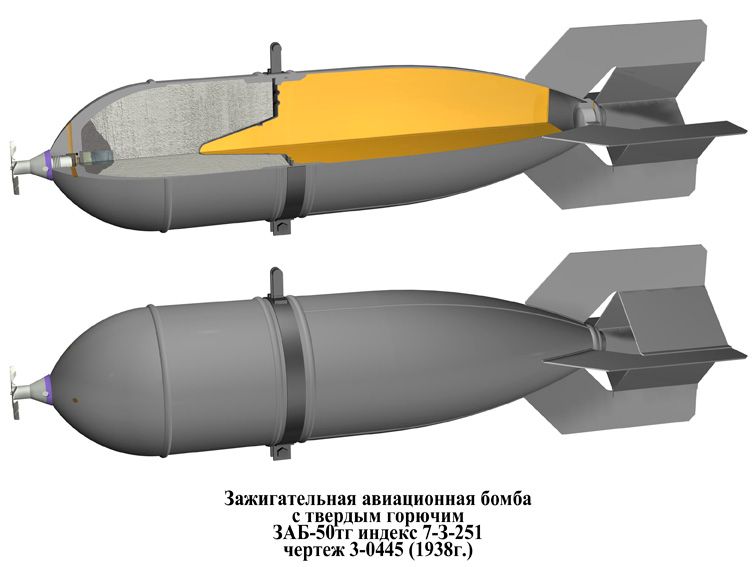
This bomb has solid flammable composition inside.
The title under drawing says:
Aircraft Fire Bomb
with solid flammable substance
ZAB-50tg Code 7-Z-251
technical drawing 3-0445 (year 1938)
FlyerI have not any additional information/images. Only these: https://www.facebook.com/media/set/?set=a.295044447262250.55539.162522150514481&type=3
FlyerPoss Uruguayan Reg CX-AMX or Arg LV-FDN.
The exact confirmation already exists – this Nord is LV-FDN.
FlyerBefore the War ended, the North Koreans have received first batch of Il-28 jets. 10 aircrafts from this batch were used during Victory Parade over Pyongyang in July 28, 1953.
The Russian press have the opinion, that Il-28 Bombers were supplied to China, but they were not used for combat flights. The US press states the opposite opinion.
But real things are the following.
The latest modern researches of Russian aviation historians have given the information, that in March 1950 the special group of Soviet airmen with Il-28 Bombers has arrived to China. These men and airplanes were from 132nd Bomber Division. The Commander of this group was Major N. A. Arsenyev, the Hero of Soviet Union. The group consisted from two squadrons.
With the beginning of active combat actions the crews of Il-28s from this group began to be involved actively for reconnaissance flights over South Korean territory. The planes were painted with Chinese insignia; all crewmen had the Chinese uniform.
These historians have found the real participant of those events – P. A. Shpak. According to his statement, airmen from his unit carried out the reconnaissance and supervision over US Navy and allied ships and naval bases in South Korea. Besides, P. A. Shpak has told, that his crew (P. A. Shpak – the pilot, A. S. Pashchenko – the navigator, S. S. Bocharov – gunner/radio operator) was shot down in their 13th sortie, but they has made the emergency landing in North Korea. 12 from these 13 sorties were the reconnaissance sorties in morning and night time, and one sortie was the combat sortie to target in South Korea. According to P. A. Shpak’s words, their plane was shot down by F-80 fighter (or – and this is most probably – this was F9F naval fighter, because of Soviet pilots went towards the target from the sea side, and they went after attack from the target to sea side again).
Sadly, this veteran pilot does not remember the exact date of those events; but he have the medical certificate, which have the record about the treatment of P. A. Shpak from July 31, 1950 until October 2, 1950 in military hospital; thus, it is possible to make the conclusion, that Il-28 was shot down approximately in July 30 or July 31, 1950.
Also, according to P. A. Shpak words, their air group was in China till the end of War. After the War this group has transferred their Il-28s to Chinese, and has left for the USSR. During the War total losses were 2 Il-28 aircrafts and one crew (it was lost approximately in 1952 – 1953).
FlyerIs the text in this book in Chinese ? And what planes shows the photos, which are placed on page together with this “Vengeance” colour profile ?
Flyerpossibly either Irag or Iran which I think had a number of civil Mk V’s post war.
Why MkV exactly ? Why not MkI, or MkIII, or MkIV – maybe, even ex-military ?
FlyerThank You very much, mr Consul, for fast answer !
I think, You have this book. Can I ask more questions ?
What about civil Percival Proctor planes, registered probably in Iraq, Greece, Burma, Hong Kong, Malaya/Singapore and Morocco ?
FlyerDear RT !
To answer Your questions:
1) Yes, in early Russian designations the “bis” means “modified” (like Italian aircraft designations of that era). But Russian Aviation historians do not confirm the existence of “Stal -3bis” designation for M-17-engined “Stal-3” aircrafts. This is possibly, such “designation” was used in some unofficial papers or in conversations to distinguish one type from another.
2) Russian abbreviation “OOS” means “Department of Experimental Aircraft Construction”, which was established in beginning of year 1930. The Chief Designer of this department was A. I. Putilov; there also other designers worked in OOS.
So, we can write full aircraft name: OOS “Stal-3”, or Putilov “Stal-3” – both ways are right.
FlyerMiG-19 is right answer.
FlyerHello from Russia, dear RT !
Mr Al Elliott was faster with his answer !
Yes, this is very rare photo.
Here is “Stal-3” airplane, equipped with water-cooled M-17 engine.
Fuselage windows exists, of course – You can not see them because of angle of shot.
Some examples of usual “Stal-3” airplanes with radial engines were later re-equipped with M-17 engines. But this replacement has not brought any advantages in comparison with radial motors.
FlyerFortunately, I have found two images more of this 36th MTAP’s crewman.
1) Lieutenant K. I. Moiseev (third from the left standing man on photo) with brother-soldiers from 2 sqn of 36th MTAP:

2) K. I. Moiseev with brother-soldiers during rare moments of rest:

Best regards,
Flyer.
FlyerSenegal AF’s Alouette 6W-SHN:

FlyerI have found only this photo of one crew of 36th MTAP:

North Fleet, 2 sqn of 36th MTAP.
About this photo is known, that lieutenant K. I. Moiseev (second man from the left on photo) was killed in February 2, 1945 during battle action. It is possible, all crew was killed.
And below is A-20 at Black Sea area in South part of the USSR – possibly, from 36th MTAP:

Hope, these will be useful.
Flyer…regarding the Chetak ( SA.316 Alo III ):
Aeroflot Alo IIIs?! Anyone seen any photos or info? Thanks!
Edit: through Google Books search I found a footnote reference to Delhi Domestic Service dispatch 10 August 1984: “8 Helicopters Exported to USSR Last Year”. So it did occur…
Edit2: Found a photo! Unfortunately no supporting info, but it is a 316 all right and has the distinctive Chetak blade antenna on the port nose.
Dear Cherry Ripe !
If You want to know more about Russian Chetaks – try this link:
http://forum.keypublishing.co.uk/showthread.php?t=87571&page=23
and look through that thread, beginning from post #670 and see the posts #675, 676, 677, 680, 708, 713. I feel sure, this will be useful for You.
Regards,
Flyer.
FlyerAlso notice the registration number’s positions under side window on G. Kozak’s image and on other images – these are same. So, this is obviously Belgian.


 Sign In







