 Jō Asakura
Moving back to AL-31FM-3….are the numbers Jo mentioned actually based on real testing?
AFAIK it was only tested in very experimental form, and even the AL-31FM-2 has not progressed far yet due to lack of orders.
Official MMPP Salyut company publication* states that General Director Yury Elisiev reported on the 22nd May 2007 that the AL-31F-M3 had commenced bench tests attaining 15.3T (page 5). Article also confirms compression ratio of 4.2 and configuration 3+6+1+1.
Once again people are obsessing over meaningless wet thrust. The F119-PW-100’s dry thrust is truly mighty (113kN), compared to the 117 rated @ 88kN.
The Izd.30 should go a long way to address this performance gap.
Jō AsakuraAustin- No. There are 2 primary considerations that rule out the 117. Firstly the need for the highest attainable dry military thrust for sustained supercruise in conjunction with the aerodynamic efficiency of the T-50. This is important tactically and for combat persistence especially given Russia’s huge land mass.
The second pertains to the AC power generation derived from the turbine speed and synchronous power generator. The PAK-FA has a whole host of avionics systems that are World firsts and will be extremely power hungry.
These reasons are probably high on the list when the former head of NPO Saturn, Ilya Fyodorov, described 117 production as “not economically viable”.
Btw, the direct Russian counterpart to the F119-PW-100 is Salyut’s AL-31F-M3. It has the same number of stages (3+6+1+1), and delivers slightly less power @ 15.3T (33,700lbs).
Here we have a combustor developed by MMPP Salyut and a firm specialising in mathematical flow models (may or may not be related to Izd.30):
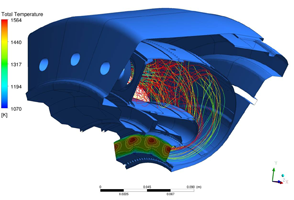
Their objective is to get the wall temperature of the combustion chamber >150°C lower than that of the legacy AL-31Fs – this will have a significant impact on the burn efficiency of the fuel-air mixture.
As one can appreciate, such components are part of greater ‘clean sheet’ design to derive the maximum benefit to achieve an end goal.
Jō AsakuraElements of ‘Izd. 30’ have, no doubt, already been test flown on an engine aboard T-10M b/n 710. The major components such as LP & HP compressors, turbines, combustor etc. have their own ‘Izdelie/Изделие’ index numbers.
A tell tale sign would be long periods of ‘710’s’ idleness followed by a flurry of activity – and this has certainly been the case, for example a prolonged hiatus from June 2013 to February 2015.
The definitive LP, HP fan stages and combustor have been available for testing for over 18 months, whilst the 1st complete Izd.30 is slated to commence bench-testing late this year or early next.
The ‘insider’ claimed one of the later T-50 ‘Stage 2’ prototypes would receive the Izd. 30, this is indicative of concurrent flight testing (T-50-10/11 & T-10M b/n 710) and bench testing and is considered the norm for engine development the World over.
IIrc, the F119-PW-100 entered both bench & flight testing in 1997, and a similar arrangement must have been in place for the YF-119/120 to power the YF-22/23 prototypes.
‘710’ photographed early last month (starboard engine is the test installation):
Jō AsakuraYou guys are missing three key words: ‘Make In India’. In which case it’s between Gripen NG and Eurofighter, imho.
My money’$ on the latter.
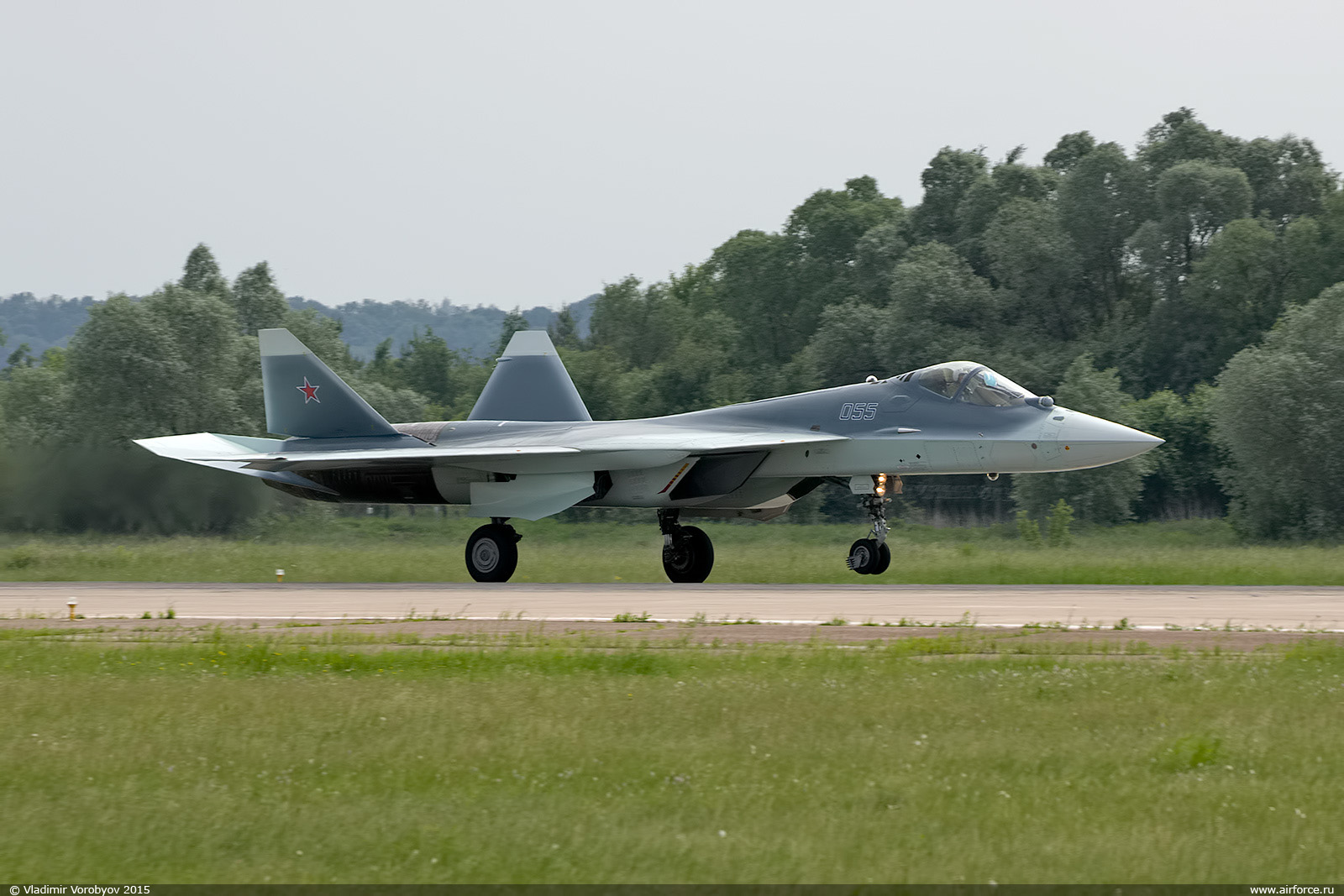
Jō AsakuraPic taken May 2014, published 27/07/15:
Jō AsakuraAdaptive wing like the Mig35 (see patent)?
Yeah, and the MiG-29K/KUB and the Su-33KUB:

Jō AsakuraMmmmmm…..truly mouthwatering, thanks.
I wonder if the ОЧК has anything to do with the rumoured adaptive wing. Here’s the SSJ’s ОЧК:

…anyways, roll on the CNT/fullerene RAM, PMC cowlings, eye popping tolerances and rivet covers.

Jō AsakuraSo a total PR of about 15.12:1 (static).
Yeah that sounds about right, given the 6-stage HPC BLISK on the FM-3.
Great pics btw, Killerbean. Me thinks the odds have shortened considerably of these two being in the same inventory 😉
Jō AsakuraNo, those are the number of stages.
The CPR of the AL-31F-M1’s LP comp is 3.6 and that for the AL-31F-M3’s is 4.2.
Jō AsakuraAl-31FM1 are in service with Russian AF Su-27SMs (also known as Al-31F series 42). Not sure if Indonesian Su-27SKM have these, can anyone tell?
http://en.take-off.ru/news/107-june2012/719-salutcontinuestoupgradeal31f
The way I understand it, the Salyut Al-31FM3 was proposed for PAK-FA but lost to Saturn Izd.117.
Yeah, MMPP Salyut’s AL-31F-M3 was the rival to NPO Saturn’s ‘117’ for the T-50 prototypes. Salyut was incensed that their product lost the tender despite having the superior product 3LP (BLISK); 6HP rated @ 15.2T. Here’s some of the tech involved circa 2006/7 (use GT):
http://sonbi.ru/salut-science/Avia/Uzly/index.htm
http://sonbi.ru/salut-science/Avia/AL-31F/2007-1.htm
MMPP Salyut also had major issues with NPO Saturn been given ‘lead developer’ status for the ‘Type 30’, to the point that all- out war ensued between them earlier this decade. Salyut have considerable experience in gas-dynamics/CFD development (in association with CIAM) and their 5/6 axis milling technologies came on-stream much earlier than NPO Saturn’s (it is for these reasons the Chinese are eager to get into bed with Salyut).
Eventually, it took a government decree to force the two engine developers to agree terms, but Salyut had to hand over considerable intellectual property to its rival, lock-stock.
please! there’s a big difference between a halfwit’s rubbish and the discussion that’s going on here..
OK…mountain’s cheque bounced, btw.
Actually this discussion is better than self gloating cr@p posted by some pakisatani trolls ( excluding likes VikasRehaman.. who has a somewhat nuanced view of things). Unless you guys have succumbed to the dark side of K2, you are OK. 😉
Anyways, any ideas what “hot sections” of components of AL 31 engines is Indian still importing from Russia. Has ToT for alloys/ceramics been shared with HAL or the Raw material is being supplied by Russia. Also will PAKFA deal consist of ToT of Engine to enable India build engine from its own raw materials?
I was under the assumption complete indigenous production of the AL-31FP entailed the ToT for alloys, ceramics, SCBs etc.
Alas, the same will not be repeated for the ‘Type-30’.
Jō AsakuraSo pls tell me what tech they used from the AL-41F, Im dying to know..
A certain V. Chepkin’s words:
For military aviation, we have created two engines, one – for the Su-35, the second – for the Russian 5th-generation fighter T-50. The first – 117C – is mostly for export. It is simpler in terms of aerodynamics…
The second engine – 117 – although it differs by only one letter in the designation – is a significantly more advanced engine, this is the real 5th generation engine…
Mr. Chepkin says, “Haavarla – Sweetie, please switch on brain & eyeballs and count how many stages”:
*http://forum.keypublishing.com/attachment.php?attachmentid=232902&d=1415030765
Now, do you see 4LP; 9HP? No? Well, that’s what he means by “significantly more advanced”, before we even get into blade chord, cooling, inlet & turbine temperatures and the associated applications of exotic alloys and ceramics all derived from (and applied in varying degrees to the 117S and 117) from the AL-41F, Savvy?
Oh, Victor Chepkin, btw, is the Chief Designer of the legendary beast that is the AL-41F.
*Pic ℅ JSTCVW09CD
Jō AsakuraEven MMPP Salyut’s AL-31F-M3 has 3LP and 6HP sections. It’s been knocking about for nearly a decade now, is rated @ 15.3T and for sure will have AL-41F tech because Salyut were minor co-developers (primarily since 1985 via a subsidiary called ‘MKB Granit’).
It beggars belief that people think that the many billions of dollar$ spent on the decade long R&D of the AL-41F would not be put to use on legacy AL-31F engines – it’s not like they’re down-scaling an NK-32!! Get a grip!!
OT, it’s nice to see the RAF pilots being so nice about the IAF’s MKI. A cynic would say they must be trying to sell them something!! 😀
Jō AsakuraYou believe that 117 engine is a further development of the MiG 1.44 AL-41 (some sort of variable-bypass-ratio tech, like on the F-23 powerplant) – sure about that? pretty certain its a development of the AL-31 as is the Su-35’s ‘117’?
Because the difference in length between an AL-31FP and the Su-35S’ ‘Article 117S‘ is only 48mm, then it’s a fairly safe assumption that both their arrangements are: 4 -stage LPC & 9 -stage HPC.
For the T-50’s ‘Article 117’ engine, the stage arrangement is 3 LPC & 7 HPC*. Hence, the 117 can be considered a down-scaled AL-41F, whereas the 117S is a close relative of the AL-31FP.
If you think that the 117 having 3 fewer stages than the AL-31F/FP makes the former merely “a development” of the later (like the 117S and the AL-31FP), then you’re plain wrong. Presenting straw-man arguments regarding YF-120’s variable bypass ratio tech migrating to the 117 from the AL-41F does you no favours either.
*http://forum.keypublishing.com/attachment.php?attachmentid=232902&d=1415030765
Pic ℅ JSTCVW09CD.
Jō AsakuraThe GaAs MMIC T/R modules for the current NO36 launched series production in 2012 and their peak output is 15W:
However, this is not the definitive version destined for serial PAK-FAs and is probably to develop and de-bug source code. AESAs with the current NO36s’ T/R modules have been offered for the FLANKER upgrade market (both domestic & foreign).
It appears they are weighing up options on a newly developed specially doped GaAs T/R module or new fabrication and materials assembly to reduce the cost of GaN modules:
http://www.tusur.ru/ru/news/index.html?path=2015/03/75.html
Eitherway, expect the definitive T/R modules to be at least twice the power and significantly more compact than the current offering. These will not break cover for a couple of years yet.
Jō AsakuraELINT/EW suite ‘Himalaya’ is sensor fused with the main [radar] AESAs for EA/jamming:
…постановку активных помех как через свои антенны, так и через активную фазированную решетку (АФАР) радиолокационной системы (РЛС).
There’s damn good reasons they’re resurrecting T-50-5/T-50R – probably because of that new power generator and the architecture for the full spec avionics. Incidentally, T-50R might be wanting its main AESA back from T-50-1 too.


 Sign In







