 Jō Asakura
Vnomad, do you know the difference between a gap filler & coating and a radar absorbent [airframe] structure?….while I’m at it:
Do you know what implications the next generation GaN L & S band AWACs will have for stealth aircraft? (for both sides?)
Do you understand the complexities of engine-duct backscatter?…and have you noticed no S-ducks on the 6G renditions?
All these have been quite extensively debated, but all you seem to do is regurgitate the same old dogma of yesteryear.
Jō AsakuraA nice bit of *Levsha logic* there! Which of the F-22, F-35 and T-50 was designed with the most recent commercially available computer hardware (and CFD & CAD software)?….and no, CNT RAM cannot be retrofitted to the F-22, certainly not without a hugely costly redesign.
It’s 2014 and that every Tom, Dick & Harriet (who can afford it) is in the stealth game these days is ample demonstration the US has lost it’s personal preserve of stealth. This almost entirely due to new materials, new fabrication techniques, increased computing power and a pool of highly skilled human resources. The only real exception remains the organic ‘black art’ development that is fighter engines.
Jō AsakuraLet me introduce you to some of the technologies that will be used to assemble the PAK-FA (c/o Austin):
http://www.compositesworld.com/articles/resin-infused-ms-21-wings-and-wingbox
As for the T-50 design, why don’t you factor in Moore’s Law between 1997 and 2010?…and there’s only so many times I can demonstrate how it’s stealth materials are a generation apart from the Raptor’s:
http://www.carbonchg.ru/application/
It’s interesting that the USN is leading the charge for the 6G, which in itself speaks volumes about what they think about the F-35C, but before we get ahead of ourselves something called ‘the sequester’ may play havoc with timelines, RFPs aside:
http://www.ft.com/cms/s/0/6fbe6550-83c2-11e3-aa65-00144feab7de.html?siteedition=uk#axzz2szKELOK3
Jō AsakuraThe ‘controversy’ surrounding T-50’s intake design is another example of the widespread intellectual defect that takes American hardware and American design priorities as a kind of holy writ. The truth is that in its basic design T-50 is both rather more advanced than the F-22, and reflects different design priorities. There is ample evidence in the public domain that T-50’s intakes and related features are the product of careful and highly sophisticated engineering. Whether they are quite as effective as an s-duct in reducing frontal RCS is an open question, but even if they are not that in no way suggests the design is inferior — that conclusion requires both additional precepts and additional data not in the public domain.
There’s enough data in the public domain to strongly suggest S-ducks are a simplistic and ‘sledgehammer’ approach the very complex problem of engine-duct RCS:
Jō AsakuraTry not to call it a blocker, TR1- it’s more complex (and ingenious) than that. Basically, it has more to do with this:

It becomes a radar “screen”(i.e ‘D9’) when it’s made of CNT modified PMC. I’ll elaborate later this week.
Jō Asakurastop desperately quoting it.
“( frequency range 9-10 GHz, phased reshegshhch M / gain 13 LB ; output power 38 dBm )”
…that’s where that account got to :eagerness:
Выходной мощность (output power) is the same term used here for this 2009 GaN development, average power 4.5W (4.2W/mm power density). Your buddy AJ levelled the same absurd claim for Max power, but then somehow acknowledged the 40W peak power in the next pic from the same institute. So *1st class*, 2 morons don’t maketh the absurdity right:
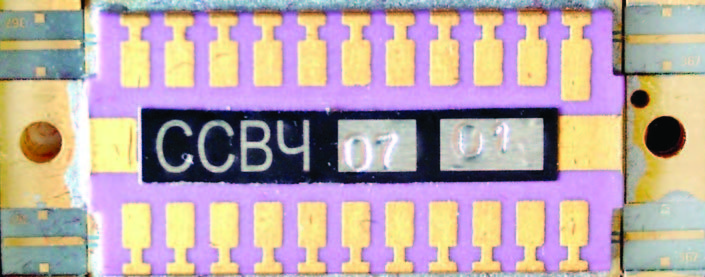
http://www.uni3dlabs.ru/portfolio/istok_animated_presentation/
GaAs MMIC average power 3W, peak power 15W (@ 01:41m), 16.8 x 5.5 x 60 mm
Oh, btw, *1st class* do you have any tangible details on US LTCC radars (outside of an NG brochure), it’s just that I couldn’t find anything. A Russian company has been waiting around for an order for a couple of years now.*
So AJ, are you ready to discuss a W/mm figure for the 6.3W GaN and a duty cycle? -which we can compare to TriQuint’s 2013 offering, or do you still think their GaAs outperforms their GaN?
Jō AsakuraOf course you’re missing my point, you’re using your comedy translator to further warp your warped opinions. Where does it say peak output 6.3W for their GaN?……erm nowhere…oh, and 15W is “phenomenal”…for GaAs. Would you like me to prove it? Cause you’re gonna look pretty stupid (again).
So you think their GaAs outperforms their GaN? If not, are you ready to factor in a duty cycle of (a conservative) 10?
Do you want me to show you how the power density of that 6.3W GaN HEMT for T/R modules of AESAs outperforms the ones in TriQuint’s 2013 brochure? Did you know that there’s more to incorporation on an AESA transceiver module than miniaturisation/power density for an 4G/LTE base station?
Did you know there are 2 competitors vying for the GaN power switches’ World record (Fujitsu, Japan & OAO NIIPP, Russia)?…and what that means for the “technology gap”? Btw, this last term of yours really made me laugh!! You really are stuck in 1985!!
How long do you think the broader “technology gap” will last, given that the Russians are busy building fabrication plants, importing capital tooling and training staff abroad for a semiconductor technology IBM has barely got out of their R&D lab?
http://www.russianelectronics.ru/leader-r/review/doc/65679/
Can you answer any of these questions?
Jō AsakuraFinally some time to fire up my computer.
So Jo, where are you at trying to prove Russian HEMT production is on par with the world leaders in the technology? Saw the comment on the application of the last product I mentioned, geez if only your sources had developed their products and documentation enough to actually show such information. Found any solid links on actual production unit specs yet or is it all still vaporware in patent documents?
This one should give you a better benchmark for when you search for an “analogue” in 15 years time.
Triquint TGF2023-20
[ATTACH=CONFIG]225269[/ATTACH]
– For Defense and Aerospace applications
– 100 Watt output
– 0-18GHz Range
– 26W/mm Power Density
– 50% PAE.
– .82 x 4.56mmI’ll go out on a limb here and say there is no Russian supplier that is anywhere near where Triquint and Cree are at today, not even remotely close. This bodes very poorly for the T-50 and its RCS issues.
Was an interesting topic though, especially quantifying how wide that technology gap actually is.
It always amuses me that you never provide links to support your spurious claims. Probably because you’re busy mixing & matching data (when you’re not telling outright lies- for which I’m still waiting for an apology):
http://www.triquint.com/products/p/TGF2023-20
Anyways would you like me to spell out how the Russky 2014 GaN offering “for the T/R modules of AESA radars” outperforms TriQuint’s analogous products (for radars)? (NOT for 4G/LTE base stations, satellite coms, [vague military] etc., though the header ‘Not Not Recommended For New Designs’ made me chuckle!!).
Tu 160, that was frankly embarrassing to read.
Regarding these composite fan blades and blisks, the materials with the best mechanical properties may not be the best at absorbing radar emissions. The blades’ geometry may also not be the best for minimizing RCS.
Regarding the use of a radar blocker, I’m wondering if the complex variable geometry inlet and powerful Izdeliye 30 engines are meant to compensate for losses from the blocker. I heard that apparently the current 117 engines are not optimized for the blockers.
If you note the SWNT absorption (thickness 1.5mm) over the frequency range 8.9-9.4 GHz for engine-duct backscatter:
As for what you call a blocker, is certainly not in the ‘conventional’ sense:
Jō AsakuraThis section is from a very recent, official NPO Saturn publication, where the head of it’s Polymer Matrix Composites engineering department discussed ongoing and upcoming projects:
[ATTACH=CONFIG]225243[/ATTACH]
Next year [2014] will be a key time in my project. Successful implementation of what is planned and work this year will take “Saturn” to the forefront [in Russia] in the use of PMCs for aircraft engine construction. A lot is planned: this production of the first working prototypes of four PMC components for the SaM146 is very serious and conducting research on the study of materials based on 3D-weaving technology and weaving of the radial, which is unique in Russia, and is a joint venture with the Nanotechnology Composites Centre (Moscow).
On a separate note, I want to mention the future of the joint venture. We initially decided not to implement a joint venture based on outdated technologies and materials that “sin” other businesses and many universities of the country. We decided to take another route: take two key concepts that are now being actively developed in Europe and the U.S., and correctly/literally modify them to address our challenges and opportunities. It was agreed that the joint venture will implement two high/future technologies: the creation of three-dimensional woven reinforcing structures followed by impregnation under pressure and molding of thermoplastic PMCs’ injection molding methods, thermoforming and [thermoplastic] overmolding.
I would like to wish that all [@ NPO Saturn] think of utilising the most futuristic [technologies] to the maximum and closely monitor all developments and trends in the World, not only live in past achievements, no matter how great they were. It is also important not to forget that the path from origins of an idea to its implementation in a real engine is very complicated and thorny, and in any case one cannot turn away from this path when difficulties arise. It is necessary to see ideas through to the end, only then will we have the best aircraft engines in the world.
This is highly significant in that the impregnation under pressure (RTM) of thermoplastics represents cutting edge technology & materials. Previously, viscosity issues of the thermoplastic resins had prevented RTM. This is the type of thermoplastic composite he means:
http://www.basf.com/group/pressrelease/P-12-442
Because he talks of first(s) in utilising PMCs for the Russian aeroengine industry, of the 4 components for the SaM146 this will probably include the fan (the fan and LPC section of the original SaM146 were developed by NPO Saturn). PMC cowlings and gondolas have already been done on the PS90A2, D-436 and PD-14, though sound proofed paneling will be a first.
The 3D weaving of the fan blade structure is the same technique used on the epoxy/thermoset GEn-X/LEAP-X. This tech has already been presented in a VIAM brochure*.
However, NPO Saturn’s use of thermoplastics would represent a several orders of magnitude greater increase in tensile/shear strength and particularly impact resistance over epoxy thermosets. As thermoplastics can be welded, the fan can be BLISKed, the simplicity of production and relatively cheap materials (100% recyclable) will have considerable cost and weight advantages over both traditional metal alloys and thermosetting composites.
The RTM press-form tech for PMC fan blades has already been developed by NPO Saturn’s wholly owned engineering subsidiary SatIZ (СатИЗ) for the PD-14- the fan/LPC is NPO Saturn’s development responsibility. Tellingly, it appears never to have got the clearance for display @ MAKS2013:
[ATTACH=CONFIG]225244[/ATTACH][ATTACH=CONFIG]225245[/ATTACH][ATTACH=CONFIG]225246[/ATTACH]
So what relevance for the Type 30? I’m of the opinion that these technologies & materials are being put through their paces not only for future versions of the PD-14 and SaM146, but as a development learning curve for the Type 30. This would be consistent with the general designer (Yuri Shmotin’s) statements of PMCs for the Type 30s ‘cold section’ and the MD (Fyoderov) quote of “non-metal fan blades”- but of course, I’m biased. You could even argue that the inferences in the last paragraph indicate development pains, possibly delamination at high rpms synonymous with fighter turbofans, as highlighted by an MMPP Salyut study circa. 2005 (see post 1).
In October last year, a delegation from ROSATOM (РОСАТОМ) visited NPO Saturn. The concern’s head, Sergey Kirienko, stated specialist software/code for the fatigue testing of fan blades had been developed over the past 3/4 years for the PD-14 and the second stage engine for the PAK-FA:
http://www.npo-saturn.ru/index_b2.php?rssid=1381247252&sat=6
ROSATOM are the state nuclear energy & weapons development agency, however, they are major league players in the PMC field, in fact they’re the parent company of the ‘Nanocomposites Technology Centre’ (Нанотехнологический центр композитов) with whom NPO Saturn are developing the thermoplastic RTM applications detailed above:
http://www.rosatom.ru/aboutcorporation/activity/compozit/
http://npo-saturn.ru/?rssid=1377678889
Though ROSATOM were involved in the fatigue testing programme for the original SaM146 and upcoming PD-14, they were not involved in the development of the nanostructured Ti alloy BT-6, nor the Ti-aluminide compound used in the 5-staged HPC of the ‘Type 30’ (also used in the LPC of the PD-14).
Also recently, this stipend award highlighted NPO Saturn’s R&D programmes for PMCs. Although all these points may or may not apply to fan blades – point 1 and especially point 4 is an absolute certainty:
4. Разработка расчётно-экспериментальной методики подтверждения ресурса деталей ГТД из ПКМ с учётом ползучести, малоцикловой и многоцикловой усталости.
4. The development of computational-experimental methods to corroborate the properties of gas turbine engine components made of PMCs, taking into account creep, low-cycle and high-cycle fatigue.
This is most probably the said software/code developed by ROSATOM and is consistent with NPO Saturn’s stated intentions to incorporate such developments for the ‘cold section’ in the near term– though interestingly it classifies development of the Type 30’s LP compressor as “long term”:
http://www.npo-saturn.ru/?rssid=1371123519&sat=6&slang=1
It is also noteworthy that the addition of CNTs to the thermoplastic PMC binders will not only significantly increase their mechanical and thermal properties (even further), but in the case of the ‘Type 30’ would have one particular (and highly desirable) by-product: stealth.
Jō AsakuraMan, that would be like trying to learn Navier Stokes from you:
The PAKFA uses a very smart set of solutions, why? S ducts are aerodynamically not the best for pressure recovery, due to aerodynamic distortions of the flow, straight ducts reduce boundary layer accumulation and therefore volume too and drag.
The grid is in the subsonic section of the inlet duct, if you remember, F-117 has a grid too for RCS reduction on the intake lips, at supersonic speeds the need for air supersonic shocks does not allow for a fixed intake, thus setting the grid deep inside the inlet duct is a very smart solution.
Remember F117 was a subsonic airplane with fixed intake.
Another advantage is the PAKFA can fly with weapons bays with camber, it will generate lift and reduce volume, this makes the jet basically a Su-27 but its cross section is very small, looking at the PAKFA from the front you see a small forebody, in F-22 or J-20 you see huge forebodies specially in J-20 the bumps for the DSI increase the frontal cross section, same problem has the F-35, this in F-35 increases drag and it is know F-35 is a fat aircraft in terms of air drag.
PAKFA will be faster, in fact what the Russians wanted is not go far stray from the Su-27 proven aerodyamics.
…Man, I think I’ll pass on that one (don’t get me wrong).
Anyways, here’s some news that still hasn’t made it to Russian fora, NO36’s current GaAs T/R module average & peak values (@01:41). Now being offered for fighter upgrades:
http://www.uni3dlabs.ru/portfolio/istok_animated_presentation/
Jō AsakuraThe article is talking about base transistors and the Pbas values are the MAXIMUM output of the base transistors for various frequencies.
…In any case, “base” certainly does not mean “average” outputs as per Jo’s “fantasy” and 4.2W/mm is certainly not 18W/mm.
Have you got anything else to show me Jo, I’m feeling very underwhelmed? Your bumbling, desperate attempts to make it look like Russia is suddenly the world leader in this area are amusing.
Before you made up GaN ‘base transistors’, didn’t you think for a moment that that’s all it would take (a moment with google) to prove you disingenuous (yet again)? I’d have thought you would’ve raised your game since not understanding what a bi-polar transistor is or does. Then *translating* stuff you know nothing about. That stuff didn’t get ‘lost in translation’- it got positively warped in your warped universe.
How the hell can you claim 4.2W is the max power of a GaN “base transistor”, yet acknowledge the very same institute’s 40W p/o in the next pic. Not contradictory much?! Oh, I get it, you’re so desperately trying to knock down anything I post, let’s not let logic get in the way of a rabid, mindless tirade, eh?
So when you’re not making stuff up, you’re busy moving the goal posts. I’m not sure what relevance 2-way radio or pleasure boat radar, has here- I’ll just dismiss it as your usual bull, probably a symptom of a head injury you sustained whilst incessant and vigorous flag-waving.
Anyways, let me try to bring you into a relevant arena- fighter radars, let’s see what TriQuint was up to in 2013:
http://www.triquint.com/products/d/triquint-gan
Now let’s see what the Russkies are up to this year:
[ATTACH=CONFIG]225094[/ATTACH]
Ooooowh!! 5W/mm for L-band, Max p/o 40W…….and 6.31W p/o for X-band, and no these aren’t your nonsensical GaAs level “base transistors”, (the L- band details pretty much reveal from where you pulled that definition), so shall we factor in a duty cycle of 10?
Now tell me, given all the pretty pictures you’ve posted showing all the imported capital equipment, do you think this 6.31W MIC will entail a bigger die? given the 4.2W (in pic 1 and duty cycle 10 for pic 2, right?) is probably the 18mm^2 one and is several years old- or will it be a significantly smaller?
Then try to think logically about your answer, and how favourably Russian AlGaN/GaN HEMTs in 2014 compares to TriQuint’s 2013 GaN-on-SiC. To spare yourself looking even more idiotic/disingenuos than you already have, I suggest you go away and do some research (hint substrate materials). Also, it appears Russian LTCC developments have really upset you, but we’ve been here before with CNT RAM, remember?
Speaking of idiotic comments, try to use your eyeballs to count how many channels (i.e. T/R modules) are in this picture of an L-band array, and the reasoning for such spacing. Failing that, look up ‘Wedgetail’ and/or Raytheon DBR- any excuse for a good flag-waving huh? Mind your head!
[ATTACH=CONFIG]225095[/ATTACH]
Jō AsakuraOldibas (or any other Russian speaker), would you be a dear and translate the text in pic 1? That’s just in case that certain somebody thinks I made this up. Thanks. It’s a Russian institute’s development paper circa 2009, paying special attention to the GaN HEMT’s power density of 4.2W/mm and where ‘Pbas’ is the base/average power output.
[ATTACH=CONFIG]225034[/ATTACH][ATTACH=CONFIG]225035[/ATTACH]
In pic 2 is the same institute’s developments dated December 2011. (A/а) is their GaN PA @ 10GHz with power output of 40W, dimensions 18mm^2; (B/б) is their GaAs PA @ 10GHz with power output 20W, dimensions 41mm^2. So basically the GaN is less than half the size with twice the power output.
The objective reader will note how favourably my calculations of NPP Pulsar’s GaN PAs (average p/o 3.5W, peak 43W over the range 4-18GHz) compare to the above development docs. in pics 1&2
Also, for the record, I made a hypothetical remark regarding the ganging of four of these L-band (1.0-1.55GHz) modules (pic below) into the huge radome aperture of the MiG-31. They’d certainly fit and the combined peak power output would be (at least) 6.4kW (>1.6kW x 4). For power and cooling I hypothesised about an independent generator/supply akin to a system used by the EA-18G. Now is that so ‘fantastical’? Bearing in mind how the Zaslon started life.
[ATTACH=CONFIG]225036[/ATTACH]
Either way it’s a different world to what Copp would have you believe, or what a certain somebody accused me of writing.
Speaking of which, he should make careful note of an output of “not less than” 400W per channel at a range of 1-1.5GHz.
Jō AsakuraSo maybe now they are probably fine tuning the LTCC tape usage . During the firing process, the LTCC tape will shrink between 12% – 16% + 0.2% in the X and Y-axis and 15%-25%+0.5% in the Z-axis . Assuming balanced metal loading and good process control, the shrinkage should be consistent. However, with certain systems, there maybe a narrow processing window in which the fabrication must take place.
I don’t know about the tape shrinkage itself, but the compactness of the module compared to conventional multichannel architecture is pretty phenomenal. Here’s what they achieved with GaAs T/R modules (from 170 to <10 grams in 4 years):
http://f-page.ru/lfp/s019.radikal.ru/i601/1312/2e/f0c540df729d.jpg/htm
Current producers of the N036’s modules, NPP Istok’s LTCC production facility photo tour (assembling GaAs MMICs for the telecoms industry:
http://twower.livejournal.com/1167078.html
Also as an addenda to the post above. The 3.5W is indeed the average p/o over the range 4-18GHz. It’s an AlGaN/GaN-HEMT on a 170nm die with a power density ~5W/mm. From the range 4-9GHz the av.p/o will be closer to 5W. The duty cycle of 10 is too high, in fact 8 can be considered ‘conservative’.
Using 8 gives a peak of 43.75W, applied to the NO36’s 1,500 elements gives 5.25kW average and a peak value of 65.6kW.
For the side & rear arrays @ 1/3 size: 1.75kW average (this compares to the 1.5kW average of the 29K’s Zhuk ME- not the 1kW stated earlier) and a peak value of 21.87 kW! exceeding ‘Irbis-E’ s peak output.
Once again these p/o ratings are likely to rise with LTCC and improvements in the power density (5W/mm is circa 2009), by switching to GaN-on-SiC, as I suspect TUSUR and at least 2 others have or will do.
…oh, and Mr. Mokrushin had a photo tour of NPP Pulsar today:
Jō AsakuraWould like to add my 2 cents.
[ATTACH=CONFIG]224997[/ATTACH]
If one Google translates the following and scrolls down to lots 8723-6 concerning ‘The underlying technology of manufacturing the power amplifier based on gallium nitride M4213412-1’:
http://www.rntd.citis.ru/php/rntd4.php?pageno=125
‘Development of the underlying technology and design of power amplifiers on the gallium nitride in the frequency range 4-18 GHz with an output power of 3.5 watts’ by NPP Pulsar, it is apparent that the 3.5 W figure is an average output. The simple logic is that it cannot be peak output because GaAs PAs can have more than twice that figure:
http://www.micran.ru/productions/svch/aesa/ (table @ bottom)
Assuming a somewhat conservative duty cycle of 10%, then this equates to 35W. If the current 1,500 element NO36 had these modules, it would have an average p/o of 5.25 kW, that’s slightly more than the Irbis-E’s average p/o. However, the peak p/o would be a huge 52.5kW, nearly 3x that of Irbis-E. Assuming the side & rear array are 1/3 the size, then that would equate to an average p/o of 1.7kW (that’s 70% more than the Zhuk-ME’s), and a peak of 17.5kW- that’s approaching Irbis-E’s peak!
Bear in mind these numbers will almost certainly be significantly higher due to the greater T/R module density afforded by LTCC, and is certainly in line with the official claim in the PAK-FA’s avionics and sensor fusion patent that the main radar arrays will have a jammer/EA function (point 16):
http://www.findpatent.ru/patent/248/2488775.html
The R&D results for those GaN PAs were signed off on 20/04/13.
Jō AsakuraActionJacksonMan, here ya go. NPP Pulsar’s Si LDMOS production catalogue data list, schematics (in mm) at bottom:
http://www.gz-pulsar.ru/index.php/poluprovodnikovaya-produktsiya-2/tranzistory-new/25-kremnievye-n-p-n-bipolyarnye-moshchnye-svch-impulsnye-tranzistory
http://ic.pics.livejournal.com/bmpd/38024980/978943/978943_original.jpg
Be quick and note well, as this site is susceptible to the ‘404’ two finger salute.
My reasoning is being GaN, OKB Planet’s PAs will outperform these in power efficiency, thermal management and other parameters but with comparable power output. Is that an unreasonable supposition?
Haloweene, several Russian defence production facilities are gearing up for GaN radar production. The most important of which will be GaN LTCC. I’m not saying Europe hasn’t got the technology (much of the capital tooling is imported from Europe!), but it certainly doesn’t have the intent and the funding.
It remains to be seen how the ‘sequester’ will effect similar programmes in the US.


 Sign In








