 Jō Asakura
Pilot in a hurry to get home:
Jō AsakuraFirst of all I’d like to apologise to everybody regarding my recent hypothesis about the stealth properties of the Magnesium Boride (MgB) fan blade based on it’s superconducting structure. Having reviewed it- I now believe this to be a false supposition.
I went on a wild goose-chase after ‘New Scientist’ spouted on about “superconducting stealth skins” for aircraft and, in my exuberance, tried to ‘fit the picture to the frame’.
Although there are some intimations that superconducting materials have stealth properties, these are likely to require cryogenic temperatures for EM attenuation as rightly pointed out by Winterstars & Erkokite. Evidence to suggest otherwise is scant and inconclusive (and can be ruled out for the harsh environments of the engine):
http://ieeexplore.ieee.org/xpl/login.jsp?tp=&arnumber=232520&url=http%3A%2F%2Fieeexplore.ieee.org%2Fxpls%2Fabs_all.jsp%3Farnumber%3D232520
http://ieeexplore.ieee.org/xpl/articleDetails.jsp?arnumber=301710&contentType=Journals+%26+Magazines
http://iopscience.iop.org/0953-2048/14/8/311/
http://www.newscientist.com/article/dn19923-nanotube-yarns-let-smart-clothing-survive-the-laundry.html
Being a former subscriber to ‘New Scientist’, I should’ve been more wary of the outlandish claims they sometimes make- by their estimations we should all be driving inter-dimensional, time-travelling, flying cars by now.
Apologies to all once again.
Having said that, I do believe I’ve cracked it.
There are structures called multi-walled carbon nanotubes (MWNTs)/многостенные углеродные нанотрубки, that have excellent broadband EM absorption characteristics:
One of the more recently researched properties of multi-walled carbon nanotubes (MWNTs) is their wave absorption characteristics, specifically microwave absorption. Interest in this research is due to the current military push for radar absorbing materials (RAM) to better the stealth characteristics of aircraft and other military vehicles. There has been some research on filling MWNTs with metals, such as Fe, Ni, Co, etc., to increase the absorption effectiveness of MWNTs in the microwave regime. Thus far, this research has shown improvements in both maximum absorption and bandwidth of adequate absorption.
http://en.wikipedia.org/wiki/Carbon_nanotube#EM_Wave_absorption
http://www.intechopen.com/books/carbon-nanotubes-synthesis-characterization-applications/microwave-absorption-characteristics-of-carbon-nanotubes
Details of nanostrucure (and nanocomposite) research for stealth applications by the Institute of Theoretical & Applied Magnetics, Russia:
State contract No U0875/2268 within the frames of Presidential Program “Integration” is aimed at development and diagnostics of amorphous, nano-crystallized and nano-structured materials with unique high-frequency magnetic properties, 2001 – 2006*. The research is carried out in collaboration with the Faculty for Physics of the Moscow State University, the Moscow Institute for Electronic Engineering and the Moscow Institute for Physics and Technologies.
Summary of FGUP ‘Urals HII Composite Materials’ research into nanocomposite structures for aircraft engine applications, based on C-SiC**:
http://www.rusnanonet.ru/articles/45708/
Here is a report (from 2002) on the synthesis of regular Magnesium Boride (MgB) structure to MgB MWNT:
http://livescience.ru/content/view/831/227/
В ОАО «НПП «Мотор» создана рабочая лопатка первой ступени компрессора ГТД на основе магниевой матрицы, армированной борными и углеродными волокнами.
OAO “NPP” Motor ” have established a working fan-blade of the [engine] compressor’s first stage based on a magnesium matrix, reinforced boron (Mg-B) and carbon fibre composite.
So by all accounts this fan-blade is a Magnesium Boride MWNT carbon fibre composite structure.
*’NPP Motor’s’ R&D for the MgB fan blade was from 2006-12, they are contractors for the PAK-FA Stage 2 engine;
**MMPP Salyut have conducted extensive R&D of C-SiC composites’ engine applications since at least 2006.
Jō AsakuraAgreed, it’ll be interesting to see how quickly ’51’ gets back into the air after its structural retrofits and commences high angle of attack loads, buffet & flutter flights (including at altitude and supersonic) for further airframe structural analyses.
If all goes well then expect ’51’, ’54’ & ’55’ to confidently and quickly open up the flight regimes @ Lipetsk for state airframe tests around 2013/14. It is planned that the first FGFA prototype will also start flight tests in India in 2014.
Incidentally, there’s another 5G fighter which will be doing the same stuff at around the same time (certification allowing, of course). One of the two only had it’s first flight just over 2.5 years ago and the other nearly 12 years ago!! 😮
Can you guess which is which? 😀
Jō AsakuraJust because some senior figures in the RuAF are declaring that state trials will commence next year and series production in 2015, these are just sound bites for the lay public.
They’re planning ~9 EMD airframes, only with the last few of these (produced post 2015) will you start to see intimations of definitive production representative machines. The recently revealed timelines for the FGFA give good indications of PAK-FA development. Imho, you won’t see RuAF standard machines until around 2017 (and that’s an optimistic assessment), so that’s 5 years’ development time/refinement/de-bugging for radar, avionics, FCS, EW, source code, stealth materials & engine.
Just because a couple of machines arrive @ Lipetsk next year for state airframe performance trials, doesn’t mean it’s anywhere near operational capability- no matter how loudly the generals blow their trumpets.
http://tvzvezda.ru/schedule/specialprojects/content/201208131641-69vn.htm/201208281535-gllr.htm
Jō AsakuraSu-35S flight trials pass 650 flight milestone (including the serial machines, above), and probably why you haven’t seen much of ‘902’, haavarla. It’s expected that this stage of trials will be concluded in October, which will allow the series production contract to be validated.

Here’s something quite interesting:
В отличие от своих предшественников, самолет получил новое крыло, новую систему управления, новый двигатель с увеличенной тягой…
Unlike their predecessors, the aircraft received a new wing, a new FCS, new engine with increased thrust etc.etc.
Surely, the official Russian Ministry of Defence website couldn’t have got this wrong?! 😮
http://www.function.mil.ru/news_page/country/more.htm?id=11317513@egNews
Jō AsakuraThe passing of a giant. A man whose personal attributes were exceeded only by his professional.
God speed, Commander.
Jō AsakuraThe passing of a giant. A man whose personal attributes were exceeded only by his professional.
God speed, Commander.
Jō AsakuraSuperconductors require cryogenic temperatures to work. You’re not going to get that in jet engine fan blades.
…and the opposite of [super] conductance is?……..resistance;
and
Superconducting materials have special radar absorbance properties by exploiting the inefficiency of high temperature superconductors above their Tc (critical temperatures).
…so by exploiting the ‘inefficiences’ resistance becomes?……….absorbance.
We’re not interested in the zero electrical resistance and ejection of the magnetic field (Meissner effect), we want the complete opposite, the superconductors atomic structure facilitates that especially @ high temperatures. Savvy?
Incidentally, there was a (recently published) patent application for the thermal shielding of a carbon-fibre ‘meta-composite’ fan blade.
Jō AsakuraThank you.
last thing. Who was scratching their heads about this?
“Not knowing is like a bitter pill, yet knowing could be worse still.”
Jō AsakuraSorry, what are you referring at ?
I am interested too.
Superconducting materials have special radar absorbance properties by exploiting the inefficiency of high temperature superconductors above their Tc (critical temperatures). It has been shown that the RCS is reduced as the magnetic field increases -in turn increasing the surface resistance within the magnetic field. The effect is more pronounced as radiation resistance decreases and superconductors are particularly efficient at absorbing X-band (microwaves), exhibiting behaviour akin to radar absorbing lossy magnetic materials such as carbonyl & ferrite iron that respond to the magnetic field in a microwave.
To date, using superconducting materials for stealth applications have been focused on the aircraft’s antennas, in an attempt to address the problem of scattering and turning the absorbed radar waves to thermal energy.
Magnesium Boride/diboride (Mg-B) properties as a superconductor have only recently been discovered (2001), it has broken new ground for superconductivity based on the well known electron-phonon interaction and hence would be particularly efficient at radar absorbance.
OAO ‘NPP Motor’ in association with the Ufa State Technical Aviation University have established a working fan-blade of the [engine] compressor’s first stage based on a magnesium boride matrix (Mg-B) and reinforced carbon fibre composite. Note the carbon fibre composite is low reflective. This has been around 5 years in the works.
‘NPP Motor’ are a contractor for the PAK-FA Stage 2 engine.
I triple checked everything- it’s the real deal.
Jō AsakuraWell given that there was a certain issue that had all the aerospace & defence journos (and probably intelligence agencies) the World over engaged in vigorous head-scratching since January 29th 2010- was, in fact, solved right here @ KeyPubs, you may need to reconsider your assessment.
Jō AsakuraI really don’t understand why you bother with the tyre stuff when length, width and depth of the bays are known through our mythical polish friend.
Well maybe our “mythical” friend has much to learn from this forum and some of its contributors. I’m sure we could give him a lesson or two in OSINT.
No offence intended, PiBu.
Jō AsakuraI would think VLO shaping, minimal frontal surface, supercruise, Eurofighter-level conventional maneuverability, TVC options for super maneuverability, fully internalized weapons, big gun, big cartridge capacity for the gun, and the best weapon suite since MiG-31. I’m not so sure the MiG 1.42 design isn’t world class if it’s completed in 1989.
You mean like this:

The MiG 1.42 is a true contemporary of the Eurofighter and if all had gone to plan should’ve flown within 6 months of the EF’s first flight (autumn 1994), it’s certainly a more advanced design, but not being in the same league as the ATF contenders contributed to the programme’s downfall. No money+no requirement = no hope.
I think a scaled down 1.44 strongly reminiscent of the above drawing would make an excellent ‘Fulcrum’ replacement.
Anyway, here is the pic in huge res. 🙂
http://img-fotki.yandex.ru/get/6605/59743220.95/0_7878b_29f66a87_orig
A huge thanks!! You can even ‘see’ the S-ducks! 😮
Jō AsakuraBut you said that space between the launchers is to big if they planed only 2 of them. I tried to explain that the clearance between them is entirely justified when you have to put larger missiles inside of it.
Yeah, I agree with your explanation. Now if we assume that the T-50’s tyre is a similar width to the FLANKER’s (0.350m) with folded winged MRAAMs being slightly less (~0.3m), then 3 abreast is a no brainer:
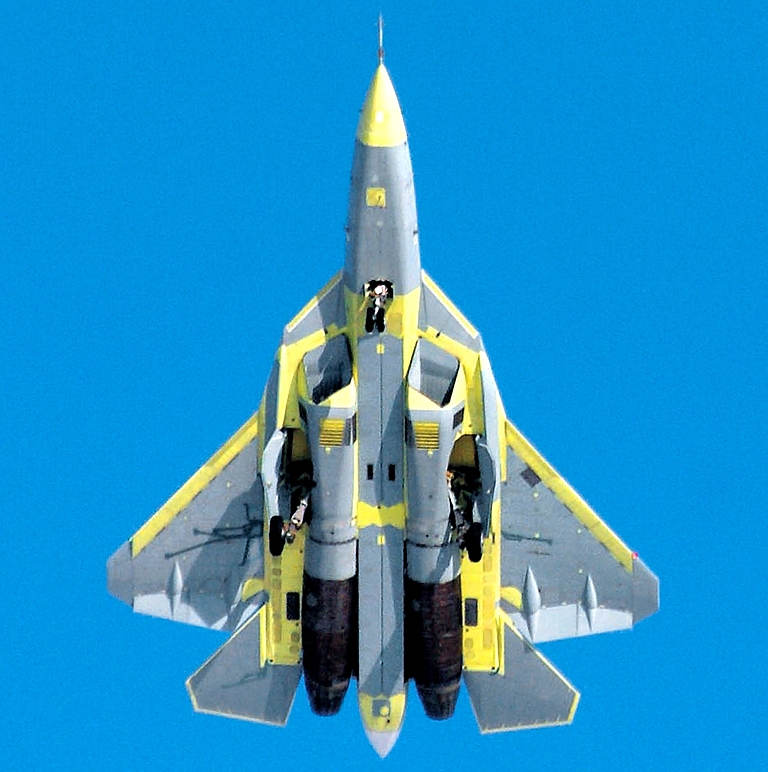
Edit: Actually, the T-50’s tyre is wider @ 0.365m, which makes for an even more comfortable fit.
Jō AsakuraI see where you’re both coming from, but that’s not entirely relevant, as the body diameter of an R-77 is slightly less than the diameter of a Su-30 main tyre (and hence by all accounts the S-37 tyre), then that still leaves ample room for 3 (the gap between the 2 launchers remains overstated).
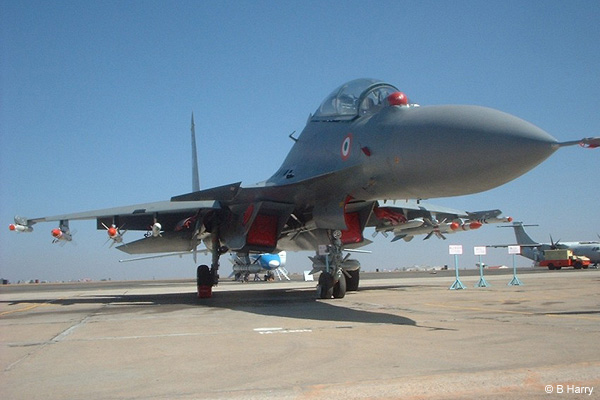
OK, let’s be more accurate. I did a quick google search and the diameter of the Su-27/30 main tyre is 0.350m, the S-37 should be the same. The body diameter of the R-VV-AE (R-77) is 0.2m, so your points would be valid for the, say, larger R-37, and that configuration may indeed be to test larger ordanance, but for the R-77 there would be ample room for the 3rd launcher (if the wings folded- wingspan of R-77 is 0.4m).
Also, notwithstanding such eyeball comparisons are notoriously difficult, but the diameter of this bay appears to be ~1m (actually 1.05m or more if you can easily fit 3 of those tyres in, as appears possible) and confirms Trident’s hypothesis of a 1m diameter T-50 bay comfortably accomodating 3 R-77 types.


 Sign In







