 Jō Asakura
Pics from ‘Engines 2012’ show (yesterday):
First pic reads ‘Future work/research’, control of air intakes (white); electrically driven pumps (yellow) and automatic fuel system (red):

Salyut’s KND 924-3 LP compressor probably for AL-31F-M3 and Izd.129/Type 30:

…whisperings of BrahMos 2?

Jō AsakuraSintra and mrmalaya, you both make valid points. So am I correct to assume that sharing the expensive task of “uninterrupted carrier capability” with the French (an important reason for the switch, the SDSR noted at the time) and interoperability with the USN, will be addressed by both PoW and QEII entering service? (though the latter may be configured as an LHD amphibious assault ship).
Jō AsakuraSo let me get this straight. Having been fortunate enough to have designed an aircraft carrier that was large enough with enough deck space to allow the relative seamless transition to a more interoperable and flexible platform (CATOBAR/EMALS), operating significantly more capable warplanes (F-35C), the UK government has decided to revert to the (then much lamented) far less capable and inflexible STOVL configuration- due to an accounting number that has been categorically disputed by someone in the know (assistant secretary of the US Navy, Sean J Stackley).
I’m also staggered by the recent Royal Navy’s wholesale endorsement of the F-35B, I was under the impression that (outside the USMC), medium class STOVL fighters were of ever decreasing tactical value…..or does the RN envisage launching future heavy UCAVs off a ski-ramp and recovering them vertically?
Given that the political decision-making has been undertaken by Mr. Bean, I wonder if Edmund Blackadder will be tasked with delivering this volte-face to parliament. I can’t wait!!:D
Jō AsakuraJō AsakuraAn update on Salyut’s AL-31FM2 engine as reported in last week’s AW&ST:
AL-31FM2 has completed climactic bench tests and is expected to enter flight tests early 2013. The tests have confirmed the static thrust increase of 4,080 lb. (to 32,000 lb.) compared to the AL-31FP, and 2,200 lb. more thrust than the AL-31FM1, these increases are due to an improved LP turbine and FADEC.
The engine size has remained the same and thus can be retrofitted to existing Flankers without changes to airframe or nacelles, according to Salut’s acting Chief Designer, Gennady Skirdov. The engine will make it’s display debut @ an industrial show at Zhukovskii in the summer.
Salut hopes the RuAF will select the engine for Su-27SM3 and Su-34. I guess this would probably be the most likely candidate for the IAF’s Super 30 upgrade.
Jō AsakuraIf memory serves, this is part of the sonar (MGK-540?) suite station aboard INS Chakra, pic was taken during ‘Nerpa’s’ fitting out.

Jō AsakuraQuadbike, you really ought to let the F-35 fantasies go (there is a good chance the IN will select the F-35C/EMALS somewhere down the line for their future carriers, but for the IAF it’s a no-go). The technical evaluation had nothing to do with L1, hence the two best candidates were down selected. IAF preferences would have been derived from technical ability (though CISMOA and risks of US political leveraging probably played a part)…..so there’ll be no “haunting”.
Even EADS is not taking Reddy’s mischief making seriously, at worst committee protocols will merely temporarily stall negotiations and, as yet, it appears Dassault’s offset negotiations with Indian industry are proceeding irrespectively. Hence EADS is holding on for the outside chance of L2 (having failed to realise that winning L1 means offering a competitive package!).
High-level Brazilian interest in the Indian technical MMRCA evaluation should reinforce it’s credibility and the leaked Swiss technical evaluation should put Rafale’s selection beyond reproach.
Jō AsakuraThanks for the pics rayrubik, she’s a real stunner!! The clearest pics I’ve ever seen of my second favourite sub (second only to Yassen).Schuka-B held the title from adolescence to my early 30s! 😀
Congratulations to the IN for a huge leap in capabilities, look forward to glimpsing her insides, I hear she has a brand new, contemporary control & battle station suite installed.
…now on her sail can be written ‘Yeh samudra hai mera’…;)
Jō AsakuraPrivateer, these are the latest updates from Pyotr Butowski in this month’s AI. T-50-1 was being prepared for high AoA tests and had been fitted with an anti-spin chute, but was grounded last August after the discovery of cracks in its load-bearing structure. In all probability T-50-1 will never fly again.
Emile, I think it’s safe to assume that Izdeliye 129/Type 30 are the in-house designations for the same family of prospective engines.
Jō AsakuraT-50-4 will be very lucky to fly by next April fools’ given the major structural changes currently being implemented to strengthen its high g load bearing capacity…..but look on the bright side, a tail-less T-50-1 will reach Monino much (much) sooner than expected!! YAAAY!! 😀
Also, informed opinion has it that Izdeliye/Type 30 engine will generate a whopping 18T (wet) and 11.5T (dry), that’s 39,700 & 25,350lbs respectively!! :eek:…oh, and will be ready for installation aboard serial machines by 2020.
Jō AsakuraOne thing Russia learnt is that when you no longer have money leap development is far too risky to be effective. So instead they test their 5th gen sensors on the Su-35 while developing a LO airframe. In the end, you get twice the money back. The sensors developed for the Su-35 will start making money on the export market and at home, and when the PAK-FA is ready, you’ll be able to provide a cost effective solution with far lesser things to be developed, with far better reliability.
Sukhoi and KnAAPO love to describe the Su-35S’ sensor suite as ‘fifth generation’, and it is evolving into a formidable platform, but the number of systems that will migrate to the PAK-FA amounts to…..errr….zero.
The Russkies are currently investing in and consolidating their R&D infrastructure in order to create a Russian DARPA, so pretty soon they’ll be in direct competition with their US counterparts as to how many countless millions they can waste.
Jō AsakuraJust wondering when is Elbit’s next gen display for SH going to be operational? because I think HAL has already jumped on the bandwagon with Elbit on this one. Also opting for Russian MFD’s seems a bit odd when money has been spent to acquire tech from Thales and Elbit.
Interesting, Elbit’s Large Area Display was formerly known as ‘Cockpit NG’ and is offered for new export SHs and Silent Eagles and later legacy upgrades.
I’m assuming ‘HALbit’s’ LAD is a collaborative venture for the very same product (it even looks the same), in which case the ‘Super 30’ would be the prime candidate- at some stage.

Soyuz1917, are these also made in Taiwan (above right)? Incidentally another Irkut product.
Acatomic, that picture may have come from a video screen capture @ MAKS, as it was first posted last October. If so I wonder which stand, Irkut perhaps? 😉
Jō AsakuraFrom ‘B’ to ‘C’ to ‘B’……now back to ‘C’?
Cameron orders independent review into F-35 decision
By Richard Scott
3/30/2012Prime Minister David Cameron has asked the UK Treasury to conduct an independent assessment of the costs associated with converting one of the two new Queen Elizabeth-class aircraft carriers to operate the F-35C: the carrier variant (CV) of the Lockheed Martin F-35 Lightning II Joint Strike Fighter (JSF).
Cameron’s intervention follows a meeting with Defence Secretary Philip Hammond on 19 March, during which Hammond is believed to have recommended backtracking on the CV acquisition plan because of the costs of carrier conversion. He is thought to have instead advocated the purchase of the F-35B, the short take-off and vertical landing (STOVL) variant of JSF.
The prime minister’s decision to seek an independent review is thought to reflect two principal concerns. First, the political embarrassment resulting from a U-turn on one of the central components of the coalition government’s October 2010 Strategic Defence and Security Review (SDSR); second, the possible adverse reaction from the US government and the US Navy (USN).
Apparently a UK MoD study of the costs of converting the carriers (installing EMALS) was said to have arrived at the £1.8bn figure.
The ‘Daily Telegraph’ claims to have seen a letter from the Assistant Secretary of the US Navy Sean J Stackley to defence equipment minister Peter Luff, claiming the EMALS equipment would cost £458m (+ £400m for installation).
Stackley’s letter reportedly ended by saying: “The department of navy is committed to supporting the success of the UK CVF (conventional carrier).”
What’s not clear is whether the initial cost and newly communicated cost apply to only one carrier conversion, or both.
Jō AsakuraJō Asakura, what is this SM2 are you talking about? SM cockpit isn’t similar to SM3.
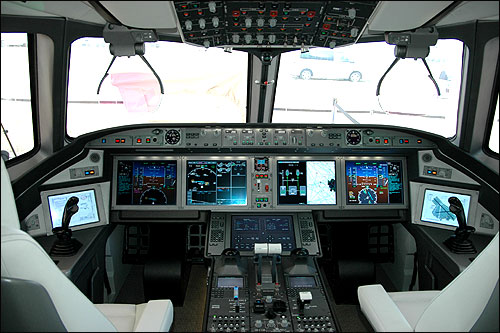
AfaIk, the central LCD of the SM3 is slightly wider than the SM’s and the outer two are identical. Though the analogue dials have largely disappeared, SM3 is still a significant ‘step down’ from the Su-35BM (901 & 902 prototypes at least, as we still haven’t seen the serial machine’s cockpit).
The pic above (which I think is slated for the ‘Super 30’) is the most advanced Russian one yet, and only a step away from a full one-piece panoramic- which will become more widespread in a few years as AM OLED tech matures and becomes commercially viable.

My bad on the SM2 & SM3, as I struggle to tell the difference between the two.
Jō AsakuraAppears to be a learning curve exercise in order to produce a much more capable fighter in the medium term.
Mitsubishi starts building ATD-X stealth prototype
Kosuke Takahashi, JDW Correspondent
TokyoMitsubishi Heavy Industries on 28 March began assembling the Advanced Technology Demonstrator-X (ATD-X) fighter: a prototype for a future fighter to replace the Japan Air Self-Defence Force’s Mitsubishi F-2.
“The aim is to produce a purely indigenous fighter aircraft,” Takashi Kobayashi, general manager of Mitsubishi Heavy’s aerospace systems, said at a ceremony at the company’s Tobishima plant in Aichi Prefecture. “Today marks the first step on the tough road towards that goal.”
The ATD-X, also known as ‘Shinshin’ (Heart of God), is being developed by the Ministry of Defence (MoD), which has provided a project budget of JPY39.2 billion (USD480 million). It plans for the ATD-X to be airborne by Fiscal Year 2014.
The ATD-X has been designed to be a stealthy air-superiority fighter with enhanced manoeuvrability. The MoD will use it to research advanced technologies and system integration, after which it plans to produce a sixth-generation fighter encompassing I3 (informed, intelligent and instantaneous) concepts and counter-stealth characteristics.
Fuji Heavy Industries, Kawasaki Heavy Industries and Mitsubishi Heavy are to manufacture the aircraft’s fuselage, main wings and cockpit, while Ishikawajima-Harima Heavy Industries (IHI) is providing two XF5-1 twin-turbofan afterburning engines for the prototype. To reduce the aircraft’s weight, carbon fibre-reinforced plastic (CFRP) is being used for around 30 per cent of the whole airframe.
http://kosuke2009.blogspot.co.uk/2012/03/my-latest-for-jdw-mitsubishi-starts.html
They’re very ambitious in the engine programme, eventually hoping to develop a F-119 class turbofan. Although the XF5-1 only has a 11,000lb thrust rating, IHI Corp. has considerable experience in building the 29,000lb F110-GE-129 for MHI’s F-2. Kudos :).


 Sign In







