Nick_76
Ken,
You sir, have talent, real talent!! Those models are beautiful.
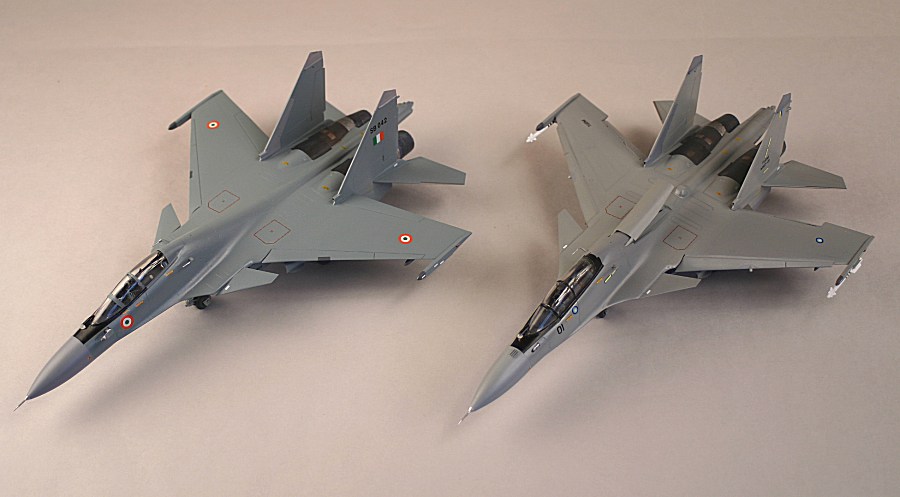
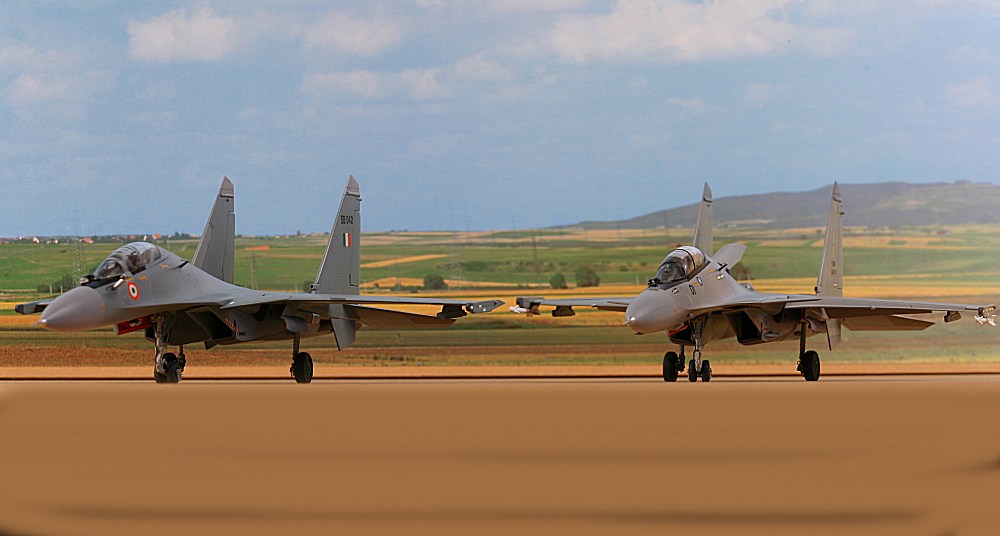
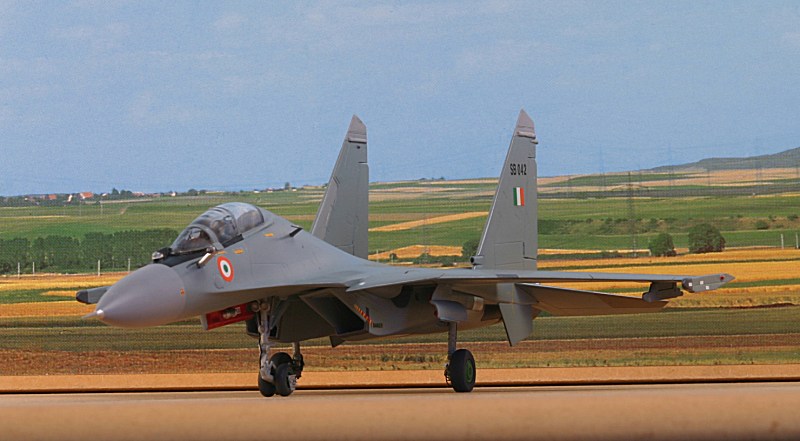
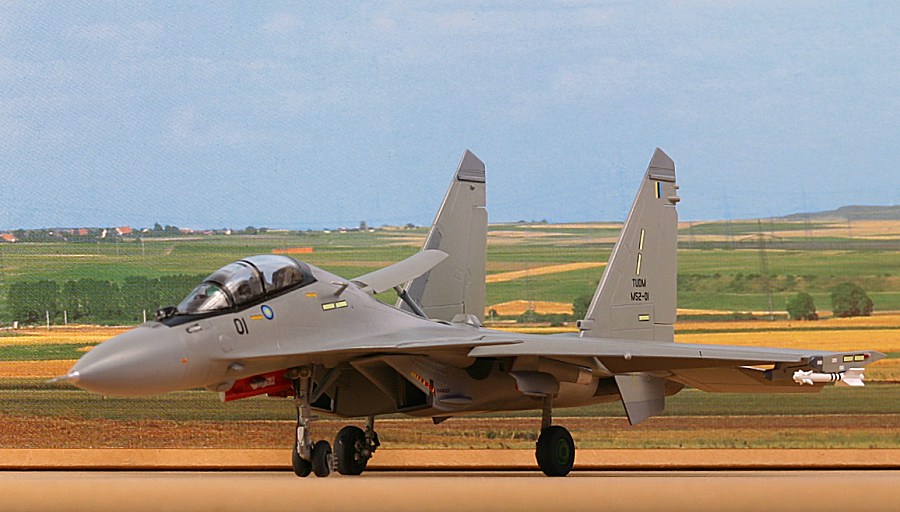
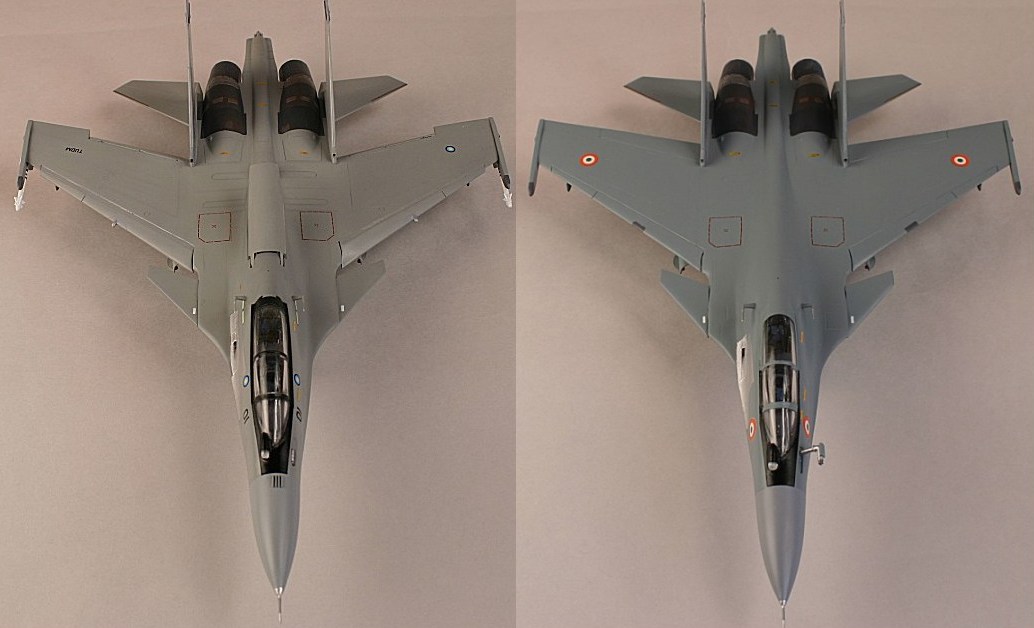
I have just converted a couple of Heller Su-27UB kits – into the MKI & MKM…
More at :- http://www.flankers-site.co.uk/modl_su-30mkm.html
Looks like I’ll now have to do an MKA….
As for black anti-glare panels, the Indian MKI only extends back the middle canopy arch, the MKM (and now the MKA) extends all the way back to the rear of the canopy..
Ken
Nick_76The MKM is still the most boootiful Su-30 MK variant as far as cammo goes!!
Nick_76So why didn’t India go for MiG’s LMFS offered from inception?
Because dear friend, MiGs LMFS was an even bigger joke than the PAK-FA. At least in the PAK-FA India is supposed to be paying “half the money”. In the LMFS, India would be footing almost the entire bill thanks to the fact that MiG had no funding from the Russian Govt for the same.
Understand?
Secondly, MiGs reputation as far as reliability and assured logistics go…is a bit of a joke right now in India. They would do far better in supporting their existing products than biting off more than they can chew and selling more moonshine.
So if the PAK-FA’s a joke, why didn’t India take LM’s offer on F-16/F-35 follow-on?
Unless you are joking, I wouldnt even believe that anybody would take LockMarts marketing stuff about the F-16 whutever seriously.
Even LockMart doesnt.
If the Indian Aerospace industry is so ‘advanced’ why didn’t they go it alone?
Oh gawsh, who ever spoke of Indias aerospace industry being so “advanced”?
Dont go nationalistic on me- again!!
All we (Austin & I) have said is that if India is to contribute $ 5 Billion into the project- it deserves far more than just immense aerospace knowledge or whatever platitudes you came up with- but ZERO technical information about what Indias workshare will be.
Why the heck should India invest in a fighter that it might just purchase off the shelf, while its money is better spent on developing its own fighter with foreign consultancy as and when required?
Heck, all thats been spent on the LCA (And a big cause of the delay) is barely $ ~1.5 Billion and not even that, since its all projected estimate.
This project seems a collosal money grab in comparison. I as a taxpaying Indian know EXACTLY what I am getting with the LCA, I know ZILCH about what I am getting with the PAK-FA.
The FC1/JF-17 went from prototype to serial production in just over 3 years, where is India with it’s beloved LCA? oh yeah, 25 years later it enters LRIP!!
Congratulations!! Can’t wait for the ‘N’, (what does the ‘N’ stand for? ‘Not yet’ perhaps?)
That has to be one of the most silly and bizarre claims I have read on the forum yet- congratulations!! Could you please tell me which cave you were hibernating in all these years?
You are obviously unaware of the FC-1/JF-17s long drawn development history dating from way back! And coming to the “beloved” LCA, those 25 years were spent in creating an actual aerospace industry, the kind that has led Russia to agree to India join the program.
Did you notice in the past year how the Russians were downplaying Indian involvement? whilst the Indians were banging the PAK-FA drums?
Yeah sure, to the extent that at each airshow, Sukhois folks were going “gimme gimme gimme” while the Indian side was:” Let us see..”
Seriously, do you think if Russia had the money, Sukhoi would have even approached India?
Hmmm…could it be that the Russians realised they don’t need Indian money afterall? ’cause Indian bargaining power has looked somewhat impotent recently, or maybe the Russian government wanted to reiterate just who exactly needs who here- especially after the Yeltsin years.
Yeah Russias bargaining power…aw gawsh, its credibility and power is at the top…via such amazing projects such as the Gorshkov.
Indias bargaining power is “impotent” sure…if not for Indian orders, your beloved tank yards and aircraft factories (Irkuts fighters anyone?!) would have faced closure, chew on that for a while. If India- even today, cancels some of its pending purchases, its not India which is going to suffer as much as your flag waving would have you believe. Security interests will force it to purchase something else or reinvest in local systems to a far greater degree than it has.
The US will come and shake your hand personally for that bit of brilliance, in handing over a long standing customer!
Get real, will you. Arms sales and nation-nation deals are not an occasion to measure whose whatsit is bigger.
India has relied on Russia all these years out of a firm belief that Russia is a reliable ally. The more incompetence Russias arms makers show in drawing up contracts and then failing their end of the bargain, and then blaming the customer for them, the more impetus Russias rivals in the market get to replace Russia.
I like Russia, I like Russian culture, anyone insults Russia without reason, 9 times out of 10, you’ll see us Indians (including me!!) coming forth to support you all.
Dont assume we dont remember Indo-Soviet ties or that we dont have faith in Russia, we do!!
BUT:
This is no longer even the Indo-Soviet days where India got friendship prices and barter trades for MiGs and T-72s. India todays pays export prices and it wants good bang for the buck.
The point being made is very very simple.
If India invests x amount of money, then it should get x amount of moneys worth.
Right now, there is very little idea of:
a)PAK-FAs current status
b)What workshare divisions will be
c)What Russia can provide India in terms of Joint development or what India gets out of this project?! :confused:
If you have any information, share it, dont wave the flag and say !@@##$ to anyone who is skeptical!!
I think all that eyerolling’s impairing your intelligence.
At least I have an intelligence- perhaps you should try some, its really enlightening. Goes well with beer and chips. :p 😉
Nick_76Regardless, in customising & indigenising weopons systems for the “boondoggle”MKI, the Indians get huge aerospace knowledge & benefits, which would never be realistically achievable by the MCA- especially if the LCA experience is anything to go by.
Oh stop the twaddle will you, for $ 5 Billion if all India gets is customization, that is “huge aerospace knowledge and benefits”?
The most India has got out of the MKI is via its own LCA program which has allowed it to integrate items on to the MKI plus its own systems. India isnt doing the Chinese thing either to make its own version of the MKI and put it in the air forever. The benefit to making the MKI in India is mostly from the spares POV. The learning is actually coming from the LCA.
5B$ in the MCA and a purchase of a few squadrons of PAK-FA is better than another MKI program now called the PAK-FA.
And whats to stop Russia from doing its usual, making another variant of the PAK-FA and putting it up for export? Which is why India needs bullet proof guarantees from Russia to not come up with PAK-XX and then say “hey, buy this y’all”.
Putting aside nationalistic chest-beating, maybe irritable Indians should observe Chinese & Japanese 5G developments to realise how difficult & prohibitively expensive developing such a warplane is.
Stop getting your knickers in a wad because the PAK-FA or anything Russian was criticized. Members on Russian forums are far more critical of the PAK-FA dawg than any Indian, ask them it is widely called a political joke in its present state. So whos doing the nationalistic breast beating? You (who gets hot because the PAK FA program viability is questioned) or Austin & I (who are skeptical of the benefits of this on paper program).
First, if India contributes the amount of money it is expected to, it deserves a far better deal than is currently stated.
If India was codeveloping the PAK-FA from scratch, it would be worth it and money well spent. Right now, all you have to state for it is “incredible aerospace knowledge & benefits”- yeah sure, we can put that in the bank because Otaku said so!! :rolleyes:
Nick_76Unless India obtains bulletproof guarantees from Russia, this PAK-FA could turn out to be another boondoggle where the Indian taxpayer is taken for a ride, even as the IAF is happy with yet another imported aircraft brought at tremendous cost, with little learning for domestic aerospace.
The MOD/SciCom should do their utmost to make sure India isnt taken for a ride in this “joint endeavour” for $ 5 Billion. :rolleyes:
Nick_76Air Attack.com
C-130J Super Hercules
Quick Links: News | Images | Videos | Specs | Sources | Bottom
The latest C-130 to be produced, the C-130J entered the inventory in February 1999. With the noticeable difference of a six-bladed composite propeller coupled to a Rolls-Royce AE2100D3 turboprop engine, the C-130J brings substantial performance improvements over all previous models, and has allowed the introduction of the C-130J-30, a stretch version with a 15-foot fuselage extension.
Designed specifically as a multi-role, multi-mission aircraft, the C-130J is equally at home for both tactical and a large range of strategic missions. Similar in appearance to earlier models of the Hercules, the C-130J is virtually an all-new aircraft. Major improvements include a state-of-the-art, computer-controlled digital flight deck.
Cockpit
The flightdeck features two head-up displays (HUDs), four large multi-function displays, five monochrome displays and fighter-style controls on the control columns. This glass cockpit technology also includes an automatic flight control system, autothrottle, head down display, traffic collision avoidance system, ground collision avoidance system and a stick pusher to prevent inadvertent aircraft stall. Integrated navigation equipment provides the pilots with an automatic navigation solution from the inertial navigation system and global positioning system as well as regular ground-based navigation aids.
This increase in automated control has allowed the minimum crew to be reduced from five in the C-130H to just three (two pilots and a loadmaster) in the J, removing the requirement for a Flight Engineer and Navigator.
Engines
New, more powerful, digitally-controlled Rolls-Royce engines, fitted with Dowty Aerospace advanced technology six-bladed composite propellers, enable the C-130J to fly much further, faster and higher than previous models. The C-130J is also the world’s first military transport aircraft to have a head-up display certified as the primary flight instrument for all stages of flight.
With proven military durability and reliability, the C-130J is at least 15% more fuel-efficient than previous models. In addition, improved technologies drastically reduce the requirements for maintenance and logistic support. The substantially lower through-life costs of owning and operating the C-130J make it the natural choice for any air force demanding an affordable multi-role transport capability.
Operators
Air forces currently operating the C-130J are the Royal Air Force, Royal Australian Air Force, the Italian Air Force, the Royal Danish Air Force, the United States Air Force, the United States Air National Guard and Reserve, the United States Coast Guard and the United States Marine Corps.
RAF
The RAF, as lead customer for the new aircraft, has taken delivery of twenty-five C-130Js. The first was delivered to RAF Lyneham in November 1999. The last was delivered on 21st June 2001. Two variants were ordered: 10 standard C-130J aircraft; and 15 ‘stretched’ C-130J-30s. The latter are 180 inches longer and have an increased load carrying volume within a comfortable payload of over 40,000lbs. The RAF trains its C-130J crews in a purpose-built school house, which was also supplied by Lockheed Martin. This contains two full motion dynamic mission simulators. Since entering service, the RAF’s C-130Js have been used in a variety of operational missions including action in the former Yugoslavia, Afghanistan and Iraq.
British industry participation in the world-wide C-130J programme is substantial. The supply chain for C-130J regularly extends to some 150 UK companies, contributions to the programme being made from all sectors of the aerospace industry from SME’s to the largest multi-nationals. UK-owned companies provide over 20% of the value of each C-130J that rolls off the production line. The UK C-130J Industrial Participation programme has to date provided approximately £1billion of business to UK Aerospace and Defence contractors, supporting in excess of 18,000 man years of employment.
Collectively, the UK industrial team is known as the UK C-130J Industrial Support Group and includes companies such as Rolls-Royce (engines), GKN Westland Aerospace (engine nacelles), Goodrich (digital engine controls) and Smiths Aerospace, including Dowty Propellers (power generation and distribution propellers). Over £740M in C-130J-related business has been placed directly with Lockheed Martin’ s British industrial partners and suppliers to date. Further sales will increase this figure.
Other air forces currently operating the C-130J are the Royal Australian Air Force, the Italian Air Force, the Royal Danish Air Force, the United States Air Force, the United States Air National Guard and Reserve, the United States Coast Guard and the United States Marine Corps. To date, 180 aircraft have been ordered and over 120 delivered. The market forecast for additional worldwide C-130J sales over the next 20 years is in excess of 300 aircraft.
RAAF
The Lockheed C-130J entered service with the Royal Australian Air Force in 1999, replacing the ageing C-30E fleet that had served since 1966. Operated by No. 37 Squadron at RAAF Richmond, approximately 50 kms north-west of Sydney, the C-130J is the most comprehensive update of the Hercules aircraft with a new two-crew flight compartment and turbo-prop engines that drive six-blade propellers. The RAAF currently operates 12 C-130J’s.
USAF
In 2001, the US Air Force contracted Boeing to upgrade hundreds of its C-130E and C-130H aircraft under the Avionics Modernization Program (AMP). Besides upgrading the E and H versions, the Air Force planned to acquire up to 168 newer, more-capable C-130J Super Hercules aircraft to fill out the ranks of its tactical airlift inventory.
Since then, however, the combat experiences of Afghanistan and Iraq have modified the Air Force’s thinking, as have shifting budget priorities. The service now wants a smaller sized intra-theater cargo hauler, dubbed the Joint Cargo Aircraft (JCA), to support troops in austere forward areas as a complement to the Hercules fleet. It is working with the Army to acquire this aircraft jointly. Chief of Staff Gen. Michael Moseley said the Air Force could buy between 100 and 150 of them, according to Defense Daily. Additionally, the projected size of the C-130J fleet has shrunk to just 79 aircraft. This may grow somewhat, however, since the Air Force Special Operations Command (AFSOC) is beginning to express an interest in acquiring the aircraft instead of upgrading older C-130s, according to the senior officials.
C-130J offered for Joint Cargo Aircraft (JCA)
In June 2006, Lockheed Martin offered the short-fuselage variant of the C-130J for the Joint Cargo Aircraft Program.
“Our C-130J solution meets or exceeds all JCA performance requirements and provides a solid cornerstone for the transformation of the Army’s fixed wing fleet,” said Rob Weiss, Lockheed Martin Aeronautics vice president for business development.
Specifications & Performance problems
In late July, 2004, the Pentagon’s inspector general issued a 34-page report that substantiated the allegation that the C-130J aircraft does not meet contract specifications and therefore cannot perform its operational mission. Because the Air Force has already payed more than 99% of the aircraft’s contracted delivery price, the Government fielded C-130J aircraft that cannot perform their intended mission, which forces the users to incur additional operations and maintenance costs to operate and maintain older C-130 mission-capable aircraft because the C-130J aircraft can be used only for training.
The Pentagon plans to save more than $5 billion by ending the C-130J program in fiscal 2007 and scrapping the purchase of 63 aircraft that was planned through 2011. The FY 2006 budget proposed to end production of the Air Force’s C-130J at 53, rather than the 168 originally projected. At $66.5 million, Secretary Rumsfeld said that the aircraft had become increasingly expensive to build and to maintain, especially given the ability to modernize existing C-130s. An Air Force report to Rumsfeld concluded that it would cost nearly as much to cancel the commercial contract – about $1.78 billion – as it would to complete it. That finding prompted Rumsfeld to reverse course, according to The Washington Post.
In June 2006, it became apparent that Defense Secretary Rumsfeld relied on faulty data when he saved the C-130J Hercules from cancellation the year before. According to a report by the Pentagon inspector general a poorly written contract it to blame for the for keeping the transport plane alive. The new report said the Air Force may have overstated the cost of canceling the contract by as much as $1.1 billion, the Washington Post reported.
The program has also been under scrutiny because the Air Force is buying the planes with a commercial contract, which does not require Lockheed to provide complete pricing and cost data, including its profit margin. Afterfacing criticism from Sen. John McCain (R-Ariz.), the Air Force said it would restructure the contract.Version C-130J
Length 97.9 ft || 29.3 m
Height 38.8 ft || 11.84 m
Wingspan 132.6 ft || 40.41 m
Nick_76PRC hasn’t made their counter offer yet. They will offer something better when the competition for the 2nd batch of JF-17s come along.
By the time the second batch comes the PAF may have something even better from Euro vendors. If the PRCs equipment was good enough in this case, I doubt an international tender would even be called.
Nick_76Hi SOC
Sumeets id was hacked, check your PM.
Nick_76In related news, the sun rises in the east.
Nick_76Ankush
To me, it suggests that the PRCs radar and AAM development has quite a ways to go. The RC-400 is inferior to the RDY2 latest variant in some key parameters, considering that the former is but a scaled down variant of the latter. And the SD-10 was touted as an uberweapon.
All in all, I would say that theres quite a ways to go yet, before the PAF which is having to match the IAFs tech heavy acquisitions, will be satisfied with Chinese avionics and gear.
Nick_76The MKI is like Arthur,existing on people’s nerves!
More like making internet fanboys c*rap their pants and then post their rambling on the forum so as to get some back at the bad bad MKI.
Nick_76If the dollar was really controlled by the central bank of China, the dollar would be stronger. And those US bonds aren’t a trump card, they’re a potential weakness. If a war, they’d be subject to cancellation. If you look up how US Treasury bonds are sold, you’ll find that sovereign holdings, such as those of China, aren’t sold as pieces of paper which you can swap for cash, but as credits to an account held by the US Treasury, in the name of Chinas central bank.
Exactly- the number of times I have heard the above silliness about the PRC controlling the US $$ boggles my mind. If the US says f*off to the PRC at times of war and cancels those bonds, its not the US which will be suffering, thats for sure.
Nick_76It looks sensible to do that, for sure. But then again, integrating a new helmet on the LCA = $$, so if that exceeds a threshold of logistics commonality and maint costs (for all French helmet with IN), it might be more cost effective to retain the Israeli Dash. Plus, theres the issue of time.
Nick_76As if the Israeli Govt would ever tom tom their involvement in the J-10. Talk about political suicide. :rolleyes:
Nick_76That comparison is misleading. You can compare the flying hours only, when it comes to attrition ratios to have a first idea!
The point is that of 4th gen aircraft, the F-16 has amongst the worst record, bar the ones with a bizarre flight profile, eg the AV-8B etc.
Even than it is still misleading, without related missions, weather conditions and related infra-structure.
So you have to go into that details to come to a convincing judgement.
You missed his point. Hes not saying the F-16s record is the same as the MiG-21s. Hes saying, that as far as its peers are concerned, the F-16 fares poorly in terms of attrition. Not that the quantum of F-16 attrition is the same as that of the MiG-21s.
In Norway related to season, you have no daylight, iced runways, mountain terrain, fog, snow a.s.o. When it comes to birdtrikes there is no difference to India. Flown with or without ordenance and many reasons more. 72 aircraft are 4 Sqns (4*18) and from 1984 does give less then one loss per year for a multi-role fighter. (1980-2007)
Norway has far better conditions viz birdstrikes than India for sure- thats a fair assumption given the # of illegal abattoirs and garbage dumps that were operating at the outskirts of Indian cities, slap bang besides the flight paths of IAF aircraft, and these problems took decades to resolve (civil-military issues and all that).
Second, comes the issue of flight hours. A MiG-21 is a 60’s era fighter, and is much more unforgiving when it comes to ~150-180 hrs/annual as compared to a F-16.
As regards seasons- doubt if they are anyway worse than what India faces, from the Thar to Leh..in terms of overall effect.


 Sign In