 Wanshan
😡
Wanshantake your pic
Non answer
Take Principe d’Asturias as example: she is designed to support 24 aircraft (12 harrier, 12 Sea King), could take up to 29 for short duration emergencies but normally carries only up to 22.
Hence my question as to what the design capacity of Clemenceau and Foch is (as opposed to the typical complement carried operationally)
WanshanYes the Russian helos do have a missile system, but I can’t remember what it is off the top of my head.
As for the Italians yes they have the Otomat Mk-1 and Mk-2 missiles
Only the assault version Ka 29 carries missiles (AT-6 Spiral), other armed Helix variants (27/28/32) carry only homing torpedo, torbedo rocket and a fw types of bombs/depthcharges.
As for the Italians, they also use the (25km) MARTE MK2/S lightweight heliborne Antiship missile system. The french use the (17km) AS 15 TT lightweight anti-ship weapon system. This is similar in range to the British Sea Skua. The chinese have the (15-20km) Ying Ji-7 (YJ-7) which was exported to Iran as C-701. The (55km) norwegian Penguin is currently the world’s most advanced small air-to-surface anti-ship missile.
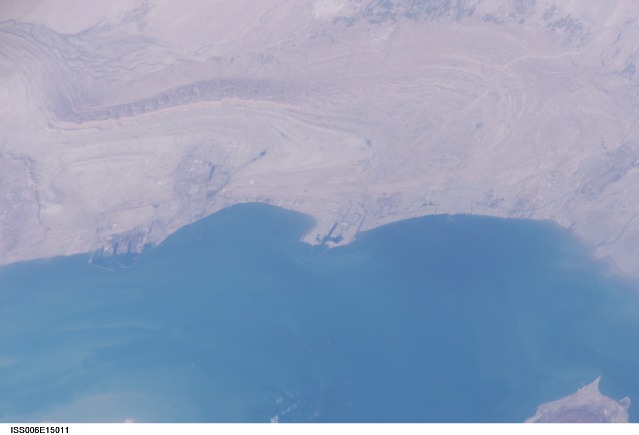
WanshanIts the Shahid Rajaee section of the port of Bandar Abbas, Iran, on the Strait of Hormoz. (but I have to admit I cheated)


Wanshan^ it’s pretty amazing, the Oriskany is nearly similar in size to the Foch yet carries much more
Assuming your observation is correct, does that mean Foch can’t carry more aircraft or doesn’t operationally?
WanshanI’ve posted a pic of the Heron in the thread on Hezbollah UAV.
WanshanI will not! According to http://www.iqtest.com my iq is 218. So unless someone can score higher I’m #1.
You actually paid the fee they ask to obtain your test results? Well, you can’t be all that smart then :diablo:
WanshanDidn’t the Italians have 2 earlier cruisers that had a couple of helos and led up to VV? They always have made very handsom ships….
Andrea Doria class helicopter cruisers
Displacement: 6,500 tons full load
Dimensions: 489.5 x 56.5 x 16.5 feet/149.2 x 17.2 x 5 meters
Propulsion: Steam turbines, 4 boilers, 2 shafts, 60,000 shp, 30 knots
Crew: 485
Armor: none (?)
Armament: 1 Terrier SAM (40 missiles), 8 76 mm AA, 6 12.75 inch torpedo tubes
Aircraft: 4 helicopters
Concept/Program: The first major Italian warships of postwar design and construction, these were combined AAW/ASW ships featuring a large helicopter facility. A third ship was planned, but deferred in favor of a larger ship.
Design: Hull based on an enlarged destroyer design. Helicopter deck and above-decks hangar aft, cruiser weapons forward. Intended to operate 3 heavy ASW helicopters but were too small; operated 4 light ASW helos instead.
Modifications: Recieved SM-1ER missiles in place of Terrier during late 1970’s refits.
Units:
Andrea Doria (C553) – Built by CNR, Riva Trigoso. Laid down 11 May 1958, launched 27 Feb 1963, completed 23 Feb 1964.
Major refit and modernization 1976-78. Stricken for disposal 19 July 1991, presumably scrapped.
Caio Duilio (C554) – Built by Castellammare. Laid down 16 May 1958, launched 22 Dec 1962, completed 30 Nov 1964. Austere refit and conversion to training cruiser 1979-80. Decommissioned to reserve 15 Nov 1989, stricken for disposal 19 July 1991, sold 31 December 1992, but had not been scrapped as of April 1998.
Enrico Dandolo(C555) – Cancelled in favor of Vittorio Veneto

Vittorio Veneto class helicopter cruisers
Displacement: 8,850 tons full load
Dimensions: 589 x 63.5 x 20 feet/179.5 x 19.4 x 6 meters
Propulsion: Steam turbines, 4 boilers, 2 shafts, 73,000 shp, 30.5 knots
Crew: 550
Armor: none
Armament: 1 Terrier SAM/ASROC ASW, 8 76 mm AA, 6 12.75 inch torpedo tubes
Aircraft: 9 helicopters
Concept/Program: A greatly enlarged and improved version of the previous class. A second unit was cancelled. In addition to the AAW & ASW roles, this ship served as fleet flagship until replaced by Garibaldi.
Design: Similar to Andrea Doria but with a larger and deeper hull; the hangar was fitted below the flight deck, within the hull. The missile magazine had a third drum, increasing missile capacity by one third.
Modifications: Modernized 1981-84 with 4 Otomat SSM and 3 twin 40 mm AA added, SM-1ER replaced Terrier.
Operational: Served mostly as a training ship post-1985, when her fleet flagship role was taken over by Garibaldi.
Built by Castellammare. Laid down 10 June 1965, launched 5 Feb 1967, completed 12 July 1969.Modernized 1981-84; served mostly as a training ship post-1985.
.JPG)
WanshanThe Moskva class supposedly had poor sea-keeping.
In many pictures you can tell they trimmed down by the bow. Flight deck aft with hangar below, AAW and ASW weapons forward, large superstructure midships. They also pitched excessively, and generally were poor sea boats. Suffered extensive machinery problems as well.


WanshanQuite right, I hadn’t noticed that.
Sounds reasonable. Anything less than 10-12 aircraft total though will make it very very difficult to maintain a CAP of two aircraft. If you don’t have aircraft on CAP then the air capable ships should probably be on picket duty, interposed along the expected threat axis to allow for time to get the aircaft in the air and still intercept the Bears before they find the convoy. In that case you’ll still need ASW escorts with the merchies
Note the Harrier is worse off at high altitude but thats likely where the Bear will be trying to maximise its detection range. Also those are max speeds for the Harrier and that will require full military power. FMP will burn fuel much quicker than cruise or the power settings for loitering on CAP. The Bear can quite likely maintain its max power settings for a lot longer than the Harrier can afford to. Now with an F-35B things might be different 🙂
Still even if the F-35B lives up to expectations I wouldn’t expect these mini-carriers with just a few aircraft to become reality. The main reason being logistics. Everyone of those ships will nedd to have the facilities, equipment and personell to maintain the aircraft and keep them in the fight. On a larger carrier you may have one or two sets of equipment to maintain 12-16 aircraft, having at least a full set to maintain 4 on the smaller vessels significantly increases the costs of getting the same number of aircraft into the fight. Now the operators might be happy enough to call this redundancy but I suspect Treasury is going to look at it and call it unnecessary duplication
Daniel
For a convoy escort, you could use 2 aviation capable FF/DD, each equipped with the same LR radar as Type 42 had and each paired with a Sea Wolf equipped consort (e.g. Type 22), away from the convoy as pickets on the 2 most likely Bear approach routes. The convoy itself could be accompanied by 2 Type 42, each paired with a Sea Wolf equipped ASW-specialist ship (e.g. modified Leander). I suppose a large containership with an Arapaho-like fit and some more Harrier FRS1 could be added to the convoy as well. This wouldn’t be perfect but would free the carriers while introducing another layer of complexity for the opponent to deal with.
In the case of UK, the main benefit would have been to free the carriers from escort duty (with military equipment convoys going to Europe as reinforcements to fight off Warsaw Pact attack). These could then pursue other tasks (ASW, ASuw, or Bear hunting) more aggressively. But it could be that Skyhook ships would have introduced an alternative to carrier aviation that could have led to funding for carriers being cut. So I suppose RN said all or nothing and went with the carriers, however small.
WanshanDan: Obviously, the air-capable FF/DD was not adopted and probably for good reason. Still, that doesn’t mean it wasn’t conceived with the role I discribed in mind.
Take a close look: that’s a ski-jump up front at the end of a short runway ontop of the hull. So, the Harrier would not operate in VTOL but rather in STOVL mode.
The hull in question has 2 Sky Hook installations, suggesting at least 2 Harriers on board, but probably a few more. If you have an escort group of 6-8 ships and 2-3 are of this type then you have 6-12 FRS1 type aircraft.
Royal Navy on Sea Harrier FA2 Aircraft endurance: 1hr 30mins (on Combat Air Patrol (CAP) 100nm from Aircraft Carrier)
Sea Harrier FRS1: Max Speed 660 mph (1065 kph / Mach 0.98 ) at sea level, 600 mph (966 kph) at 36000 ft
Tu95RT Bear: Max Level Speed, at altitude: 575 mph (925 km/h) at 40010 ft (12205 m), Mach 0.87
Yep: difficult but not impossible.
Wanshan“Iowa loses? AAAATTT!! Wrong answer”
Yes, I know there’s a tendency to romanticize about Iowa taking on big bad Yamato, as well as a tendency to couch the “versus” in terms of a scenario that plays to Iowa’s strengths. There’s also a fair amount of outright misinformation, including some I noticed in another thread here. But in the end, the disparity in the two ships’ relative vulnerability is too great a disadvantage for Iowa to overcome. Could she defeat Yaamto? Certainly. Is that the most likely outcome? No.
USN radar was far better than Japanese: Iowa would have seen Yamato first and would have had better aim at greater range. Also, I think USN had better damage control.
WanshanWhat value does embarking a single Sea Harrier on a frigate provide to a Fleet commander?. How long can a 4-5000ton vessel support such an airframe?. The avcat bunkerage on a frigate is designed to give a modest ASW chopper a couple of dozen sorties before depletion how long would that support a tactical jet fighter?. How many aircraft weapons can be stowed aboard and how many missions could be undertaken?. Even if grouped up with, perhaps, 4 Harrier-carrying FFG what missions could this little flotilla actually undertake?. Theres not enough airframes for CAP so there is no airborne Fleet Air Defence. There isn’t likely to be any AEW choppers as all the decks are taken up with fighters so its shipboard air sets and radar horizoning, a la 1982, all over again. Long range precision strike is the only practical task for such vessel, same as for the Austral design etc above, and, in my opinion, we aleady have that achieved much, much easier with TLAM/Mk41!.
I think the idea of Sea Harrier + Skyhook on a frigate/destroyer sized hull was in the context of convoy escort duty: the Harriers were to shoo away Tu142 recon birds. By having those little Harrier ships, bigger Harrier carriers would be relieved from convoy duty and free to do a little more aggressive hunting work. I think there would be more than just 1 Harrier per small hull. Anyway, much like the WWII idea of mounting a Hurricane on a few merchant ships to shoo away the Focke Wulf Condors, which later developed into MAC ships.
WanshanGarry,
effectively Soviets experimented a kind of (nuclear) ballistic missile with anti-ship capability, named SSN X 13 (?). this never entered in service, but i am pretty confident that this was the “ultimate” anti-ship weapon.
Vortex, with very modern tecnologies, even a 127mm have more range than teh 406, but this not explain nothing: AFAIK. despite developements planned, no “super” 406 100 miles+ shells were deployed.
The question is not that 20 SSN 19 can sink a Iowa and 20 406mm can sink the Kirov, insthead we can argue that Musashi and Yamato can match Essex carriers: 20 460mm are enough also for them. We can argue that if a WWI battleships comes in front a port filled of modern warships, with 30+RF guns it can sink them in few minutes: why not? But it was not a realistic case.As the torpedoes and bombs used vs Mushasi and yamato it has always wondered me how the Musashi resisted at 50% more hits than Yamato and it was able almost to save her ( if only a port was available within 30 km!). improved weapons or weak point hitten on Yamato?
But as explosive and destructive power, the other problem is the speed. If the hit is made by a subsonic bomb it’s a thing: differenlty, it’s a huge problem.
Losat missiles shows well how the KE is important to pierce an armour. If a SSN 19 or a SA-n 6 hits a target, it’s not only the HE cahrge, but also something like 400-500 MJ of KE that are more than a tank gun reserve fired at 0 mts. Supersonic-Hipersonic weapons could make a different outcome than a slower system. A very heavy and or very fast can pierce armoured structures , like Fritz.X and tallboy showed, the problem is the KE available ( weight plus speed ) expecially if the warhead have also a semi-piercing warhead.
Yamato’s remains were located and examined in 1985 and again examined, more precisely, in 1999. She lies in two main parts in some 1000 feet of water. Her bow portion, severed from the rest of the ship in the vicinity of the second main battery turret, is upright. The midships and stern section is upside down nearby, with a large hole in the lower starboard side close to the after magazines.
Yamato vice Musashi sinking: Yamato was listing to port with a fire raging in the aft superstructure, then exploded and sank. Musashi went down by the bow and sank, it did not explode like Yamato. Perhaps Yamato got an unlucky hit on a magazine or perhaps the fire caused the explosion of munitions (Japanese damage control prodecures and equipment were far less developed than those of US, same reason why they lost some CVs – including half-sister carrier Shinano – when USN managed to save many a stricken CV)
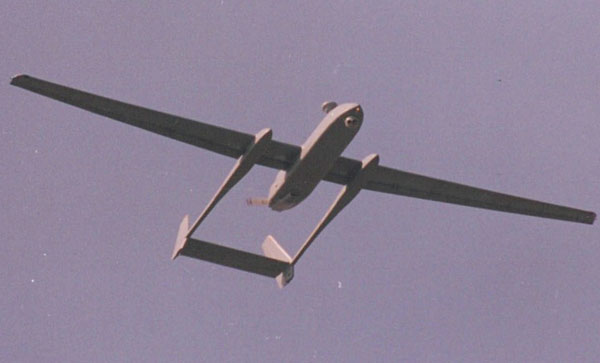
WanshanBelow is an image of an Israeli Heron UAV by IAI (Malat) – so much for the previous claim
http://www.israeli-weapons.com/israeli_weapons_aircraft_uavs.htm
This is an Iranian Mujahir UAV
I think this is also a Mujahir UAV


 Sign In







