Wanshan
Possibly!
On November 7, 2004, Hizbollah, an Islamic militant organization with close ties to Iran, flew the Mohajer-4 over northern Israel for approximately 5 minutes. The UAV entered Israeli airspace at more than 100 knots and an altitude of about 1,000 feet. After briefly flying over the seaside city of Nahariya, the UAV fell into the sea as it returned to Lebanon. An embarassment for the Israeli government, the overflight proved to be a symbolic success for Hizbollah, which claimed the flight to be an appropriate response to Israeli incursions over Lebanon.
The prominent London-based Arab daily newspaper Ash-Sharq Al- Awsat quoted an unnamed senior officer with the Iranian Revolutionary Guards as saying Iran has sold 8 Mohajer-4s to Hizbollah.
Source: http://www.globalsecurity.org/military/world/iran/mohajer.htm
The Iranian UAV Mojaher is dubbed Mirsad-1, meaning “observation post” in Arabic. See also http://www.isrjournal.com/story.php?F=505509
However, there are other possible sources of the UAV, including Ukraine and Russia. See here: http://www.armscontrol.ru/UAV/mirsad1.htm
WanshanDepends on whether you are comparing single seat ‘early’ F15A or ‘late’ twin seat F15E with twin seat F14 and for which role (air defense, strike, ground attack).
WanshanThe Japanese Yamato was struck by some ten torpedoes, mainly on the port side, and several bombs before she sank. Musashi and her consorts were attacked by hundreds of U.S. Navy carrier aircraft. This battlewagon was hit by some nineteen torpedoes and seventeen bombs. Though her heavy protection withstood this massive damage to a degree probably unsurpassed by any other contemporary warship, Musashi capsized and sank about four hours after she received her last hit.
Just to give an idea of how much punishment BBs can take.
Standard USN air droppable torpedos weighed 1005kg/2216 lbs and had warheads with 262kg Torpex. Typical aircraft armaments in these cases consisted of 454kg/1000lbs and 227kg/500lbs. Respectively, these contained about 241kg and 119kg of HE explosive.
Name Type Bomb-Weight HE-Weight
AN-M30 GP 100 lb 54 lb
AN-M57 GP 250 lb 123 lb
AN-M64 GP 500 lb 262 lb
AN-M65 GP 1,000 lb 530 lb
AN-M66 GP 2,000 lb 1,051 lb
AN-M56 Light Case 4,000 lb 3,245 lb
AN-Mk1 Armor-Piercing 1,600 lb 215 lb
By comparison, the SS-N-19 Shipwreck weighs 7000 kg and has a 750kg conventional high explosive or a 500 kiloton nuclear warhead. The 1,800kg 48N6 missile of the S-300PMU1/SA-N-6/SA-10 GRUMBLE contains a
145kg high explosive warhead.
Assuming Mk13 torpedos and 500lb bombs were used, it took at least some 3 tons of explosive to sink Yamato (and 7 tons to sink Musashi). That’s the same weight of explosive as in 4 (9) SS-N-19 or in 21 (48) SA-N6. More missiles would be required if the warhead weight of these russian missiles includes anything other than explosive.
WanshanThe major reason for decommissioning the Iowa class battleships was economics. Each battleships required a crew of almost 1600 men. Their missile payload was about 78% of a Spruance class destroyer’s missile payload, but the destroyer has 22% of an Iowa’s crew. Their unique gunfire support capability was judged not to be worth the cost (in money and manpower) of maintaining them in service.
https://wrc.navair-rdte.navy.mil/warfighter_enc/History/dyk/1stpage/iowadcom.htm
However …
Apparently, for the cost of ONE Burke destroyer, you can modernize & commission TWO Iowas providing 18 406 mm guns, 12 to 24 5″ mounts, over 392 missiles for all occasions, on a vessel that can survive more damage than anything in existence. The yearly cost of a battleships isn’t that much more than an Aegis cruiser.
http://www.warships1.com/US/BB61stats/index-BB2-pst03.htm
To staff two battleship with FULLY EXPERIENCED crews would have the personnel impact on the Navy of staffing two new DD-21’s!
http://www.warships1.com/US/BB61stats/index-BB2-pst06.htm
IOWA and WISCONSIN both have over 20 years left on their hulls – WITHOUT SLEP (Service Life Extension Program). Iowa’s carry over 2 million gallons of DFM(diesel fuel marine) and are the only combatant ever made with an UNREP (underway replenishment) rig to refuel other ships at sea. She serves as a forward deployed, armored, well armed oil tanker that can sail at 33+ knots. Iowa’s were designed to have 2500 enlisted. The suggested compliment today is less than 1500. That’s a lot of extra supplies that she can carry into a battlezone to distribute to the “small boys” around her. Iowa’s ability to effect repairs are unparalleled in today’s navy save the shore-based shipyards. She has complete machine and tool-n-die shops to fabricate parts for the underway battlegroup. The Iowa’s are HUGE and can carry fleet/battlegroup commanders with no problem. This is to support their staffs and communications. Iowa’s medical/dental facilities are only equaled by the carriers. She can take on MANY sick sailors and is staffed by over 40 corpsman and 5 doctors. And, of course, NO ship can put “ordinance on target” like a battleship.
http://www.warships1.com/US/BB61stats/index-BB2-pst08.htm
WanshanWanshan: haven’t you heard that the X-43 has been out on trials doing deck landings?
That doesn’t preclude that pic being a fake, does it?
X-43 …. isn’t that an Unpiloted Hypersonic Research Vehicle rather than an UCAV? Must be Boeing X46 UVAC-N, the naval version of X45 J-UCAS, currently in competition with the Northrop Grumman X-47A Pegasus UVAC-N, that you are referring to.
If you check under ‘X-45 system’, ‘gallery’, ‘op concept’ here: http://www.darpa.mil/j-ucas/index.htm you will find that these are concept images, not real images.
More info here; http://www.designation-systems.net/dusrm/app4/x-45.html
X45
X46
X47
Wanshan
This supposedly is the Mirsad-1. (Source: Debka File)
http://www.spacewar.com/news/uav-05zd.html
WanshanPerhaps Brazil should skip a couple of generations and go straight to UCAVs:) http://www.darpa.mil/j-ucas/
IMHO that pic is an artist impression of the UCAV PS-ed onto a real pic or a carrier deck.
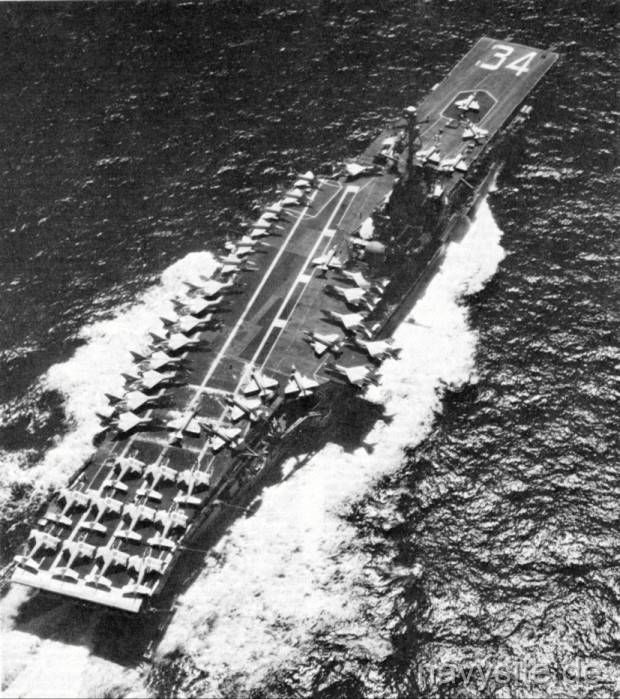
Wanshanthe ship reminds me alot of the USS Oriskany
I’m amazed that they could fit over 40+ aircraft on that deck.
Looks like there’s 46 aircraft on deck in this pic:
14 F8 Crusader
18 A4 Skyhawk
11 A6 Intruder
3 E1 Tracer
WanshanApril 11th 1945: BB64 USS Missouri about to be hit by a Japanese A6M “Zero” Kamikaze, while operating of Okinawa. The plane (which weighed about 2 tons and came in at around 300-350mph) hit the ship’s side below the main deck, causing minor damage and no casualities onboard the battleship. A 40mm quad gun mount’s crew is in action in the lower foreground. The kamikaze left his Machine Gun in the Barrel of the 40mm Gun
U.S. Navy photograph by Seaman Len Schmidt / U.S. Naval Historical Center

Actually, BB64 was hit twice. The first time was the more dramatic of the two hits and the dent (!) from that attack remains to this day.
In the April 11th attack, the kamikaze struck the starboard side, just below the main deck near where turret 3 is. Some of the plane (and the pilot) ended up on the deck, the rest (including his unexploded bomb) fell harmlessly into the ocean. The hit looked bad, but the damage control crews had the fire out in about 3 minutes and when the smoke cleared the kamikaze pilot was the only fatality. Missouri suffered no significant damage from the attack.
The second strike on April 16th 1945 was actually a bit more damaging. The pilot almost missed the ship but his wing clipped the stern crane on the Missouri before the plane went into the sea behind Missouri. The explosion sent debris up onto the deck causing a couple of injuries and tearing some holes in the gun bucklers (“Bloomers”) of turret 3.
WanshanThe TASM has an operating range of 250nm (maximum range of 470nm) as compared to TLAM-C (maximum range of 675nm) and TLAM-N (maximum range of 1,500nm)
For its defense against missile, modernized Iowa class has not just 4 Phalanx CIWS but also Mk 36 SRBOC chaff launcher and AN/SLQ-32(V) 3 ECM.
As originally outfitted the Iowas carried between two and three OS-2U Kingfisher observation planes.The Kingfishers were replaced by the new Seahawk observation plane in late 1944 – early 1945. Advances in radar technology eventually led to the removal of the seaplanes and the catapults from all four of the ships around 1948. This left the large fantail area of the ship empty of equipment. It wasn’t long until it was occupied by the newest addition to military airpower: the helicopter. The modern Iowas could land six types of helicopters: the UH-1 Iroquois, SH-2 Seasprite, SH-3 Sea King, CH-46 Sea Knight, CH-53 Sea Stallion and the LAMPS III SH-60B Seahawk. SH3 Sea King and SH60 Seahawk: None embarked but landing area and unhangared parking area for 4.
In late 1986 the USS Iowa was the first of the class to receive the new Pioneer RPV system which consists of a ground control station, two portable control stations and eight Pioneer aircraft. The missions of the new system are surprisingly similar to that of its predecessors. They are reconnaissance, surveillance, search and rescue, weapons targeting, and target damage assessment. This system offers all the benefits of conventional aircraft, but has the added quality of small size, stealth, ease of recovery, low cost, and eliminates the need to send pilots into hostile airspace. The Pioneer RPV has a range of 185km (100 nmi) and employes a Jam Resistant protected
Redundant Uplink.
Aircraft:
1943-1945 3 Vought OS2U Kingfisher floatplanes
1945-1947 2 Curtiss SC-1 Seahawk floatplanes
1951-1953 1 Sikorsky HO3S-1 helicopter
1968-1969 (New Jersey only) SNOOPY QH-50 control and telemetry system
(Gun-Spotting surveillance version of DASH)
1983-1992 1 Kaman SH-2 Seasprite helicopter (more could be carried)
1-3 Pioneer UAVs (Unmanned Piloted Vehicles)
RPV and Helicopter Fueling and Storage (1983-1992)
The fuel stowed in a 500 gallon bladder in one of the aft gun tubs was Motor Gasoline (Mogas) for the RPV. The bladder was also in a dolly type carriage that could be jettisoned quickly in case of fire. JP-5 for the helos was stowed in new tanks below 3rd deck on the starboard side aft. The space originally held two cylindrical tanks of Mogas that were cut up and removed. However, the two tanks on the port side remained as day tanks for JP-5. Helo maintenance was operated out of the old movie booth on centerline, main deck just aft of turret III. Helo ops were controlled by a new control station built on 02 level and over the top of turret III. Helo stowage was intended to be on the long ramp forward of the helo deck on the starboard side. Port side was intended for a boat trailer stowing two motor whaleboats. A new boat boom was added to the port side of the after superstructure to handle those boats. RPV’s were stored in hut-like cannisters and assembled out on deck. Plans were drawn for a semi-permanent hangar where RPV maintenance and assembly could be done out of the weather.
March 18 1944: First shore bombardment by USS IOWA against Mili Atoll in Marshall Islands. The USS IOWA received her first hit when she was struck by two Japanese 4.7 projectiles, neither of which caused significant damage. On 11 April 1945 USS Missouri opened fire on a low-flying suicide plane which penetrated the curtain of her shells to crash just below her main deck level. The starboard wing of the plane was thrown far forward, starting a gasoline fire at 5-inch Gun Mount No. 3. Yet the battleship suffered only superficial damage, and the fire was brought quickly under control. New Jersey lost a few men but suffered little damage when hit on one of the turrets by fire from shore batteries.
In 1987 an Iowa class BB was clocked doing 34-35 knots. That’s faster than Kirov class’ top speed of 31 knots….
Iowa class info
Pioneer UAV

WanshanTomahawk ASMs are long retired. did the Iowa ever field Harpoons ? I am sure there is space, but one just has to go with standard fit. Kirov has the heaviest SAM and CIWS armament among naval ships and should not have a issue with a few harpoons.
32 – Tomahawk ASM/LAM – 8 armored box launchers
16 – Harpoon ASM – 4 quad cell launchers.
WanshanPeople have to keep in mind that there is a difference between the maximum number of fixed and rotary wing aircraft that can be supported and the number that will normally be carried.
For example, take the Spanish Principe d’Asturias: The ship has facilities to support up to twelve AV-8B/B+ aircraft. The carrier also has facilities to support up to twelve helicopters. That makes support facilities for a total of up to 24 aircraft, of which half would be kept on deck and half in the hangar. In an emergency a maximum of 17 aircraft can be stored in the 2,300m² hangar. Keeping the deck park the same, that means that the ship is capabable of supporting a maximum of 29 fixed wing and rotary wing aircraft for a short duration. In practise, however, the ship typically carries 10 AV-8B/B+, 6 SH-3H, 2 SH-3H AEW, and 4 AB-212 (total 22). Note that the difference between the typical and maximum possible number of aircraft is almost 25%.
For the new IN ships, perhaps a good approach would be to take the maximum number of fixed and rotary wing aircraft quoted and apply that margin to arrive at the likely number of aircraft to be carrier operationally. Also, keep in mind that there recently was talk of a Mig29K variant with wings folding closer inboard than the original. If true this woud mean a substantially smaller footprint for this fixed wing aircraft relative to LCA and rotary wing assests and a greater total number of aircraft that could possibly be carried on board these new ships.
WanshanThe original film set and models used during the making of Das Boot are open to the public as a part of the tour of the Bavarian Film Studios, Munich, Germany. There exists also a VIIC and a XXi as floating musea in Germany
The real U-571 was a Type VIIC U-boat laid down on 8 June 1940 at the Blohm & Voss Shipyard in Hamburg. It was commissioned on the 22 May 1941.
WanshanDirected by Wolfgang Petersen Released in 1981 after two years of filming ‘Das Boot’ (The Boat) was, at the time of production, the most expensive German film in history, costing 30 million Deutsche Marks (US$40 million). Location shooting included segments shot in the La Pallice bunkers. There were three models made of the U-Boat used in the film, one of which was an exact replica made by the company that originally manufactured the boats during WWII. Although they wanted to use an authentic one for the film, the only surviving VII-C Class U-Boat is now a national monument in Germany and could not be used for filming. The non-functional full-size replica U-boat was accidentally sunk during filming, later raised and used also in ‘Raiders of the Lost Ark’. A smaller-sized functional model 6-7m replica was used to film ‘at sea’ scenes. The original film set and models used during the making of Das Boot are open to the public as a part of the tour of the Bavarian Film Studios, Munich . The original U96 was a Type VII-C.
WanshanWanshan , The P-15A and P-17 was designed quite some time back , I mean the design of Weapons system and Sensors was freezed quite some time back. Also as of now just Aster-15 is available and Aster-30 is still not approved for exports.
Barak-2 is a good sign but we really dont know when its going to come , I mean by 2008 or 2010 or probably much earlier , and Aster is available now as a functional system , we can go for Barak-2 for later ships
You might be right about that freeze. But that means although Aster 15 is functional IN might still not get it. Likewise for Aster 30: Barak 2 timetable is unknown but so is the timetable for when Aster 30 will be relased for export.


 Sign In