 Wanshan
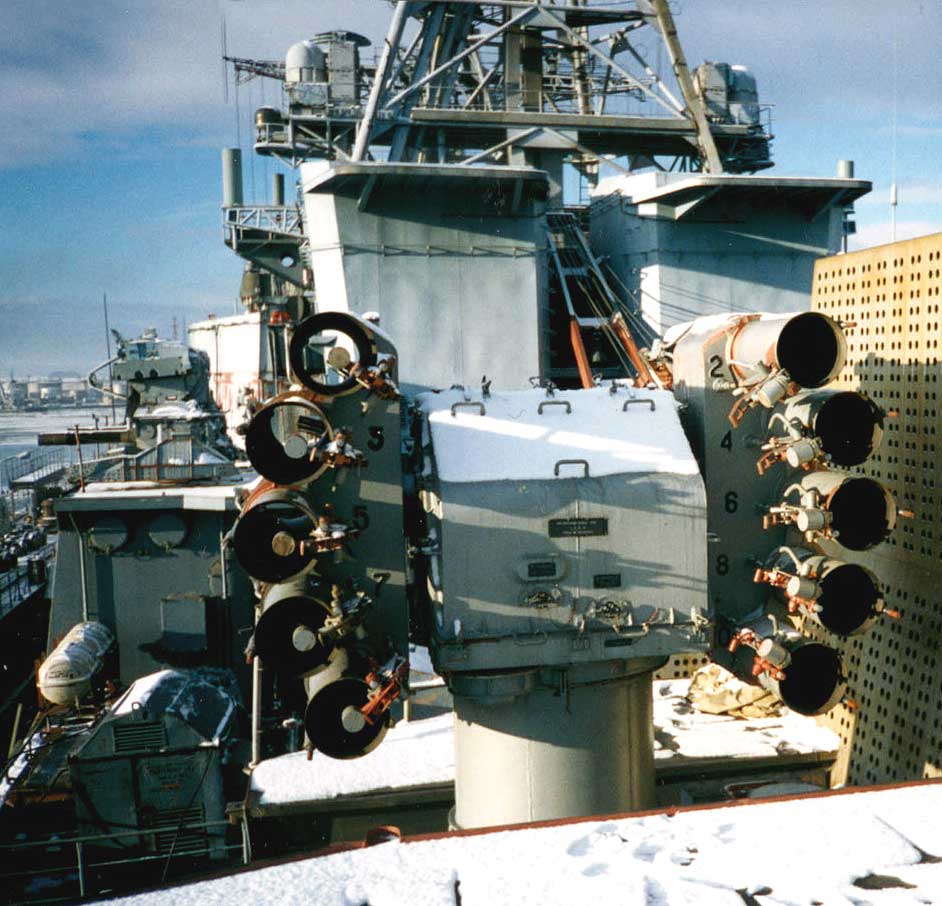
I wonder what those large cylindrical objects beside the Type730 and FL3000N are? They appear to be on a rotating mount and are similar in shape to a searchlight, could they be RBU, or some form of defensive chaff launcher?
My buess (BestgUESS)would be RBU-12000 / UDAV-1M.
The UDAV-1 system is designed to use different types of rockets for highly efficient multi-layer defence of surface ships against torpedoes. The system is also capable of engaging submarines and frogmen.
The system comprises: the KT-153 remotely controlled multi-barrel automated launcher with indirect elevation/traverse stabilisation; the 111SG depth-charge rockets with HE warhead and impact-time fuse to engage underwater targets; the 111SZ mine-laying rockets with hydroacoustic proximity fuse for remote mining of a water area to make a barrier for incoming torpedoes; the 111SO decoy rockets to divert homing torpedoes from the surface ship by creating false acoustic target; the fire control devices; the ammunition lading device; ground support equipment.
The UDAV-1 MLRS operates in conjunction with the ship’s sonar.
http://warfare.ru/?lang=&catid=267&linkid=1735

WanshanWhy would Australia be even modestly relevant in a hypotetical war between China and the US? The center of the action would most certainly be over nearby South Korean and Japanese territories, never in VERY peripheral Australia (which by the way is located between 4800 and 7400 Kilometers away from the Taiwan Strait!)…
Best Regards,
Hammer
Huh? (can’t follow: didn’t talk about Australia, neither did the article)
WanshanApart from the sanctions preventing this currently – I doubt very much China or Russia find Iran a particularly comfortable client and Iran is in a very weak bargaining position IMO and needs to be as self-sufficient as possible otherwise the end up paying money for goods they will never receive.
Of course if they really want to annoy the US they could sign an agreement with China to sell their oil exclusively to China at below OPEC rates, and give China sea, air and land basing rights, in return for say 6 new Type 056 Corvettes, 3 – 4 squadrons of JF-17 and a couple of regiment’s worth of advanced SAM’s such as the HongQi 9 which was “inspired” by the Patriot missile.
That’s way too large an investment. They only need to provide just enough support to Iran to keep the country in the game, as a drain on US resources.
WanshanThe latest reports on the current Iranian air-defence exercises are saying that Iran’s S-300-class missile is a locally upgraded version of the S-200.
Right ….. :rolleyes:

S-200 missile (5V28V)
Weight 7 100 kg
Length 10.8 m

Lightest original S-300 missile (5V55K/KD)
Weight 1 450 kg
Length 7 m
Heaviest S-300 missile (48N6E2)
Weight 1 800 kg
Length 7.5 m
WanshanWanshanFirst Chinese aircraft carrier nears completion
CHINA’S first aircraft carrier, built on the hull of an abandoned Soviet warship, is nearing completion, according to Western analysts.
The arrival of China as a member of the carrier club would be the most potent symbol of the country’s burgeoning military power, even if its first model is based on a rehashed version of a warship that was never finished by its original owners. The Soviet Union collapsed before work could be completed.The Varyag is expected to make its maiden voyage next year or 2012. “Photos regularly reveal an increasing tempo of work on the Varyag,” Richard Fisher, an authority on the Chinese military at the International Assessment and Strategy Centre in Alexandria, Virginia, said yesterday.
Full Story
“an increasing tempo of work” …???!?!??
At best, we’re able to observe more visible work but that doesn’t mean faster work. And of course, major surgery as on the island structure takes longer and proceeds slower than installation of more numerous smaller elements e.g. sensors, weapons etc. There is no way of telling how fast work was conducted internally.
:rolleyes:
WanshanHere’s that russian system I was talking about earlier. The vehicle is a GAZ 39371 ‘Vodnik’, one of many possible carriers. The optronic system is called “Fenix” or “Phoenix” and the AD unit has 4×2 (4×3?) Igla and 2x 7.62 HMG. The Feniks-ME module, manufactured by Opto-Electronic Technologies DS JSC, is designed to support firing of the Igla-S, Mistral, Stinger and other AD missiles from the GAZ-39373, BTR-80, BTR-90, etc.
http://www.army-guide.com/eng/product1681.html
A new development, unveiled in 2001, is the PHOENIX air defence system installed on the VODNIK 4×4 vehicie (a Russian counterpart of the US HUMMER). PHOENIX carries eight IGLA-S missiles but its unique feature is a brand-new thermal imaging seeker with 360° coverage. This device is said to be able to detect a fighter aircraft from a range of 15km, a helicopter from 10km and a guided air-to-surface missile from 5km. In addition to the VODNIK, PHOENIX can be installed on other vehicles of either Russian or foreign origin as well as smali naval vessel.
WanshanThe missile itself is an IR or Radar missile. The acquisition and launch of the missile is all radar based, no IRST IIRC.
SYSTEM OPERATION
1. Target is acquired and tracked by
3-D target acquisition radar
2. Missile is launched and flies to a
lock-on point, using an on-board
inertial navigation subsystem
3. IR seeker locks on and missile
intercepts target under seeker
control
4. Continuous updating of target
course from surface radar during
missile flight, via a telecommand
link, to enable engagement of
manoeuvring targets.
http://www.deneldynamics.co.za/brochures/Broc0266_Umkhonto-IR%20external.pdf
Of course, there’s no reason why you couldn’t use an IRST like Sirius instead of a 3D radar….
WanshanThanks, interesting survivable stuff, here’s what i found:
The scanner provides coverage over a wide field of view in azimuth with an elevation baseline adjustment. It covers 240° in azimuth and -7 to +17° in elevation.
3 jeep’s with a sensor each, linked up to a 4th jeep with a rack of missiles should be a fine AD.
Why settle for 240×17 degrees (ADAD) when you can have 360×18 (FIRST)?
Thales SIRIUS – (Naval) Long range infrared search and track system (1200kg)
http://www.thalesgroup.com/Pages/PressRelease.aspx?id=5916
You get a nice passive detection system if you couple an IRST (e.g. ADAD, FIRST) to ECM (eg boxes on SA-9/13 command vehicles) and sound detection (e.g. Rafael’s Helispot) and construct an integrated pic of the battle space though sensor fusion techniques.
The Helispot system detects, identifies and tracks approaching helicopters from a 10 to 12 kilometer range. While radar, infra-red and other optical detection systems must have line-of-sight to the target, Helispot can operate without line-of-sight. Like IR and ECM, it is immune to screening or jamming counter-measures as it is a fully passive system.
More here: http://www.fas.org/irp/agency/dod/jason/infrasound.pdf
WanshanLike the british ADAD (Air Defence Alerting Device), which is an infra red thermal imaging surveillance system.
ADAD was developed by Thorn EMI Electronics, Electro-Optics Division, Pilkington Optronics, now Thales Optronics (part of Thales Land & Joint Systems), as a lightweight, compact, autonomous system which detects rotary- and fixed-wing aircraft through their infra-red emissions and then indicates their bearing and elevation to the operator. A version developed for use with the vehicle-borne Starstreak missile automatically slews the weapon sight onto the target’s bearing and elevation. The use of ADAD requires that the vehicle be, briefly, stationary. SP HVM Starstreak with ADAD entered service with the British Army in October 1995. ADAD has also been selected by the German Air Mobile Forces’ LeFlaSys (ASRAD) Light Mechanised Short-Range Air Defense System (Wiesel II derived ‘Ozelot’ vehicle). Pilkington Optronics has also developed the Protector system, which employs the Adad as a cueing device for a trailer-mounted electro-optical target acquisition and tracking unit, carrying an auto-track camera and a laser ranger. This provides precise target positions for up to six guns, which individually compute the required firing elevation and lead-angle.


http://www.armedforces.co.uk/army/listings/l0115.html
http://www.janes.com/articles/Janes-Electro-Optic-Systems/Thales-Air-Defence-Alerting-Device-ADAD-air-defence-sensor-United-Kingdom.html
http://www.army-technology.com/projects/starstreak/
http://www.army-technology.com/projects/leflasys/
A similar system is the German Rheinmetall/Diehl Fast InfraRed Search-and-Track (FIRST). This is a land-based IRST offering 360° passive surveillance imagery, claimed to be better than a SHORAD radar.FIRST is claimed to meet all the challenges of an air defence unit, from fighters through attack helicopters to cruise missiles, UAVs and other smart weapons. It can be deployed as either a stand-alone unit integrated with a static surveillance or air defence unit or on a vehicle-based air defence unit.A maritime version, known as FIRST Navy, has also been developed and trialled. Rheinmetall Aims among other things for Canadian Frigate Upgrade Business. It is likely to be part of future German groundbased air defences (SYsFla), including as ADAD replacement.

http://www.janes.com/articles/Janes-Electro-Optic-Systems/Rheinmetall-Diehl-Fast-InfraRed-Search-and-Track-FIRST-Germany.html
http://www.aviationweek.com/aw/blogs/defense/index.jsp?plckController=Blog&plckScript=blogScript&plckElementId=blogDest&plckBlogPage=BlogViewPost&plckPostId=Blog%3A27ec4a53-dcc8-42d0-bd3a-01329aef79a7Post%3A5019df1f-aace-41f7-b77f-cef9674560e8
http://www.defpro.com/daily/details/255/
There is also a russian wheeled AD system with 2×4 Igla with an 4-plane IRST system on top of the turret. However, I’m is from a good 10 years back and I am unable to locate pics and info about it at this time. Think I saw it in MilParade back in the day access online was free.
Traditionally, the use of irSt systems has been more common in naval than in land applications (due to lesser size/weight constraints, I suppose) e.g. Thales Artemis: http://defense-update.com/products/a/artemis.htm
WanshanI think you are missing my original point. As you can clearly see from the pics and your own descriptions, the Gorshkov has had its entire hull either rebuilt, or resurfaced and repainted. Just seeing the difference between the initial and final pics will illustrate that.
Errr, no I’m not. Rather, you seem to be playing games.
You point: “If you compare the pics from different stages of the refurbishment, or even from the beginning to present, the outer hull, at least, has been completely rebuilt and expanded. The deck and superstructure are also being rebuilt.”
The outer hull I take to mean the outside hull plating from the main deck down to the keel. Rebuilding I take to mean taking apart then putting back together again.
None of this has actually happened to most of the ship’s hull.
Modifications have been made to the main flight deck, elevator and the island. Again, these are done because of the requirement to effectively operate Mig29K. Not necessarily because the state of the main flight deck and superstructure had deteriorated to the point that it needed replacing. Such extensive modifications wouldn’t have been necessary to effectively operate Yak-38 or even Sea Harriers.
That is the difference between refurbishing/rebuilding (bringing back to working condition) and modifying (structural adaptations to a new role).
In comparison, the Kirovs that have been mostly sitting in port in the open like so many other semi-neglected ex-Soviet vessels will be in no state to serve that long unless a lot of structural work is done, which probably won’t be the case if they’re looking to bring them back to service by 2012-14.
“From 1999 “Admiral Nakhimov” has stood near a Sevmash berth. In spite of such a long period of inactivity, the cruiser was kept in good condition by the enterprise’ss services and crew. According to commissioning manager Boris Gulin, at that time the repair schedule is being updated. During 2008 shipbuilders were preparing for “discharge of reactor active zone” – that is the removal of the ship’s reactor’s core and replacement with a fresh core. Such a refueling operation could require several years to complete, suggesting that the Admiral Nakhimov was unlikely to return to active service prior to 2010″
http://www.globalsecurity.org/military/world/russia/1144-units.htm
WanshanJudge for yourself then.
The Gorshkov as it originally was before reconstruction work began.
Even the hull was rebuilt. My point here is that the Vikramaditya can comfortably be expected to last another 30 years because of the extent of reworking. If the Kirovs are expected to last a similar period then everything from the cabling to the steel in the hull and superstructure will have to be refurbished.
You’ve only illustrated how the skijump was ‘grafted’ onto the original bow and how a deck extension was installed on the port side, going around the island. There is no evidence in any of these pics that work on the lower portion of the outer hull involved systematic removal of all the original hull plates and installation of new hull plates in their place. Clearly, the entire lower outer hull was cleaned and made rustfree. I’m sure that in areas with really bad steel condition and corrision, some patchwork must have been doned. The entire lower outer hull was then primed and repainted. This would be normal and expected after such a long time of inactivity and neglect. However, it is nothing like a complete outer hull rebuilding because that hull was so bad. What took place IS part of refurbishing and, more importantly, modifying the ship and adapting it to its new intended role. Modifications (=alterations) are distinct from refurbishment (=maintenance)
The Vikramaditya project involves extensive modifications to the original ship. The cruiser-carrier’s guns, anti-shipping and anti-air missile launchers on the front deck are being removed and replaced with a full runway and ski jump, the deck must be widened in numerous places, its boilers are being changed out to run on diesel fuel, the rear aircraft elevator is being enlarged and strengthened, and other modifications like wiring replacement are necessary to make Gorshkov a fully modern ship.
Many of Gorshkov’s key modifications are aircraft-related, including the new arrester gear and ski jump. New boilers and wiring are the other major components.
The original carrier’s complement was 12 Yak-38 Forger V/STOL fighters, 12 Ka-28 helicopters, and 2 Ka-31 airborne early warning helicopters. The removal of the Gorshkov’s forward missiles, addition of the ski ramp, and other modifications will improve the ship’s air complement somewhat.
Carriage ranges given for the refitted Vikramaditya seem to average 12-16 fighters and 4-16 of the compact Ka-28/31 helicopters; diagrams seem to suggest total stowage space for a “footprint” of no more than 15-16 MiG-29Ks, with each Kamov helicopter sporting a comparative footprint of about 0.4, and about 5-6 open footprint spots on deck.
http://www.defenseindustrydaily.com/ins-vikramaditya-may-hit-delay-cost-increases-03283/
I.e. the structural work on the deck and superstructure is all related to its intended use as a Mig-29 equipped carrier. A greater number of larger, heavier and non-STOVL fighter aircraft neccessitates many structural modifications (in addition to any refurbishments).
Mig-29K (percentage relative to Yak 38)
Length: 17.3 m (57.76 ft) = 106%
Wingspan: 11.99 m (39.34 ft) = 164%
Height: 4.40 m (14.44 ft) = 104%
Wing area: 43 m² (462 ft²) = 232%
Loaded weight: 18,550 kg (40,900 lb) = ?
Max takeoff weight: 24,500 kg (54,000 lb) = 217%
Powerplant: 2× Klimov RD-33MK afterburning turbofans, 9,000 kgf (88.3 kN, 19,800 lbf) each
Armament
1 x 30 mm GSh-30-1 cannon with 100 rounds
9 hardpoints: 8 x under-wing, 1 x centerline for up to 5,500 kg (12,125 lb) of weapons and fuel tanks = 275%
Yak-38M
Crew: One
Length: 16.37 m (50 ft 1 in)
Wingspan: 7.32 m (24 ft 0 in)
Height: 4.25 m (14 ft 5 in)
Wing area: 18.5 m² (199 ft²)
Empty weight: 7,385 kg (16,281 lb)
Loaded weight: kg (lb)
Max takeoff weight: 11,300 kg (28,700 lb)
Powerplant: 1 x Tumansky R-28 V-300 turbojet, 66.7 kN (15,000 lbf)
Powerplant: 2× Rybinsk RD-38 turbojets, 31.9 kN (7,870 lbf>) each
Armament
Guns: GSh-23L 23mm gun pod (GP-9). This gun could be carried in one or two PUK-23-250 pods fixed under the external pylons of wings.
Bombs: two FAB-500 or four FAB-250 under pylons, two incendiary ZB-500, or two nuclear tactical RN-28.
Max Payload 4,410 lb (2,000 kg)
Wanshan“no rebuild took place there at all.”
Yeah, except for the part where they pulled all the wiring and rewired the entire ship. There isnt an inch of the ship that didnt see work done on it, electrical if no other kind. The real cause for all these delays is the rewiring job. Altogether there is only a couple thousand miles worth of wiring being installed, totally an easy job….. :rolleyes:
With the Kirovs practically the entire superstructure will need to go because all those obsolete antennas will need to go.
FYI, I was responding to this remark by Witcha “the outer hull, at least, has been completely rebuilt and expanded. The deck and superstructure are also being rebuilt”
The rebuild of the deck is because of intended Mig29 operations, not necessarily because the deck as such was bad. The rest of the OUTER hull was NOT rebuild. None of this has anything to do with rewiring.
As for your remark about the Kirov’s superstructure needing to go because of new antennae, see Veliky: new antenna installation didn’t involve superstructure work.
WanshanEr, no. If you compare the pics from different stages of the refurbishment, or even from the beginning to present, the outer hull, at least, has been completely rebuilt and expanded. The deck and superstructure are also being rebuilt.
With Gorshkov – the carrier – let’s not confuse refurbishment with modification: in order to operate Mig29s (for which it was not designed) the deck needed to be strengthened, enlarged and a skijump added. That is not the same as refurbishing. The outer hull from the flight deck down was left untouched: no rebuild took place there at all.
WanshanSKorean navy ship sinking after boat collision
A South Korean navy ship was sinking after colliding with a larger fishing boat late Wednesday, leaving one sailor dead and two missing, the military said.
The 150-ton navy vessel was returning to its base following a routine patrol mission when it collided with a 270-ton fishing boat in the waters northwest of the southern resort island of Jeju, a spokesman at the Joint Chiefs of Staff said.
Twenty-eight navy sailors were rescued but one of them died while being treated at a hospital on the island. Two others were still missing, the spokesman said on condition of anonymity citing department policy.
Full Story
Wondering under what conditions this occurred (day/night, rough/calm weather, fog/clear etc.)


 Sign In








