Wanshan
The distance of the SAM does not matter, the quality of the system does, increase the distance of the missile to 150kms, what good will that do, if the aggressor can see your ship a huge, massive chunk of metal at 300 kms distance, they can fire their missiles and stay away from the effective area of your SAM systems, then its the same game of shooting down the missiles.
The point was about which threats there may be against IN. You suggested there weren’t any that the current capability can’t deal with. I beg to differ. A ship not in EMCON will give its position away irrespective of whether or not it is stealthy. (how do ships at sea detect air threats severla hundreds of km away without going active?) Besides, the agressor by have an SSK shadowing a group of opposing vessels, again making the radar related stealthiness of ships less relevant.
If a navy has an aircraft carrier with a squadron or two of naval fixed wing fighter aircrafts, they could send these aircrafts to deny the hostile aircraft an opportunity to fire their weapons.
Yes they could, if they detected them. How well will a SHAR handle a Su-30MK#? Or a Mig-29 an F15E? How many will be available to defend the task group?
The total area out to which a ship can provide cover can be off-set by distributing the capability amongst your vessels, for e.g the frigates carry very near the same sensors, systems and weapons as the destroyers, and thus they can provide a screen for a major vessel like a Aircraft carrier.
Then the issue about an AAW vessel becomes a moot point because all escorting vessels are considered AAW vessels (but none of these is particularly specialized and hence all are less capable than a specialised vessel would be, unless all are top of the line AAW ships, which they aren’t)
No i was responding to the very elaborate list of planes you had quoted and making my point that the real threat is the one you can not detect in time, a plane and a missile in open sea can be found through sensors at long ranges and appropriate countermeasures can be taken to respond.
Without going active and revaeling the position of the stealthy ship?
With what will the IN see the incoming aircraft/missiles? AEWH?
“There are only four helicopter-based AEW platforms in existence. One is the Royal Navy Sea King ASaC7 naval helicopter. It is operated from the Royal Navy’s Invincible-class aircraft carriers. The creation of Sea King ASaC7, and earlier AEW.2 and AEW.5 is the consequence of the harsh lessons learnt by the Royal Navy task force sent to the South Atlantic in the 1982 Falklands War. The lack of AEW coverage for the task force was a major tactical shortcoming at the time. Also, the Spanish Navy fields the SH-3 Sea King in the very same role, operated from the carriers Principe de Asturias and Juan Carlos I
Another helicopter is the Russian-built Kamov Ka-31, deployed by Indian Navy on Krivak-III frigates and reportedly used by the Russian Navy on its sole Kuznetsov aircraft carrier. It is fitted with E-801M Oko (Eye) airborne electronic warfare radar which can track up to 20 targets simultaneously with aerial detection range 90 mi (150 km) and surface warships up to 160 mi (250 km).
The most modern helicopter-based AEW is the AgustaWestland EH101 AEW of the Italian Navy.”
http://en.wikipedia.org/wiki/Airborne_early_warning_and_control
Su-30
Kh-31A mod 1 50 km.
Kh-31A mod 2 69 km.
Kh-31P mod 1 150 km.
Kh-31P mod 2 200 km.
Kh-59ME : 200 km (110 nmi)
Kh-59MK : 285 km (150 nmi)
A few pairs of aircraft on different vectors and there you have it.
WanshanGot that covered with the planned capability to accomplish GoIs objectives in the region.
The biggest threat sails under the water, and that is where the IN lacks in offensive and defensive capability.
With 45km russian missiles and -eventually – 70km israeli missiles, you mean you don’t think AShM equipped aircraft out to 1500km from nearest shores are a problem?
Are we switching the discussion now from AAW to ASW?
WanshanThat was the way how one of the first Russian ASMs KSSch was operating, which dropped warhead into water app. 60 m from the target.
What would happen to the delivery vehicle? Would this also hit the target (double whammy)?
WanshanI don’t think IN can see any hostile nation in the IOR which require more than the projected capability(the ships work with the two fleets).
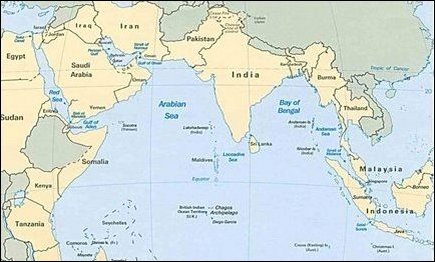
Just to get an idea of the distances involved
Colombo (Sri Lanka) to Jakarta (Indonesia) is 3301.7 km (1781.6 nmi)
Colombo (Sri Lanka) to Mogadishu (Somalia) is 3836.1 km (2070 nmi)
Colombo to Mekka (Kingdom of Saudi Arabia) is 4601.4km (2482.9)
Colombo to Jerusalem (Israel) is 5371.9 km (2898.7 nmi)
SLOC choke-points are
Suez canal
South African Cape
Malacca Strait
Hormuz Strait
The (unrefueled) ferry range of the Su-30 is 3,000 km (1,620 nmi) at altitude.
Combat radius is 1600km without refuelling
Su 30 operators in the region include: People’s Republic of China, Indonesia, Malaysia, Vietnam, Russia
The unrefueled range of the Su-27 is 3,530 km (2,070 mi) at altitude; (1,340 km / 800 mi at sea level). The Su-27 Flanker typical combat radius is 1500km
Su-27 operators in the region include Angola, People’s Republic of China, Eritrea, Ethiopia, Indonesia, Vietnam, Russia
The ferry range of F-15E is 3,900km (2,100 nmi) with conformal fuel tank and three external fuel tanks.
Operators include Israel, Saudi Arabia, Singapore
As for unrefueled ranges of the F/A-18C/D
Combat radius: 400 nmi (460 mi, 740 km) on air-air mission
Ferry range: 1,800 nmi (2,070 mi, 3,330 km)
Operators include Australia, Kuwait, Malaysia
F/A-18E/F
Combat radius: 390 nmi (449 mi, 722 km) for interdiction mission[92]
Ferry range: 1,800 nmi (2,070 mi, 3,330 km)
Operators include Australia
Panavia Tornado IDS
Range: 1,390 km (870 mi) typical combat
Ferry range: 3,890 km (2,417 mi) with four external drop tanks
Operators include Saudi Arabia.
Xian JH-7
Combat radius: 1,759 km (890 nm, 1,093 mi)
Ferry range: 3,700 km (1,970 nm, 2,299 mi)
Operator People’s Republic of China
Su-24 Fencer
Combat radius: 615 km in a lo-lo-lo attack mission with 3,000 kg (6,615 lb) ordnance and external tanks
Ferry range: 2,775 km (1,500 nm, 1,725 mi)
Operators include Russia, Syria, Iran, Angola
Further, consider ‘old school’ bombers such as
Harbin H-5/Il-28 Beagle
Range: 2,180 km (1,177 nmi, 1,350 mi)
Operators: People’s Republic of China (?), Egypt, Somalia, Yemen (?)
Harbin H-6 /Tu-16;
Range: 6,000 km (3,200 nm, 3,700 mi)
Combat radius: 1,800 km (970 nm, 1,100 mi), Turbofan powered K-version 3,500 kilometres (2,200 mi)
Operators include: People’s Republic of China, Egypt, Indonesia, Russia
Further, with the Russian AF
Su-34: Combat radius 1,100 km (680 mi) Ferry range: 4,000 km (2,490 mi)
Tu-22M3: Combat radius: 2,410 km (1,500 mi) with typical weapons load
T95/Tu142: Range: 15,000 km (8,100 nmi, 9,400 mi) unrefueled, Combat radius: 6,500 km (3,454 nmi, 3,977 mi)
Tu160: Range: 12,300 km (7,643 mi) practical range without in-flight refuelling, Mach 0.77 and carrying 6 × Kh-55SM dropped at mid range and 5% fuel reserves. Combat radius: 7,300 km[31] (3,994 nmi, 4,536 mi) , 2,000 km (1,080 nmi, 1,240 mi) at Mach 1.5.
I’ve not considered F16 and Mig29, but these could obviously play a role, assisted by tankers.
F16 > Bahrain, Egypt, Jordan, Indonesia, Israel, Oman, Pakistan, Singapore, Thailand, UAE
Mig-29 > Eritrea, Iran, Malaysia, Myanmar, Russia, Sudan, Syria, Yemen
Quite a few of the above countries actually also have aerial refuelling capability:
Australia (A330 MRTT)
Indonesia (C-130)
Iran (B-707, B-747)
Israel (B-707, C-130)
Kuwait (C-130)
Malaysia (C-130)
People’s Republic of China (H-6, Il-78)
Russia (Il-78)
Saudi Arabia (C-130, KE-3A, A-330 MRTT)
Singapore (C-130)
Wanshanpictures or it didn’t happen:cool:
I suspect ‘succesful’ means it hit its intended target (rather than just that it launched and flew correctly)?
WanshanI have a document that claims Vulkan and possible Sandbox (I don’t have the doc handy at the moment) supposedly dove below the waterline just before impact. Any truth to this?
I’ld expect that move to cause the missile to break up and disintegrate.
WanshanHi,
the folded blade feature on the Appaches is a standard or is specific to the versions aboard Invencible?
regards
Ayala Botto
Lisbon, Portugal
I think it has become standard on A and D models, it is at least available in kit form. A blade fold kit, developed by The Boeing Company for use on the WAH-64 Apache Longbow, was unveiled Sept. 28 1998 in Mesa, Ariz., at the rollout of the first WAH-64 Apache Longbow for the United Kingdom. The US adopted it in 2003 after the US Army asked Boeing to develop a system that would substantially reduce the time it takes to reassemble and have Apaches ready to fly after they roll off a transport. The blade fold system, produced by Boeing in Mesa, Ariz., speeds deployment of the Apaches shipped by cargo aircraft. The new blade fold system allows the main rotor blades to be folded along the aircraft’s length without being removed. The solution also provides for storage of the Apache Longbow’s radar dome on the aircraft aft of the rotor hub for transport. Also available for the Blackhawk and variants. This blade fold kit allows a maintenance team to fold and drop the blades on the Black Hawk for air-transportability. Blade fold is fully manual so that operations may be accomplished in undeveloped areas.
http://www.boeing.com/rotorcraft/military/ah64d/news/1998/news_release_981015n.htm
http://www.boeing.com/rotorcraft/military/ah64d/news/2003/q2/nr_030619m.html
http://www.davisaircraftproducts.com/products/helicopter-blade-restraint-systems-and-hoist-clamps/helicopter-blade-restraint-systems1/boeing-apache-ah-64.html
http://www.davisaircraftproducts.com/products/helicopter-blade-restraint-systems-and-hoist-clamps/helicopter-blade-restraint-systems1/sikorsky-uh-60-series.html
http://www.tpub.com/content/ahapache/TB-1-1520-238-20-135/TB-1-1520-238-20-1350001.htm
Wanshanan 18-year overhaul …… >chuckle<
WanshanSo it seems that the IN is getting 2 decommissioned Osprey class minesweepers from the US.
Derivative design of the Italian Lerici/Gaeta class, which also served as the basis for ships of the Royal Malaysian Navy (as the Mahamiru class), the Nigerian Navy, the Royal Australian Navy (as the Huon class), the Royal Thai Navy (as the Lat Ya class) and the Mito class under construction for the Finnish Navy. The Republic of Korea Navy apparently operates an unlicensed derivative (Swallow class).
Wanshanin that case it was a meaningless discussion. P15B is not intended to be AAW anyway, much less world or any other class.
I think that was Jonesy’s point to begin with.
WanshanThat there is no way Project 15B will be built outside India.
Even if that is so, it doesn’t mean it will be a worldclass AAW ship (which I think the original discussion was about).
Wanshanwhich source have proven reliable in the past?
http://3.bp.blogspot.com/_QKkSf03VuFY/S60QNOHPKvI/AAAAAAAACXA/yA5tTupF2hk/s1600/DSC02248.JPG
Photo: INS Kolkata– Suman Sharma, Defexpo-2010Kolkata class models and drawing over the last decade have changed their superstructure and work was done on heat, sound and radar emissions as the project progressed, more work will be done on the project, priority will be given to build time first and cost, its not that hard to see that, the navy needs these ships.
One argument put forward was that it would not be wise to manufacture the ship abroad as it incorporated advanced indigenously developed stealth features
http://www.indianexpress.com/news/navy-seals-45-000cr-deal-seven-warships/479132/2The GRSE-DCNS-Vison comptech JV is expected to work with Directorate General of Naval Design for the design.
http://www.business-standard.com/india/news/seven-new-stealth-frigates-to-be-built-in-india/365019/Its another generation of naval design which includes institutions that designed the previous frigates and most of the people involved will be the same.
Not sure what point or points you are actually trying to make now.
WanshanThere has been plenty of news about P-15B, nearly all suggests it is a follow on variant of P-15, will have the same propulsion, machinery systems, some weapon systems might be added/changed depending on their availability, the Israeli sensors, weapons and management systems will remain the same, their will be changes to the superstructure, much like their were changes made to the existing P-15A destroyers as new requirements were added (the design started out different).
http://www.bharat-rakshak.com/NAVY/Images/P15a.jpg
http://i31.tinypic.com/23r41l.jpga completely new design will require the whole process to start again, and IN has issues with the build time and project costs.
If there has been news about it, let’s see some references to sources that have proven reliable in the past. CGs that are about P15A are not cutting it.
Mod Edit: Please do not post substantial cut-and-pastes from external sources.
We have had complaints from other publishers about this practice.
A summary and a link is quite sufficient.
My apologies.
The design will be done in India, with consulting where ever it is required, that is the trend that can be followed back to the last few decades. All the institutions involved in defining, designing, and constructing the project will be the same ones that were involved with the Shivalik Class.
So?
The construction will include new modular techniques and the navy wanted the first two to be built in shipyards with experience while the methods were absorbed into Indian shipyards, however now the Ministry of defence has decided that all of the ships will be built in India
http://www.business-standard.com/india/news/seven-new-stealth-frigates-to-be-built-in-india/365019/
“A Request for Information (RFI) was reportedly issued to about 12 international firms, mostly in Europe and Russia. By soliciting tenders from so many foreign firms, and insisting on improved stealth requirements, India is implicitly creating the option of having Project 17-A ships use a very different base design than the Project 17 Shivalik class frigates.”
http://www.defenseindustrydaily.com/india-issues-rfi-for-stealth-frigates-02866/
… even if they were all to be build in India.
WanshanThe Israeli Barak 8 and ER are still in the late developmental phase, the sensor and associated hardware software technology has a lot of work done through the generations, its not like this is the first project they are completing, and the program was selected after considering all available options.
The Kolkata class is a generational development of IN designs, AAW that the Indian navy needs, and is cutting edge in that respect, with a 15-B follow up to the design (as the current one dates back to near 2000), an entire generation of ships displaying designs built to the Indian Navies requirements, instead of it being the other way around. Of-course that also means utilising consulting where it is required, for example the work which will be done upon the Project-15B for signature management (sound, radar and infrared) will be worth good millions of pounds and the BAE with its experience can offer this consulting service.
Kolkata (P15A) is a redesigned Delhi (P15, which is modelled after the Sovremenny concept), much in the same way the Talwar is a redesigned Krivak III. P-15B should probably be viewed more as a P17 relative to a Krivak III or P-17A relative to Talwar.
Of course, P-17A may well be a non-Indian product. From Bharat-Rakshak:
“Project 17A (P17A) is the next generation of surface combatants, which form part of the ongoing Project 17 (P17) program of multi-role stealth frigates. A total of seven vessels is projected in this element of the program, with the Indian Navy having issued an RFI (Request for Information) in late 2006. The RFI has been issued to numerous European and Russian shipyards, with the plan involving the first vessel to be built in an international shipyard and the remaining six vessels to be constructed in India itself.”
This means it is by no means a given it will be a development of the current P17.
Interestingly, also from Bharat-Rakshak:
“In March 2009, the Defence Acquisition Council (DAC) which is the apex procurement body in the Indian Ministry of Defence (MoD) approved four vessels for construction at MDL. Production is slated to commence in 2010. No other details are available.”
P-15B is still shrouded in mystery, there is no way of telling how cutting edge it is or isn’t.
WanshanThey didn’t go off…:eek:
>Chuckles<
All nicely hit the hull`though 😉


 Sign In