 Bager1968
Except that (as we all expected) the WTO just ruled that Boeing got “illegal government subsidies”.
Which means that both Boeing and Airbus are back on the same footing in that respect.
Which leaves US Aerospace… whose major partner Antonov receives subsidies from the Ukrainian & Russian governments.
Bager1968IIRC, I may still have an old AI issue which included phots and 3 views of what was proposed circa 1987… not an under-the-tail ramp, but at the time the mock-up was a side loading cargo door and deployable ramp
If you had clicked on the link in my post, you would have noted that there were 3 different versions on offer in 1987:
FLIGHT INTERNATIONAL, 1 August 1987
A militarised version of the BAe 146QT, the BAe 146MSL (Military Side Loader) has the standard upward opening 131in-wide side cargo door, while the BAe 146MT (Military Tanker) features underwing flight refuelling pods to give the aircraft a dual-point aerial refuelling capability which is compatible with most combat aircraft.
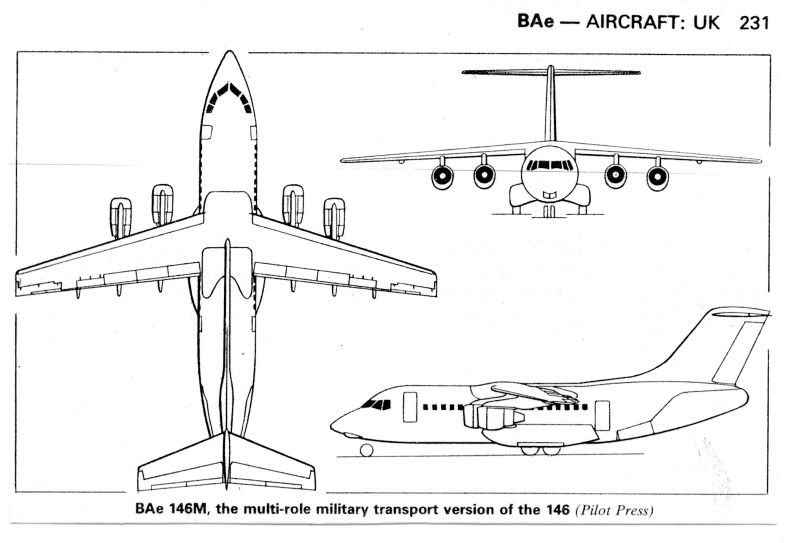
A BAE 146M (Military Rear Loader) variant offers large hydraulically operated rear-loading-ramp doors allied to a lowered main deck floor capable of accepting larger and/or heavy payloads. The main undercarriage will be redesigned to tandem configuration and housed in fuselage sponsons.
The range of any of these models can be extended by the installation of a flight refuelling probe above the flightdeck.
Bager1968Although RAM treatment is totally pointless in Afghanistan or any other likely place, it may mess up the plane for a future major maintenance cost if you don’t keep it in shape. It will cost more in that respect.
Which is why the F-35 is designed to be easy to maintain(to include its RAM).
Precisely… the F-35 has the RAM material fused into the composite skin of the aircraft… it is a physical part of the aircraft, not an externally-applied coating like on the F-117/B-2/F-22.
Thus, far less “stealth-related” maintenance, and far fewer concerns about field maintenance.
Bager1968Besides, no US carrier had that funnel shape!
Definitely not USS Antietam… during her Jan-March 1955 med-cruise she carried S2F-1 (VS-26), HSS-1 (HS-1), and AD-5W (VC-12 Det.)… no Cutlasses.
Browsing here: http://navysite.de/carriers.htm (click on the carrier you want then scan down the page until you find a sentence telling you to “click here” to see a list of deployments) finds this, however.
USS INTREPID CV-11: March 12, 1956-September 5, 1956; CVG-8; VA-83 (F7U-8); Tail code E; Area of Operations: Mediterranean (her tail code for her 1955 Med-cruise was F, and she had no F7U aboard then).
The ship that had tail code E assigned in 1955 was USS Lake Champlain CV-39… but she had no F7U aboard for her September 28, 1954-April 22, 1955 Med-cruise.
The only other ship to carry F7Us into the Med in 1954-57 (the only years the F7U was deployed aboard ship) was:
USS Ticonderoga CV-14: November 4, 1955-August 2, 1956; VA-66 (F7U-3); Tail code K
Thus, it seems that 1956 must be the actual year of the photo and CV-11 USS Intrepid the ship… especially as you can make out VA-83 on the port vertical stabilizer of the Cutlass!!
The only units to have taken the type to sea were:
VF-124, USS Hancock (CVA-19), August 1955 – March 1956; VF-81, USS Ticonderoga (CVA-14), November 1955 – August 1956; VF-86, USS Forrestal (CVA-59), January – March 1956; VF-83, USS Intrepid (CVA-11), March – September 1956; VF-212, USS Bon Homme Richard (CVA-31), August 1956 – February 1957.
Bager1968Just as an example of how I think the mods want things to work…
A few months ago, PhantomII started a thread on the F-100*.
While I was back-checking to see if any old threads had pertinent info, I found a question from a similar thread from 2006 that was never answered. Since I had recently come across the exact info the poster was asking about, I answered him… but NOT in the old thread.
I looked up the poster in the “members” area and found he was still active (had posted recently).
Since there was a currently-running thread on the aircraft, I put my answer there in the new thread, but quoting the question from the old thread and linking to it.
If, however, there had not been a currently-running thread, I would have answered in the old thread and it would have been fine, because my thread-resurrecting post would have been pertinent & relevant to that thread, and provided new info that answered an unanswered question in that thread.
* actually, he started 2 copies of the same thread, one in Historic (which quickly died from a bad case of being ignored) then the second (more successful) one in Modern Military.
Bager1968For the “new production Harrier II” crowd…
Between 1969 and 2003, 824 Harrier variants were delivered. While manufacture of new Harriers concluded in 1997, the last remanufactured aircraft (Harrier II Plus configuration) was delivered in December 2003 which ended the Harrier production line.
13 years since the last new whole airframes were produced, and 7 years since the last new airframe components were produced (the remanufacture hung a new fuselage under overhauled main wings & tail structures, with refurbished engines stuffed into them).
All the subcontractors who built the airframe components have long since gone to building other things (and some have likely gone out of business), and the production jigs, etc have been scrapped (unless the government paid for them to be stored… and is still paying the storage fees).
Likewise, McDD (bought by Boeing) will have disposed of anything required solely for “whole-aircraft” manufacture (again, unless the government is paying them to store them).
The possibility of re-starting production of new Harriers is very unlikely… unless a large sum of money is spent up-front to re-establish the capability to build them.
Bager1968I guess BAe forgot they already tried to market a “BAe 146M” in 1987… and it didn’t sell then.
Full details here:
http://forum.keypublishing.com/showpost.php?p=1391920&postcount=11
Bager1968The UK built 4 ships of the Invinivible class and one slightly larger derivative so the size and scale are not outside the realm of possibility.
No, they didn’t!
The UK built 3 Invincible class ships, and that “slightly larger derivative” came 13 years after the last of those 3!
Bager1968Some grate footage here,
Mark
Nope… that footage doesn’t grate* on me at all… if fact, it appears rather great**!
Bager1968EDIT: Also I thought the Canberra’s are being built at a cost of about £1 billion a ship, therefore two LHD’s would be ~£2 billion compared to £5.2 billion for the CVF’s!?!
The ship cost is £3.9 billion for the CVF’s… £1.3 billion was development costs (already spent & gone with no possibility of recovery).
Subtract the £1.25 billion already contractually obligated, and you get a maximum “savings” of £2.65 billion.
Then you spend ~£2 billion for your two LHD’s (actually more, as there would be a few detail changes for UK-specific equipment.
That is if they are built in Spain, as the RAN’s Canberra class is… which means virtually no taxes being returned to the UK Treasury… unlike now, where a lot of taxes are coming back on all the salaries & other “in-UK” purchases.
So you save at most £650 million and get two smaller, less-capable ships.
Not really much of a good deal, it seems to me.
Bager1968Daring’s crew (including Captain & OOW) are in the clear here.
She was being moved with assistance of tugs, and one tug suffered an engineering casualty, causing her to veer into Daring’s side.
Bager1968If conditions are perfect, you don’t need much vertical stabilizer at all.
B-52H 61-023: 1964-01-10, over New Mexico… landed safely in Arkansas (it took hours to find a B-52 base with no ground winds and to plan the landing attempt).
Of course, this was one of a series of vertical stabilizer failures after the change from high-altitude to low-altitude bombing… something the B-52 wasn’t designed for (sounds familiar, right V-bomber force?)… the other 3 aircraft crashed*, with fatalities.
1963-01-24 B-52C 53-0406, 7 dead 2 survived, Elephant Mountain, Maine
1963-01-30 B-52E 57-0018, 2 dead 4 survived, Mora, New Mexico
1964-01-13 B-52D 55-0060, 3 dead 2 survived, Cumberland, Maryland
* in addition, several other B-52s crashed after horizontal stabilizer & main wing failures during high-speed low-level flight.
Bager1968A friend was looking at material on the SR.177 and noted that it said it was to have A.I.23 with an 18″ reflector, and he began looking to see if this was the same as on Lightning or different.
All he could find mentioned the proposal for a modified Lightning with a reflector of 27″… and on a thread on the Secret Projects board a poster claimed the production Lightnings had a 24″ reflector.
This seemed a bit large to him, and thus the question.
As a general rule, the larger the reflector diameter, the longer the range of the set, and the better the sensitivity becomes.
Thus, if the SR.177 had a smaller reflector, it would not have been as capable of conducting a radar-guided intercept as the Lightning.
Bager1968Did anyone see the rumours of a replacement for HMS Endurance? Where is that funding coming from in these cash strapped times?
Nobody is proposing to cut capital spending to zero. Ships, aircraft, guns etc. will still be bought – just fewer or cheaper ones.
Besides… how much does a used Norwegian icebreaker cost?
http://www.portsmouth.co.uk/newshome/HMS-Endurance-to-be-replaced.6519109.jp
Bager1968The memo I have seen basically made that point (Wish I could find the blooming thing!)
The RAAF expressed a decided preference for an improved A-5 Vigilante, citing the uncertain technical risks of the still-in-development F-111 compared to the known characteristics of the in-service A-5.
However, the F-111 was chosen in 1963 (mainly on political grounds).
The F-4 was never in the picture of the initial decision… the USAF offered B-47s as the “interim aircraft”, but the RAAF said they weren’t needed, as the F-111 was to be in service before 1970.
The first F-111C was handed over to the RAAF on 4 September 1968, but problems with the wing carry-through box (the advanced wing sweep mechanism) delayed delivery to Australia. After further development and testing, and after much negotiation regarding aircraft fatigue life, the aircraft remained stored at General Dynamics until final acceptance in 1973.
As a result of this unexpected delay, 24 F-4E Phantoms were leased to Australia to provide an interim attack capability.
The report of the RAAF Evaluation Team online here: http://naa12.naa.gov.au/scripts/imagine.asp?B=1533518&I=1&SE=1
The evaluation looked at F-4C & RF-4C, Mirage IVA, RA-5C, TSR.2, and TFX (F-111).
DaveF68, I believe this is what you were referring to? Especially the next-to-last paragraph on page 3.
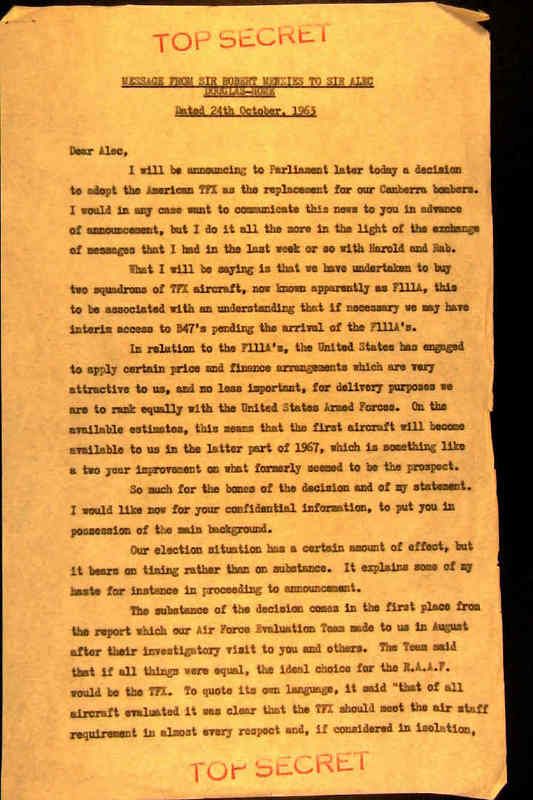
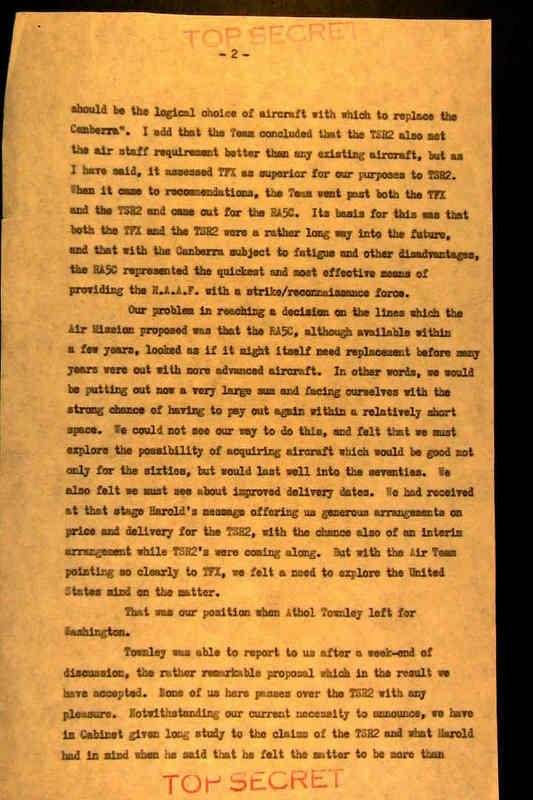
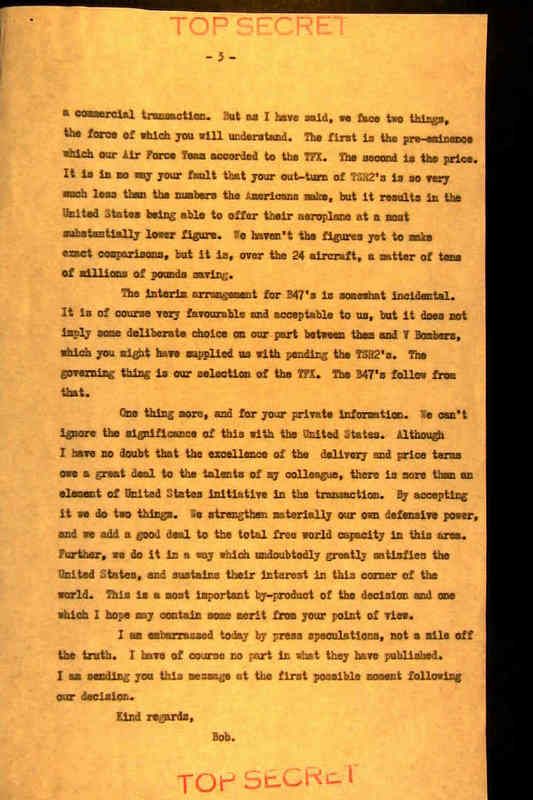
{edit: my copy of the memo is a larger file size, and enlarges more clearly. PM me if you want me to e-mail it to you}


 Sign In







