 Bager1968
I first saw the McD questionaire in the late 1980s, while I was in the USMC.
The other is also familiar from the time-frame… we had lots of such lists.
Sometimes the solution was to change aircrew…
The back-seater in F-4s & F-14s was called the Radar Intercept Officer… RIO for short.
P: radar not functioning correctly.
S: removed & replaced R10, system checks 4-0.
P: control stick feels loose.
S: tightened loose nut behind stick, works fine.
Bager1968Thanks, Peter, anneorac, & tornado64.
Having not gotten an answer here, I asked on PPRuNe last night, and got this from a chap calling himself “radar101”:
I’ve just been up in the loft with a tape measure to find my dish:
dish width is ~53 cm / 21 in
dish height at the join between the 2 reflectors is ~48.5 cm / 19 in
The reason for the 2 halves is that although it was amplitude comparison monopulse in the vertical plane, it was phase comparison in the horizontal plane – the L-R feed horns thus needed to be about 3 ish wavelengths apart.
And rhajaramjet said
The dish was in reality two parabolic reflectors joined along the vertical edge. It was a V clever arrangement; with the four-horn feed (split two to each half of the reflector) it transmitted (at 8,500MHz – 9,000MHz) four overlapping lobes which allowed the radar (unlike contemporary conical scan radars) to use sum and difference signals to angle track from a single pulse.
And now you’ve confirmed the correctness of his measuring (not that I had any doubts).
Bager1968In a truly honest, wide-ranging review, EVERYTHING is “on the table”!
You look at every possibility, throw out the ludicrous, then begin zeroing in past the improbable towards the practical.
Unfortunately, journalists usually cannot comprehend the differences in the categories.
Bager1968Anyone?
Bager1968Vickers Valiant B.1
Serial c/n Aircraft History
WP201 ? Was expected to be on loan for approx 6 months in 1955 for Bomb Ballistic trials. Used for the Blue Steel Nuclear ‘stand-off’ bomb which was being built by A.V.Roe & Co Ltd. Over 50 two-fifth scale model Blue Steel bomb were delivered to RAAF Edinburgh Field for the trials.
WP204 ? Departed for Australia 27/09/60. Received by RAAF 26/08/60. Operated by Base Sqn Edinburgh for A.V Roe and Co. departed for the UK 04/01/62. Returned to the UK 11/01/62. Used for the Blue Steel Nuclear ‘stand-off’ bomb which was being built by A.V.Roe & Co Ltd. Over 50 two-fifth scale model Blue Steel bomb were delivered to RAAF Edinburgh Field for the trials.
WP206 ? Received by RAAF 17/10/61. To A.V Roe and Co 17/10/61. Returned to the UK 27/05/63. Used for the Blue Steel Nuclear ‘stand-off’ bomb which was being built by A.V.Roe & Co Ltd. Over 50 two-fifth scale model Blue Steel bomb were delivered to RAAF Edinburgh Field for the trials.
Vulcan B.1/B.2
Serial Aircraft History
XA903 First Flight 10/05/57. Delivered to RAF 31/05/57. Arrived in Australia 16/11/60. To Base Sqn Edinborough 17/11/60. Returned to RAF 06/02/61. Preserved Wellesbourne Mountford UK.
XH539 Arrived in Australia 12/12/69. Date of return unknown. Scrapped Waddington 1989.
Basically, all the “V”-bombers that made it onto RAAF inventory were there for weapons trials, and the RAAF was simply administrative custodian.
Nothing is said about RAAF evaluations relating to possible purchase.
Bager1968If anything in the ranting of that group of amateurs at U.S. Aerospace is actually true, that is.
Bager1968I don’t see the problem.
He confirms what I said… that the physical and design main-mission replacements were A-1>A-6 and A-3>A-5.
That one of the A-3/A-5 missions was later transferred to the A-6 changes nothing. I already mentioned that several of the EA-3/KA-3 missions were transferred to the EA-6B/KA-6K… this is just one more post-design mission shift.
We are saying basically the same thing… it is just that your earlier assertion was that the A-6 was designed to replace the A-3, which is not correct, and your friend confirms this.
Bager1968He also thinks
Any idea what ‘luvery’ is?Be nice if the SHars are still there, might have to pop down.
As the “u” is the first letter to the left of the “i” on a standard keyboard, he likely just mis-hit the key, then failed to catch it before posting.
http://www.merriam-webster.com/dictionary/livery
1liv·ery
noun ˈli-və-rē, ˈliv-rē
plural liv·er·ies
Definition of LIVERY2:
a : the distinctive clothing or badge formerly worn by the retainers of a person of rank
b : a servant’s uniform
c : distinctive dress : garb
d : chiefly British : an identifying design (as on a vehicle) that designates ownership
Bager1968Not an F-84F Thunderstreak (swept-wing version).
It is a straight-wing Thunderjet… F-84 A/B/C/D/E/G.
Label says “F-84E”.
But still a nice wall decoration… and a rather nice prize.
Bager1968USS Nevada BB-36 1 March 1919 with kite balloon (for gunnery spotting via telephone wire).
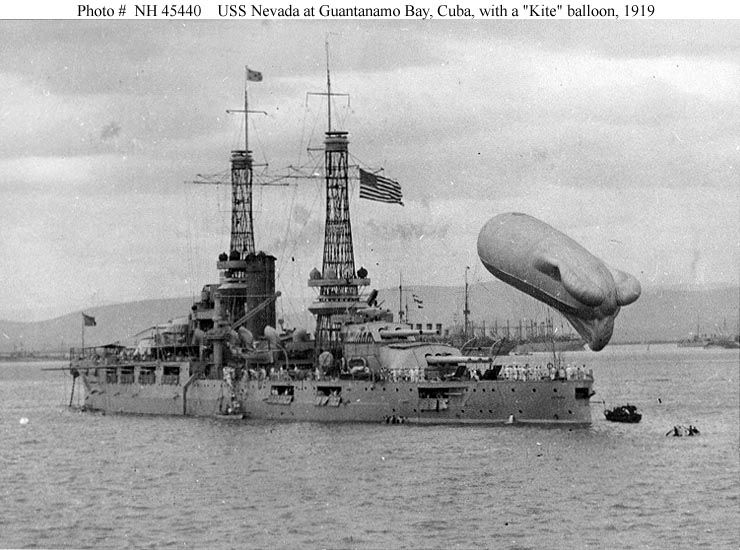
The US Army assigned its first aircraft to the Signal Corps… which had been using tethered balloons for troop spotting & gunnery control since the American Civil War (1861-1865).
Bager1968“Neue Elyis” may have been “Neuve Eglise”.
Phase: the Battle of Bailleul, 13 – 15 April 1918
Second Army (Plumer)
IX Corps (Gordon)
19th (Western) Division
25th Division
34th Division
49th (West Riding) Division, fought in defence of Neuve Eglise
59th (2nd North Midland) Division
71st Brigade of 6th Division
South African Infantry Brigade of 9th (Scottish) Division
88th Brigade of 29th Division
100th Brigade of 33rd Division, fought in defence of Neuve Eglise
108th Brigade of 36th (Ulster) Division.
Battle of Bailleul
On 13–15 April, the Germans also drove forward in the center, taking Bailleul, 12 km west of Armentières, despite increasing British resistance. However, Plumer assessed the heavy losses of Second Army and the defeat of his southern flank, and ordered his northern flank to withdraw from Passchendaele to Ypres and the Yser Canal; the Belgian Army to the north conformed.
This is both the proper time and place for his capture… and confirms a withdrawal by British forces right when he lost contact with his unit.
Bager1968Battle of the Lys (1918) (9 – 29 April 1918), also known as the Battle of Estaires or the Fourth Battle of Ypres
He mentioned being in Ypres on 10 April 1918, and arriving near Neue Elyis on Sunday which would be the 14th. Then, he was “being sent out on outpost Monday night” (15th) and wandering trying to find food and his own troops until capture at 9:30 (doesn’t say am or pm) on 16 April (Tuesday).
Since he said Batt. 9 (Battery or Battalion) was empty, I suspect there had been a withdrawal by the British troops and his unit had been sent out to delay the Germans while the withdrawal was carried out. He was captured while in B.H.Q. (Battalion Headquarters).
Wiki-waki article on the battle: http://en.wikipedia.org/wiki/Battle_of_the_Lys_%281918%29
Bager1968Yugoslavia also supplied a Yak-23 to the US. (Defection from Romania). No doubt it helped foster good relations with the west?
http://www.youtube.com/watch?v=bFXAdrJoQl0
TJ
What I saw said that the Yak-23 was being shipped through Yugoslavia via rail, and the Yugos “lost” the cars for a few days.
The Yak-23 was already crated up, and so it was easy to just load them into a C-124 and fly them to Wright-Patterson AFB, where it was un-crated, examined, assembled, flown, taken apart, and re-crated.
It was then flown back to Yugoslavia, where it was re-loaded aboard the freight cars, “found”, and shipped on to its scheduled destination a few days late.
Bager1968I have a possible suggestion… perhaps someone with research resources in Norway can find what was done with the 200+ F-84Gs Norway had when they were removed from service.
Portugal, a fellow NATO member and F-84G operator, used the F-84G in combat in its campaign to hold onto its African colonies starting in 1961, and continuing until 1973.
Is it possible Portugal bought surplus Norwegian aircraft, and that this is one being shipped south?
{edit… never mind… the OP mislead us (unintentionally, I’m sure).
Here is the actual photo caption (page 25 of the photo site):
Númer myndar: GRÓ 005 051 2-1.jpg
Ljósmyndari: Gunnar Rúnar Ólafsson
Myndatexti
1955-1960 Reykjavíkurhöfn, flugvél á flutningaskipi. Hafnarverkamenn.
This is the correct time period for shipments of F-84s TO Norway!
Bager1968Because, like so many things the GAO has its hand in, it was designed to produce a result that could be used to try to cancel the program.


 Sign In







