Bager1968
Condensing from this thread: http://www.phpbbplanet.com/forum/viewtopic.php?t=3614&mforum=warshipprojects
I recall reading that one reason the A-12 avenger II and NATF (swing-wing F-22) programs were canceled c.1990 was that they might have been only marginally capable of operating from a Nimitz deck.
…………………………
The “marginal capability” had nothing to do with the size of the ship, but marginal stability & control authority of the aircraft in the event of system malfunction or battle damage.
…………………………
The A-12 was way over weight, handled sluggishly, and performed poorly. It would have worked, maybe, if all the weight needed to make it carrier capable was pulled off and it was turned into a land based strike aircraft, but then again, maybe not.That’s from statements on another board from an aeronautical engineer who worked on it.
…………………………
None of the contractors on A-12 had extensive experience with bonding large composite structures, and some of the wing spars simply could not be joined with the required strength. This issue was never solved, and was a major reason why the program was canceled. The whole thing was a bad idea start to finish.
…………………………
I seem to remember from the time that the winning bid (for the development phase) from McDonnell Douglas/General Dynamics was around US$4.38 billion, while the losing bid from Grumman/Northrop* (separate companies at the time) was around US$6 billion. (ceiling cost for MD-GD bid was $4.84B)At the time of cancellation, the development costs** had increased to right about what N/G had bid… fancy that.
The company with the most experience building carrier aircraft & the one with the most experience with composite structures had a much better handle on the real cost than their competitors… what a shock!
* Northrop had had experience in large composite structures from building the B-2, and was major sub-contractor on the F/A-18… including all its smaller composite structures (horizontal stabilizers, for example).
** estimated “per aircraft” cost had risen from $100M to $165M
…………………………
There were a lot more problems with the A-12 design than bonding large composite structures; the stealth requirements were significantly more difficult than those of the B-2, as they needed to be all-aspect (the B-2 is not particularly stealthy from above).The aero people where I was working at the time were also pretty universally of the idea that the Dorito Chip had quite little chance of a successful carrier landing. Deltas can’t really use flaps — the nose down pitching moment makes the aircraft dive — and a delta’s pitch control surfaces decamber the wing on approach, which tends to reduce the lift coefficient on approach.
Bager1968Dassault Mirage F1.M53
1974PERFORMANCE
Max. speed 2335 km/h 1451 mph
Range 1200 km 746 miles
ARMAMENT 2 x 30mm cannons, 4000 kg of weapons, seven external stations
==================================================Dassault Mirage 2000
1978PERFORMANCE
Max. speed 2333 km/h 1450 mph
Ceiling 17060 m 55950 ft
Range w/max.fuel 3335 km 2072 miles
ARMAMENT 2 x 30mm cannons, 6,300 kg (13,900 lb) of weapons, nine external stations==================================================
Enlighten us, Sens. Other than it uses a huge wing area I’m not seeing its huge advantages.
Mirage 2000 has 57.5% more payload capacity, and 2.78 times the range.
I see two big advantages for Mirage 2000!
Bager1968The USN defined them in this way:
CVA: Attack Carrier – a carrier whose air wing is composed of aircraft designed for fighter and attack (bomber) roles, with only minimal self-defense ASW capabilities. This type developed from the WW2 Fleet Carrier types.
CVS: Anti-Submarine Warfare Carrier – a carrier whose air wing is composed of aircraft designed to find and sink submarines. This type developed from the WW2 Escort carrier types.
CV: Multipurpose Carrier – a carrier whose air wing is composed of aircraft designed for fighter, attack, and anti-submarine roles. This type is usually created by adding ASW aircraft to an Attack carrier in lieu of some of its fighter or attack aircraft.
This is the type meant in current discussions of “Fleet carriers”.
In the 1950s & 1960s, the USN put its fixed-wing ASW aircraft in the CVS air wing along with ASW helicopters and 4 A-4 Skyhawks (armed with Sidewinder AAMs) for self-defense.
The CVAs had only a few ASW helicopters and mostly fighter & attack types.
The air wing of USS Hornet CVA-12 (later CVS-12) illustrates this perfectly: CV-12 deployment and air wing list
When the USN retired all of the Essex class carriers in the early 1970s, the remaining carriers received S-3 Viking fixed-wing ASW aircraft in addition to their normal 6-8 ASW helicopters (except for Midway and Coral Sea, whose hangar height were too short to take them), and were redesignated as Multipurpose Carriers (CV).
The UK uses the term “Strike” instead of “Attack”, but the concept remains the same.
Note the actual air wings of the “big 4” RN carriers of the middle Cold War period: RN carrier air wing composition list
HMS Ark Royal:
1955-1956: 16 Sea Hawk FGA6; 14 Sea Venom FAW21; 6 Gannet AS4; 4 Skyraider AEW1; 1 Dragonfly HR5
This is a “multipurpose” air wing (note the ASW Gannets).
1957-1958: 16 Sea Hawk FGA6; 14 Sea Venom FAW21; 4 Skyraider AEW1; 1 Dragonfly HR5
This is a shift to a “Strike/Attack” air wing.
1962-1963: 12 Scimitar F1; 14 Sea Vixen FAW1; 4 Gannet AEW3; 8 Wessex HAS1; 1 Whirlwind HAR5
This is still mainly a “Strike” air wing, as the Wessex doesn’t have the range or “on-station” endurance of the Gannet.
1970-1978: 12 Buccaneer S2; 14 Phantom FG1; 4 Gannet AEW3, 1 Gannet COD4; 7 Sea King HAS1; 1 Wessex HAS1 (SAR)
Same as above.
HMS Hermes:
1960-1962: 8 Scimitar F1; 12 Sea Vixen FAW1; 4 Gannet AEW3; 5 Whirlwind HAS7; 1 Dragonfly HR5
“Strike” wing as above.
1966-1970: 7 Buccaneer S2; 12 Sea Vixen FAW2; 4 Gannet AEW3, 1 Gannet COD4; 5 Wessex HAS3; 1 Wessex HAS1 (SAR)
ditto
1973-1979: 9 Wessex HU5; 9 Sea King HAS1
Now there is a shift to an ASW/commando assault air wing (note the near doubling of the ASW capability).
1981: 8 Sea Harrier FRS1; 9 Sea King HAS1
And now to a “semi-multipurpose” air wing (but without the longer-ranged ASW aircraft of a true CV).
The CVF is intended to carry F-35B for fighter & strike duties, but only a small number of Merlin HM.2s for ASW, which provide only a relatively close-in capability.
In this sense, the USN carriers are also now back to CVAs (although they have not been redesignated as such), as the S-3 has been retired without replacement, and their only ASW capability comes from SH-60s, which are also pretty “close-in only” helicopters.
So don’t feel bad… no one in the world is operating a true “multipurpose” air wing any more… they are all either Strike or ASW carriers!
Bager1968If you look at the pic of the stern of Ark Royal I posted back in post #4 of this thread, you will see a very similar flight-deck extension there.
Look at how far that one extends compared to the flat end of the hull.
It is this very actual item on a UK carrier of just slightly smaller size that inspired my version.
Bager1968Out of interest, for your Batch II and Batch III, why didn’t you extend the port side sponson forward of the gun/missile sponson as you did with the starboard sponson aft, electing in the Batch III to have the overhang aft of the missile sponson and bringing that forward in the process?
So ultimately having a flight deck shape something along the lines of the US carriers.
All of the RN’s large carriers rebuilt in the 1960s kept at least one weapons mount on each side. Eagle was fitted with 6 SeaCat launchers (1964), Hermes with 2 SeaCat (1966), and Ark Royal (1970) was fitted for 4 SeaCat, but never shipped them.
If you look, there would be little room to use that small area of flight deck when landings are taking place, as you couldn’t park any aircraft there and still clear the landing path.
The USN’s carriers got away with it because their hulls are wider, and their flight decks at least 1 (if not 2) more decks above the waterline, giving room to mount missile launchers below the flight deck and still have good arcs of fire.
This ship doesn’t have that kind of room, so to protect the port side a missile launcher needs to be in a “cut-out” in the flight deck.
Bager1968And Kuwait operates F/A-18C/Ds… interesting.
F-15SEs should be sufficient against anything Iran has… which is Kuwait’s current main concern.
No need for F-35s yet, but I would have expected interest in the Super Hornet or “Ultra Hornet” (my term for Boeing’s new export version).
Bager1968Ouch, wont those things be 40 to 50 years old in 10 years time?
Admiral Ushakov: commissioned December 30, 1980; decommissioned 1990 after reactor accident
Admiral Lazarev: commissioned October 31, 1984; inactive from 1994, in reserve & defueled 1999
Admiral Nakhimov: commissioned December 30, 1988; inactive since 1999, undergoing modernization since October 30, 2008
Adm. Ushakov saw only 10 years service, and will be 40 years old in 2020.
Adm. Lazarev saw only 10 years service, and will be 36 years old in 2020.
Adm. Nakhimov saw only 11 years service, and will be 32 years old in 2020.
Pyotr Velikiy was commissioned 18 April 1998, and is still in service, having seen more “in-service time” than any of the first 3 ships!
Bager1968Unlike many smaller Air Forces, the US Navy flies the &&^% out of its aircraft… not only are they providing air support in a shooting war, but the very nature of carrier aviation requires more flying to maintain those skills.
This means that a difference of 5% in engine life (between overhauls) means a whole lot of millions of $… not over the life of an aircraft, but per year (the USN has 505 Super Hornets, and will add another 124 over the next 2-3 years).
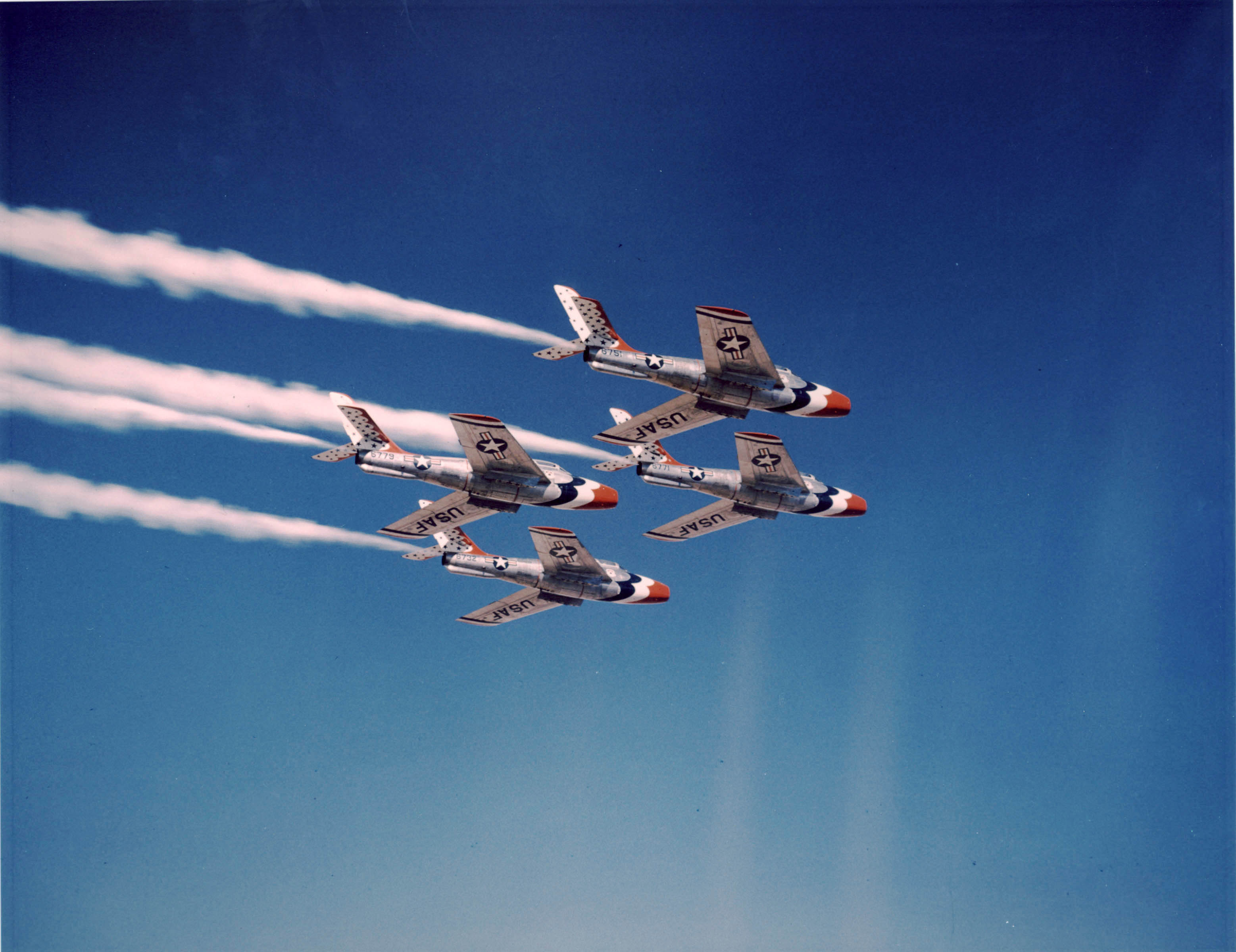
Bager1968Pictures of T-Bird F-84F’s are always neat to see and although probably not the best airshow performer, I’d have loved to see them in action.
As you wish.

Bager1968I like this shot* of the one & only XF-84F (XF-96A) (49-2430), originally intended to be the last F-84E on contract.
http://www.flickr.com/photos/my_public_domain_photos/4533871676/
Although the photo label is incorrect, calling it a YF-84F. Two pre-production YF-84F aircraft (51-1344 and 51-1345) were built, and these were the first with the 7,200 lb.s.t. J65 (Wright-built Armstrong-Siddeley Sapphire), which produced 38% more power, and required a redesign of the fuselage, as it was of greater diameter and required more air-flow than the 5,200 lb.s.t. Allison J35-A-25 of the earlier F-84s and the XF-84F.
Note the difference in the intake between this photo XF-84F front view
and this photo production F-84F front view
* from the first link in Thunderbird167’s post
Bager1968The comments above leave me a bit puzzled…why would the Marines need/want a ASW aircraft when that’s a Navy mission?
Likewise, why would SAC need a F-27, the command lost its internal transport capabiliy (they operated C-124 strategic airlifters to support SAC deployments) back in the 50s.
That quote is from the website of the F27 Fokker Friendship Association (see link above the quote)… you’ll have to ask them where they got the information for their article… it is possible they got something confused. The structure of the line an ASW version for the US Marines model M-294A, a STOL version for the US Navy and a standard version for the Strategic Air Command likely should have read a STOL version for the US Marines model M-294A, an ASW version for the US Navy and a standard version for the Strategic Air Command.
As for SAC… the comment about SAC & the USMC seems to be linked to the restart of production of the F27E in October 1960, so SAC still had some transports (The C-124s were transferred from SAC to MATS in 1962). It seems to have been a non-ramped version, which would mean a personnel transport. The loss of SAC’s transports right when the C-138 was being pitched would have cut off the project.
And I don’t see a mention of the C-138 designation.
The authoritative Putnam U.S. Military Aircraft since 1909 by Swanborough and Bowers, lists the C-138 as “Resereved for USN. Cancelled” with no mention of a specific aircraft.My guess is the F-27 was going to be pitched to the Navy for the C-138 requirement, but the program itself was cancelled before a airframe selection was made.
Anyone have a better idea?
From the thread on secretprojects.co.uk/forum that I linked to in my previous post:
C-138
The C-138 designation had originally been skipped and reserved for use by the US Navy (see also H-36/38).Later, it was planned for allocation to the Fairchild F-27 (license-built Fokker F-27 Friendship), if that type were acquired by the USAF. This did not happen, and therefore the C-138 designation remained unused. It is not known, why a designation was reserved for the F-27 before any firm plans to acquire the aircraft were actually made.
Source: http://www.designation-systems.net/usmilav/missing-mds.html
Bager1968Thread here: http://www.secretprojects.co.uk/forum/index.php?topic=5854.msg98914;topicseen (with the same pic) gives info on where the US government info on this is held.
http://www.fokkerf27.nl/index.php?option=com_content&task=view&id=54&Itemid=39&limit=1&limitstart=1
F-27C
Right from the start Fairchild did try to get their hands on defense orders. But especially in 1960 and 1961 did Fairchild mainly concentrate on military orders for the US Army, US Air Force and US Marines. The four military versions of the Fairchild F-27C (an F-27A with cargo door, which, strangely enough, never was certified) were summarised under the Model M-258.
The M-258G was in fact an F-27A with cargo door and powered by RR Dart 8 engines (military version of the RR Dart 7 Mk-258) and with military communication and navigation equipment.
The M258H was the same as the M-258G, but equiped with double slotted high lift flaps and a fully movable horizontal stabilizer (STOL). Fairchild had plans to buy Fokker’s F1 prototype.
The M-258J was the same as the M-258H, but had a cargo door at the rear of the shortened fuselage (rear loading)(Fokker F27MS). And the last M-258K again was the same as the M-258J, but powered by 2 General Electric T-64-GE-8s. Also, a version with Lycoming T-55 engines was developed. But it was all in vain. Not one order resulted.
[…]
They still had expectations for a defense order viz. an ASW version for the US Marines model M-294A, a STOL version for the US Navy and a standard version for the Strategic Air Command. A single order from these authorities would mean an assignment for minimal 100 units for Fairchild.
[…]
In the beginning of 1961 PanAm wanted to buy 5 Fairchild F-27As, so they could start a new airline, somewhere in Africa; this by order of the American Government. But the mandate did not materialise, even if an option had been taken.
Not a single United States Defense order was secured by Fairchild, in spite of a lot of effort and a lot of time. The lack of such an order became in fact the deatblow for the F-27 production in the US.
Enclosed is a picture of the Fairchild M-258 design which received the USAF designation C-138.
The picture was provided to me by NASM and is contained in their Fairchild Collection, Box 504, Folder 12.
Clearly a derivative of the Friendship, but with clam shell doors.
In Box 98 Folder 11 of the Smithsonian’s Fairchild Archive Collection there is this: F-27 (M-258) Military configuration, booklets
Also, in Box 503 Folder 12: Fairchild M-258 model, photographs
If someone want to write to the archivists, in a few months all curiosities will be satisfied.
I am planning to send a new request to the Smithsonian for other matters. If no one volunteers and you are VERY patient, I can add this.
Bager1968There also appears to be differences further forward on the fuselage, an extra window for example.
The Searchwater in its proposed postion should give 360 degree coverage anyway, so what exactly is the point in going for the LockMart idea?
Window number & placement seem to be up to customer specification… the fuselage is designed so that each location can be either skinned or fitted with a window. Note the difference in window numbers on the starboard side of the HC.3 and the concept drawings.
The main justification for the Lockheed proposal is to re-use the HM1 airframes… however that is likely to be the most expensive option, given the likely development & integration costs.
Second-most expensive would be new “utility variant” airframes to keep numbers up, while transferring Searchwater/Cerberus from the Sea King ASaC.7s to the palletized Merlin variant.
Cheapest would be to just use the existing HC.3s, and accept the reduction in numbers available for troop/cargo use. This is, unfortunately, the most likely choice.
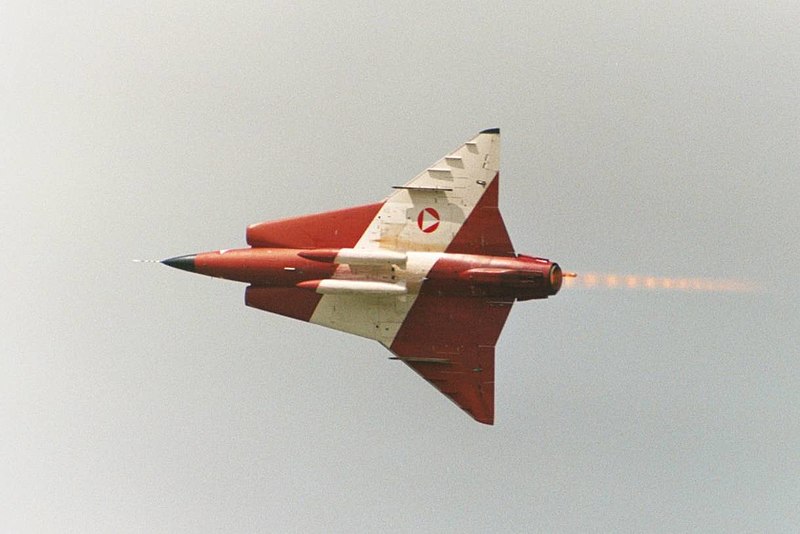
Bager1968Favorite to love?
Saab J-35D & J-35F Draken!
Favorite to hate?
MiG-21/Chengdu J-7.

Bager1968The Lockmart AEW seems quite risky as im curious how are they going to deal with disruption to the picture by the rotors with a 360 AESA system
The same way that radars have screened out reflections from close objects since at least the 1960s (if not earlier).
A little circuit called a “time-gate”… which rejects signals that return too quickly, indicating the came from an object very close to the transmitter/receiver antenna.
Besides, with the antenna fitted on the fuselage, the rotors won’t be in the way, as they will be on a flat plane above the radar panels.
“360 degrees” refers to the horizontal plane… not to directly above or below the helicopter.


 Sign In