 Bager1968
To recap from earlier posts, etc… the HM1 has no rear ramp, the aft fuselage is quite different, and would need to be replaced to allow the proposed palletised system to be fitted.
The HM1 (and its upgrade, HM2) are NOT “utility variants”… they are specialized ASW variants! The “utility variants” all have the ramp!
Note the following:
HM1 Merlin: [A visit, board, search and seizure team from the Royal Navy frigate HMS Monmouth (F235) performs a fast-rope insertion on the flight deck of the U.S. Navy guided missile destroyer USS Fitzgerald (DDG-62) via Monmouth´s AgustaWestland AW101 Merlin HM1 helicopter from 829 Naval Air Squadron while at sea on 8 September 2007.]

HC3 Merlins have the ramp.

Just a slight difference… the entire airframe aft of the main-wheel sponsons.
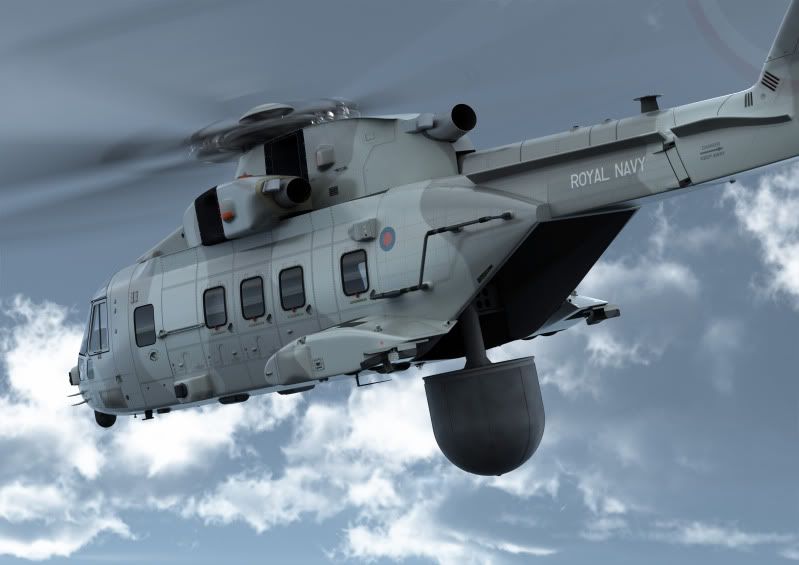
Here is the proposed system:

Bager1968IAn Invincible class ASW carrier could allow them to (finally) retire their even older steampowered ex-Dutch De Zeven Provinciën-class cruiser BAP Almirante Grau (CLM-81), which dates from 1973.
March 1973 in Peruvian service… she was laid down September 5, 1939, launched December 19, 1941, and (after being suspended during the rest of WW2, then re-designed), completed November 18, 1953, serving in the Royal Netherlands Navy until her sale to Peru.
Bager1968Bell Cobra.
Both the single-engined AH-1G/S* and twin-engined AH-1J/T/W versions.
* split into -E, -F, -P, & -S variants after 1988
Bager1968The one advantage the Lockheed proposal has is that it could use the 8 non-ramp-equipped HM1s that are not going to be upgraded to HM2, thus avoiding the cost of either new airframes or reducing availability of the current Merlin fleet.
The Thales proposal requires either using existing HC3s (and thus reducing the number of those available for their primary troop-carrying role), or buying new ramp-equipped Merlins to maintain fleet numbers.
The main question is, is there money available to maintain fleet numbers (for either the more expensive Lockheed electronics or the extra ramped Merlins), or will the budget force an addition of the ASaC role without providing more aircraft to carry out that new role.
I strongly suspect the latter, which will see Thales win, and the RN lose (by having to “dual-role” some HC3s)!
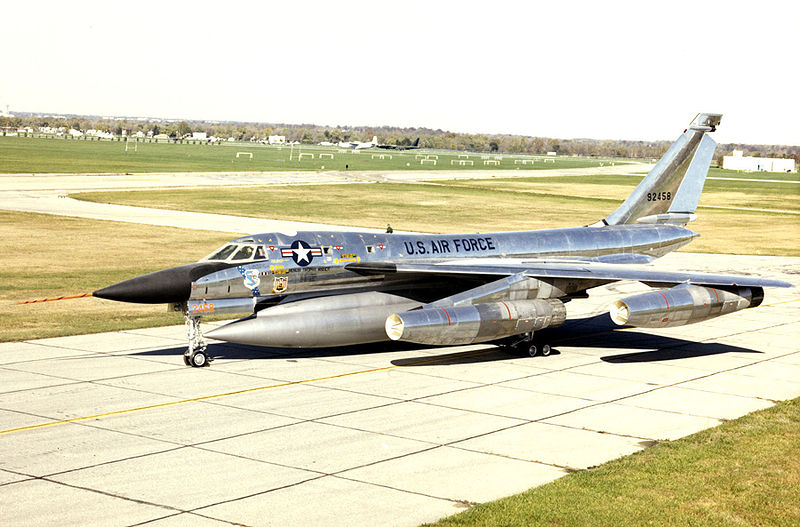
Bager1968Hmmm… that belly pod looks familiar…. where have I seen it before?
Oh, yes… that’s where!
Convair B-58:
Bager1968How on earth do you work that out, includes anything that is old and prefferably not in service anymore, civil, military, prop or jet.
Even a thread on the F-117 on there at the moment.
I hate this idea that people that are into historics like Spitfires, and anything else is not for them.
I seem to remember that the F-100 thread got similar amount of replies on both forums.
Ummm… checking the threads, the one in Historic got only 15 replies, and only 7 posters replying. One of those later replies was Pagen01, and all he said was “Now I’m confussed, I’ve been answering this same thread in Modern military!!“, so there were only 14 actual replies and 6 actual posters.
In Modern Mil, it got 36 replies, and even if you remove the 5 relating to the Mod’s question, that leaves 31 (still over twice as many. Also note that there were 12 different repliers (14 counting the mod or the poster who only replied to the mod).
So, in Mod-Mil, it got twice as many contributing responses, from twice as many contributing posters, generated more discussion, got nice pics, and provided more useful info.
Case shown.
Yes, Historic does discuss jets, but almost entirely limited to either:
UK-produced aircraft,
none-UK aircraft types that had been stationed in the UK,
examples of none-UK types that are preserved in the UK, or
those that are somehow WW2-related or earlier.
Bager1968Beyond doubt a two seater.
USAF, USN, USMC, & F-35 Program head all say that isn’t going to happen.
What do you know that they don’t?
Bager1968The argument is that the USAF has a large fleet of older C-130s which will need replacing in the medium-term, & that neither the C-130J nor C-17 (which, BTW, is coming to the end of production unless more are ordered) is a suitable replacement.
The C-17 can’t get into all the places those C-130s can, & the increasing size & weight of equipment (e.g. AFVs) means that the proportion of kit which can’t be transported by C-130J is increasing rapidly.
In the current economic and political climate in the US, there is no way Congress will authorize purchase of a 100% foreign-built aircraft (that will then get some avionics changed out with US-standard models), when Lockheed will push for a wide-body “C-130XL” to fill the role!
Lockheed Explores Niche For Widebody C-130
The 62,000 lb payload variant (31 short tons) can use the same engines & main wing as the C-130J (42,000 lb payload), which would save cost and increase commonality… and would take care of the “capability gap”… which is expected to be around 10% of theater needs by 2025.
The added selling point will be that “it is just another version of the C-130, an existing aircraft”… not technically true, but Congress is rather gullible that way*.
However, current studies are for a true STOL (1,000-2,000 foot run, USAF) or even VTOL (US Army) transport to replace the older C-130s (-H & earlier), something the A400M cannot do.
If that program “takes off”, it will cost enough that neither the rather expensive A400M nor the C-130XL will even be considered, and the C-17 will get the chance to prove its claimed “tactical transport capability”.
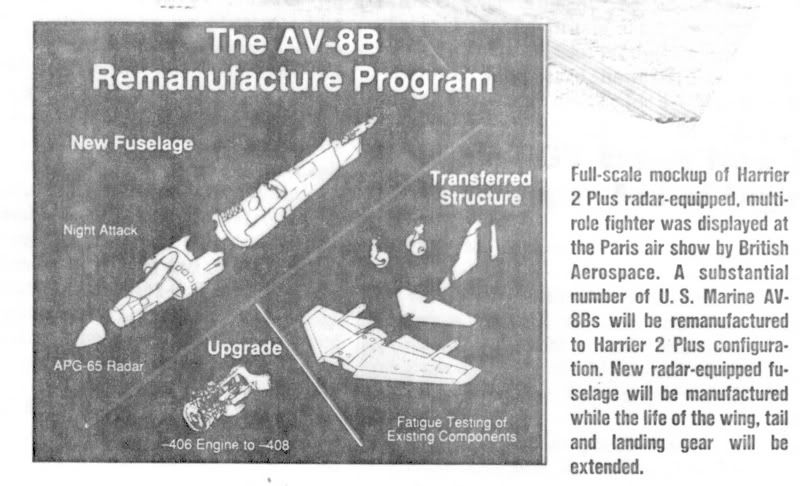
* the AB-8B+, which had about a 65% new airframe (85% new content overall), was sold to Congress as an “upgrade of existing AV-8Bs” (not as a new model, hence it not being designated AV-8D, as it should have been), and about half the production run was of existing aircraft that had the landing gear, main wing, & tail removed and installed on the new fuselage.
Bager1968OK, thanks for the additional info.
Your first post made no mention of data-linking from another ship that was using an active radar.
This is indeed much like having a grunt on the ground using a hand-held laser designator to “paint” a target, with a jet carrying laser-guided bombs and a laser receiver using the second-hand info to hit the target.
Its just a more advanced version… and should work pretty well.
However, the “active” ship would not be a nice place to be… unless you rotate the job between several data-linked ships.
Hmmm…
Bager1968That only works if the incoming aircraft are radiating in the radar frequency ranges.
If they are “running silent”, than the ship depending on the passive system is blind.
That’s why the USN built the E-1 Tracer and then replaced it with the E-2 Hawkeye… they fly scores of miles away from the carrier and do the volume-search mission, while the carrier shuts off all its radars.
The E-2 sends a data-stream to the carrier allowing them to see everything the E-2 sees, but the carrier itself is not transmitting anything, and is therefore much harder to find, while still seeing everything that is going on!
Bager1968The one and only EC-130V (test aircraft built in 1992 for the USCG using the APS-145 radar & dome of the E-2C Hawkeye). It is now a test aircraft with the USN, who used it as test-bed for the Hawkeye 2000, and it was still active as of 2005.

In the late 1990s, Lockheed then proposed an AEW&C version of the stretched C-130J (the -30) for foreign sales… no buyers had been found by the mid-2000s, and status of the program is unknown at this time.
The C-130J-30 AEW&C is based on the stretched variant of the Lockheed C-130J Hercules II, which features new engines and digital flight station for two pilots. The C-130J-30 AEW&C is fitted with the AN/APS-145 on pylons above the rear fuselage of the aircraft. A tactical command center and crew rest module is fitted into the cargo compartment to contain seven operator consoles and the Northrop Grumman (ESID) Group II+ mission system derived from the E-2C Hawkeye. Lockheed Martin have teamed with Northrop Grumman (ESID) and Transfield Defence Systems of Australia for the C-130J AEW&C.
EC-130V & C-130J AEW&C
Bager1968Ummm… since you provided basically no info on what you are talking about, I tried Google.
The only entries I could find were about a UK “trance-music band”, a 1952 movie (about Col Tibbetts, pilot of the B-29 that dropped the A-bomb on Hiroshima), a 2007 movie (about the setting up of the Newfoundland>Greenland>UK aircraft ferry route in WW2), a Gay/Lesbian tour agency, and an Alaskan tour agency.
Adding the word “Space”, brings us to the 1995-96 TV series “Space, Above and Beyond”, which is a Sci-Fi series about a future war in space which started in 2063.
So, exactly what are you watching?
Bager1968Does the ASaC(‘Area Surveilance and Control’) designation signify that the Merlin will be capable of controlling friendly fighters unlike typical AEW helos that only perform surveillance?
Yes… the Searchwater radar was developed for the Sea King AEW variant* during the Falklands war in 1982… specifically to provide area control of Sea Harriers for Fleet Air Defense.
* originally designated Sea King AEW.2, they used the Thorn-EMI ARI 5930/3 Searchwater radar. This did provide a limited and primitive fighter control system as well as detection and warning capabilities.
They were upgraded between 2000 and 2004 with the new Cerberus system, which consists of the Searchwater 2000AEW X band radar (with data-linked fighter control capabilities). The helicopters themselves were also modernized, and redesignated Sea King ASaC.7.
Bager1968The tailhook is controlled separately from the landing gear, so it is certain that the Su-33 has it lowered (where is it obscured from view by the engine & tailplane), while the J-15 has it stowed in flight position.
That difference in the pics is irrelevant.
Bager1968Everything I have read on ex-Varyag is that when she was sold to the Chinese, she was “without engines”.
Now I know how sloppy & imprecise most journalists are, but maritime terminology uses “engines” for the mechanical propulsion devices (reciprocating engines, steam turbines, gas turbines, diesel engines, electric motors), and always refers to boilers separately from the engines!
When speaking of both, the terms “propulsion plant” or “propulsion unit” is used, with “propulsion system” adding the propeller shafts & propellers as well.
“Boiler” or “steam plant” are the terms used when speaking of just that part.
Therefore, assuming the comments were an accurate relaying of what a naval source said, then the boilers were in place, and only the turbines were lacking.
This makes sense, as boilers are large items that are usually installed during construction of the hull, before the decks above them are built. As Varyag was structurally complete, it would be expected that the boilers were indeed present.
The turbines are also usually installed at the same time as the boilers, but they can be disassembled for a total rebuild (including replacement of all internal parts) well after the ship is completed, so I can see how they could have been left out with the intent of being installed later.


 Sign In







