 Bager1968
Why are there clear shadows from the stack of fuel cans & the men on the far left, but very indistinct and faint (if any at all) shadows from anything/anyone else in the shot?
Except the guys on the far right have shadows from nearly the opposite direction as the guys on the left!!
Sure looks faked-up to me.
Bager1968Strangely enough I think the two seat trainer variant was the only Cougar to see combat duty, as some sort of C&C platform. Not sure if it was for other aircraft or artillery.
In 1966-67, four TF-9Js of H&MS-13* were used in the airborne command role to direct airstrikes against enemy positions in South Vietnam. This marked the only use of the Cougar in combat.
*Headquarters & Maintenance Squadron 13; Marine Air Group 13; 1st Marine Air Wing; USMC
The Marine Corps, during the early 1960’s, adopted the Naval Aviation Maintenance Program (NAMP) and organized its aviation supporting units into the Headquarters and Maintenance Squadrons (H&MS). This organization was developed to enhance aviation supportability by providing intermediate (“I”) level maintenance for all aircraft, and aircraft support equipment attached to a specific Marine Aircraft Group (MAG).
The operational structure of the H&MS was not standardized throughout the
Marine Corps. Some H&MS were operational squadrons with assigned aircraft, while other H&MS had no aircraft assigned and provided only IMA support to the air groups.
H&MS-13 was reactivated March 15, 1951, at Marine Corps Air Station El Toro, California, as Headquarters and Maintenance Squadron 13. During September 1966, the squadron deployed to the Republic of Vietnam and remained until October 1970.
H&MS-13 was one of the “operational” H&MS units, flying TF-9J Cougars in the 1960s, TA-4F Skyhawks in the 1970s, and OA-4M Skyhawk IIs through most of the 1980s.
In June 1965, MAG-13 became a unit of the 1st Marine Aircraft Wing at Marine Corps Air Station Iwakuni, Japan, where it operated until September 1966 when it deployed to the Republic of Vietnam. Based out of Chu Lai, MAG-13 supported the III Marine Amphibious Force and other forces in I Corps and II Corps tactical zones, Laos, North Vietnam and Cambodia. Initially the Group consisted of VMFA-314, VMFA-323 and VMFA-542 all operating F-4B Phantoms.
As an aside, I was in the USMC from 1981-89, and as an “I”-level avionics tech, I was assigned to H&MS-13 from 2/83-6/87, except for deployed periods overseas – 6 months with H&MS-12 in Japan in 1984 & some short periods with AIMD aboard USS Ranger (Carrier Air Wing 2) in 1985-87. I was with H&MS-11 in 1988-89.
Bager1968If you are referring to the 1st pic below, I think you are actually looking at the rudders. For comparison, I’m posting a pic of Gorshkov and 2 of Vikramaditya in dry dock, which shows the general arrangement of rudders and screws on the Kievs, which is very similar to that used on Kuznetsov and Varyag.
Actually, I am thinking of this model… and of how there are structures in that photo that match where the model has the rudders… and the curved line of the keel-end on the model that matches the curved structure just above the water in the photo.

It seems Kuznetsov & Varyag have their rudders and propellor shafts much further aft than the Kievs did.
Bager1968Interesting… in the pics Stonewall linked to it appears they have yet to fit a rudder or propellor shafts… the rudder spot is empty, and there are no supports for the shafts.
It seems quite a bit more work is needed… :rolleyes:
Bager1968Well, there’s a bunch in AMARC… but their condition is “questionable”, I’d say.
Bager1968In addition to the issue of the USN Phantoms having a larger diameter radar dish, there was another system the USN Phantoms had that would have needed changing if they adopted the USAF-style nose gun.
Starting with the F-4A, an AAA-4 infrared search and tracking sensor was added in a prominent bulge underneath the radome. It was fitted (or retrofitted) from F4H-1F number 5 (143390) onward. This sensor was only the second IR sensor to enter service outside the USSR. It required radar data for range information.
This system was kept in the F-4N upgrade of the F-4B, but was deleted in the F-4J/S… which had an even larger radar dish: the AN/AWG-10 fire control system housed in an enlarged radome.
F-4B (note the AAA-4 under the radome):

F-4E (note the gun, which has displaced the AAA-4 {removed, not relocated}):

Bager1968You probably got it (either directly or second-hand) from this Kawasaki ad:

Bager1968To put it simply (and actually be helpful):
Baku was laid down in 1978 at Nikolayev South (Shipyard No.444) in Ukraine, launched in 1982, and commissioned in 1987 (named for the city of Baku in the Soviet Republic of Azerbaijan).
The ship was renamed Admiral Gorshkov after the collapse of the Soviet Union in 1991, as the city of Baku was now in independent Azerbaijan. Sergey Gorshkov was responsible for the expansion of the Soviet Navy during the Cold War.
In 1994, following a boiler room explosion, the ship was docked for a year of repairs. Although she returned to service in 1995, she was finally withdrawn in 1996 and offered for sale.
Baku, 1989:
Bager1968Sorry, but that link is one of those that show the current day’s stories… and the mid-air is no longer displayed there.
This might work better:
http://www.lahontanvalleynews.com/article/20100316/NEWS/100319907/1007&parentprofile=1045
The pilot of the severely damaged jet ejected, while the other pilot was able to return his Super Hornet to NAS Fallon.
Upham said the pilot who ejected landed in waist-deep snow and had to wait about 90 minutes to be rescued by the base’s Longhorns Search and Rescue helicopter.
Upham said the pilot was then taken to Banner Churchill Community Hospital where he was treated for mild hypothermia and released. The other pilot was examined as a precaution and released.
Bager1968No, it’s definitely not B-25.
The Mitchell had needle blades – these are paddle blades typical of the B-17, B-24 and C-47.
Anon.
Yes… the tips are rather broad, and a look at all the B-25 pics I have show a distinct taper to all the blades.
Nice ID point to remember… thanks.
Bager1968This is where i read it
http://www.thunder-and-lightnings.co.uk/lightning/history.php
mentioned here also
http://www.military-aircraft.org.uk/jet-fighter-planes/english-electric-lightning.htm
curlyboy
Both “sea stories” related without any specifics whatsoever… not even the general region in which it supposedly occurred, much less exacting details like the year of the event, model of either aircraft, unit(s) involved, or indeed anything that could possibly be used to verify the tale.
And, both are nearly exactly the same wording, meaning they came from the same unverified and unmentioned source.
I have heard a lot of such stories… many of which began with the words “No ****, this really happened…”.
Bager1968Yes, almost certainly B-17.
The reduction gearing is typical of the Wright Cyclone engine (planetary gear). The only other two realistic options with this prop would be P&W Twin Wasp-powered B-24 and C-47 but that engine uses the Farman bevel gearing very different to that seen here.
Looks like it’s in great nick, with no obvious corrosion, which is amazing considering it has been under the sea for (presumably) 65-odd years.
Anon.
Ummm… the B-25 also had this propeller, and Wright Cyclone engines.
The RAf alone got over 900 B-25s.
Add in the other types on page 6 of this PDF that had Cyclones, and there are more candidates.
http://files.asme.org/ASMEORG/Communities/History/Landmarks/5572.pdf
Bager1968Does anyone else think lt’s odd that the landing distance is longer??
Wheel brakes probably provide more stopping power than skimming on the surface of the water.
Unless you fit the plane with panels to open up below waterline.
Bager1968I read somewhere that the RN’s (and now Pakistans) type 21 frigates were intially developed jointly with Australian. any truth to this?
I posted that in this very thread, #17 above.
It is mentioned in CONWAY’S ALL THE WORLD’S FIGHTING SHIPS 1947-1982 PART I (THE WESTERN POWERS), in the entry for the Type 21 (Amazon class), in the UK section. Here is the exact text:
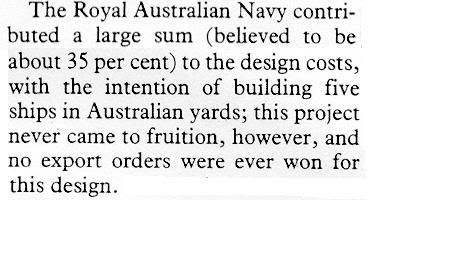
The full entry is shown here:
http://i22.photobucket.com/albums/b336/Bager1968/misc%20ships/Frigates/Amazonclass.jpg
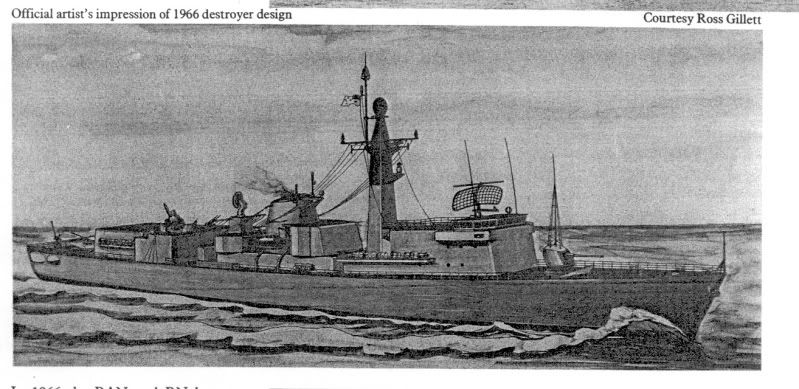
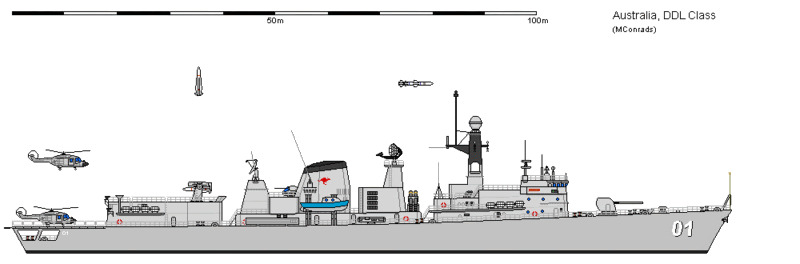
Bager1968DDL drawing from Conway’s (the one that’s missing from Ja Worsley starting post for the thread):
MConrads did this, based on the official drawing in Unicorn’s PDF:
I do have both in much larger format, much better than the photobucket-reduced versions above, if anyone is interested.


 Sign In







