 Bager1968
http://www.stratpost.com/saab-offers-naval-gripen-to-india
Saab offers naval Gripen to India
Monday, December 28, 2009
By Saurabh JoshiSaab AB, the Swedish defense major, has received a Request For Information (RFI) from the Indian Navy for the supply of carrier-borne fighter aircraft. The company, which received the RFI earlier this month, is pitching a little-known naval variant of its Gripen NG fighter, called the Sea Gripen. Saab is already bidding for the 126 Medium Multi Role Combat Aircraft (MMRCA) tender of the Indian Air Force (IAF), for which it has offered an advanced version of the Gripen NG, called the Gripen IN.
Saab has been studying the idea of designing a carrier-borne variant since the mid-’90s but the company only decided to launch the Sea Gripen program in the wake of its existing campaigns for the air forces of India and Brazil and the moves by the two countries to build a serious carrier capability, even though at that time there was no formal request from either country. Saab is planning to pitch the aircraft to countries with smaller-sized carriers and says they expect more nations to show interest in the Sea Gripen, because existing naval fighters are either of an older generation or large-sized, forcing them to buy or build large ships as well.
According to Peter Nilsson, Gripen’s Vice President of Operational Capabilities, the Sea Gripen is intended for both CATOBAR (Catapult Assisted Take Off But Arrested Recovery) as well as STOBAR (Short Take Off But Arrested Recovery) operations. “There will obviously be differences in the MTOW (Maximum Take-Off Weight). In a CATOBAR concept, the Sea Gripen will have a MTOW of 16,500 kilograms and a maximum landing weight of 11,500 kilograms. In a STOBAR concept it depends on the physics of the carrier. Roughly, the payload of fuel and weapons in STOBAR operations will be one-third less than the payload in CATOBAR operations. There will be no differences in ‘bring-back’ capability,” he says.
Nilsson says Saab hasn’t had to make any dramatic changes in the basic Gripen NG to design the Sea Gripen, because of its existing abilities, saying, “What helps is the Gripen´s ability to operate from road base strips.”
“The basic Swedish Air Force requirements in the original design for enabling short strips’ operations are very like enabling carrier-based operations. Qualities like low landing speed, high pitch & roll authority, high-precision glide slope control, high-precision landing capability, high sink rate clearance, strengthened airframe etc., are built-in from the beginning. This is in addition to the Gripen´s aptitude for active service in the field with easy maintenance, like engine changes in less than an hour in the field and no need for external power etc, enabling a shorter ‘mind jump’ required for the Sea Gripen in comparison to the ability of other land-based fighters to transform into ‘deck-based’ fighters,” he says.
“We do not have to start from scratch. We do not have to redesign the aerodynamics – we do not have to redesign the flight control system or the avionics. We already have a rugged, rough and strong airframe built for ‘carrier-like’ landings,” explains Nilsson.
While all the sensors, avionics and weapons and the GE 414 of the Gripen NG will be offered in the naval variant, the Sea Gripen will be notably different with a new undercarriage and nose gear to cope with the higher sink rate forces and catapult launches, as well as an arrestor hook, which has been redesigned and ‘beefed-up’ from the existing arrestor hook in the Gripen NG.
“There is strengthening of the airframe in a few minor areas due to an even higher sink-rate clearance of over 20 feet per second and the forces and stress in catapult launches, and ‘marinizing’ of the aircraft,” says Nilsson, while stressing that the inherent Gripen NG design minimizes the need for strengthening the airframe and making the aircraft sea-worthy, as the Gripen NG already has salt-water protection and the ability to operate in hot and humid conditions.
The Sea Gripen will be around 400 kilograms heavier than the Gripen NG, with the augmented airframe giving ‘an empty weight between 7500-8000 kg’. “The Sea Gripen will be a very, very interesting alternative for nations with smaller-size carriers. Its well-balanced weight and size in comparison to heavy, twin-engine alternatives allows nations to move from ‘air defence’ carriers to a concept with strategic capabilities, without having to replace their existing carriers,” says Nilsson, also adding, “Due to its balanced size there is no need for structural changes like folding wings etc.”
While the Swedish Armed Forces are not currently looking for a carrier ability, with the Sea Gripen, Saab is looking for partnerships with nations looking for self-reliance in their naval aviation programs. “Saab AB will establish the Sea Gripen as a new-generation carrier-based fighter option in the future, offering its design and engineering skills for partnership with a country with a developed aircraft industry and a carrier-equipped navy,” says Nilsson, also adding that the Sea Gripen program’s human resource skill-sets include engineering and flying experience of carrier-based operations in both, combat as well as peace-time roles.
And while he recognizes that presence of established naval fighters, he is confident of the Gripen’s abilities. “The Sea Gripen will challenge existing carrier-based fighter manufacturers,” he says, emphasizing, “I challenge any existing deck-based fighter to perform a night landing in severe conditions with snow or rain and strong crosswinds on a Swedish standard road-base strip of 17 x 800 meters, rearming and refueling in less than 10 minutes and then taking-off. And not just once for the purpose of showing-off. The system’s performance & physics, maintenance concepts and stress tolerances should be designed for 30 years of daily operations in these conditions,” while at the same time, attesting the Gripen’s requirement for the dimensions of a landing strip to be 9 x 600 meters.
Bager1968kiwi_dave, “remanufacturing” would indeed be required for the CH-46s to have much of any post-USMC usefulness, considering that the last of the 664 US-built CH-46 airframes left the assembly line in 1971!
All the remaining “Phrogs” have been re-built at least once already, and some twice or more.
If you can find any of them on the market, perhaps some of the 160 Kawasaki KV-107s (license-built CH-46s) produced in Japan would do… but since the last of them came off the line in 1988, they might need some airframe regeneration as well!
Bager1968http://www.stratpost.com/saab-offers-naval-gripen-to-india
Saab offers naval Gripen to India
Monday, December 28, 2009
By Saurabh JoshiSaab AB, the Swedish defense major, has received a Request For Information (RFI) from the Indian Navy for the supply of carrier-borne fighter aircraft. The company, which received the RFI earlier this month, is pitching a little-known naval variant of its Gripen NG fighter, called the Sea Gripen. Saab is already bidding for the 126 Medium Multi Role Combat Aircraft (MMRCA) tender of the Indian Air Force (IAF), for which it has offered an advanced version of the Gripen NG, called the Gripen IN.
Saab has been studying the idea of designing a carrier-borne variant since the mid-’90s but the company only decided to launch the Sea Gripen program in the wake of its existing campaigns for the air forces of India and Brazil and the moves by the two countries to build a serious carrier capability, even though at that time there was no formal request from either country. Saab is planning to pitch the aircraft to countries with smaller-sized carriers and says they expect more nations to show interest in the Sea Gripen, because existing naval fighters are either of an older generation or large-sized, forcing them to buy or build large ships as well.
According to Peter Nilsson, Gripen’s Vice President of Operational Capabilities, the Sea Gripen is intended for both CATOBAR (Catapult Assisted Take Off But Arrested Recovery) as well as STOBAR (Short Take Off But Arrested Recovery) operations. “There will obviously be differences in the MTOW (Maximum Take-Off Weight). In a CATOBAR concept, the Sea Gripen will have a MTOW of 16,500 kilograms and a maximum landing weight of 11,500 kilograms. In a STOBAR concept it depends on the physics of the carrier. Roughly, the payload of fuel and weapons in STOBAR operations will be one-third less than the payload in CATOBAR operations. There will be no differences in ‘bring-back’ capability,” he says.
Nilsson says Saab hasn’t had to make any dramatic changes in the basic Gripen NG to design the Sea Gripen, because of its existing abilities, saying, “What helps is the Gripen´s ability to operate from road base strips.”
“The basic Swedish Air Force requirements in the original design for enabling short strips’ operations are very like enabling carrier-based operations. Qualities like low landing speed, high pitch & roll authority, high-precision glide slope control, high-precision landing capability, high sink rate clearance, strengthened airframe etc., are built-in from the beginning. This is in addition to the Gripen´s aptitude for active service in the field with easy maintenance, like engine changes in less than an hour in the field and no need for external power etc, enabling a shorter ‘mind jump’ required for the Sea Gripen in comparison to the ability of other land-based fighters to transform into ‘deck-based’ fighters,” he says.
“We do not have to start from scratch. We do not have to redesign the aerodynamics – we do not have to redesign the flight control system or the avionics. We already have a rugged, rough and strong airframe built for ‘carrier-like’ landings,” explains Nilsson.
While all the sensors, avionics and weapons and the GE 414 of the Gripen NG will be offered in the naval variant, the Sea Gripen will be notably different with a new undercarriage and nose gear to cope with the higher sink rate forces and catapult launches, as well as an arrestor hook, which has been redesigned and ‘beefed-up’ from the existing arrestor hook in the Gripen NG.
“There is strengthening of the airframe in a few minor areas due to an even higher sink-rate clearance of over 20 feet per second and the forces and stress in catapult launches, and ‘marinizing’ of the aircraft,” says Nilsson, while stressing that the inherent Gripen NG design minimizes the need for strengthening the airframe and making the aircraft sea-worthy, as the Gripen NG already has salt-water protection and the ability to operate in hot and humid conditions.
The Sea Gripen will be around 400 kilograms heavier than the Gripen NG, with the augmented airframe giving ‘an empty weight between 7500-8000 kg’. “The Sea Gripen will be a very, very interesting alternative for nations with smaller-size carriers. Its well-balanced weight and size in comparison to heavy, twin-engine alternatives allows nations to move from ‘air defence’ carriers to a concept with strategic capabilities, without having to replace their existing carriers,” says Nilsson, also adding, “Due to its balanced size there is no need for structural changes like folding wings etc.”
While the Swedish Armed Forces are not currently looking for a carrier ability, with the Sea Gripen, Saab is looking for partnerships with nations looking for self-reliance in their naval aviation programs. “Saab AB will establish the Sea Gripen as a new-generation carrier-based fighter option in the future, offering its design and engineering skills for partnership with a country with a developed aircraft industry and a carrier-equipped navy,” says Nilsson, also adding that the Sea Gripen program’s human resource skill-sets include engineering and flying experience of carrier-based operations in both, combat as well as peace-time roles.
And while he recognizes that presence of established naval fighters, he is confident of the Gripen’s abilities. “The Sea Gripen will challenge existing carrier-based fighter manufacturers,” he says, emphasizing, “I challenge any existing deck-based fighter to perform a night landing in severe conditions with snow or rain and strong crosswinds on a Swedish standard road-base strip of 17 x 800 meters, rearming and refueling in less than 10 minutes and then taking-off. And not just once for the purpose of showing-off. The system’s performance & physics, maintenance concepts and stress tolerances should be designed for 30 years of daily operations in these conditions,” while at the same time, attesting the Gripen’s requirement for the dimensions of a landing strip to be 9 x 600 meters.
Bager1968Since CVF(UK) is powered by gas turbines (similar to, but much larger than, the shaft turbines that power helicopters & prop-driven transport aircraft like C-130 & A400M) driving electric generators, which then power electric motors driving the propellers, what is the future of fuel for that type of engine?
The USAF is working on that…
http://www.rentechinc.com/pdfs/Tennesse%20Air%20Guard%20-%20First%20Test%20Flights%20of%20Coal-Derived%20Fuel.pdf
Synfuel skies: Tennessee Air Guard Wing Helps in First Test Flights of Coal-Derived Fuel
By Wayne Risher, Memphis Commercial Appeal Thursday, January 15, 2009
The Air Force’s first coal-powered jet tested the skies over Greater Memphis this week.
A C-5 Galaxy, fueled by a 50-50 blend of traditional jet fuel and a synthetic fuel made from coal, took off and landed at Memphis International Airport and performed touch-and-go landings at Millington Regional Jetport.
The field testing, based at the Tennessee Air National Guard facility on Swinnea, was part of an Air Force effort to develop alternative fuels that lessen reliance on foreign oil.
“What I was told is, America is the Saudi Arabia of coal. We have an abundance of it,” said Master Sgt. Fred Carver, a test director from the Air Mobility Command’s Test and Evaluation Squadron at McGuire Air Force Base in New Jersey.
“This is the first time an Air Force aircraft has been tested with this coal-derived fuel,” Carver said.
Carver led a team from three Air Force bases that converged on the 164th Airlift Wing last week to perform the tests.
The C-5 is a supersized military transport, capable of tipping the scales at nearly 1 million pounds when it is loaded with tanks and other cargo. Nine are stationed at the wing’s new base at the northwest corner of Swinnea and Shelby Drive.
Col. Harry Montgomery, wing commander, said the 164th was honored to help with the tests.
“The offer came down and we had the availability to do it, so we volunteered to be the test site for the C-5,” he said. “If it reduces our dependence on foreign oil to provide the fuel the Air Force needs, I see it as a great thing.”While coal-based fuel is an alternative to petroleum products, it’s still a fossil fuel and thus subject to environmental debate. The country’s commitment to developing clean coal technology was an issue in the 2008 presidential election.
The Air Force Research Lab certified a blend of up to 50 percent coal-based synthetic for testing purposes. It has been used by the British military and commercial aircraft in South Africa since at least the 1990s, with no known problems, Carver said.
The C-5 and and other Air Force jets historically have burned kerosene-based jet propellant. Carver said the Air Force also has tested a synthetic fuel derived from natural gas in B-52s, C-17s, KC-135s and F-22 fighters.
A flight crew from the 164th flew a Galaxy in a preliminary test Tuesday with one of four engines fueled with the coal-based blend.
With all four engines burning the blend, the plane flew a four-hour training mission Wednesday that included the stop at Millington and attainment of altitudes up to 28,000 feet, wing spokeswoman Maj. Kris Jones said.
After the second flight, Carver said early data looked good.
Carver said the Air Force would use the results from the Memphis tests to determine whether there should be more extensive evaluation.
“This is what we call an operational assessment; it’s a quick look to see if further tests are warranted.”
— Wayne Risher: 529-2874
How much coal is left in Wales?
:diablo:
Bager1968He didn’t say it was at 90%, just that it was heading there. 90% readiness is the goal, despite it being difficult to reach.
Bager1968http://www.koreatimes.co.kr/www/news/nation/2010/01/205_53441.html
This is from October…
“The Navy plans to launch six 5,600-ton “mini-Aegis” destroyers between 2019 and 2026 in an effort to help facilitate coastal and blue-water operations, the service said Tuesday.
The medium-sized KDX-IIA destroyers equipped with SPY radar and close-in weapon systems will be a core part of the Navy’s strategic mobile fleet led by 7,600-ton KDX-III destroyers, it said.
“Given the need for overseas deployment, combined forces training and regular maintenance, we need more destroyers,” Rep. Kim Jang-soo of the governing Grand National Party said. “It’s more urgent and effective to build three more KDX-II-class ships if the cost is the same as building a 1-trillion-won KDX-III destroyer.”
Hmmm… The KDX-II’s are going to be outfitted with Aegis… This will be interesting…
That sounds like ships comparable to the Norwegian Nansen class Aegis Frigates.
Bager1968C-5A swap for new C-17s has hitch
imageTen more C-17 Globemasters are heading to Air Force flight lines, but there are strings attached.
Air Force leaders have said they want to retire one C-5A Galaxy for each of the 10 new C-17s, which were approved by Congress and the president in December as part of the 2010 budget.
Also included in the budget is about $5.8 billion for other new aircraft and upgrades.
In other words, 10 of the C-5As that have already been dropped from the C-5M upgrade program.
Bager1968I wonder if the older Tarawas or Wasps later on would be made available for sale as second hand small carriers for allied navies. Since the large nuclear Nimitz class is out of question. I believe the non-nuclear Kitty Hawk was offered for sale to India for free, provided they would refit it and buy new Super Hornets for it, but it would prove far too costly even so.
I think that at “only” 40-50 thousand tones and perhaps certified with F-35Bs, would be a nice proposal, instead of scrapping. Age might be an issue of course, but then again, INS Viraat and NAe Sao Paolo have lived to this day after half a century and still survive…
Ummm… since you are new here, I’ll be gentle.
The Kitty Hawk story was the fevered invention of an Indian journo who confused his delusions with reality.
Indian government/military officials said India never asked & the US never offered, the US Secretary of Defense said India never asked & the US never offered… and no one could ever find any evidence the offer was made/asked, or anyone (other than the journo, and those who blindly parroted his lies) who said that the offer was ever real.
As for the Tarawas, they are pretty worn out, and are not being offered for sale.
* USS Tarawa (LHA-1) (decommissioned, Category B reserve), San Diego, California, Years from Commission to Decommission: 32.8
* USS Saipan (LHA-2) On October 28, 2009 departed Philadelphia under tow for the International Shipbreaking Ltd yard in Brownsville, Texas, for scrapping.
* USS Belleau Wood (LHA-3) Expended as a target, 13 July 2006
* USS Nassau (LHA-4), In commission, Norfolk, Virginia
* USS Peleliu (LHA-5), In commission, San Diego, California
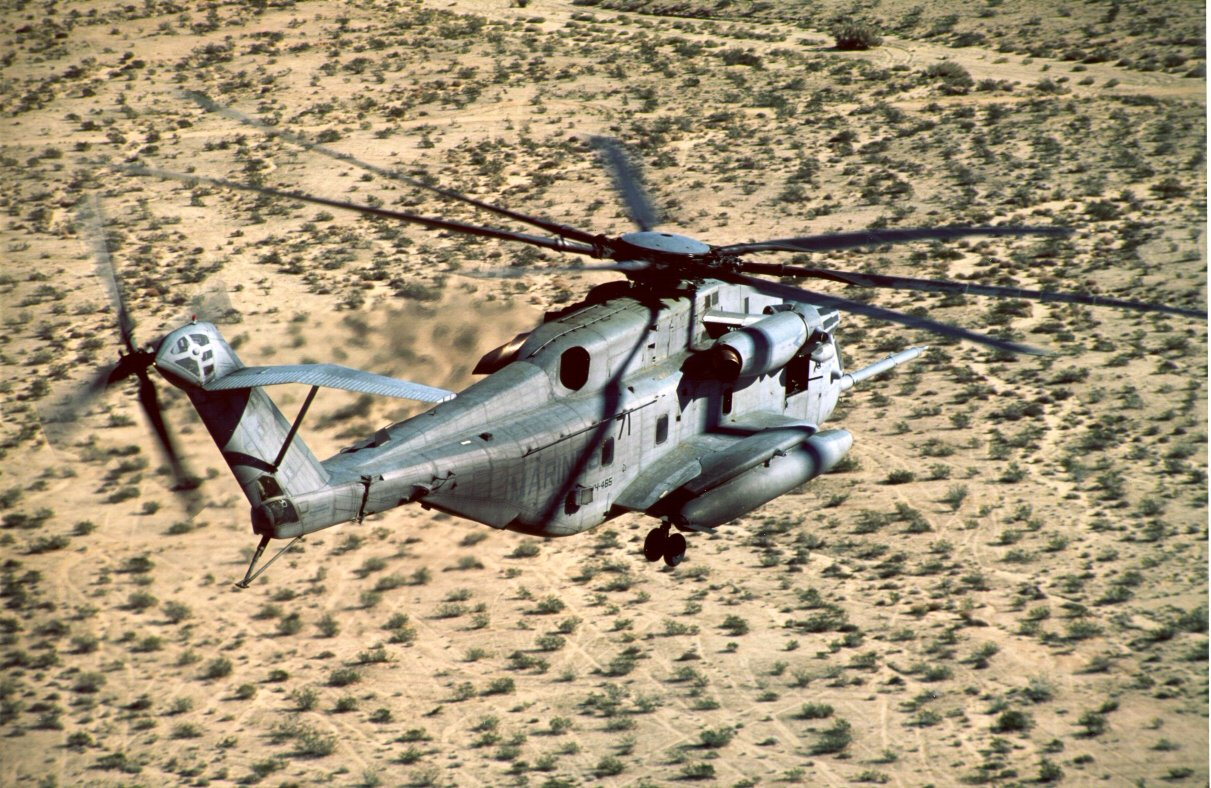
Bager1968A CH53 will quite happily fly with only 3 main rotor blades, a chinook wont :p
Correction… a CH-53A, D, or variants of those can, as they have a 6-blade main rotor.
The CH-53E (and the CH-53K), however, has a 7-blade main rotor, so good luck trying that with one of those.
Bager1968Don’t ask me what the problem is. I have none.. I only respond to pfcem’s claim that F-35 is a FIGHTER not a BOMBER (a F-111 replacement), even if Aussies are replacing their F-111 with.. guess what.. F-35..
If they do… for now though, they are in the process of replacing their F-111s with F/A-18Fs… which WAS designed as a “heavy striker first/fighter second” to replace the A-6 Intruder (the F/A-18E was the F-14 replacement).
Exactly what they buy to replace the Super Hornets with (after their F/A-18A-mod Hornets are replaced with F-35As) is still to be seen. They could buy more F-35As, F-35Cs, or maybe buy into a USAF F-15E replacement program.
Bager1968New Year and New Hopes
Valery Valkov, RusNavy.com editor-in-chief…..
We wish all sailors and pilots safe return to native quays and airdromes. Let the 2010 pass without ghastly accidents and needless victims.
Something I can happily wish for all nations’ militaries.
Bager1968This episod was done about future air-air combat options. It featured in the circumstances examples of dogfights between USAF F-22’s against formations of Russian Su-30 and French Rafales (I was very surprised of it). This means, for the US aviation experts and USAF pilots who took part to this TV documentary, that strategical situations showing combat between US forces and European nations is not a totally impossible option for the future.
No, no more than the US thought it might be fighting against Iran when it sold F-14s to them in the 1970s.
Rafale has been in the running for sales to many arabic nations that are currently friendly to the US (Morocco, Saudi Arabia, etc), but which might conceivably suffer internal upheaval (possibly fundamentalist-led revolution) leading to a change in alliance, and possibly to hostility to the US.
Bager1968UK Ministry of Defence signs contract for seventh C-17 Globemaster
Excellent… now for #8, #9, & #10 (the MOD reserved sequential serial numbers for 10 way back when).
Bager1968Wow… take-off & landing in drydock? Or has Shi Lang been moved to pier-side?

Bager1968Is the CH46 related to the CH47?
Nic
Same manufacturer an both used by the USMC. Also both are tandem rotors.
Ummm… no.
It is true that the CH-46 IS built by Boeing/Vertol (Vertol was the original builder, and was bought by Boeing), as is the CH-47.
However, the USMC does NOT use the CH-47! It uses the CH-53 family instead.
The CH-46 is the same size/passenger/cargo class as the Sea King (SH-3/S-61) and AW101 Merlin.


 Sign In








