 Bager1968
Since you edited your response at the same time I responded to you, its fair that I recognize your belated recognition of the point I raised.
No, we don’t want to waste tax-payer money on something that doesn’t work… but neither do we want to throw away something that might well be a good (or even great) aircraft in the long run just because of some inaccurate, deliberately misleading, vendetta-fulfilling diatribe by dishonest “experts” who can get someone to publish their tripe.
Some automatically support the aircraft, and some automatically oppose it… disagreeing with either (or both) positions does not make us stupid, it makes us free.
Yes, some published commentators HAVE proven themselves to be worthy of automatically being dismissed, as their writings habitually are full of the mis-information, bias, and dishonesty shown by these particular individuals.
None of us are required to give anything they say any credence whatsoever… and bad-mouthing those who don’t want to listen to that garbage is not particularly an even-handed thing in itself.
Bager1968Funny… it seems most of the replies DID list the specific points that the responders found inaccurate or distorted… do you suffer from selective blindness much?
Bager1968I didn’t know that US Navy shipboard-certified jet fuel HAD a wiring diagram?

We now return you to your regularly scheduled Jet Provost conversation.
Bager1968Hmmmm….somebody forgot the Fin 😀
I certainly wouldnt want to fly it in that configuration 😀
Here is a better view of the inverted vertical fin (complete with rudder).

Bager1968Note their very inaccurate portrayal of the P-38… they claim it was a failure as a fighter… mentioning only the worst of its admittedly mixed ETO experience.
They deliberately ignore its outstanding record as a fighter in the Pacific, where it shot down more Japanese aircraft than any other US Army Air Force fighter… outshining the P-51, P-47, P-40, & P-39. It was the aircraft in which the United States’ two top aces of the entire WW2 got their victories over the “superior” Japanese aircraft… Major Bong (40) & Major McGuire (38).
The ETO’s top two American pilots got theirs in P-47s, Gabreski (28) and Johnson (27).
The Army’s top 4 aces in the Pacific flew P-38s, and 7 of the top 8.
http://www.acepilots.com/usaaf_pto_aces.html
Similarly, their assessment of the F-111 mentions only its problems, and ignores its successful later combat record.
Their entire article is full of selective editing (and discarding) of facts, deliberate distortion of facts, and outright falsehoods (like the lift-fan BS).
Bager1968The XCH-62 was just a tad too big for ship-board use 😉 … but would have been a match for the Mil-26!
http://www.globalsecurity.org/military/systems/aircraft/h-62-pics.htm


Bager1968Looking at the shape of that I’d say it was the basis of what became the Alize
As Wanshan posted in the second post (first reply) in this very thread!
Ya might wanna read the whole thread before posting… just saying.
The Breguet 690 Vultur was a mixed-powerplant design incorporating an Armstrong Siddeley Mamba turboprop in the nose and a Hispano-Suiza Nene turbojet in the rear fuselage. The jet provided additional thrust for combat performance and take-off.
Experience with the Vultur, first flown on 3 August 1951, led the French navy to abandon the idea of such a powerplant for a strike aircraft. Instead, Breguet was contracted to develop a three-seat carrier-based anti-submarine aircraft from the Vultur [the Breguet 1050 Alize].
http://www.aviastar.org/air/france/breguet_vultur.php
This three-seat carrier-borne anti-submarine hunter-killer was derived from the 960 Vultur naval strike aircraft.
The first prototype [of the Breguet 1050 Alize] flew on 6 October 1956 and was followed by five pre-production aircraft. Orders for 75 production Alizes were placed by the French Navy and the first was officially delivered on 20 May 1959. Sixty-five were in service by May 1961. A further contract for Alizes was received subsequently from the Indian Navy and 12 were delivered, plus two ex-French aircraft. Two French Navy squadrons operated Alizes on board the carriers Foch and Clemenceau.
Bager1968And those variable intake designs add weight, increase required maintenance time, and increase the likelihood of a failure during a mission… which can cause the loss of an aircraft if the intake screws up at a critical time.
So, if your radar & missiles can compensate for a slightly lower top-end speed, then it is best to keep things simple.
Bager1968Apparently, this site has more info… and it was indeed a mid-air!
http://forum.armyairforces.com/Lightning-Collision-with-RAF-Bomber-December-1943-m168150.aspx
according losses of the 8th and 9th airforce on 22 dec 1943 had an F-5B midair collision with an Hallifax
s/n of the plane was 42-67318…..
History card for 42-67318 F-5B-1-LO..
shows last entries:
Soxo, 30 Nov 43-13 Dec 43
May have been repaired or stripped for parts prior to being condemed.
Then Condemned 9 Jun 1944…..
The interest being the New type Halifax tail unit (Square type) that was only just being introduced on new a/c and reto-fitted on older a/c.
…..
I have found only ten or so Mk III Halifax a/c lost between 16th Nov 43 and 22nd Dec 43, but there were several others of other mark’s that were abandoned in air that the Lightning could have collided with, however the chance that they had been converted is I think slim.
The ten Mk.III’s were –
25-11-43 … HX237 “HD-A” – 466 Sqdn
1/2-12-43… HX235 “HD-D” – 466 Sqdn
9-12-43 … HX276 “HD-Y” – 466 Sqdn
16-12-43 … HX296 “HD- ” – 466 Sqdn
19-12-43 … HX245 “BM – ” – 433 Sqdn
19-12-43 … HX277 “BM- ” – 433 Sqdn
20/21-12-43…HX270 “TL-M” – 35 Sqdn
20/21-12-43…HX273 “TL-J” – 35 Sqdn
20/21-12-43…HX236 “HD-J” – 466 Sqdn
20/21-12-43…HX273 “HD-W” – 466 Sqdn
Another site has this:
http://rmena.org/bulletin-june09.pdf
The Lightning was obviously a very robust aircraft and could survive heavy damage. We were shown several photos of damaged planes that were able to continue flying. In one case a Halifax had a midair collision with the Lightning and left its tail section impinged in the wing, and the Lightning was able to land safely. Apparently the Halifax was lost. Another example showed a plane that had run into a telephone pole, lost one engine and had its wing bent back but
still flew home.
Bager1968Fascinating details , remarkable the damage these aircraft could take and make it safely home or at least back to the ground !
Wasnt there a story of two b-17’s colliding and actually flying for a while joined together?
http://www.historynet.com/bizarre-b-17-collision-over-the-north-sea-during-world-war-ii.htm
Bager1968Boeing B-17F-5-BO (S/N 41-24406) “All American III” of the 97th Bomb Group, 414th Bomb Squadron, in flight after a collision with an Me-109. The aircraft was able to land safely. (U.S. Air Force photo)

A ground close-up:

P-38–F5B after mid-air collision with H-P Halifax
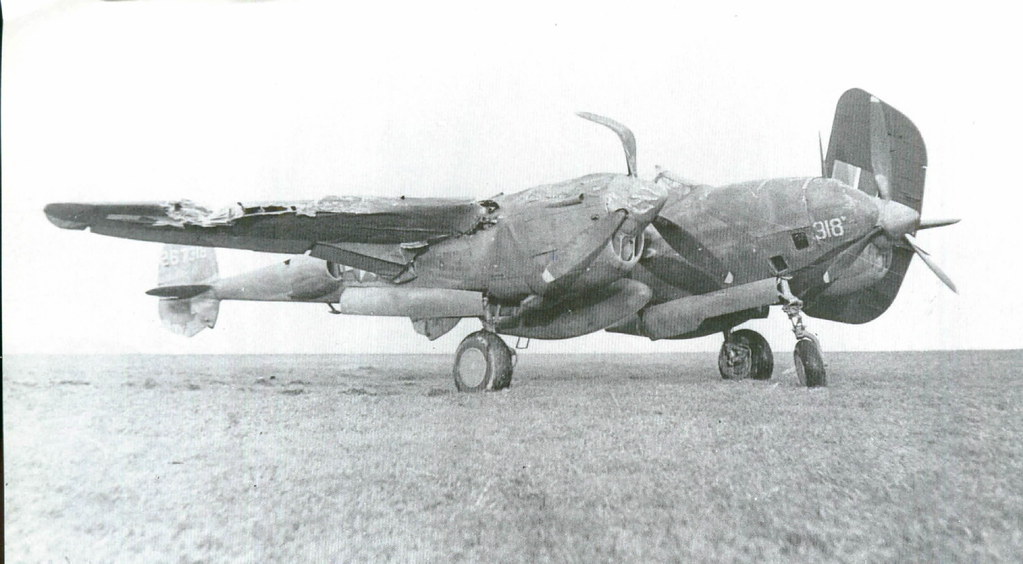
Thomas W.Smith’s P-38 after going head-on with an ME-109:

Bager1968Of course… it is used in specific situations where it gives either an advantage over other sensors or where it can gather info that they can’t get any other way.
None of a subs sensors are used all the time… not even passive sonar (some conditions render it useless and require the use of active sonar or radar instead).
Bager1968It is a navigation radar, to avoid colisions with ships and islands, for peacetime purpose.
What is?
He is referring to my earlier post:
Yes, most modern subs, from many nations, do have a surface-search radar mounted in one of the masts in the conning tower… and a number have air-search radar as well.
Sperry Marine, a Charlottesville, VA-based unit of Northrop Grumman, received a $20.9 million firm-fixed-price contract (N00024-09-C-5304) to supply AN/BPS-16(v)5 navigation radar systems for 8 US Navy Virginia-class Block III nuclear attack submarines.
The AN/BPS-16(v)5 is an X-band submarine navigation radar and electronic navigation system that provides navigation surface surveillance. The radar includes a naval electronic chart display and information system (ECDIS-N) which runs on Sperry Marine’s voyage management system (VMS) software.
note that “(v)5” means the fifth version of this particular radar.
No submariner is dumb enough to engage surfaced.
Then the US spent a heck of a lot of money for nothing on this:
http://www.naval-technology.com/projects/la/
The Los Angeles class submarines are equipped with a comprehensive suite of sonars:
…..
The surface search, navigation and fire control radar is the Sperry Marine BPS 15 A/16. The system incorporates a video processor, touchscreen radar controls and an hydraulically driven raise and rotate mechanism.
Which most certainly WAS intended to be used to attack targets from a shallow depth, with the radar mast extended out of the water.
Bager1968Which can also be used to locate ships in wartime… unless there is a special circuit that disables the system if the owning country declares war on someone? :rolleyes:
Bager1968No, he’s referring to the “4 type 214 submarines” cited in the article.
No mention was made in the article about where the subs would come from… I was assuming new-build ones specifically for this contract.
German-made submarines in latest US arms packageThe United States is preparing to sell German-made submarines to Taiwan as part of its latest arms package. That’s according to the US-based Foreign Policy magazine, which was quoted on the website of Hong-Kong newspaper Singtao.
Foreign Policy reported that the United States may make an announcement on its latest arms deal to Taiwan before next Friday, when President Barack Obama will attend the UN Climate Change summit in Copenhagen. The package is not expected to include F-16C/D fighter jets but should include 60 Black Hawk helicopters.
News agency Reuters also quoted remarks by US state department official Robert Kovac that the United States would sell four Type 214 submarines to Taiwan. The Type 214 submarine is developed and built in Germany and is currently operated by navies including South Korea and Turkey. It features an Air-Independent Propulsion (AIP) system to run at reduced noise and avoid detection.


 Sign In







