 Bager1968
Apparently this is a known problem…
Not the first time this has happened – the Eagle and Strike Eagle have both had issues with moisture weakening (repeated freezing/unfreezing) the honeycomb elements of both sets of stabs.
Bager1968Rail roads waste 35% of the entire petroleum economy. If you’re looking for waste start there. The Air Forces use the fuel or lose the budget.
Ummm… rail transport uses far less fuel to move freight on a gallons per mile per ton basis than road transport, and hugely less than air transport, so how do you get the “waste” bit?
Or are you proposing elimination of freight transport altogether?
Bager1968Strictly speaking any ship that carries aircraft is an “aircraft carrier”.
They may not a Nimitz class, but one of their primary roles is still to carry aircraft (whether fixed wing or rotary), in my book this makes them Aircraft Carriers.
So this is an aircraft carrier in your mind.

And this:

Lets try some reality here… USS America LHA-6:
http://www.globalsecurity.org/military/systems/ship/lha-6.htm
LHA 6, the first ship of the LHA(R) program, will be able to operate and support a detachment of 20+ Joint Strike Fighters. LHA 6 features several aviation capabilities enhanced beyond previous amphibious assault ships. These include an enlarged hangar deck, realignment and expansion of the aviation maintenance facilities, a significant increase in available stowage for parts and support equipment, and increased aviation fuel capacity.
LHA 6 will be multi-functional and versatile, modifying existing Command, Control, Communications, Computers and Intelligence (C4I) spaces to allow for flexible mission dependent reconfiguration. LHA 6 will also have increased cargo magazine capacity, better survivability, and greater service life margins. LHA 6 will use the same gas turbine propulsion plant, zonal electrical distribution and electric auxiliary systems being designed and built for LHD 8, the final of the Wasp class amphibious assault ships.
The LHA(R) will replace the LHA 1 class of amphibious assault ships, and will have the flexibility to operate in the traditional role as the flagship for an Expeditionary Strike Group as well as potentially playing a key role in the maritime pre-positioning force future (MPF(F)). As the Navy’s Seabasing plan matures, the flexibility to operate with the Expeditionary Strike Group and as part of the MPF(F) will make the LHA(R) a vital cog in the Sea Base. LHA(R) will be a variant of the gas turbine-powered LHD 8.
The one key difference of LHA(R) from LHD 8 is that it will be an aviation-enhanced assault ship tailored for the US Marine Corps future Aviation Combat Element centered on the STOVL F-35B Joint Strike Fighter and the tilt-rotor V-22 Osprey.
Repeat… aviation-enhanced assault ship!
It will still carry a troop load of 1,687 troops (plus 184 surge), and is intended to be part of the amphibious assault team… which means it will be pretty near hostile coasts… which is one very important reason why it doesn’t have nuclear power… there is a much higher possibility of it sustaining serious damage (or being sunk) than for an aircraft carrier (which it decidedly is NOT… your particular obsession notwithstanding).
Bager1968As used by the Canadian Forces.
Then there is the “ultimate development” of the Caribou/Buffalo… NASA’s QSRA:
Bager1968Yes, CNS Almirante Williams (FF-19) (ex-HMS Sheffield), a batch 2 ship.
She was decommissioned from the RN on 5 November 2002, and commissioned in the Armada de Chile on 4 September 2003.
She began a refit in March 2008, in ASMAR Talcahuano for installation of OTO 76 mm gun, Harpoon anti-ship missile and Barak SAM instead of Sea Wolf for defence.
She just recently was returned to service,conducting her post-refit trials last month, so she was unavailable for the photo shoot Tango III posted from.
There are pics & discussion (in Spanish) here: http://base.mforos.com/730111/3280645-fragata-tipo-22-2-ff-19-almirante-williams/?pag=23
Page 23 & all of page 24.


Bager1968USS Iwo Jima (LPH-2) off the coast of South Vietnam, 1965.

USS New Orleans (LPH-11).
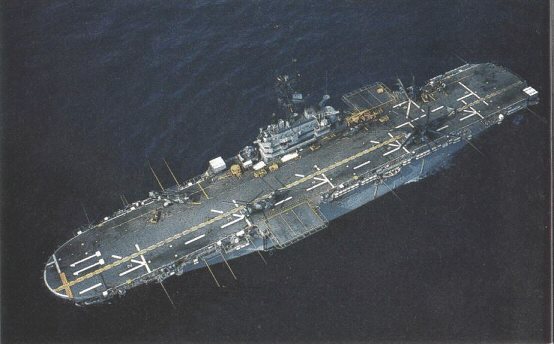
7 of the class, first commissioned 1961, last decommissioned 2001.
Bager1968No sign that the earth beneath or behind the aircraft has been disturbed.
I would suspect, if this is a real photo, that the aircraft has been craned to where it is.
Bager1968Load them on a heavy lift ship and sail them to the USN’s dismantling facility in Bremerton, Washington.
The USN has cut at least 118 reactor compartments out of decommissioned SSN/SSBN/CGNs and moved them up the Columbia River to the Hanford Nuclear Reservation, where they are sitting in a large pit, waiting to be buried.
Bager1968Jackjack, when one acquires an aircraft one always has to also pay that. You know what it really means? It’s specific fuel dispensers, workbenches, tools, pilot gear, briefing computers/software and so on and so forth. Same with training thing no matter if you buy a F-25, a Tiffy or a Super Tucano…
So people were “calculating” how the LRIP costs $75 million. All the trickery aside (missing engines and sutff) the difference here is amost $160 million per unit. Or in other words: it three times as expensive in reality compared to what the PR people stated.
By the way, if I read Faulkner’s comments right this price doesn’t even include spares or weapons.
Ok, lets get specific here… part of the cost here are the simulators for initial (and recurring) training for how to fly the F-35… those cost nearly as much (or perhaps more) than an aircraft… and the total of the rest isn’t trivial either.
Yes, LRIP aircraft are expensive by themselves, but the other costs are a far higher portion of this contract than you are admitting.
Bager1968Replica was primarily meant as a stealth tech demonstrator to use as leverage against the Americans in the JSF program. I don’t what provisions if any the Replica had beyond that in the way of weapons bays, radar, etc…
None. It was an aircraft-shaped box, nothing more.
Its sole purpose was to prove that the Brits had a good understanding of the math of stealth shaping & could handle RAM material production.
Bager1968Yep… the WTO could rule that the US government is illegally subsidizing Boeing… which would put things on an even footing again… 😉
Bager1968Sorry, but it really was just slogging through Google entries for “Hungarian actress, Hollywood, 1920s” and looking up every one I could find named.
You will note that I listed a number of them, and featured someone else, not Lya de Putti!
Although I did see that her death was a bit more dramatic than Pondskater mentioned.
First, background:
Born as Amalia de Putti in Vécse, Hungary (today Slovakia), she was one of the four children of Julius de Putti, a cavalry officer, and his wife, the former Countess Maria Katarina Hoyos. She had two brothers, Geza and Alexander, and a sister, Mitzi.
She began her stage career on the Hungarian Vaudeville circuit. She soon progressed to Berlin, where after performing in the ballet, she made her screen debut in 1918. She became the premiere danseuse at the Berlin Winter Garden in 1924.
Around that time German film director Jol Mai noticed her and cast her in her first important film, The Mistress of the World. She followed this success with noteworthy performances in Manon Lescaut and Varieté. The latter, from 1925, featured her opposite Emil Jannings. Both films are Ufa productions. While in Germany De Putti starred with such actors as Conrad Veidt, Alfred Abel, Werner Krauss, Grete Mosheim and Lil Dagover and was filmed by directors F.W. Murnau and Fritz Lang.
The actress came to America in February 1926. At the time she told reporters she was twenty-two years old. Her ocean liner’s records list her as having been twenty-six. De Putti was generally cast as a vamp character, and often wore her dark hair short, in a style similar to that of Louise Brooks or Colleen Moore.
De Putti starred in D.W. Griifith’s The Sorrows of Satan (1926). The film was released in two versions, one in America and the other in Europe. In the American version one scene had De Putti fully dressed. The same scene in the European release had De Putti topless.
The following year, De Putti went to Hollywood, but found little success there. Despite working with such distinguished actors as Adolphe Menjou and Zasu Pitts, she failed to make it big, and left the screen by 1929 to attempt to re-start her career on Broadway.
Her Hollywood efforts were inhibited by her foreign accent. Later she went to England to make silent movies and studied the English language. Soon she returned to America to attempt talkies.
Then the dramatic scene:
She was hospitalized to have a chicken bone removed from her throat, and contracted a throat infection. She was taken to the Harbor Sanitarium, then located at 667 Madison Avenue. She reportedly behaved irrationally and eluded her nurses. Eventually she was found in a corridor. She developed pleurisy in her right side, followed by pneumonia in both lungs.
She died in 1931, aged 32, in the Harbor Sanitorium.
Bager196890inFIRST… The USN had not only decommissioned many nuclear powered subs and cruisers, it has scrapped them and dealt with their reactors… WITHOUT dumping them in the ocean.
So the USN knows very well what the cost is for disposal!
http://www.oregon.gov/ENERGY/NUCSAF/subfact.shtml
Since 1986, the U.S. Navy has disposed of reactor compartments from deactivated nuclear-powered submarines at the Hanford Site in Washington state. Oregon takes an active interest in the program because the Navy ships the compartments 310 miles up the Columbia River, which forms Oregon´s northern border. Oregon´s involvement is to assure the safe transport of the reactor compartments.
Beginning in 1999, the Navy also began the disposal at Hanford of reactor compartments from nuclear-powered cruisers. These reductions in the nuclear fleet are the result of the retirement of aging weapon systems and cutbacks in the number of U.S. Navy ships in the post-Cold War era. The reactor compartments are prepared for disposal at the Puget Sound Naval Shipyard in Bremerton, Washington. The Navy selected Puget Sound for the job partly because it is near Hanford.
The Hanford Site occupies 586 square miles of south central Washington desert. The reactor compartments are placed in a large open pit in the 200 East area of the Site, which is on a plateau about seven miles from the Columbia River. Eventually, the pit will be covered with dirt.
Through June 2009, 118 reactor compartments have been taken to Hanford. On average, between six and eight shipments had been made each year; however, in recent years, that has dropped to only one or two each year.
The reactor compartments are classified as low-level radioactive waste. They do not contain loose radioactivity or contaminated fluids and their exteriors are not contaminated. The iron and metal alloys within the reactor vessel have become radioactive after years of reactor operations.
Before deciding on Hanford as its disposal site, the Navy considered other U.S. Department of Energy sites. The Navy also considered disposing of the compartments by sinking them in the ocean. After evaluating the costs and environmental impacts of both ocean disposal and land burial, the Navy determined that land burial at Hanford was the preferred option.
Yep… 118 reactor compartments have been removed from their ships and are now stored at Hanford!
Bager1968Well, the USN carriers being commissioned in 1955-58 had 4 desalination plants aboard, enough to supply the whole crew of 4,000+ with one shut down for maintenance… and all the other ships had similar plants as well.
I spent 364 days at sea aboard USS Ranger CV-61 in 1985-87 and we had restrictions on water use less than 1 in 5 days.
Bager1968Having said that, so do diesels but that’s being overcome.
Been overcome long ago… see large trucks and their many-gear transmissions


 Sign In







