 Bager1968
The FJ-1 Fury was the original, a straight-winged carrier aircraft, and used the GE J35.
The F-86A Sabre was a swept-wing, de-navalized development of the FJ-1, with so many changes it was a new, different aircraft, including the GE J47 engine.
The FJ-2 Fury was a barely navalized F-86F, using the same GE J47 engine.
The FJ-3 Fury was an slightly improved FJ-2, with the Wright J65 engine.
The FJ-4 Fury was another completely different aircraft, with a completely redesigned fuselage, a new wing, new horizontal & vertical tail surfaces, and a more reliable version of the J65.
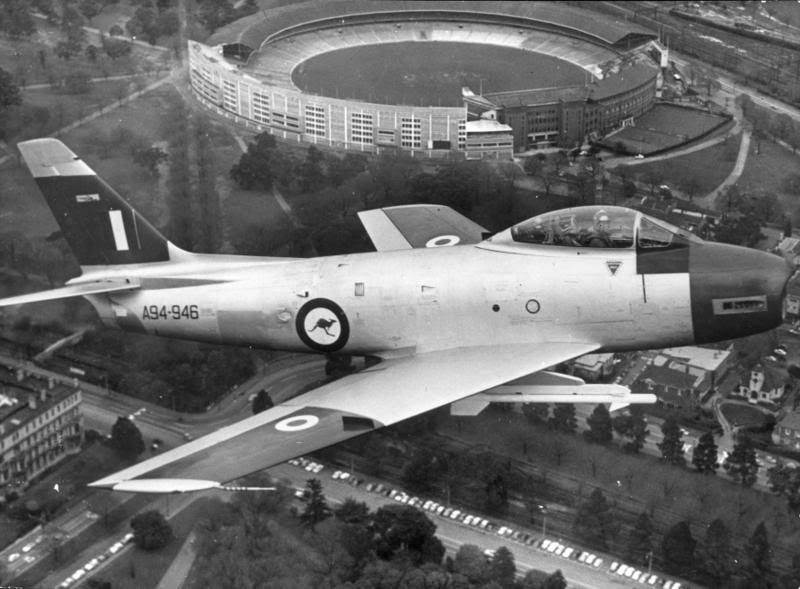
Bager1968My favorite is the FJ-4 “Fury Four”, although the Commonwealth CA-27 Sabre mk33 is a very close second:
http://f-86.tripod.com/fj4.htm
The Navy commissioned North American to push its Fury/Sabre design one more step, one more step in a line that started with the FJ-1 in 1947 and progressed through the whole family of F-86s, the FJ-2, a navalized ’86, and FJ-3’s. What they created was the finest single seat day jet fighter without an afterburner that would ever be built. Curiously, the prototype didn’t even carry an “X” moniker as the Navy skirted around constraints on the number of new designs.
The Fury Four however was a new plane. It was not an F-86 variation or a new..better..FJ-3. Here’s why. The Navy wanted a dayfighter with more loiter time and range (They got fifty percent more, a range of 2,000 plus miles, due in part to the redesign that enabled the FJ-4 to carry 50 percent more internal fuel than the FJ-3). They got this by enlarging and reshaping the FJ-3 fuselage and creating a “wet” wing by milling it out of a single piece of aluminum.
More on that in a bit. The tail surfaces were of new design and thinner, a dorsal fin shaped the upper fuselage aft of the cockpit. All this was wrapped around a J65-W-16A engine that developed 7,700 lbs. of thrust. Also, the wheelbase was widened by two feet, and the undercarriage was a new stronger gear and with that an ability to handle greater side loads. She was the first fighter equipped with a liquid oxygen system and gave the pilot the range of the fuel tanks! The Fury Four was equipped for in-flight refueling, and armed with Sidewinders and 20 mm cannons. The guns didn’t drag along the problems that they had in the FJ-2 and 3, and harmonized nicely at 2,000 feet. The plane flew like on rails in the gunnery pattern.
So now let’s get back to that wing. A new wing of spectacular design. It had inboard high lift flaps, a controllable drooping leading edge (serving up sweet slow flight characteristics), and mid span control surfaces. While the wing retained the 35-degree sweep of earlier FJ’s, the chord ratio was only six percent and more highly tapered. Brig. Gen. Jay Hubbard, USMC, the high time FJ-4 pilot, liked to say that the wing “thought it was a delta.” She easily slid into supersonic flight. An airframe that could have handled a bigger powerplant, a wing that would have loved it.
One gets a glimpse of this knowing that a couple of FJ-4s (the FJ-4Fs) were tested with an supplemental 5,000 lbs. thrust rocket engine, and on one flight went 1.41 Mach and reached 71,000 feet.
FJ-4 pilot Dick Percival said he felt that when he strapped in that it was “part of him” and never felt that sense in future Crusader and Phantom tours. Nor did ex Blue Angel Chuck Hiett who helped to guide the “Four” through the Fleet Introduction Program. He says, “You wore the plane like a glove. Its maneuverability made it a fighter pilot’s dream.” That came with the bird’s terrific rate of roll. Robert Dorr reports that at a reunion of Pax River types, Ace and Test Pilot Marion Carl was asked what was the greatest fighter-plane he flew and responded, “Oh, the FJ-4, of course.” Carl had flown ’em all.
The FJ-4 had one final act in its evolution: as an attack plane, the FJ-4B. The wings were strengthened with six hard points. These variously could handle bombs, Bullpup air to surface missiles, fuel tanks, and the “Buddy” refueling package. Also new was a LABS bombing system allowing for tactical nuclear weapons delivery and a extra set of speedbrakes. 222 of the FJ-4Bs were assigned to Navy and Marine attack squadrons. Again, the FJ-4B filled a gap as F9F Panthers and AD Skyraiders were retired while awaiting the splendid A-4.
As an aside, imagine this… the A-4C also had the same 7,700 lb.s.t. J65-W-16A engine (US-built Armstrong-Siddley Sapphire 100), and the A-4E (1963) replaced this with the 8,400 lb.s.t. J52, which was developed to produce 11,200 pounds thrust in the A-4M (1970 -408 variant). What if the FJ-4 were also fitted with the J52-P-408 (A-4M engine), or even the 8,400 lb.s.t. & 1965 9,300 lb.s.t. versions?
Specifications of the FJ-4 Fury:
Engine: One Wright J65-W-16A turbojet rated at 7700 lb.s.t.
Dimensions: wingspan 39 feet 1 inch, length 36 feet 4 inches, height 13 feet 11 inches, wing area 338.66 square feet.
Weights (FJ-4): 13,210 pounds empty, 20,130 pounds takeoff (clean), 23,700 pounds takeoff.
Weights (FJ-4B): 13,778 pounds empty, 28,000 pounds gross.
Performance: Maximum speed: 680 mph at sea level, 631 mph at 35,000 feet.
Combat ceiling: 46,800 feet.
Initial climb rate: 7660 feet per minute. Climb to 30,000 feet in 6.3 minutes.
Takeoff run to clear 50 foot obstacle 4250 feet.
Combat range: 1485 miles (clean), 2020 miles with two 200-gallon drop tanks and 2 Sidewinders.
Combat radius: 518-840 miles.
Armament: Four 20-mm cannon and up to 3000 pounds (6000 pounds for the FJ-4B) of underwing ordnance, including up to four Sidewinder AAMs.


Specification of the Commonwealth Sabre Mk.32:
Engine: One CAC-built Rolls-Royce Avon 26 turbojet rated at 7500 lb.st.
Performance: Maximum speed: 700 mph at sea level, 672 mph at 10,000 feet, 607 mph at 38,000 feet.
Initial climb rate: 12,000 feet/minute. Service ceiling: 55,000 feet.
Tactical radius: 290 miles (clean), 400 miles (with 2 drop tanks and two Sidewinder AAMs).
Maximum range with two 200-gallon drop tanks: 1150 miles.
Weights: 12,120 pounds empty, 15,990 pounds normal loaded (clean), and 18,650 pounds maximum.
Dimensions: Wingspan 37 ft. 1 1/4 inch, length 37 ft. 6 inches, height 14 ft. 4 3/4 inches, wing area 302/26 square ft.
Armament: Two 30-mm Aden cannon (162 rounds each) and two AIM-9 Sidewinder infrared-homing air-to-air missiles. Underwing loads could include two 500-lb bombs and two 100 Imp. Gall. drop tanks.
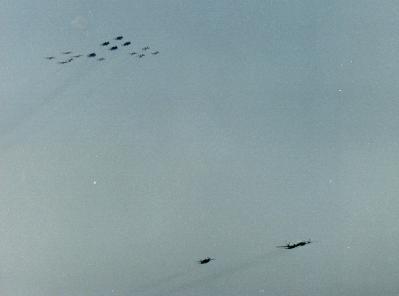
Bager1968During the “bad old days” of the “Cold War”, Bears overflew US ships all the time.
I remember in late 1987, in the Indian Ocean when I was aboard CV-61 USS Ranger. We were having our “steel beach” relaxation day, and we were overflown by a Bear at probably ~2,000 feet altitude.
It was escorted by a French F-8 Crusader… Clemenceau was in the area, and we were covering each other during replenishments, etc (our Captains had visited each other’s ships earlier).
Check out this thread: http://warships1discussionboards.yuku.com/topic/5479
Another USN vet posted a nice pic of a Bear (suitably escorted) which overflew his carrier just ahead of a formation of the carrier’s planes (it was during a show for visiting dignitaries).
Bager1968I got this from one of these discussion boards a while back :
Ingeniería Naval, septiembre 2002 pag 61 y sucesivas
Eslora total……………………………..241,8 m
Eslora entre perpendiculares……………….222,8 m
Manga de trazado…………………………..29,5 m
Puntal a la cubierta de vuelo……………….22,5 m
Desplazamiento a plena carga………..25.500/27.000 t
Tipo propulsión……………………….CODAG/COGAG
Potencia propulsora………………………57/66 MW
Velocidad máxima continua ………….25,5/26,5 nudos
Autonomía a 15 nudos …………………7.500 millas
Operaciones de aviones hasta ……….estado de mar 5
Operaciones del buque hasta ………..estado de mar 9Did Bazan….which was later known as IZAR…..and now is know as Navantia…..ever release any drawings or general arrangements of the BSAC/SAC 220 or 200?
Was there a really serious sales and design effort behind this project, or was it just a long shot sales pitch to China?
I have a slightly more detailed black and white drawing of the SAC-220. It looks to have two 75m cats. It looks to be able to fit about 20 hornets and four Hawkeyes. To be honest, I think the slightly smaller SAC-200 is a better deal. It could be used as a cheap training carrier or when used with a squadron of say a navalized JAS-39C/D could be an effective training. The slightly larger conventional version of the Charles de Guelle offered to India by DCN is a much better light carrier design.
Well, it seems that the SAC-220 & 200 were offered seriously to the Brazilian an Argentinian navies and later to China. Of course it would be a general design, the country interested in it would must to pay a more detailed R&D work.
Navantia/Izar/Bazan never makes public a lot of information of its designs (included that builded!).
Marketing has never been a Spanish strong point.
Just when was this ship design first proposed, and when was it offered?
Bager1968Putin will be out of office in a month so I think all this machismo stuff will end soon — hopefully.
The President’s office, yes.
But isn’t he trying for the Prime Minister’s office?
And isn’t there a piece of legislation in the process of approval that would transfer back to the PM all those powers Putin had transferred to the President when he took office?
“Out of power”?? Not hardly.
Bager1968Fairchild made two:
C-82 Packet


C-119 Flying Boxcar (with auxiliary Viper)

C-119G

C-119J Discoverer/Corona satellite retrieval aircraft

Bager1968Well, the Viper is in the Jet Provost… and there are Orpheus flying in Gnats.
They were not really competitors, as they were in different thrust classes… at least until the late 1960s versions of the Viper. The Viper started out at half the thrust of the Orpheus.
I suspect that if the Orpheus had been in a civil aircraft like the Viper was (HS 125), or in multiple trainers used by many nations (Jet Provost/MB 326) then it would have been upgraded as well… as shown by the Or.12 prototypes.
As its primary use was in the Gnat, and the Japanese T-1A trainer, there was less demand for upgraded versions that took advantage of the improved materials and efficiency designs developed in the 1960s.
Viper 100 (1954): 1,640-1,900 lb thrust, 515 lb, 68.72” long, 24.55” wide, 28” high; Jet Provost
Viper 200 (1960): 2,000-2,700 lb thrust, 570-710 lb, 64” long, 24.55” wide, 28” high; Jet Provost, Soko Galeb, Shackleton, MB 326
Viper 500 (1962/1966): 3,000-3,410 lb thrust, 730-815 lb, 71.1” long (85″ with thrust reverser), 24.55” wide, 28” high; HS.125, Soko Jastreb, BAC 167, MB 326GB
Viper 600 (1969): 3,700-4,000 lb thrust, 810-830 lb, 71.1” long (89″ with thrust reverser), 24.55” wide, 28” high; HS.125-600, MB 326K
Bager1968At a rate of what… 50-60 per year?
Bager1968Orpheus [Bristol Siddley] Airflow: 84 lb/sec
model date thrust weight length diameter SFC
Or.1 (Prototype) 1955 3,285 lb — 73” 32.4”
Or.2/701 (Gnat F.1/Finland) 1957 4,500 lb 790 lb 73” 32.4” 1.057
Or.2/701-01 (India Gnat F.1/Ajeet) 1958 4,700 lb 790 lb 73” 32.4” 1.057
Or.2/703 (HAL HF-24) 1960 4,850 lb 790 lb 73” 32.4” 1.057
Or.3/801 (Etendard VI) 1957 4,850 lb 825 lb 75.45” 32.4” 1.080
Or.3/803 (G.91 series) 1958 5,000 lb 825 lb 75.45” 32.4” 1.080
Or.3/805 (Fuji T-1A) 1958 4,000 lb 825 lb 75.45” 32.4” 1.080
Or.4/100-04 (Gnat T.1 UK) 1959 4,230 lb 900 lb 75.5” 32.4” .964
Or.4/101 (Gnat T.1 UK) 1960 4,520 lb 900 lb 75.5” 32.4” .964
Or.500 (C-119) 1961 5,750 lb — — 32.4” —
Or.12 (Prototype) 1959 6,810 lb 1,170 lb 82.7” 32.4” .976
Or.12R (Prototype) {T/O only} 1959 6,810 lb {8,170 lb} 1,560 lb {1,479 lb} 32.4” .976/1.62
Correction to my earlier post… the Or.12R had both all-altitude afterburner (reheat) and take-off-only reheat versions. The all-altitude version has the higher weight shown above, and has a thrust listed only as “more than 9,000 lb (4,080 kg) thrust”.
If you wish, I can send you a scan of the Jane’s All the World’s Aircraft engine section listing on the Orpheus. If I put it on Photobucket, it will get shrunk beyond readability (1,572 kb jpeg).
Bager1968— the LHA-R because these 50.000 tons Escort Carriers are allowing MCAir to become a second Navy, but it is the Navy who is promoting it since they don’t have enough CVN and hope they can sneak in more carriers (sea control ship) thru the USMC door. Without the LHA-R the whole F-35B is in question, since it’s pretty useless having a STOVL fighterbomber on land when you don’t have a STOVL airlifter that can support it. And I strongly dispute the fact that the MC needs LHA-R. It needs it because the Navy wants to be all-blue-water (that’s why the don’t have SSKs), resp doesn’t have enough CVN to support amphib ops and is prioritizing;
Apparently, you are completely unaware just what the LHA (R) is, and what it really does!
While LHA 6, the first ship of the LHA Replacement (LHA(R)) Program, will be an aviation-centric modified repeat of the LHD 8 (with the well deck removed and hangar enlarged), it will still carry 1,687 troops (more for short-term “surge capacity”). No CVN will be able to do that.
That is what the USMC wants it for, and besides, the aviation facilities and complement are STILL centered around direct support of USMC amphibious and land-based operations, NOT as some sort of “escort carrier”/strike platform.
LHA-6 will cost ~$3.08 billion, about one third of which will be one-time development/design costs.
By comparison, CVN-78 is projected to cost well over its budgeted $11 billion!
You could buy 3 LHA-6 for the cost of another CVN-78, now couldn’t you?
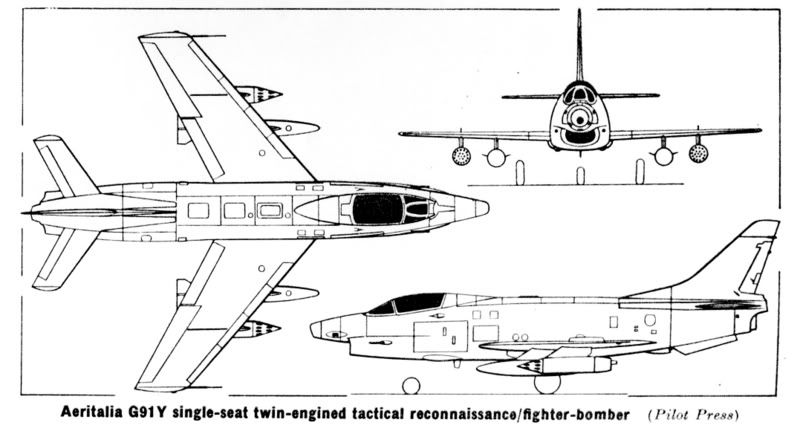
Bager1968G91/G91R/G91T: single nose intake, single Bristol-Siddeley Orpheus 803 turbojet; Max Power Rating 2,268kg (5,000lb) thrust.
G91Y: single nose intake, two (side-by-side) General Electric J85-GE-13A afterburning turbojets; Max Power Rating 1,236kg (2,725lb) dry thrust [1,850kg (4,080lb) with afterburning] each.
The G91/91R entered service in 1958, and the G91T in 1960. The G91Y first flew in December 1966.
The Orpheus used in the early G91s was the 803… an OR.3 series engine. In 1959, however, Bristol-Siddeley was testing an improved version, the Or.12, which was rated at 6,810 lb thrust. A version with a “take-off only afterburner”, the Or.12R, was also tested, and rated at 6,810 lb (8,170 lb with afterburner).
In 1961, they produced the Or.500, rated at 5,750 lb thrust, which was installed in late-model C-119s as an auxiliary engine.
To me, either of these would have been good engines for an upgraded version that would have required far less redesign than the eventual twin-J85 did.
The Orpheus did have about the same fuel efficiency as the J85 (Or.3/803 SFC 1.080 lb fuel/lb thrust/hour; Or.12R .976/1.62; Or.500 .97; J85-13 1.03/2.22), but the redesign also increased the internal fuel capacity, resulting in increased range, as well as higher weapons load and better take-off/climb characteristics.
Bager1968A bit better drawing than that one on Wiki-waki (larger):
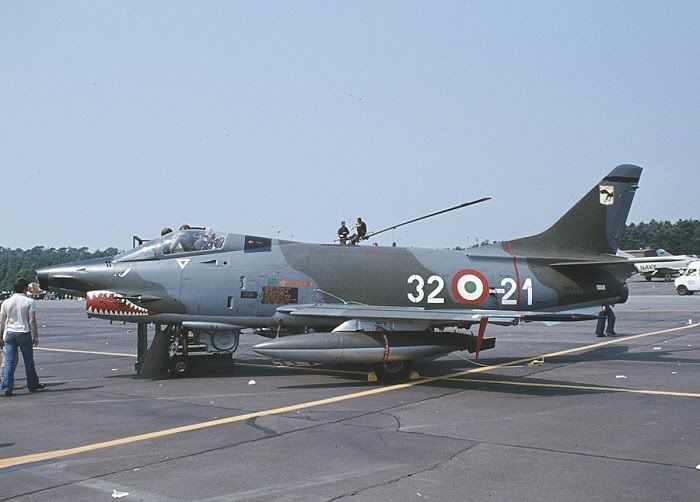
G91Y at Ramstein:
Bager1968Or they turn around and drop their weapons on their launch point.
Bager1968Don’t forget the “small Emerson radar ranging set installed in the extreme nose”.
In other words, about the same as a Korean War-era F-86A/E.
Not much, but it was an improvement over just the “lead-computing gunsight”, which was indeed developed for US fighters in WW2.
Bager1968Any info/pictures of the cancelled italian Trieste aviation cruiser?:)
That same question was asked on the Warships Projects forum (which specializes in “never-were” ships) on 02 Feb 2006… without result. Given that several knowledgeable Italian sources post there frequently, it appears that no info is publicly available… but I’ll revive the question there and see…


 Sign In







