 Bager1968
Exactly… the F-5A/B is most likely the aircraft referred to, as it was specifically designed for exactly the role being discussed.
excerpted from http://home.att.net/~jbaugher1/f5.html:
The development of the Northrop F-5 began as far back as 1954, when a Northrop team toured Europe and Asia to examine the defense needs of NATO and SEATO countries. The result of the tour was a 1955 company design study for a lightweight supersonic fighter that would be relatively inexpensive, easy to maintain, and capable of operating out of short runways and secondary airstrips as well as from small aircraft carriers.
…
The design of the lightweight fighter began in 1955 under the company designation N-156. The N-156 went through several different configurations before the final design was decided. The N-156TX proposal had the engines mounted in two underwing pods and had a crew of two seated in tandem underneath a shallow canopy. The N-156NN was a proposal for a naval version that had a configuration similar to that of the Grumman F9F and was intended for use from US Navy escort carriers and similar-sized ships such as those operated by the Royal Navy. The mothballing of the Navy’s fleet of escort carriers effectively killed off the N-156NN. In 1965, some studies were made of an aircraft with a folding ventral fin and a booster rocket.
…
The mockup was inspected by the Air Force early in 1958. In the meantime, the Air Force had studied the N-156F in greater depth and had come to recognize that the fighter proposal had great promise as a low-cost fighter for many of America’s allies who could not possibly hope to afford the expensive interceptors that were at that time entering USAF service. On February 25, 1958, the Air Force authorized the construction of three prototypes by Northrop under the company designation N-156T and to be called *Freedom Fighter*. The USAF serials were 59-4987/4989. In addition, one static test airframe (59-4993) was ordered.
…
In the meantime, flight testing continued unabated. The aircraft conducted in-the-field maintenance tests, rough-field operations and operations from an unprepared strip at NAS Pensacola. Test firings of Sidewinder, Sparrow III, and Falcon air-to-air missiles took place, and drops of various externally mounted ordnance such as bombs, unguided rockets, napalm tanks and Bullpup air-to surface missiles took place. There was even a test with a 2000-lb “special weapons shape” on the centerline. The aircraft could carry a heavier load than the F-100 and had a higher speed, better airfield performance, and a lower fuel consumption rate. Nevertheless, at the conclusion of the tests in August of 1960, the Air Force concluded that it had no requirement for the aircraft.
The incoming Kennedy administration brought a fresh look to many defense matters. In particular, in pursuit of its goal to “support any friend and oppose any foe in the support and defense of freedom”, the new administration gave new consideration to the funding of the sales of advanced warplanes to American allies throughout the world. For this mission, the USAF supported stripped-down versions of the F-104G Starfighter which was then entering service with Japan and several NATO air forces. Another contender was an adaptation of the Navy’s Vought F8U Crusader. However, the Department of Defense and its International Security Affairs Agency preferred the N-156F.
…
On April 25, 1962, the Department of Defense announced that it had chosen the N-156F for its Military Assistance Program (MAP). America’s NATO and SEATO allies would now be able to acquire a supersonic warplane of world-class quality at a reasonable cost. The USAF was to act as the purchasing agency for the program and was put in charge of crew training. The planes were to carry USAF serial numbers for record-keeping purposes.
The F-5 was also sometimes sold commercially under the terms of Foreign Military Sales (FMS).
Note: SEATO (SouthEast Asia Treaty Organization) included Thailand.
Bager1968F404 [General Electric]; Inlet diameter (at engine face) 27.7”; Airflow: 142-146 lb/sec
RM12 [Volvo Flygmotor/General Electric {F404}]; Inlet diameter 27.9”; Airflow: 150 lb/sec
F414 [General Electric]; Inlet diameter 30.6”; Airflow: 169 lb/sec
Overall engine diameter is ~35″ for all 3.
Thus, while there is only a small difference in airflow between the F404 & RM12 (4-8 lb/sec), there is a significant difference with the F414 (another 19 lb/sec).
Thus, the Gripen NG will have redesigned intake/ducting to handle the higher airflow requirement.
Bager1968Most of the pics & drawings (all of those hot-linked) are gone… only the ones with separately shown links still work.
Bager1968A-9A
The Northrop A-9A was a large ground-attack aircraft which was designed in competition with the A-10. Although it was not chosen for production, it was a formidable aircraft in its own right. Like the A-10, it carried many “hard points” for weaponry beneath its wings.
One A-9A is currently in the March Field Museum at March Air Force Base. The other is on display at the Castle Air Museum in California.
Specifications
Manufacturer: Northrop
Type: Attack Bomber (Light)
Length: 53 feet 6 inches [16.3 meters]
Height: 17 feet 10 inches [5.4 meters]
Wingspan: 57 feet [17.4 meters]
No. of Engines: 2
Powerplant: Avco/Lycoming ALF-502
Thrust (each): 6000
Speed: 837km/h
Ceiling:
Range:
Armament: 1 30mm gun,8,350 kg armament


Bager1968Japan to halt AH-64D Apache orders after 13th airframe
By Seiji Hirokawa
DATE:10/09/07
SOURCE:Flight International
Tokyo’s planned final purchase of one Fuji Heavy Industries/Boeing AH-64D Apache Longbow attack helicopter in fiscal year 2008 will halt orders of the type for Japan’s army after just 13 airframes way short of the 60 originally sought to replace the service’s current Fuji Heavy Industries/Bell AH-1S fleet.
The decision to stop Apache orders has been taken due to the type’s high unit cost, and as a result of Japan’s annual procurement model, under which the nation would take around 20 more years to complete its planned purchase. Fuji, which will this year complete a new licence production facility for the AH-64D, will receive compensation from the Japanese defence ministry following the decision.
With only enough aircraft being acquired to equip one Apache squadron, the army will extend AH-1S operations until a new replacement plan is been determined through a future White Paper. Fuji delivered Japan’s first AH-64D in March 2006, and the type participated in an army firepower demonstration in late August.
Sounds like one customer who is finding the Apache “a little rich for their blood”.
Bager1968Are you sure about Vengeance?
This is from the Fleet Air Arm Association of Australia website:

The mast & antennae look a bit different, but this view looks pretty similar?

Bager1968Yes, Sferrin, the XL (prototypes only, over 20 years ago) could… but the aircraft under discussion for India is NOT the XL, now is it?
No current F-16 model has any such recessed/semi-recessed/internal missile carriage, so Plawolf’s point is still valid.
Bager1968India is building the HAL HJT-36 as an intermediate Jet Trainer to replace their 200-odd HJT-16s.
I cannot find anything substantive on the HJT-39, the twin-engined Combat Air Trainer version of the HJT-36, dated more recent than 2005.
All the ones from 2007 are just people talking about it in a general way, so it seems this second Hawk purchase, which brings the total to 123, really is the formal end of the HJT-39 project.
Bager1968To the best of my knowledge, every nation that has conducted primary carrier-landing training has had at least one mock-up of a carrier deck to train its pilots with… and the mock-up included the same equipment a real carrier had, including carrier arresting gear* and often catapults (if their ships had catapults).
This arresting gear works, and actual arrested landings are conducted as part of the training (and sometimes catapulted launches as well).
Thus, if India is intending to eventually conduct its own primary carrier pilot training, it would set up such a facility itself… and would require a carrier-rated trainer to use with it.
Thus, the Goshawk would be logical if this is what India is planning.
* not a standard “field emergency arresting system” as found on most fighter airfields, but the same equipment as is fitted in the aircraft carrier.
Note that when China scrapped the former HMAS Melbourne in the mid-1980s, they removed the catapult and installed it in a land-based deck-simulator to conduct research on catapults and catapulted take-offs.
Bager1968And why should India adopt a new trainer type, with a whole new logistics & maintenance train, when they could buy more of what they already are buying?
Remember, they already contracted to buy 24 from BAe, and to build 42 more… which (combined with this new order) will make 99 built in India… 123 total.
Pure capability and individual airframe cost are only a part (less than half) of the deciding factors.
Bager1968As it went down into the water, in wartime, I expect it is still at the bottom of the lake!
Lake Victoria has a maximum depth of 84 m (276 ft) and a mean depth of 40 m (131 ft), and is 68,800 square kilometres (26,560 mi²) in size.
That’s a lot of lake to try to recover wreckage from…even if the crash spot is known to within a couple of miles.
Bager1968The report says they do not meet the specs for metal thickness as manufactured… and inside the airframe there is nothing to wear away the metal (for those items).
It appears to be a manufacturing defect.
Bager1968Companion site:
http://www.jet-engine.net/civtfspec.html
Bager1968Ja, you know the 1928 Australia was a Heavy cruiser! 😉
The previous government offered that it would better facilitate the use of UAV’s abord the vessels, but puplic sentiment and logic see that these ships will have a fixed wing compliment, which accounts for the order of 20 F-35B’s
What order, any info?
AIP is still possible, it just means no direct-drive option… they power electric generators.
Bager1968The AV-8B+ actually should have been designated AV-8E!!
The Night Attack upgrade was originally to be designated AV-8D (acccording to Donald, David: Modern Battlefield Warplanes, page 89. AIRtime Publishing Inc, 2004. ISBN 1-880588-76-5). Early approval efforts showed Congresscritters responded better to the “just an upgrade of an existing model, not a new model” pitch, so that’s how it was sold. The Night Attack upgrade first flew in 1987, with production deliveries from 1989.
At the time the APG-65 upgrade was approved (finally*), the US military was in the middle of its “Cold War is over, shrink the Military to provide a Peace Dividend to the taxpayers” size reduction.
In that environment, and with the USN being forced to accept the F/A-18E/F to replace the F-14 & A-6 (instead of the preferred Naval F-22, or the second-choice F-14/2000 strike-fighter), there was no chance of getting “a new version”.
Again, the USMC had to sell it to Congress as “just an upgrade of an existing model”… 😉
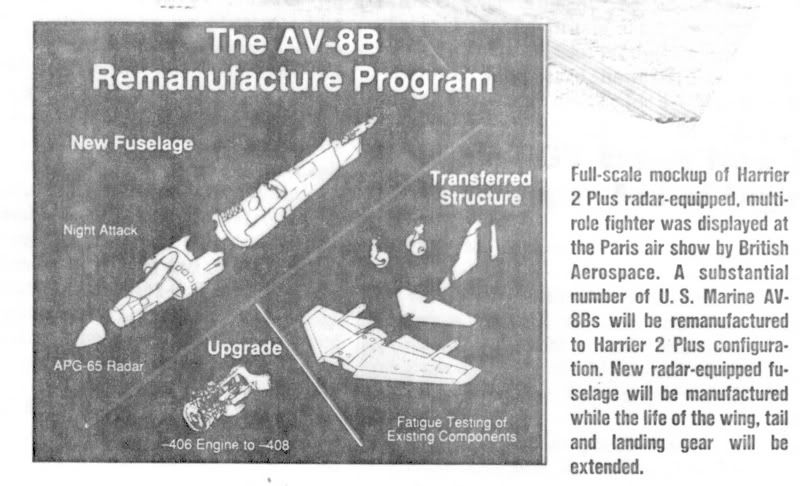
* Ships and Aircraft of the US Fleet (12th edition) by Norman Polmar, published in 1981 (I bought my copy new in August 1981) mentions:
“An AV-8B+ aircraft has also been proposed for Navy shipboard use. This aircraft would differ from the basic AV-8B by having increased engine thrust (22,600 lb.s.t.), an APG-65-derivative radar, autopilot, improved navigation and all-weather landing equipment.”
Of course, the USN refused to buy any Harriers, and the USMC was unable to fund it for another 10 years, until Spain and Italy agreed to share funding of the upgrade (the B+ first flew 1992, with deliveries from 1994).


 Sign In







