 Bager1968
Zulu Cobra, anyone?
Why not… the Marines thought that was the better way to go.
That way, they will already be marinized for use from the Oosumi class LSTs and the Hyuga class DDHs.
Bager1968In the spirit of the flights to be honored, how about something from before WW2?
Perhaps a DC-3, or something in that vein?
Bager1968Well, the real question is Boeing vs Lockheed, now isn’t it?
Lockheed had won the jet tanker competition, and Boeing built the Dash-80 (prototype for both the KC/C-135 series and the B707) as a private venture.
The USAF decided to buy a limited number as “interim tankers” pending delivery of the Lockheed plane… which was to have a greater transferable fuel load and a faster cruise speed (and more powerful engines).
The KC-135 was “good enough, and available now”, so the USAF quietly ordered lots of the Boeing birds, and informed Lockheed that their tanker was no longer wanted.
Here is a link to a discussion about the events, with drawings of the Lockheed tanker proposal:
http://www.secretprojects.co.uk/forum/index.php/topic,1348.0.html
“On March 26, 1952, Boeing’s president, Bill Allen sent a memo to his division heads, asking if they thought they could fly a prototype jet transport in just two years. Jim Barton in Boeing’s cost-accounting group said it would cost $13 to $15 million. On April 22 Boeing’s board of directors unanimously approved $15 million for Project X, or the Model 367-80, better known as the Dash-80. This project posed an enormous risk, for the military had not described the specific performance details that it wanted, and the $15 million investment represented more than twice Boeing’s profits from 1951. Although the plane had civilian uses as well, if the Dash-80 failed as a tanker, Boeing could fail too.
At SAC’s Requirements Conference in November 1953, General LeMay called for 200 jet tankers. The Air Force announced a design competition for a jet tanker on May 5, 1954, and invited Boeing, Convair, Douglas, Fairchild, Lock—heed, and Martin to participate. At that point Boeing’s leaders could only forge ahead with the Dash-80, which had its first successful flight test on July 15, and pray that it would win the competition.
On August 3, 1954, with the jet-tanker design competition still in progress, the Air Force decided to buy interim tankers. The Air Force Secretary, Harold E. Talbott, announced an order to buy 29 tankers from Boeing. Less than two weeks later the Air Force said it would buy 88 more Boeing tankers. It looked as if Boeing was set to win the competition, but it didn’t.
In February 1955 the Air Force announced that Lockheed had won the competition and at least one of its tankers would be funded for construction. In the very same announcement, however, Talbott said the Air Force would buy an additional 169 tankers from Boeing. Eventually it canceled Lockheed’s paper proposal.”
Bager1968But those are Jercules… not Hercules. 😀 😀 😀
Bager1968Note that those produced for France and the UK were the only P-38 models without counter-rotating props… even the XP-38 (the very first one) had them… although they did rotate opposite all other P-38 models
quote from http://home.att.net/~jbaugher1/p38.html
“Chronologically, the Lightning Mark I for the RAF was the next model produced. In France, as early as the spring of 1939, the Comite du Materiel and the Etat Major had been taking a look at the P-38 as a possible substitute for the Breguet 700, Potez 671, and Sud-Est S.E.100 twin-engined fighters then under development. In April 1940, the Anglo-French Purchasing Committee ordered 667 P-38 fighters. The two versions were the Model 322-61-03 (or 322-F) for France and 322-61-04 (or 322-B) for Britain.
Both the British and French delegations insisted that the Lockheed fighters be equipped with Allison engines without turbosuperchargers and with strictly right-handed rotation.
This was because they wanted the engines to be interchangeable with those of the Curtiss H.81A Tomahawk which had been ordered by both Britain and France in great numbers.
In addition, the Committee wanted to optimize the aircraft for medium-altitude combat as was currently the dominant mode of aerial warfare in Europe, rather than the high-altitude role for which the P-38 had originally been designed.
The Anglo-French delegation was also aware of the problems currently being experienced by the War Department in the delivery of turbosuperchargers, and did not want to run the risk of costly, time-consuming delays since they wanted all the planes delivered in less than a year.
It turned out that this decision was particularly unfortunate.”
“There is at least one occasion in which Lightnings served with Axis forces, joining the list of aircraft which served on both sides during World War II.
The Regia Aeronautica managed to obtain an intact P-38G when it had been forced to land on Sardinia on July 12, 1943 due to navigation equipment problems during a flight from Gibraltar to Malta.
The captured P-38G was repainted in Italian markings and was flown to the experimental center at Guidonia for evaluation.
It was flown from there on August 11, 1943 by Col Angelo Tondi to intercept American bombers.
Tondi is credited with possibly shooting down one B-24D Liberator.
However, the Italian P-38G was grounded shortly thereafter because of a lack of spare parts.
The Italians acquired additional Lightnings in a more orthodox manner six years later.
When Italy joined NATO, the Aeronautica Militare Italiana received 50 Lightnings (P-38Js, P-38Ls, and F-5Es), which operated them until they were replaced by jets.”
Bager1968:
Originally Posted by Shadow1 According to a report on CNBC this morning, Lybia will be buying 13 to 18 Rafale (Or Rafaele, according to the newscast ) from Dassault Aviation for 3.2 billion dollars. Does anyone have any information which might correlate this story?The price looks way too steep if you ask me. There must be something more connected with it.
“Nous allons acheter pour plus de 3 milliards d’euros d’Airbus, un réacteur nucléaire, et nous voulons aussi acheter de nombreux équipements militaires.
Nuclear reactors are not cheap.
Bager1968I recall seeing an article on the web … perhaps Cybermodeler or Hyperscale… in which the modeler produced a wonderful rendition of the Baracuda with wings folded – scratch built the entire fold area – all in 1/72… must see if I can find that article again.
Edit… found it… IPMS Stockholm… http://ipmsstockholm.org/magazine/2005/10/stuff_eng_benshahar_barracuda.htm oh, and it was 1/48… but still sure I’ve seen it done in 1/72
The article you linked mentioned that 1/72 model you remember…
“The model captured my attention following the detailed work of Allan Yee on a 1/72 Frog sample.
…
Allan provided me with the technical drawings. Without them I could not accomplish this work.”
Perhaps you could contact this Alan Yee for more info?
Bager1968Ah, we’ll just borrow the RN’s “rolling STOVL landing” technique, and no problem.
The Marines did that before (F4U Corsair, left turn landing technique), why not now… especially with the Marines crossdecking to keep the Brit deck crews current*?
*Just a couple of months ago, remember? Since the USMC will probably be getting their F-35Bs before the RN, maybe we will train the RN deck crews first?
Bager1968First all British ( and world ) aircraft to fly under its own power would be John Stringfellows 1848 steam powered monoplane ( based on Hensons Steam carriage) and of a more practical configuration than many later dead-end designs e.g. Wrights.

http://www.flyingmachines.org/strng.html
Ah yes, the flying models (much too small to carry even a child) that flew for all of 30 feet or so in a straight line.
Note that even this brilliant engineer diverted from the monoplane and went to bi and triplane models, as well as a tandem-wing twin-propellor monoplane in an ultimately futile attempt to find a design he could enlarge to carry a pilot.
Bager1968An AEW variant could even have been developed, and fitted with Searchwater radar…
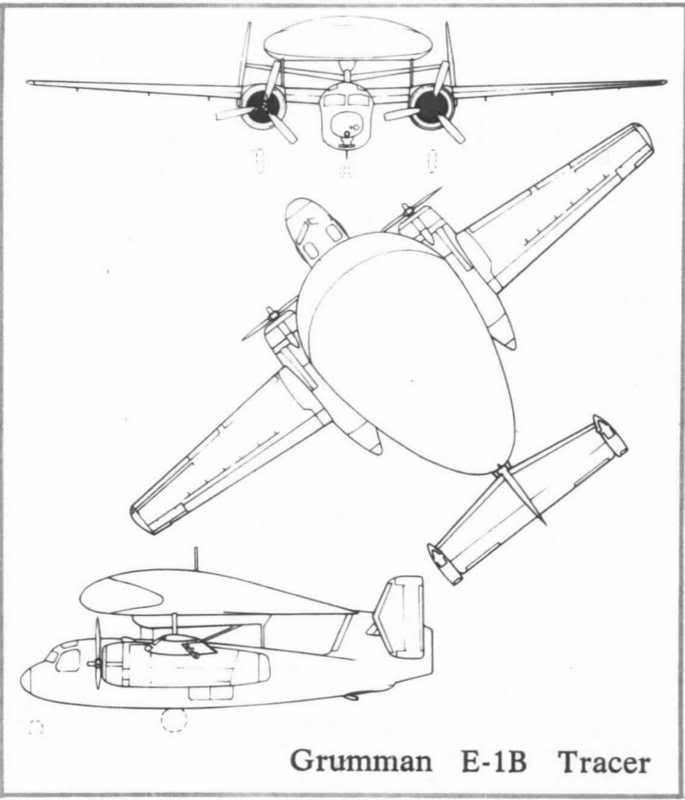
You mean something like this?
E-1 (WF-2) Tracer (modified C-1 Trader {cargo version of S-2} airframe with classic Grumman side-fold wings):
E-1B VAW-11 CVA-19 1962

E-1B VAW-11

E-1B CVA-42 Feb1970
line drawing
Bager1968Just cross-deck a few of the USN LHD deck crew… who ARE trained for, and used to, STOVL ops!!
The USMC has operated AV-8A/C/B/B+ from the USN’s LHA/LHDs for over 20 years now, and will continue to do so with their F-35Bs.
No problem.
Bager1968Even the USN kept its “underpowered” F-14As with reworked TF-30s and did not replace that with F110-GE-400 at hand. There was a serious reason for that!
The answer to that is 100% politics.
The USN did re-engine 50 F-14As with F110-GE-400s.
The F-14A(Plus) program to re-engine the TF30-powered F-14As with F110-GE-400 called for the manufacture of 38 new aircraft and the rebuilding of 32 existing F-14As. These 70 aircraft were all built/converted, and were later redesignated F-14B.
This was to be an interim program, replacing only the engines, while the full F-14D avionics suite was being developed.
When this was ready, 104 of the original F-14A fleet were to be upgraded to full F-14D configuration, along with a planned 108 new-build F-14Ds.
With the “end of the Cold War”, Secretary of Defense Dick Cheney ordered the F-14D program funding slashed in 1989, and stopped completely in 1992. In the end only 37 new-build and 18 converted F-14Ds were produced.
There were no technical problems with this engine change… only political problems.
This site has info and illustrations on the two installations:
http://www.anft.net/f-14/f14-detail-engine.htm
Engine: P&W TF30 GE F110
Diameter 1245 mm 1180 mm
Weight 1825 kg 1740 kg
Rate of airflow 118 kg/s 120 kg/s
Bypass Ratio 0.73 0.85
Max. Combustion Chamber Temperature 1590 K 1745 K
Thrust 68.0 kN 73.8 kN
Thrust with Afterburner 112.0 kN 124.5 kN
Specific Fuel consumption 68 kg/(kNh) 75 kg/(kNh)
Specific Fuel consumption with Afterburner 255 kg/(kNh) 201 kg/(kNh)


Bager1968Those links are for the FD.2… the Fairey Delta 2, which is a single-seat research aircraft..
The link PMN1 gave goes to drawings & specifications for a larger, two-seat fighter proposal.
But, that explains why “Fairey ER.103” came up blank… ER.103 was NOT a Fairey designation, but a Ministry of Supply-issued Experimental Requirement number, which applied to several proposals from different manufacturers (including EEs proposal, which became the Lightning).
Bager1968Well, the further up the leg goes, the greater the force needed to keep moving it, as the wheel is getting further from the pivot-point horizontally, and thus is more affected by gravity.
Thus, while the hydraulic pressure is great enough to move both legs from the vertical alignment, the increasing combined force requirement soon exceeds the capacity of the hydraulic system, and one leg stops (or slows greatly) until the more easily-moved one reaches full retraction and the fluid stops flowing through that actuator.
Bager1968You know… the politicians who appropriate money, sign contracts, give orders to the military.
The one that exists as a continuing structure without regard to which party is in majority or claims the Prime Minister as a member.
That one. :rolleyes:


 Sign In







