Bager1968
Interesting photo there. Is that a biplane in a field or on top of a building or maybe flying over?
It is a stock file photo of RAF Waddington – and other than to make a nice visual, has no relation to the incident.
Bager1968Unfortunately, that poster last visited on 6th January 2010, so I don’t know if he will respond.
Bager1968Is this actually FAH 603 restored or is it a different FG airframe with a Honduran paint job?
The FG-1s were Goodyear-built F4U-1s.
The aircraft in question is a F4U-5, built by Vought.
Bager1968All this talk about payload, etc.
Brazil wants to replace first its small number of Mirage 2000s, and then its F-5s.
What payloads did they carry? Yeah, Gripen-E can carry everything that Brazil needs it to, with a full fuel load.
Bager1968Here is the Spitfire De-Icer C*ck, which certainly looks closer to me? though only two position, despite three pipe unions?
[ATTACH=CONFIG]227948[/ATTACH]
One input line, two output lines (or vice-versa). So only two positions.
Bager1968This article is only available to registered Flightglobal users
Can you give another link that the rest of us can read?
Bager1968The article fails to mention the other reasons for the Seahorse project to be dropped.
http://mustang.gaetanmarie.com/articles/naval/naval.htm
In the words of the test pilot Lt. Elder, who made nearly 150 simulated launches and landings with the ETF-51D and the actual shipboard arrested landings and take-offs, “from the start, it was obvious to everyone that the margin between the stall speed of the aircraft (82 mph) and the speed imposed by the arrester gear (90 mph) was very limited.”
Bob Elder “made all carrier landings at the speed of 85 mph. Luckily, the Mustang reacted well, even in the most delicate situations. One just had to use the throttle wisely.” Elder reported that speed control on the ETF-51D was excellent. He also stated that “the forward visibility was good and never gave me any problems. In fact, fighters with radial engines such as the F4U or F6F were worse than the P-51 in that respect.” The aircraft also behaved well during catapult launches.
But everything was not perfect. As previously mentioned, the margin between stall speed and maximum engagement speed was small, too small for safety. Rudder control at low speeds and high angles of attack was inadequate. In addition, landing attitude had to be carefully controlled to avoid damaging the airframe upon landing.
One of the handling quirks of the Mustang was also potentially dangerous. During a missed approach or a wave-off, power has to be re-applied gently. If not, the aircraft could roll rapidly, or even snap-roll. At such low speed and altitude, the result could only be fatal.
The carrier suitability trials were rather short: only 25 landings and launches were made. Elder wrote “Although I had “premiered” many US Navy aircraft carrier landings, no such experience had been as interesting as with the Mustang”. Nevertheless, he did not think the Mustang had its place in naval operations.
Add to that the abundance of the F6F Hellcat and the F4U Corsair, and the impending introduction of the F8F Bearcat & F7F Tigercat, and there just wasn’t a need for the Mustang on carriers.
But NAA persisted:
However, North American Aviation did not forget about the ETF-51D experiments. It later presented another navalized Mustang project to the Navy. This project, NAA-133, was based on the P-51H, the last Mustang model to see production.
Modifications were similar to those carried out on the ETF-51D. The airframe of the NAA-133 would have been strengthened. This was particularly important as the P-51H airframe was lighter but not as sturdy as that of the P-51D. It also included a folding wing design. Two external drop tanks would have been fitted on the wingtips. The rear part of the fuselage was more heavily modified to accommodate the tailhook: the tailwheel doors were lengthened to fit the entire tailhook. The lower part of the rudder was cut out, to make space for the tailhook when in retracted position. Also, the twin dorsal antennas of the standard P-51H were replaced by a single antenna.
The NAA-133 project never went further than the design stage. However, the US Navy did continue to play with the idea of navalized Mustangs for some time. In August 1945, P-51H-5-NA #44-64420 was transferred from the Army Air Forces to the Navy. It was used to determine whether the P-51H had low-speed performance that would allow it to operate from carriers. The handling of the aircraft at approach speeds was considered adequate and much better than that of the P-51D. Once this had been ascertained, no further testing was undertaken for some time.
In late 1947, another P-51H was borrowed by the US Navy: P-51H-10-NA #44-64700. This aircraft was modified by the Naval Aircraft Factory and received a center-line catapult attachment point. The aircraft was used to test new catapult equipment. A few catapult launches were made at different weights, and the type was considered suitable for catapulting with no further modification.
Obviously, the Navy was interested in the Mustang’s long range at a time when early jets had very short “legs” and could not stay over the battlefield or stand patrol for extended periods. Nonetheless, navalized versions of the P-51H appear not to have been attractive enough to warrant further interest. Attempts to navalize the Mustang thus came to an end and the “Seahorse” became an amusing and little-known “what-if” part of aviation history.
In light of the concerns over a hard landing damaging the P-51D’s airframe, the lighter airframe of the P-51H would be even more fragile, despite its better low-speed characteristics.
Of course, by 1947 the early AD-1 Skyraider was about to enter service – with a long range and a massive payload.
Bager1968Ongoing Program ? Meaning the P8 sold to the US Navy & India were all prototypes ?
Not exactly. Even when an aircraft reaches full production not all of the kinks have always been worked out, not the entire range of capabilities has been added. For years the RAF flew Tornados that didn’t have a radar that was up to scratch, aircraft get introduced to service before their full range of weapons have been integrated, things like that.
The current-standard P-8As are, according to the USN, an “interim standard”, with a mix of legacy systems from the P-3C and new systems. The full-up P-8 suite is to be installed later in the production run, with the early aircraft upgraded during their initial scheduled major depot inspection periods.
Bager1968Actually, that “HIVA” was using a mix of initials and Roman numerals –
H-4A (16,000 lbs to 85 mph in 72.5-ft); Essex hangar fit (removed from May 1943)
F MK II (10,000 lb to 35 mph) flywheel type aboard CV-2 & CV-3 from 1920s
H MK II (7000 lbs to 70 mph in 55-ft); pre-war Yorktown class & Wasp fit (including hangar catapult)
H-2-1 (11,000 lbs to 70 mph in 73-ft); CVE/CVL fit, late 1943 fit for CV-3 & CV-6
H-4 (3,500-16,000 lbs to 90 mph in 95-ft); Essex class early fit
H-4A (16,000 lbs to 85 mph in 72.5-ft); Essex hangar fit (removed from May 1943)
H-4B (18,000 lbs to 90 mph in 96-ft); Essex class later fit
H-4C (16,000 lbs to 85 mph in 72.5-ft); CVE/CVL fit late war
H-4-1 (28,000 lbs to 90 mph in 150-ft); Midway class early fit
H-5 (16,000 lbs to 90 mph in 96.7-ft); seaplane catapult (all converted to H-4)
H-6 (60,000 lb to 120 mph); seaplane catapult
H-8 (15,000 lb to 120 mph or 62,500 lbs to 70 mph in 190-ft); replaced H-4B & H-4-1 in post-war Essex & Midway class modernizations
H-9 (45,000 lb to 120 mph or 100,000 lbs to 90 mph in 210-ft); for CVA-58 United States, cancelled
Bager1968The type had several tail boom/tail rotor failures during its short service, leading to a lack of further orders. I don’t remember if they developed a fix before the aircraft program was terminated or not.
Bager1968to me, there is only one simple sollution to build a cheap & cost effective CAS platform:
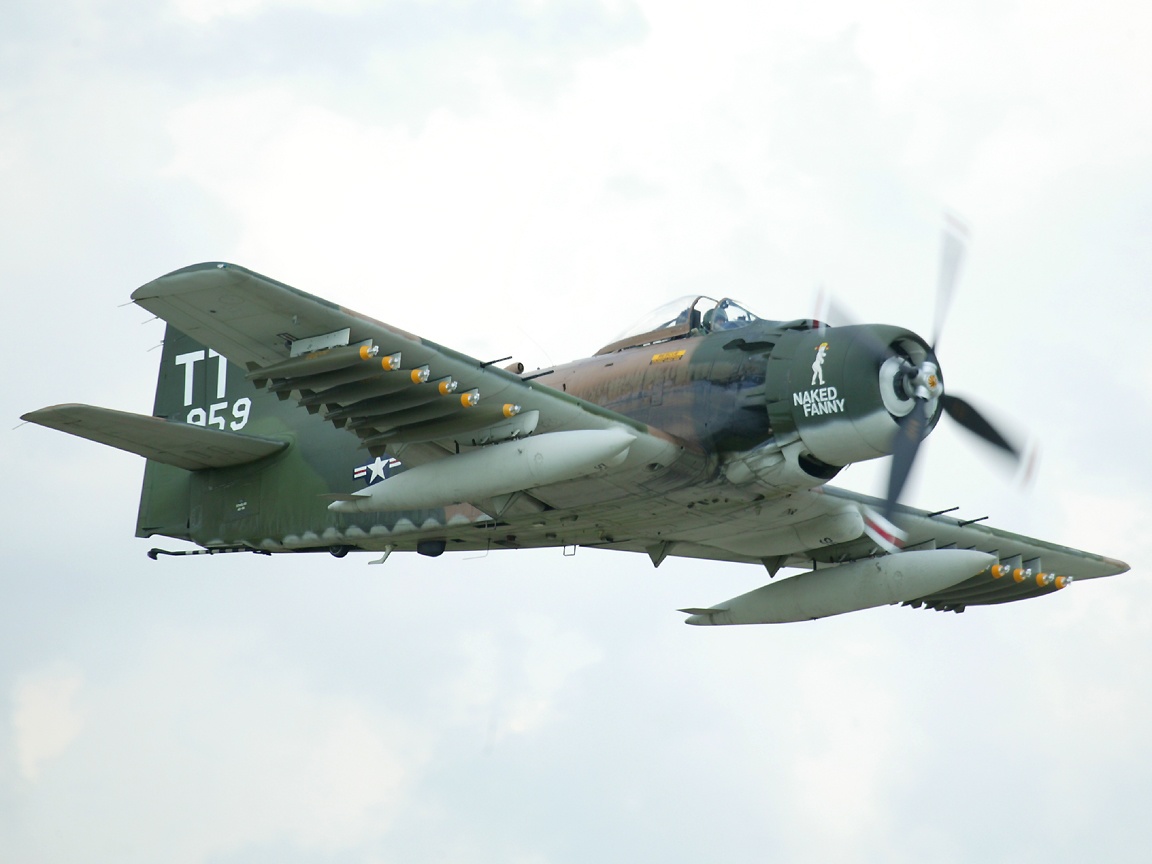
a Turboprop variant of the A-1 Skyraider :dev2:
The USN already tried that, and dropped it:
A2D Skyshark:
[ATTACH=CONFIG]227527[/ATTACH]
[ATTACH=CONFIG]227528[/ATTACH]
Bager1968Please forgive me, for I find I must…
Broncoski!!! >grin<
Bager1968We have an exclusive offer for people wishing to follow the B-24 restoration project.
For the 1,000th facebook page “like” the selected person will receive 1 of the following items to choose from –
We are at 580 likes – so maybe suggest to your friends to join up and maybe one of them will be the lucky gift winner courtesy of the Werribee B-24 Liberator project. Visit their page at https://www.facebook.com/B24Werribee
So… you are telling me that when I “liked” your page a month ago I made a mistake? >grin<
Bager1968Also TT, above the rear mounted middle engine is a pulpit like structure for the rear gunner to climb up into. The rotating rear propeller only inches away from him.
Yes… don’t forget the “protective cage” to keep him clear of the propeller.
[ATTACH=CONFIG]227458[/ATTACH]
Bager1968My Aerofax is out on loan – but I remember it being in there – meanwhile a Google of ‘MiG-25 bizjet’ finds it…..
Ken
The biggest issue to me is the insanely improper fore-aft CG compared to the C/L.
The only way to lift the nose would be to apply so much angle on the horizontal stabilizers that they would also function as air brakes!
That thing needs both canards larger than the horizontal stabilizers mounted just forward of the passenger windows and for the leading edge of the wing to be moved forward to about where the lerx starts now just to fly controllably.


 Sign In