“a smaller, lighter, twin engined, twin-seat tactical bomber with great armor protection of the vital parts, something along the lines of a twin engined MiG-27 on steroids..”
How about the F-4 as it might have been…
From Joe Baugher’s entry on the development of the F-4:
http://home.att.net/~jbaugher1/f4_1.html
“Although the Navy was favorably impressed by the Model 98B proposal, the Grumman XF9F-9 Tiger and the Vought XF8U-1 Crusader which had been ordered respectively in April and June of 1953 appeared to satisfy all the Navy’s immediate requirements for supersonic fighters. Nevertheless, the Navy encouraged McDonnell to rework its design into a single-seat, twin-engined all-weather attack aircraft to compete against designs being worked on by Grumman and North American.
McDonnell submitted a formal development proposal for the F3H-G/H to the Navy in August of 1954. The Navy responded in October of 1954 by issuing a letter of intent for two prototypes and a static test aircraft. The Navy assigned the designation AH-1 to the project, reflecting its intended ground attack mission. The AH-1 was to have no less then eleven weapons pylons. Armament was to consist of four 20-mm cannon.
On December 14, 1954, the multirole mission of the aircraft was formally abandoned by the Navy, and McDonnell was requested to rework the proposal as an all-weather interceptor. McDonnell was instructed to remove the cannon and all hardpoints except for a centerline pylon for a 600-US gallon fuel tank. In addition, troughs were to be added for four Raytheon Sparrow semi-active radar homing air-to-air missiles. A Raytheon-designed APQ-50 radar was added, this installation being essentially that installed in the F3H-2 Demon. A second seat was added to accommodate a radar operator.”
So, without the later re-design to delay things, the single-seat AH-1 would have competed with the A-6 for the Navy’s all-weather attack aircraft… which might have been picked up by the USAF to replace the F-100s (and complement the F-105) in the early 1960s, and therefore been available throughout the Vietnam war.
That would also have meant something else for the new USAF fighter… maybe the improved F-106 they had been considering?
http://home.att.net/~jbaugher1/f106_3.html
pic here:
http://forum.keypublishing.co.uk/attachment.php?attachmentid=146295&d=1162069775

“only a stop-gap until the arrival of the F-35”
I was getting that the -Fs would be the last Hornets to be replaced by the F-35, meaning they will be in RAAF service well after the arrival of the first F-35s.
Nice pics, thanks for posting those shots of the “Phantaroo”.
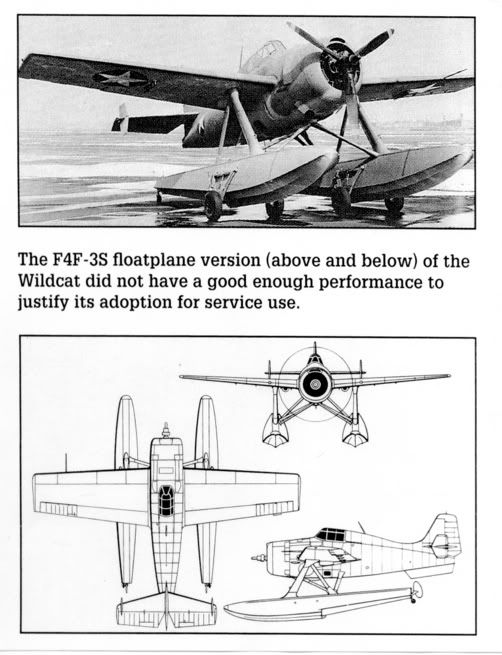
Grumman F4F Wildcat

So, like I thought… 4 x J75.
True, they wanted “action footage” but no one had shot any when the actual event happened, so their special effects department whipped some up using the authentic still shots as a pattern.
How many of them have flown back and landed safely after a mid-air in which over 75% of one main wing was ripped off? (Israeli F-15)?
That one flew with most of the weight being supported by center-body lift.
Of course, that also depends on whether you are in a formal setting… like a classroom, or hanging out with your buds… llamo = name, not “called”!
If you leave out the “es”, then and only then is the formal “My name is Jon” converted to the informal “I’m called Jon”!
And Jon for short for Jonathan, since you have decided to be a nitpicking wank&r…
Probably because those units have not released the numbers of the aircraft they are sending… if they have, they have not been accessed by the operators of that website.
In the first part of this thread, which I just read, there were references to “a stretched, afterburner-equipped 346 could replace the Typhoon”.
My first post was in response to that… which I just looked at and saw was posted in 2004, as was post #13, which I referred to with my last sentence.
The second post was also in response to one of those 2004 posts… which makes me rather embarrassed.
I should really check dates before responding 😮
Compare the early US refueling technique for converted WW2 bombers (B-29/50 and KB-29s:
“The first nonstop around-the-world flight was accomplished by B-50A-5-BO (S/N 46-010) “Lucky Lady II” assigned to the 43rd Bomb Group. The flight which lasted from Feb. 26 to March 2, 1949, took 94 hours, 1 minute to complete.
About two-thirds of the B-50As were modified as receiver aircraft for an in-flight refueling technique developed by the British. The fuel delivery aircraft (KB-29M) would fly above and forward of the receiver aircraft (B-50A) and unreel a long refueling hose. The crew of the B-50A would extend an apparatus from the belly of the aircraft designed to snag the refueling hose trailing behind the KB-50M. Once the fuel hose was captured, it was pulled into the bomb bay of the B-50A where the crew connected it to the refueling manifold. Once the fuel transfer was complete, the hose was released and the KB-29M reeled it back in.”
BME330… some of us Anglos do know the difference,,, and are hindered by our “US standard” keyboards not having a tilde to place over our “canon/canyon” when spelling.
BTB, me llamo es Juan… spelled Jon, but you would say Huan with a exxagerated H.
Well, a stretched, afterburnered 346 would be about the same (when compared to the Typhoon) as the F-5 Freedom Fighter was to the F-4 Phantom back in the early 1960s… remember that?
Or how about the F-16 to the Typhoon’s F-15?
It would not have the same comprehensive avionics suite, nor the payload/range capacity of the Typhoon, simply because of its smaller size.
As the “low” part of a “High-Low mix”, however, it would indeed be “the Dog’s Bo!!ocks!
Well, it was almost certainly a USSR student, and likely a TP-39 that was never on the USAAF inventory (having been already assigned to the USSR), which is why it is not on the list of USAAF crashes.
No doubt there is a loss record somewhere in the Russian archives.
Only one version of the AIM-4, the AIM-4D, was rated for use against fighter-sized aircraft, and it was poor as a dogfight missile, because the IR seeker needed 5 seconds to cool down, could only stay cooled down for a short time, and had only a limited number of cool-down cycles available.
A better seeker would need to be developed, or the AIM-9 Sidewinder certified for the Delta Dart to be a decent Fighter, as opposed to a Bomber Interceptor.