Bager1968
They appear much larger and correctly oriented when you click on the photo itself, so all is good.
Bager1968Here is a simplified internal layout:
Bager1968I am curious why you refer to a “dumb bomb” since with a modicum of common sense even an eight year old could figure out that Germany was not investing so much effort just to deliver a simple high explosive warhead?
I don’t think he’s going to answer you, as the post you replied to was made on 23 May 2004, and wd1’s profile says:
Last Activity
20th February 2011 10:23
which was 3 years ago yesterday.
Bager1968http://http://www.shuttleworth.org/shuttleworth-collection/shuttleworth-collection.asp
The Shuttleworth Collection
Home of the ‘Edwardian Flying Machines’!
The world famous Shuttleworth Collection is home over fifty unique and mostly original airworthy aeroplanes.
Many of the aircraft are the only surviving airworthy examples of their marque in the world.
Bager1968We all know that the Nimrod was a extensive modification of the De Havilland Comet,
But could the Vickers VC 10 also have been used in the role as a maritime aircraft.Peter
I would guess with modifications it would be feasible. Goodness knows why the RAF didn’t have a Concorde for the Royal Squadron.
The RAF did evaluate both the VC-10 and the HS Trident as possible Shackleton replacements, and determined that they would be “too large, too expensive, and take too long to enter service”.
The actual first choice was the Breguet Atlantic, but British insistence on a “quid-pro-quo” (in the form of either French purchase of the P.1154 or using a Rolls-Royce engine in the Mirage IIIV) coupled with the French refusal of such an arrangement killed the deal, and caused the return to a British aircraft, by default the smaller & cheaper Comet (Nimrod) variant.
This document mentions all of that, and much more, in the Shackleton-replacement chapter (pages 33-57):
WHAT DROVE MARITIME PATROL AIRCRAFT PROCUREMENT IN THE POST-WAR ERA?
What I find intriguing was the proposed “double-decker” version of the Super VC-10: http://www.vc10.net/History/doubledeck_super_vc10.html
Bager1968IRST added to F/A-18E/F
An updated version of AN/AAS-42 used on the F-14 in the 1980s, useful in detecting and tracking low flying cruise missiles which threaten the CSG.
In the nose of the centerline-mounted fuel drop-tank?
Really? That’s an awfully expensive disposable item!
Bager1968For strafing and general ground-attack (locomotives, etc) I’d prefer the B-25C/D modification – with the extra 20mm gun (see text below the 5th photo). Actually, I’d prefer to mount two 37mm cannon in the lower nose and two .50 mg in the upper nose (plus the 4 .50 mg on the forward fuselage sides).
Or 4x 20mm cannon in the nose, and the “cheek” 4x .50mg.
Note that the B-25C/D strafer “cheek” blisters were different from the production B-25G/H/J blisters. The earlier installation had both on one side in a single fairing, while the later put each gun in its own fairing (which produced less drag).
B-25C-1 41-12971 Dirty Dora:
[ATTACH=CONFIG]225508[/ATTACH]
[ATTACH=CONFIG]225509[/ATTACH]
13th AF B-25 New Caledonia July 20 1943:
[ATTACH=CONFIG]225511[/ATTACH]
[ATTACH=CONFIG]225512[/ATTACH]
B-25C Mitchell, “Margaret” was converted to a low level “Strafer” in the B-25 Conversion centre in Townsville. Eight forward-firing Browning machine guns were fitted to the aircraft. Four in the nose were positioned through the original bomb aiming panel making air-sealing easier:
[ATTACH=CONFIG]225510[/ATTACH]
A few strafer B-25’s modified at Brisbane during April-May 1943, carried, in addition to the 50 calibre four gun nose battery, a single fixed 20 mm cannon in the forward firing position at about the 4 o’clock position as you look at a strafer nose. They were not very effective due to the problem of syncronizing their firing trajectory with the nose guns, and other problems, and were soon removed and the position faired over. In addition to the nose gun installation, all C & D strafers were fitted with two additional 50 calibre machine guns (two on each side, total of four) fitted in separate side package housings on each side of the lower fuselage, below the cockpit. This gave a total forward firing armament barrage of 8 x 50 cal Machine Guns, plus, on a few aircraft, one 20mm cannon.
Factory “cheek” .50 mg fairings:
[ATTACH=CONFIG]225513[/ATTACH]
Bager1968Diana Barnato-Walker has previously been billed as “the first woman to pilot an aircraft through the sound barrier” in her Lightning flight of 26 August 1963.
Maybe the word ‘through’ is the key word, here?
Read about Jacqueline Cochran…..
Who flew a Canadair Sabre up to, through, and past Mach 1 on May 18, 1953.
Bager1968Given that we haven’t heard about such incident in the A330 civil fleet and that the grounding is a mil issue only, it’s probably related to the mil conversion of the plane.
So, pressurization hickup, fuel circuit flaw, engine or electrical failure, outside event factoring in ? It will be interesting to know.
Actually, there has been such an incident with civil A330s:
http://australianaviation.com.au/2011/12/computer-fault-blamed-for-qf72-qantas-nose-dive/
A rare computer fault caused the sudden nose dive of a Qantas flight in 2008 that injured 119 people, an investigation by the Australian Transport Safety Bureau has concluded.
The incident occurred on board Airbus A330-303 VH-QPA operating QF72 that departed Singapore for Perth on October 7 2008. While cruising at 37,000ft, one of the aircraft’s three air data inertial reference units (ADIRUs) began outputting spikes of incorrect values including erroneous angle of attack data. Minutes later, primary flight computers initiated a pair of dramatic, uncommanded dives.
Though lasting only a few seconds, the dives hurled unrestrained passengers against the ceiling and overhead bins, injuring 110 of 303 passengers and nine of 12 crew members. After regaining control of the aircraft, pilots declared a MAYDAY and made an emergency landing at Learmonth Airport, where the flight was met by the Royal Flying Doctors Service and CareFlight. Fourteen people were airlifted to Perth for hospitalisation.
The ATSB investigation found that the computer algorithm for processing angle of attack data, while generally effective, was unable to manage multiple spikes in the data over a short span.
“The occurrence was the only known example where this design limitation led to a pitch-down command in over 28 million flight hours on A330/A340 aircraft, and the aircraft manufacturer subsequently redesigned the angle of attack algorithm to prevent this type of accident from occurring again,” the report said.
However, the investigation did not determine what led the ADIRU to spit out the incorrect data in the first place, concluding only that the spikes were likely initiated by a “rare type of internal or external trigger event.”
Speculation has long centred on interference from nearby Naval Communication Station Harold E. Holt as a possible culprit, especially after a second Qantas flight suffered an ADIRU malfunction in the same area in December 2008. However, the ATSB investigation concluded that the station’s very low frequency radio transmissions were “unlikely” to have played a role “based on multiple sources of information.”
Naturally, an uncommanded sudden pitch-down during an in-flight refueling with, say, an A400M “plugged in” could be… problematic!
Personally, the claim to have “fixed the problem” when they don’t actually know what triggered the event does not fill me with confidence about the completeness of the solution.
Bager1968A U.S. Air Force C-17.
Romanian transportation ministry said the C-17 Galaxy aircraft had 15 people on board.
So was it a C-5B Galaxy or a C-17 Globemaster II?
Bager1968And they have stepped up their modernization & reactivation of the nuclear-powered cruisers.
Bager1968The Brits originally wanted the P-40 (which they used almost exclusively for ground attack), but NAA convinced them they could quickly design & build something that could be a good fighter as well.
The Allison-engined P-51As (Mustang I) showed such promise that the RAF asked for a trial fit of the Merlin – and the result is well-known.
The USAAF did order a dive-brake equipped ground attack version of the P-51A, and I presume that could have been the basis for a developed ground-attack version.
Bager1968This report has 77 dead & 1 survivor:
http://abcnews.go.com/International/wireStory/state-radioalgerian-military-plane-crash-kills-99-22459445
Algerian military says 4 crew & 74 passengers, earlier Algerian government statement said 99 passengers.
Bager1968It’s interesting that the USN is leading the charge for the 6G, which in itself speaks volumes about what they think about the F-35C, but before we get ahead of ourselves something called ‘the sequester’ may play havoc with timelines, RFPs aside:
http://www.ft.com/cms/s/0/6fbe6550-83c2-11e3-aa65-00144feab7de.html?siteedition=uk#axzz2szKELOK3
No, it says nothing about how the USN feels about the F-35C.
The USN has always said the F-35C would NOT replace the F/A-18E (nor the F/A-18F either), which is the USN’s current primary A-A fighter, and is planned to remain so after introduction of F-35C!
At first there was speculation and hoping about an A-A UCAV, but the USN has decided the tech isn’t ready for that, so they are asking for a manned air-superiority fighter to replace the Super Hornet.
Purchases of the F-35C will continue as planned (Congress permitting).
Bager1968xecutive Overview: World Air Forces
Welcome to the 39th edition of IHS Jane’s World Air Forces. The information here contains a brief look at major procurement events, structural changes and operational deployments that have occurred over the last six months.
Brazil Selects a Fighter Capability with Future
…..
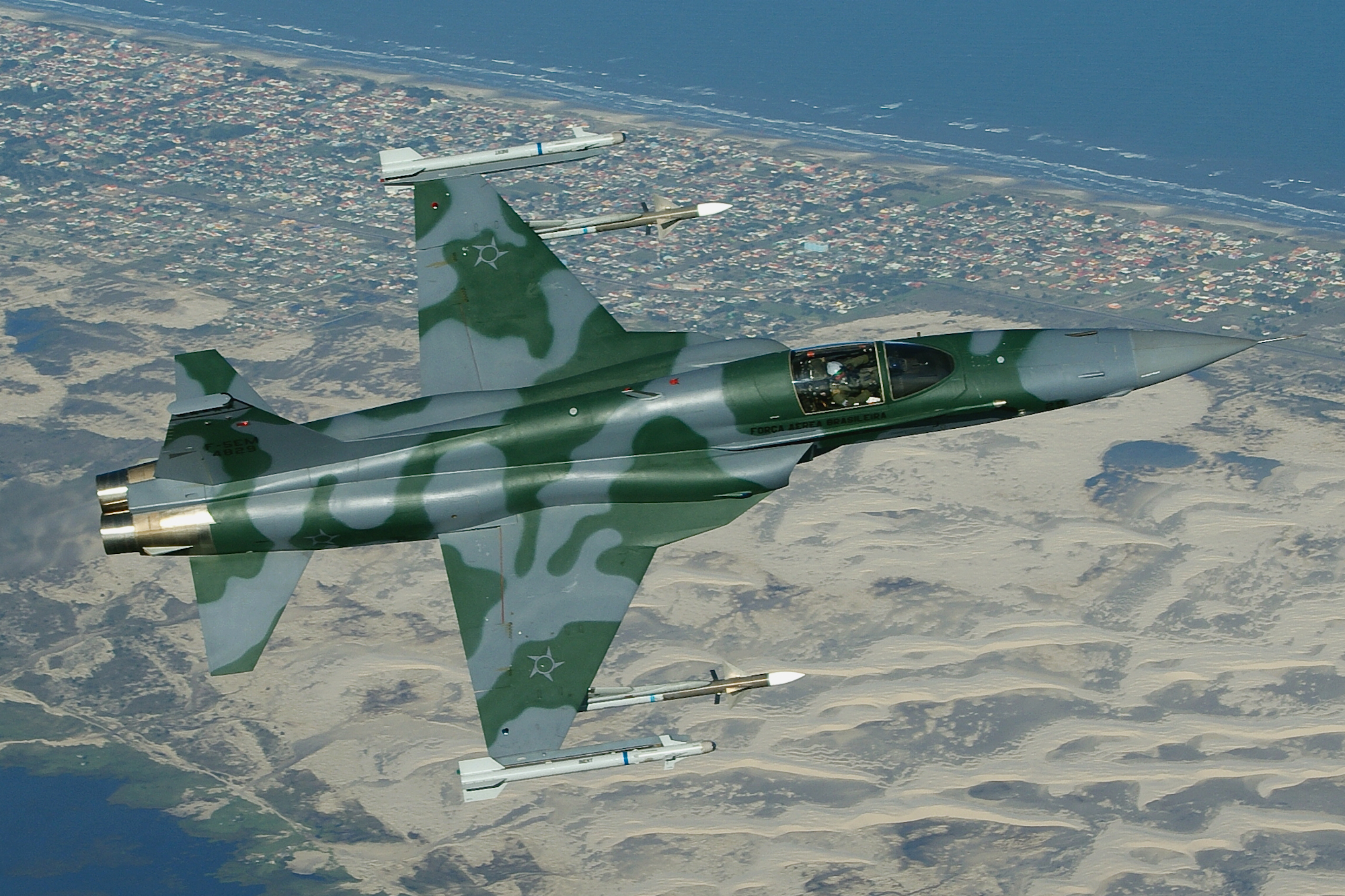
To this end, the Gripen is being procured first to replace the FAB’s Mirage 2000C fleet, which was retired at the end of December 2013. In addition, assuming the aircraft is positively judged, it will also replace the F-5EM/FM Tiger II and AMX A-1M in the medium term. Importantly, like the Gripen, these are all single-engine aircraft.
The author of this Jane’s article needs to get a new pair of glasses.
The “single-engined F-5EM”:
http://www.fab.mil.br/sis/enoticias/imagens/original/11681/f-5_tc%20sergio.jpg
[ATTACH=CONFIG]225311[/ATTACH]


 Sign In