 Bager1968
The Bell X-1 design team themselves came up with the idea of the all flying tailplane.
…which of course was a feature of the preceeding Miles M52 design.
True… Bell didn’t come up with the all-flying tailplane.
Curtiss (and NACA) tested that on the XP-42 in both a wind tunnel and in flight in 1944-46!
Note that the XP-42 first flew in March 1939, and it still had its original tailplane in March 1943.
http://www.nationalmuseum.af.mil/factsheets/factsheet.asp?id=2244
http://crgis.ndc.nasa.gov/historic/643_Test_120_-_XP-42
http://crgis.ndc.nasa.gov/historic/XP-42
Curtiss XP-42
This highly modified Curtiss P-36A became the XP-42 when it was re-engined and took part in drag-reduction and all-moving tail research with the NACA at Langley. The last flight of this aircraft took place in April 1947; and it was scrapped in July of that year.
The Curtiss XP-42 from the NACA Langley Research Center, Virginia (USA), in flight on 13 April 1945. Note the single-piece horizontal tail planes. NASA photo EL-2000-00251
Note that the first flights in the UK of an all-flying tail-plane were in October 1944 on a modified Spitfire, flown by Eric Brown.
Thus it was flying on modified prop-fighters in both the US and UK by late 1944!
Bager1968The Bell X-1 design team themselves came up with the idea of the all flying tailplane.
…which of course was a feature of the preceeding Miles M52 design.
True… Bell didn’t come up with the all-flying tailplane.
Curtiss (and NACA) tested that on the XP-42 in both a wind tunnel and in flight in 1944-46!
Note that the XP-42 first flew in March 1939, and it still had its original tailplane in March 1943.
http://www.nationalmuseum.af.mil/factsheets/factsheet.asp?id=2244
http://crgis.ndc.nasa.gov/historic/643_Test_120_-_XP-42
http://crgis.ndc.nasa.gov/historic/XP-42
Curtiss XP-42
This highly modified Curtiss P-36A became the XP-42 when it was re-engined and took part in drag-reduction and all-moving tail research with the NACA at Langley. The last flight of this aircraft took place in April 1947; and it was scrapped in July of that year.
The Curtiss XP-42 from the NACA Langley Research Center, Virginia (USA), in flight on 13 April 1945. Note the single-piece horizontal tail planes. NASA photo EL-2000-00251
Note that the first flights in the UK of an all-flying tail-plane were in October 1944 on a modified Spitfire, flown by Eric Brown.
Thus it was flying on modified prop-fighters in both the US and UK by late 1944!
Bager1968I guess North Sea Boats has some explaining to do.
Bager1968Success would be VERY dependent on the exact situation.
In the mid-1980s, when the USMC was first wiring its AH-1W Cobras to carry 2 AIM-9 Sidewinders, the USAF was laughing, claiming that that was a waste of time and money, that no helicopter could possibly defeat a jet fighter.
Shortly after, there was a joint exercise where USAF F-16s and USMC AH-1Ws (among many other aircraft) were participating. The USMC issued a challenge to the USAF… there would be two AH-1Ws at a specific set of co-ordinates at a specific time, and the F-16s were welcome to “attack” them.
When the radar warning receivers on the Cobras indicated the F-16s were “painting” them with their radar, the Cobras dropped behind a cliff. They waited until the F-16s appeared and took “simulated” shots with their AIM-9s. The result, on the networked engagement simulation equipment on all the aircraft, was 2 dead F-16s and 2 live Cobras.
Needless to say, the USAF claimed the Marines had cheated… to which the Cobra crews replied “Of course we did, you think the Soviets won’t?”
However, the last I heard in the late 1990s, the total kill success in exercises for both the Marine Cobras and the Army AH-64 Apaches (equipped with air-launched Stingers) was about 10-15 helos “shot down” for every jet fighter “downed”.
If you add in the transport helos “down” the ratio is far, far worse!
Bager1968Indeed… sticking those gear legs into a bog upon touchdown could result in a forward-somersaulting Stuka… which would not end well for aircraft or crew!
Bager1968Indeed… sticking those gear legs into a bog upon touchdown could result in a forward-somersaulting Stuka… which would not end well for aircraft or crew!
Bager1968Hello everyone,
Was wondering if anyone knows what active operations the french had during the 1950s??
…..
I understand they were busy losing Algeria and had some interest in Vietnam but pictures of them in action are limited.
The French had more than “some” interest in Vietnam… or should we say “French Indochina”?
FIC was a major French colonial possession, and there was considerable fighting between native and French forces up until the peace treaty in July 1954 (and some after that in the southern French-held part as well).
Among other aircraft used by the French were the F6F Hellcat, various marks of F4U Corsair, SB2C Helldivers, and TBF Avengers… including operations involving the ex-British carrier Colossus (Arromanches, transferred 1946) and the ex-US light carriers Belleau Wood (Bois de Belleau) and Langley (La Fayette).
French service as Bois Belleau
She remained in reserve until transferred to the French Navy under the Mutual Defense Assistance Act on 5 September 1953. In French service she sailed under the name Bois Belleau (R97) (literal translation of “Belleau Wood”).
In April 1954, the carrier departed from the Toulon French Naval Base, Toulon towards French Indochina in order to replace the Arromanches (R95). She arrived around 20 May in Halong Bay. Although the critical Battle of Dien Bien Phu was over, her US-built fighters and bombers were immediately used by the French forces, as the war was not over. After peace with the Viet Minh, the Geneva Conference was signed on 21 July 1954. The Bois Belleau sailed for France, where she then joined the Algerian War.
Bois Belleau was returned to the United States in September 1960, stricken from the Navy List on 1 October 1960, and scrapped.
Langley was taken out of “mothballs” early in 1951, refurbished and transferred to France under the Mutual Defense Assistance Program. Based in Toulon, La Fayette carried out many missions in the Far East until June 1953. During this action, her airgroup included F6F Hellcats and SB2C Helldivers. Modernized in 1953-1954, she served in the Mediterranean and on the African coasts. In early 1956 she returned to Indo-China (which had been partitioned after the cease fire) equipped with F4U Corsairs and TBF Avengers. She was involved in the Suez Crisis air and landing operations along with Arromanches (R95) and British carriers beginning in October 1956. In March 1960, La Fayette participated in the rescue operations in the Moroccan city of Agadir, damaged by an earthquake. It then took part in the repatriation of the first refugees from Algeria. After more than a decade of French Navy service, she was returned to the United States in March 1963 and was sold for scrap a year later.
In French service, La Fayette sailed nearly 350,000 nautical miles, her planes having carried out 19,805 landings. The La Fayette was awarded the Military Cross for its first missions in Indo-China. The name of La Fayette is now carried by the frigate La Fayette (F710).
The French aircraft carrier La Fayette (R96) arriving in France on 11 September 1951, with her air group on deck. The air group consisted of 16 Grumman F6F-5 Hellcat, 4 F6F-5N night fighters, and 12 Grumman TBM-3E Avenger. The carrier had just been transferred from the U.S. Navy to France.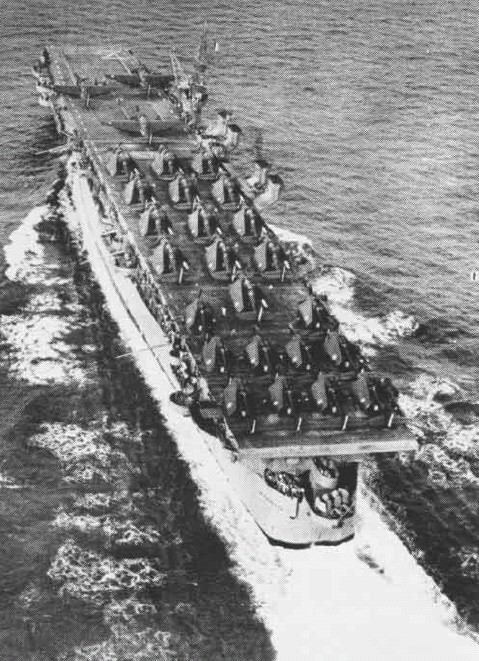
Bager1968Hello everyone,
Was wondering if anyone knows what active operations the french had during the 1950s??
…..
I understand they were busy losing Algeria and had some interest in Vietnam but pictures of them in action are limited.
The French had more than “some” interest in Vietnam… or should we say “French Indochina”?
FIC was a major French colonial possession, and there was considerable fighting between native and French forces up until the peace treaty in July 1954 (and some after that in the southern French-held part as well).
Among other aircraft used by the French were the F6F Hellcat, various marks of F4U Corsair, SB2C Helldivers, and TBF Avengers… including operations involving the ex-British carrier Colossus (Arromanches, transferred 1946) and the ex-US light carriers Belleau Wood (Bois de Belleau) and Langley (La Fayette).
French service as Bois Belleau
She remained in reserve until transferred to the French Navy under the Mutual Defense Assistance Act on 5 September 1953. In French service she sailed under the name Bois Belleau (R97) (literal translation of “Belleau Wood”).
In April 1954, the carrier departed from the Toulon French Naval Base, Toulon towards French Indochina in order to replace the Arromanches (R95). She arrived around 20 May in Halong Bay. Although the critical Battle of Dien Bien Phu was over, her US-built fighters and bombers were immediately used by the French forces, as the war was not over. After peace with the Viet Minh, the Geneva Conference was signed on 21 July 1954. The Bois Belleau sailed for France, where she then joined the Algerian War.
Bois Belleau was returned to the United States in September 1960, stricken from the Navy List on 1 October 1960, and scrapped.
Langley was taken out of “mothballs” early in 1951, refurbished and transferred to France under the Mutual Defense Assistance Program. Based in Toulon, La Fayette carried out many missions in the Far East until June 1953. During this action, her airgroup included F6F Hellcats and SB2C Helldivers. Modernized in 1953-1954, she served in the Mediterranean and on the African coasts. In early 1956 she returned to Indo-China (which had been partitioned after the cease fire) equipped with F4U Corsairs and TBF Avengers. She was involved in the Suez Crisis air and landing operations along with Arromanches (R95) and British carriers beginning in October 1956. In March 1960, La Fayette participated in the rescue operations in the Moroccan city of Agadir, damaged by an earthquake. It then took part in the repatriation of the first refugees from Algeria. After more than a decade of French Navy service, she was returned to the United States in March 1963 and was sold for scrap a year later.
In French service, La Fayette sailed nearly 350,000 nautical miles, her planes having carried out 19,805 landings. The La Fayette was awarded the Military Cross for its first missions in Indo-China. The name of La Fayette is now carried by the frigate La Fayette (F710).
The French aircraft carrier La Fayette (R96) arriving in France on 11 September 1951, with her air group on deck. The air group consisted of 16 Grumman F6F-5 Hellcat, 4 F6F-5N night fighters, and 12 Grumman TBM-3E Avenger. The carrier had just been transferred from the U.S. Navy to France.
Bager1968Hmmm… BuNo 160998
It came off the assembly line in 1978, and was the 4th A-6E built from the start with the TRAM* upgrade (160995 was the first).
160993/160998 Grumman A-6E Intruder
c/n I-594/599
160995 (c/n I-596) in storage at Naval Air Depot, NAS North Island, CA. Noted in compound
behind restoration hangar at Yanks Air Museum, Chino, CA Nov 2002
160996 (VA-35) crashed into sea Nov 18, 1981 after undercarriage
collapsed aboard USS Nimitz. Both crew ejected safely.
160997 to AMARC as 5A0151 Feb 8, 1995. SOC Mar 16, 1999.
160998 to AMARC as 5A0222 Sep 5, 1996. SOC Jun 14, 2002.
* TRAM = Target Recognition Attack Multisensor. This is the AN/AAS-33A Detecting and Ranging Set, a FLIR/Laser weapons guidance system.
It is housed in a round turret under the nose forward of the nose landing gear.
Make sure yours has this, for completeness. 😉
Bager1968Hmmm… BuNo 160998
It came off the assembly line in 1978, and was the 4th A-6E built from the start with the TRAM* upgrade (160995 was the first).
160993/160998 Grumman A-6E Intruder
c/n I-594/599
160995 (c/n I-596) in storage at Naval Air Depot, NAS North Island, CA. Noted in compound
behind restoration hangar at Yanks Air Museum, Chino, CA Nov 2002
160996 (VA-35) crashed into sea Nov 18, 1981 after undercarriage
collapsed aboard USS Nimitz. Both crew ejected safely.
160997 to AMARC as 5A0151 Feb 8, 1995. SOC Mar 16, 1999.
160998 to AMARC as 5A0222 Sep 5, 1996. SOC Jun 14, 2002.
* TRAM = Target Recognition Attack Multisensor. This is the AN/AAS-33A Detecting and Ranging Set, a FLIR/Laser weapons guidance system.
It is housed in a round turret under the nose forward of the nose landing gear.
Make sure yours has this, for completeness. 😉
Bager1968In the late 1960s the US offered Essex-class fleet carriers to Britain.
Of course, by that time they were a 20-year-old design that shared very little with those currently being built in the US.
Additionally, the ones offered weren’t the modernized ones, they were the unmodified ones that had been in reserve for years, so that Britain could modify them to suit the RN.
Bager1968Ideally I would like to see RMAF to get additional 2ndhand low-houred legacy hornets to replace the MiG’s (i know that is near impossible, but i think the kuwaiti ones will be up in the market soon if the rafale/f-15 rumours are true), consolidate on just 3 types, the MKM, Legacy Hornets and Hawks.
With current trends, those Kuwaiti Hornets are likely to be purchased by NAVAIR for the USN/USMC, and the US will pay more than Malaysia can.
If Kuwait chooses F-15 to replace their Hornets, then return of the Hornets to the US would likely be a formal offset in the contract!
Bager1968I don’t think this new rafale offer will change the course of the swiss competition but the fact that Dassault can offer the same price for its rafale than SAAB for its gripen NG should mean that the actual picture of price comparison (purchase costs) is more tight than some would think…
http://www.tdg.ch/suisse/nouvelle-offre-dassault-rafale/story/30455437
So Dassault are tacitly admitting they were overpricing Rafale due to greed. Either that, or Dassault are willing to accept selling at a loss in order to regain lost purchase-price profits through higher support/overhaul costs later on.
The price reduction is basically meaningless, due to Rafale’s much higher operating costs, which IS part of the Swiss calculation.
Bager1968LCS 3 “Fort Worth” has been commissioned.
Complete with arachnid colony. And theme song: http://www.youtube.com/watch?v=Vgx7abJH6uI
Navy’s LCS-3 Spider Infested
by Mike McCarthy
August 29, 2012 – Defense Daily[ABOARD THE FUTURE USS FORT WORTH] – They can deal with the occasional busted part or software glitch, and the hard work that accompanies resolving it. But one thing the sailors on the latest Littoral Combat Ship are getting a little fed up with is the big, ugly and menacing-looking spiders dangling around the new warship.
And there are many. The future USS Fort Worth (LCS-3) is infested with them. Some larger in diameter than golf balls, the brownish spiders show up in droves around sunset, spinning webs around railings to catch prey, or greet crew by suddenly pirouetting down from overhangs.
Their presence stems from prime contractor Lockheed Martin’s [LMT] partner for building the ships, Marinette Marine. The Wisconsin shipyard on the shores of Lake Michigan gets overrun with the spiders this time of year as they seek the fresh water to prey on insects, the ship’s commanding officer, Capt. Randy Blankenship, said. It didn’t take long for them to get aboard the ship ahead of sailing Aug. 7.
“They inundated the crap out of the ship,” he said. “We’ve been thinking about going out and getting a big extermination kit.”
The critters aren’t harmful, he says, nor do they appear to have penetrated living quarters like the mess room and bunks. But the arachnids are–at the very least–a nuisance around the mission bay, bridge and deck areas of the ship.
“It’s annoying. It’s annoying as can be,” Blankenship said, adding he wants the ship to be a presentable as possible during its Sept. 22 commissioning ceremony in Galveston, Texas.
Blankenship predicted their population will dissipate at sea as food sources dwindle. There were even more when the ship initially got underway, when measures taken by the crew to rid themselves of the creatures proved fruitless.
“We were out there with friggin’ water hoses. Fire mains. 50 PSI going after those suckers,” Blankenship said. “Those little resilient *******s came right back.”
An extension entomologist at the University of Wisconsin-Madison, Phil Pellitteri, said the spider’s presence will dissipate because they’ll run out of insects to eat at sea. Even if they make it to laying eggs, the newborns will have nothing to feed on and will quickly die.
“When they hatch, they’re in big trouble,” he said.
By examining a grainy cell phone photo sent through email, Pellitteri identified them as belonging to the orb weaver family of spiders and confirmed they’re harmless. The large webs they spin could have easily allowed them to be picked up by wind and blown onto the ship, he said.
The orb weaver is a “late summer” spider, Pellitteri said, meaning they could have infiltrated the ship after it was delivered to the Navy in early June and remained at Marinette before its departure earlier this month. Michael Draney, an entomologist at the University of Wisconsin-Green Bay, said the orb weavers on the ship could be of the Larinioides sclopetarius species, which is also know as the “bridge spider” because it’s the “only spider in our region that is usually willing to spin its orb web on metal.”
Lockheed Martin said it was unaware of the problem. “We weren’t aware of a spider issue on board LCS-3,” a company spokeswoman said. “We can work with the Navy on a solution if needed.”
Regardless of when or how the spiders came aboard, the crew wasn’t thrilled about their unwanted shipmates.
“The ship’s (bleeping) infested with them,” said one sailor. “We’ve got to live with them, I guess,” added another one before dropping a few expletives and concluding with: “It’s ridiculous.”
For some members of the crew, the spiders can be a source of entertainment during long night watch shifts. With food becoming scarce at sea, the spiders start going at each other, as one of the vessel’s chiefs noted.
“They’re awesome. They are fighting right now because they don’t have any food. We stand six-hour watches and it can be boring, and (spider brawling) takes up a good four hours,” Chief Matthew Moore said before reminding himself of his captain’s presence. “We’re still being vigilant, of course, but we can’t help it because they’re right there.”
Pellitteri said attempting to eat each other could be one reason for the fighting, but it may also have to do with their “brutal way of mating.”
Reply With Quote
Bager1968the fact is that it is a swiss comission that will do the investigation… if they appointed a comission for that, they (the parliament) obviously have suffi iently strong suspicions about the matter.
as for “bribery is a standard in that business”, how come there are inquiries, sometimes trials and jail sentences?
I think that is easy to answer. There are inquiries, sometimes trials and jail sentences because the arms trade is rather corrupt.
And because politicians, in their desire to appease upset voters, will make a show of “rooting out corruption” from time-to-time… when they are sure that neither they nor any of their friends are involved this time.
That doesn’t mean that they are really trying to “root out corruption”, just that they are making a show for the voters!


 Sign In







