 Bager1968
It looks like that is the 75 US gallon tank.
Five different auxiliary tanks were fitted to the Thunderbolt during its career:
1. 200 U.S. gallon (758 l) ferry tank, a conformal tub-shaped jettisonable tank made of paper, which barely cleared the ground on grass airfields, was used as an interim measure between 30 July and 31 August 1943;
2. 75 U.S. gal (284 l) drop tank, a teardrop-shaped steel tank produced for the P-39 Airacobra, was adapted to the P-47 beginning 31 August 1943, initially carried on a belly shackle but used in pairs in 1944 as underwing tanks;
3. 108 U.S. gal (409 l) drop tank, a cylindrical paper tank of British design and manufacture, used as a belly tank beginning in September 1943 and a wing tank in April 1944;
4. 150 U.S. gal (568 l) drop tank, a steel tank first used as a belly 20 February 1944, and an underwing tank 22 May 1944;
5. 215 U.S. gal (810 l) belly tank, a wide, flat steel tank developed by VIII Service Command that allowed performance-degrading wing pylons to be removed, was first used in February 1945.
The tanks made of plastic-impregnated (laminated) paper could not store fuel for an extended period of time, but they worked quite well for the time it took to fly a single mission. These tanks were cheaper, lighter, and were useless to the enemy if recovered after being dropped—not only did they break apart, but they did not provide the enemy with any reusable materials that could be scavenged for their own war effort.
Thunderbolt P-47D “Kathie” (artwork by Milton Caniff) with 75-gallon drop tank buzzes the airfield at Bodney, England. Serial# 42-8424 was assigned to Lt. William D. “Bill” Schwenke, 487th FS, 352nd Fighter Group, 8th Air Force. This aircraft was lost after being struck by flak on 11 March 1944, forcing Schwenke to bail out into the English Channel. He was never seen again. Source:USAF
Here is a cylindrical belly tank:
Bager1968Thank you, Brother Fedaykin.
His manifestations appear everywhere:

Bager1968I think it predated the pyramids somewhat!
http://en.wikipedia.org/wiki/Oscar_Gustave_Rejlander
Adrian
Voila! Or is that Viola!?:D
Combination printing is the technique of using two or more photographic images in conjunction with one another to create a single image.
Combination printing was popular in the mid-19th century due to the limitations of the negative’s light sensitivity and camera technology. For example, the long exposures required at the time to create an image would properly expose the main subject, such as a building, but would completely overexpose the sky. The sky would then lack detail, usually appearing as solid white. Hippolyte Bayard was the first to suggest combining two separate negatives, one of the subject matter and a properly exposed negative of clouds, to create a balanced photograph.
The technique was also used to create new, original compositions. Photographers such as William Lake Price and Oscar Rejlander are famous for using combination printing. Rejlander’s Two Ways of Life is one of the most distinguished examples of the technique, combining 32 negatives to create the final image.
Controversy broke out in the photographic community about the use of combination printing in the mid-19th century. Photographs originally had been regarded as truth and that the camera never lied. However, with the ability to manipulate the final product, it shattered the notion that photographs depicted “truth.”
The technique paved the way for yet another artistic process, photomontage.
Yes, the mid-1800s!
Bager1968Matthias,
Do you perhaps mean “jig”?
A fixture to build up a structure.The Buchon fuselage seemed to be complete, now a completely new fuselage is built, why is that?
Cheers
Cees
Just because it is “complete” doesn’t mean that the structure is strong enough to be safely flown.
Fatigue cracking, corrosion weakening, and similar problems can not be spotted from a distance… a magnifying glass, microscope, or other methods (dye penetrant, magnetic flux, etc) have to be used to detect defects.
Some times you have to replace most of an otherwise-complete structure simply because the original parts are no longer strong enough to use.
Bager19681) Various reasons, including the attempted scrapping of the aircraft carrier Clemenceau at Alang in India, have given asbestos insulation a bad rep due to health hazards. I’m guessing the Navy got overly conscious about these things and wanted a non-asbestos insulation.
The boiler insulation choice was made well before the Clemenceau problem… asbestos & its removal have been serious issues since the mid-1980s.
Yes, ship-scrapping at Alang did bring the issue forward in India, but mainly due to issues from scrapping the ex-British carriers 25 de Mayo & Minas Gerais in the late 1990s & early 2000s.
If anything I’d question the boiler design bureau for choosing ceramic materials that couldn’t withstand the temperature ranges when a number of proven non-asbestos insulation options are available in the West.
2) Because the land-based testbench used asbestos insulation and was therefore an inaccurate representation of the performance of the real thing.
Well, as things stand at least three boilers will need to be replaced and the others may need their insulation changed. I hope this time they just use asbestos as intended. The Human Rights groups and environmentalists can drown.
Exactly… the claim that the shipyard will be paying for the repairs strongly indicates that the shipyard was at fault… they likely were the ones that made the final choice of the exact material, and they chose one that was not rated for the temperatures those boilers reach.
Bager1968Basically, the later versions with smaller radome and antenna were able to have the same or better resolution by advances in antenna design & construction and improvements in signal-processing circuits (as well as in the components of those circuits).
They just didn’t need that large set-up to do what they needed to.
I expect that the fabric of the inflatable cover was also not as durable as required, the antenna folding mechanism was a problem (jamming in place, etc), and the added weight/volume of the inflating equipment, etc was detrimental to payload/range performance.
Bager19681. Stronger (and thus heavier) airframe & landing gear required for carrier landings.
2. Corrosion-resistant materials required, thus no light-weight magnesium parts, etc.
3. Access must be provided to more areas of the airframe/skin to allow more frequent & in-depth corrosion inspection & treatment.
All of which increases weight significantly. Note that the empty weight of Rafale-M is 7.3% [500 kg (1,100 lb)] heavier than that of Rafale-C.
However, Super-Hornet is also a larger aircraft than Rafale, with more powerful engines.
Compare Rafale to the older Hornets as well as SH.
Rafale-M: Length: 15.27 m (50.1 ft); Wingspan: 10.80 m (35.4 ft); Height: 5.34 m (17.5 ft); Wing area: 45.7 m² (492 ft²)
Empty weight: 10,196 kg (M); Loaded weight: 14,016 kg (30,900 lb); Max. takeoff weight: 22,200 kg (M) (54,000 lb)
Powerplant: 2 × Snecma M88-2 turbofans; Dry thrust: 50.04 kN (11,250 lbf) each; Thrust with afterburner: 75.62 kN (17,000 lbf) each
F/A-18C: Length: 56 ft (17.1 m); Wingspan: 40 ft (12.3 m); Height: 15 ft 4 in (4.7 m); Wing area: 400 ft² (38 m²)
Empty weight: 23,000 lb (10,400 kg), Loaded weight: 36,970 lb (16,770 kg); Max. takeoff weight: 51,900 lb (23,500 kg)
Powerplant: 2 × General Electric F404-GE-402 turbofans; Dry thrust: 11,000 lbf (48.9 kN) each; Thrust with afterburner: 17,750 lbf (79.2 kN) each
F/A-18E: Length: 60 ft 1¼ in (18.31 m); Wingspan: 44 ft 8½ in (13.62 m); Height: 16 ft (4.88 m); Wing area: 500 ft² (46.5 m²)
Empty weight: 32,081 lb (14,552 kg); Loaded weight: 47,000 lb (21,320 kg); Max. takeoff weight: 66,000 lb (29,937 kg)
Powerplant: 2 × General Electric F414-GE-400 turbofans; Dry thrust: 13,000 lbf (62.3 kN) each; Thrust with afterburner: 22,000 lbf (97.9 kN) each
Bager1968I have found that the inflatable radar trialed on the HH-2D that started this thread was named “Cubic Corps”.
AND HERE IS YOUR LANDING PHOTO!
HH-2D Cubic Corps radar deflated (the antenna folds flat inside):
And more experimental Kaman H-2 versions:
HH-2C CSAR Seasprite with YSH-2E experimental radar installation in front of “turret” for M134 7.62 mm six-barreled “minigun” (similar to M61 Vulcan cannon).

HH-2C (6 built):
larger version here: http://www.flickr.com/photos/sdasmarchives/6313190976/sizes/o/in/set-72157627928485093/
Bager1968Only the US Navy continues to buy a 30 year old tactical jet design (F/A-18). But USN is known for “200 years of tradition, unimpeded by progress”. 😮
Try learning something… the “30-year-old” F/A-18 was the A/B/C/D version… the last of which was delivered in 2000.
The current production is the F/A-18E/F… which is a redesigned aircraft, different enough that it SHOULD have received an entirely new designation. The only reason it didn’t was to fool Congress with false claims of “just an improved variant”.
This aircraft was designed with a 25% larger airframe, and many other differences!
Design work began in 1988, the aircraft was ordered built in 1992, and first flight was November 1995… with production starting the same year.
Therefore it is only a 20-year-old design. 😉
Note that first flight of the Rafale technology demonstrator was in July 1986… two years before design work began on the Super Hornet!
First flight of Rafale-C was May 1991 (4½ years before SH), first flight of Rafale-M was December 1991 (4 years before SH), and first flight of Rafale-B (2-seat) was April 1993 (2½ years before SH)!
Series production for the French Air Force began in December 1992 (3 years before SH).
Why is France building an older-design aircraft than the USN? 😀
Bager1968Here is the Sea King AEW in RN service:


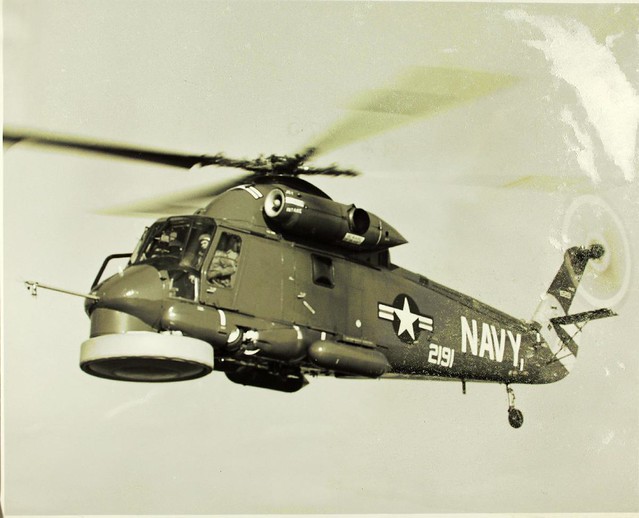
Bager1968A U.S. Navy Kaman YSH-2E ”Seasprite” anti-submarine helicopter was tested with an inflateable radome in the early 1970s. |Source=U.S. Navy Naval Aviation News July 1973 page 23]
It was actually a modified HH-2D (BuNo 152191), and the radome was inflatable… it had a diameter of 80″ (6′ 8″) and an inflated height of 52″ (4′ 4″). When deflated it had a height of 12″ (1′).
There were also two YSH-2Es purpose-built, 149033 & 150169, with a smaller radome (but still larger than the radome of the production SH-2F).
This was a surface-search radar only, for ASW/SAR use!
http://www.history.navy.mil/nan/backissues/1970s/1973/jul73.pdf

Kaman YSH-2E Seasprite LAMPS II-prototype (BuNo 150169) landing on the guided missile cruiser USS Fox (DLG-33) at San Diego, California (USA), in 1971.

The production SH-2F had a fixed low-profile radome.

Bager1968OK… so passing by Vietnam. Originating point quite a bit south, and end point quite a bit north.
Bager1968Not to mention the F-22’s old-tech externally-applied RAM coatings, while the F-35 used RAM-impregnated composite skins that are far more rugged and durable.
Many of the F-22’s features are older, less-capable, and far more costly & manpower intensive to maintain than those of the F-35.
Any “reboot” of the F-22 would only be for a new model that is actually significantly redesigned and updated*… it would be to the F-22A as the F/A-18E was to the F/A-18A: a new airframe & materials design sharing a similar shape and a politically-driven (and deceptive) common type number.
This would increase the per-unit cost significantly.
* F-35-derived radar/EO/computer systems, new composite skin material (requiring redesign of the underlying airframe structure), modified weapons bays for more ground-attack weapons, provisions for external weapons loads.
Bager1968I wonder if it will be scrapped in Alang. They could use the money they’d get from dismantling another aircraft carrier.;)
No, she has been purchased by Leyal Ship Recycling of Turkey, and will ba scrapped in the same Turkish facility in Izmir that is scrapping HMS Invincible as we speak!
http://www.portsmouth.co.uk/news/defence/mod-confirms-ark-royal-to-be-scrapped-1-4244563
There is little reason for this choice (other than pure money), as there is a ship-scrapping industry in both Europe and the UK that is perfectly capable of handling her! In my opinion, the return to the UK in taxes, wages, and the economic boost from supporting the work and workers should have been taken into account (but wasn’t).
HMS Fearless (LPD) was scrapped in Ghent, Belgium by Van Heyghen Recycling from October 2007 onwards.
HMS Intrepid (LPD) was scrapped by Leavesley International in Liverpool, UK starting in September 2008*.
The French carrier Clemenceau has been scrapped by Able UK’s Teesside Environmental Reclamation & Recycling Centre, Graythorp, Hartlepool, commencing 19 November 2009 and completing by the end of 2010.
As Clem was longer, wider, and heavier than Ark Royal, there is no reason why Ark (or Invincible) should have had to leave the UK as anything other than loads of cut-up steel.
Bager1968Looks interesting. Would this mobile dock be capable of repair works or would it be just for refuelling?
It is not a dock, but a mother ship:
The Montford Point Class Mobile Landing Platform is intended to be a new class and type of auxiliary support ship, as part of the US Navy’s Maritime Prepositioning Force of the Future (MPF-F) program. They’re intended to serve as a transfer station or floating pier at sea, improving the U.S. military’s ability to deliver equipment and cargo from ship to shore when friendly bases are denied, or simply don’t exist. That’s very useful in disaster situations, and equally useful for supporting US Marines once they’re ashore.
…..
In brief, the idea behind “seabasing” is that a chain of supply transfer ships could support special ships and floating platforms at sea. This setup could then could be used to transfer cargo between ships, or to fast transports, medium and small lighterage for transport ashore.
…..
http://www.defenseindustrydaily.com/The-US-Navys-Mobile-Landing-Platform-Ships-06525/


 Sign In







