 Bager1968
Some thoughts:
1. the mid mounting seems a more stable location than further forward.
2. does the gun turret turn 360 degrees? Or is it just vertically adjustable?
3. A 20mm gun in that configuration would be devastating for close in work
A hint: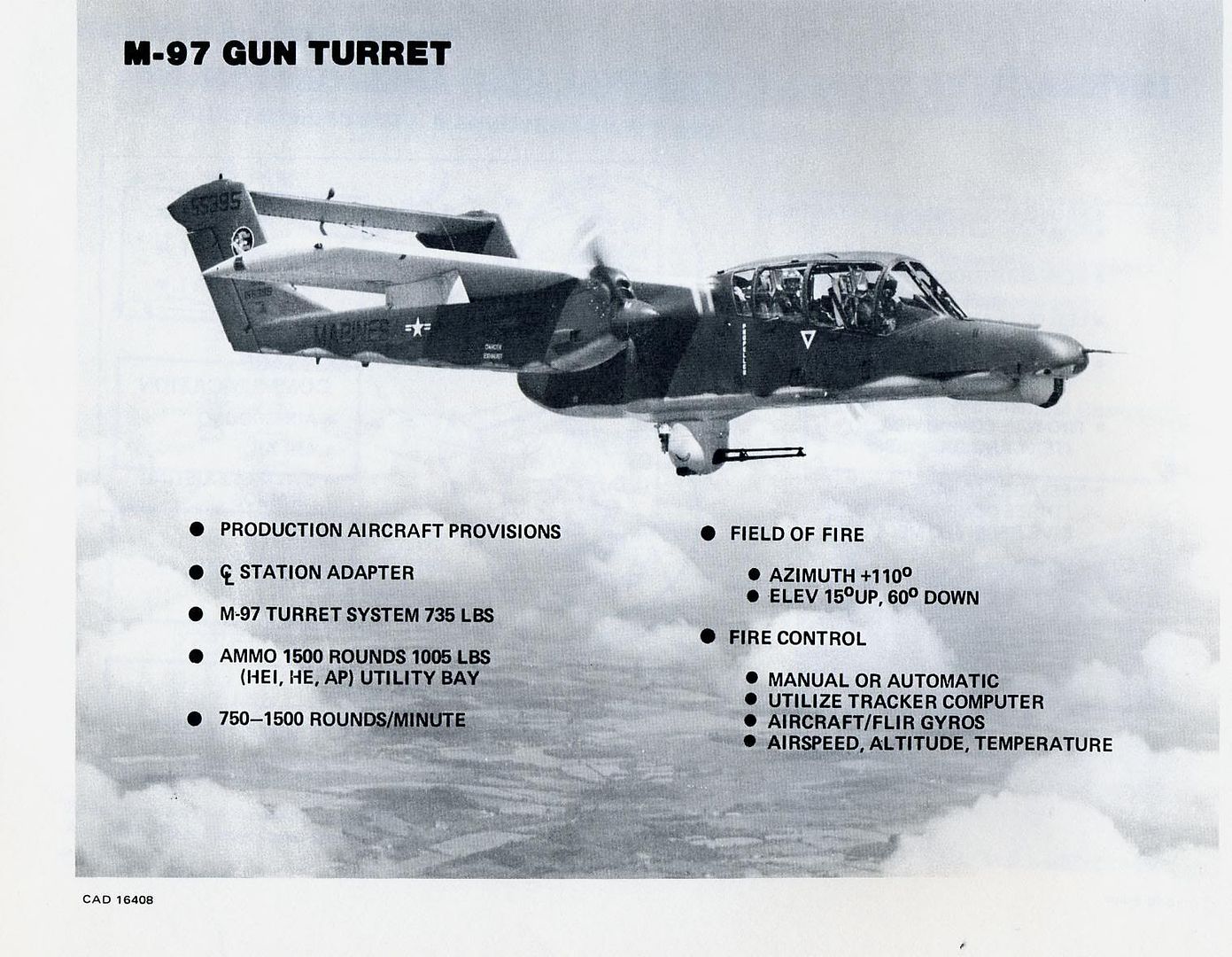
Azimuth: +110°
Elevation 15° up; 60° down
So it could rotate 110° left or right from center.
Lots more at this post, and in that thread.
http://www.militaryphotos.net/forums/showthread.php?65214-OV-10-Bronco-commercial-catalog-(issue-1964)&p=4281812&viewfull=1#post4281812
Bager1968🙁
Norway….:(
I hope they did not have to go through pain and agony.
I hope they could find every human remains and give a proper burial. RIP.
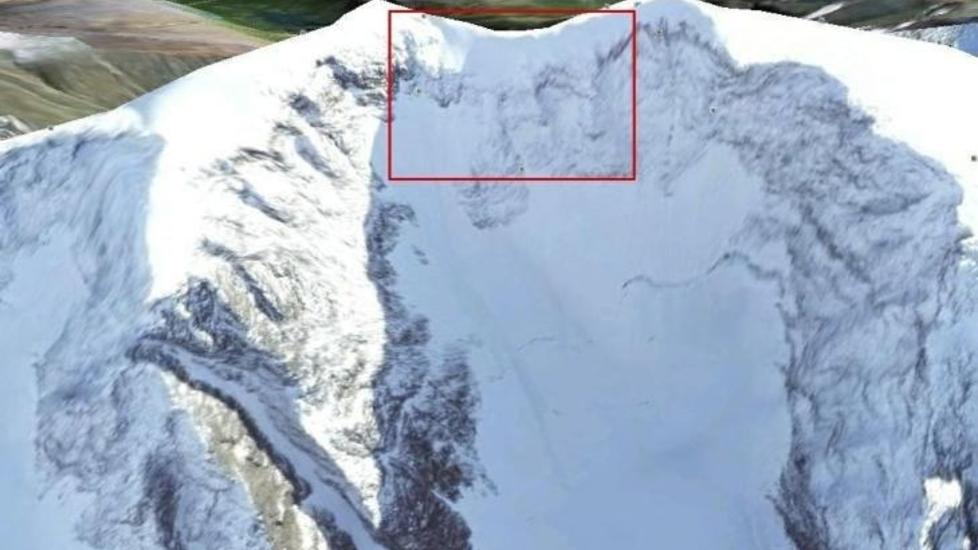
It appears that the aircraft flew into a steep slope at full speed, just below the crest.
Many more details on PRuNe, starting with this post, with photos of the area.
http://www.pprune.org/7085965-post49.html
It appears they were south of the “normal approach path”…they were supposed to be clear of the mountain, but were off-course.
Thuis link is to a map released by the Norwegian government with the planned and actual courses:
http://forsvaret.no/sites/artikkelbilder/PublishingImages/Planlagt%20flyrute%20Siv.jpg
http://forsvaret.no/sites/artikkelbilder/PublishingImages/Radarbilde%20fra%20CRC%20S%C3%B8rreisa.jpg
Bager1968What, the Swiss bank accounts given to each selection board member didn’t have as much in them as was promised?se
Bager1968Thread had been dead for 6 years.
Wouldn’t it have been better to leave it resting peacefully in its grave and start a new one?
The Mods wouldn’t have minded.
Bager1968Biz Jet based on the MiG-25R:
http://www.testpilot.ru/russia/mikoyan/mig/25/a/images/mig25-sbj.jpg
That wouldn’t fly… not with that long tube out in front of the wings.
Bager1968The quote from irtusk’s link:
Ohio Air National Guard Capt. Dave Lohrer argues that the service added 53 more airmen than the C-27J needs to its cost analysis to push the 25-year life-cycle price up an additional $112 million, according to the Defense News report.
The US Coast Guard may be taking those orphaned Spartans…
http://www.navytimes.com/news/2012/03/air-force-coast-guard-talk-c27j-deal-031112w/
Air Force, Coast Guard talk C-27J deal
By Marcus Weisgerber – Staff writer
Posted : Sunday Mar 11, 2012 10:14:18 EDTCoast Guard Commandant Adm. Robert Papp told lawmakers last week that he has talked with Air Force Chief of Staff Gen. Norton Schwartz about the feasibility of transferring C-27Js to the sea service. The Coast Guard is conducting a business case analysis of transferring the cargo haulers.
The Coast Guard flies C-130Js and EADS-produced CN-235s, which it calls the HC-144. The Coast Guard opted for the HC-144 over the C-27J because of lower life-cycle costs, Papp said at a House Appropriations homeland security subcommittee hearing. Still, he’s not ruling out a mixed fleet of HC-144s and C-27Js.
“[S]ometimes things fall in your laps and if we can get … basically free from the Air Force, we might be able to come up with the plan that would allow us a mix of the [CN-235s], a mix of the C-27s, and, oh by the way, that might put some extra money in our budget that we could devote to some of these other projects,” Papp said March 6.
Papp noted that the C-27J and C-130J use the same engines, which would help cut the logistical costs of operating two aircraft.
If Australia bought them from the USAF they would have a hard time supporting them… Alenia has vowed to not support anyone who buys those aircraft from the US government:
http://www.defensenews.com/article/20120227/DEFREG02/302270007/Alenia-Warns-U-S-Over-C-27J-Sales
Bager1968Pratt & Whitney TF33s (civilian designation JT3D)… an early-generation turbofan using a J57 turbojet core, used only on the B-52H (all other B-52 models had J57s).
Bager1968Pratt & Whitney TF33s (civilian designation JT3D)… an early-generation turbofan using a J57 turbojet core, used only on the B-52H (all other B-52 models had J57s).
Bager1968Hanger deck too low for E-2?
No.
The hangars of the Essex class had the same “clear height” as those of the Midway class… 17′ 6″.
Note that this was the same as the Centaur class (including Hermes), Eagle, Ark Royal, and Victorious (after her rebuild).
Simply put, priority was given to putting the most advanced aircraft aboard the supercarriers.
By the time there were sufficient numbers of E-2s in service to start in on replacing the E-1s aboard the Essex class carriers, the “late-to-end of Vietnam” fleet downsizing was in progress.
It was obvious that any E-2s bought for those ships would soon not have a carrier to operate from, and that they would be surplus to requirements.
Bager1968Ohhhhh Swerve, you crack me up mate- Article 10 of the Surrender stated that Japan will give up all forms of agression and renounce all weapons that can be viewed as agressive. The weapons you call “Strike weapons” are used in a defencive posture only. ASM’s are not only a strike weapon but can also be employed to stop ships getting close to the Island Nation.
…..
I agree, what I could read mentioned no government source thus someone has a great dream- besides, Japan wont have carriers again as these are recognised as Strike weapons and thus fall under the terms of Article 10.
The Surrender document was only in effect until Japan placed in effect a Constitution of which the US approved.
That Constitution has been in place for many, many decades now, so what the surrender document said is no longer applicable. (On May 3, 1947, Japan’s postwar constitution went into effect.)
CHAPTER II: RENUNCIATION OF WAR
Article 9:
Aspiring sincerely to an international peace based on justice and order, the Japanese people forever renounce war as a sovereign right of the nation and the threat or use of force as means of settling international disputes. 2) In order to accomplish the aim of the preceding paragraph, land, sea, and air forces, as well as other war potential, will never be maintained. The right of belligerency of the state will not be recognized.
The official interpretation of the constitution (which overrides the surrender document) is that the only weapons which are forbidden are those with no defensive purpose, & that anything which can be used defensively is acceptable. The important point is the intention: does Japan intend to use the weapon for defence or aggression?
Aircraft carriers are specifically mentioned in the official interpretation. It states that Japan will not acquire “offensive” aircraft carriers. Note the implication that “defensive” carriers are OK, although it’d be very hard to tell them apart.
The red letters are my emphasis of the text.
Japanese Ministry of Defense website discussing the Constitution of Japan and Right of Self-Defense
The Government’s View on Article 9 of the Constitution
A. Self-Defense Capability to Be Possessed and Maintained.
The self-defense capability to be possessed and maintained by Japan under the Constitution is limited to the minimum necessary for self-defense.
The specific limit has a relative aspect of varying with the international situation, the level of military technology and various other conditions. It is defined in the Diet, the representatives of the people through deliberations about each fiscal year budget etc. However, whether or not the said armed strength corresponds to “war potential” prohibited under paragraph 2 of Article 9 of the Constitution is an issue regarding the total strength that Japan possesses and maintains. Accordingly, whether or not the SDF are allowed to possess some specific armaments is decided by whether the total strength will or will not exceed the constitutional limit by possessing such armaments.
But in any case in Japan, it is unconstitutional to possess what is referred to as offensive weapons that, from their performance, are to be used exclusively for total destruction of other countries, since it immediately exceeds the minimum level necessary for self-defense. For instance, the SDF is not allowed to possess ICBMs, long-range strategic bombers or offensive aircraft carriers.
B. Requisites for Exercise of Right of Self-Defense.
The use of armed force for the exercise of the right of self-defense under Article 9 of the Constitution is confined to corresponding to the following three requisites:
(i) there is an imminent and illegitimate act of aggression against Japan;
(ii) there is no appropriate means to repel this aggression other than the use of the right of self-defense; and
(iii) the use of armed strength is confined to the minimum level necessary for repelling.C. Geographical Scope of Exercise of Right of Self-Defense.
The geographical scope of use of the minimum force necessary to defend Japan as the use of self-defense right is not necessarily confined to the Japanese territorial land, sea and airspace. Generally speaking, however, there is no specific definition of how far this geographic area stretches, since it would vary with each individual situation.
It is, however, not permissible constitutionally to dispatch armed troops to foreign territorial land, sea and airspace for the purpose of using military power, as a so-called overseas deployment of troops, since it generally exceeds the minimum level necessary for self-defense.
D. Right of Collective Self-Defense.
Under international law, there is recognition that a state has the right of collective self-defense, that is, the right to use armed strength to stop armed attack on a foreign country with which it has close relations, although the state is not under direct attack. It is beyond doubt that as a sovereign state, Japan has the right of collective self-defense under international law. It is, however, not permissible to use the right, that is, to stop armed attack on another country with armed strength, although Japan is not under direct attack, since it exceeds the limit of use of armed strength as permitted under Article 9 of the Constitution.
E. Right of Belligerency.
Paragraph 2 of Article 9 of the Constitution provides that “the right of belligerency of the state will not be recognized.”
As already mentioned, it is, however, recognized as a matter of course that Japan can make use of the minimum force necessary for self-defense. It is a quite different conception from exercising the right of belligerency
Bager1968This was at least the second ATAC mishap at Fallon in the last two years. They lost an A-4l due to engine problems about 2 years ago very near where the Kfir crashed or forced landed. The A-4 pilot ejected successfully but apparently there was not an ejection from the Kfir.
I am shocked that it was an A-4L!
I wouldn’t expect J-65 powered Skyhawks to still be in use for that kind of work, considering the availability of surplus J52 Skyhawks (A-4F/TA-4F, etc).
http://alert5.com/2010/07/10/atac-a-4-crashes-at-nas-fallon/
I see that they, for some reason, gave up J52-408 powered A-4Ns (11,200 lbst) in favor of those ancient A-4Ls.
http://a4skyhawk.org/9e/atac/atac.htm
* A-4N (4) – leased from “ATSI”
* F-21 KFIR
* MK-58 Hawker Hunter
* A-4L (leasing from “A-4L LLC”, have returned the “N”s to “ATSI”
In any case, it appears that they have replaced their A-4s with L-39s. (Every time I see one I think “Warsaw Pact TA-4”.)
http://www.atacusa.com/atac_aircraft.html
* J65 is a license-built Sapphire 100… an engine design that first flew in the late 1940s!
The designation A-4L was assigned to 100 Naval Air Reserve A-4Cs that were upgraded during the Vietnam War. The upgrade was designed to bring them up to the standards of Skyhawks that were currently in fleet service, in the expectation that there could be two Reserve carrier air wings that would be fully combat-ready should the need arise.
The upgrade included the installation of an uprated J65-W-20 engine with 8400 lb.s.t. for takeoff, plus the addition of the dorsal avionics pod. In addition, the wing lift spoilers that were first introduced on the TA-4F were included in the modification kit. However, the number of weapons pylons remained at three.
The first A-4L upgrade was flown for the first time on August 21, 1969. It was the first of 100 aircraft to be so modified.
Bager1968Thanks for that, had looked @ avcanada, and was merely commenting on what had been said on the other forum with regards to what is descriebd as buffalo Joe’s “fib”.
It would seem unlikely that there would have been a crew onboard if it was a training flight ? Having watched one of the progs today they would appear to have plenty of footage of electra aircrew doing precisely that !
The co-pilot also said that it was NOT a training flight… but that they were returning from another airfield.
But apparently you have decided to ignore everything the crew who were actually flying the plane said, and believe those who weren’t there and who are saying he is lying about everything.
Bager1968Thanks for that, had looked @ avcanada, and was merely commenting on what had been said on the other forum with regards to what is descriebd as buffalo Joe’s “fib”.
It would seem unlikely that there would have been a crew onboard if it was a training flight ? Having watched one of the progs today they would appear to have plenty of footage of electra aircrew doing precisely that !
The co-pilot also said that it was NOT a training flight… but that they were returning from another airfield.
But apparently you have decided to ignore everything the crew who were actually flying the plane said, and believe those who weren’t there and who are saying he is lying about everything.
Bager1968Thank you very much Bager:)
What does that mean?
Could it be that the LLTM for DDG-116 had been ordered long time ago? Even before the one for DDG-115 (highly unlikely but still possible).
Is it possible that Bath Iron Works would be using leftovers from other ships (DDG-115 and previous units)? (again highly unlikely but still possible, if we assume that the GD would order somewhat more material per unit for contingencies)Sorry for asking noob questions in the news thread:o
I’m not sure what is going on with that contract… although it is possible that there are enough spares in inventory, and that the use rate of those spares is lower than expected… so that the LLTM components can be supplied from that spares inventory.
An example would be the building of the Space Shuttle Endeavour.
Most of her structure and systems were spares, both from repair inventory and items left over from the building of the earlier shuttles… structural components especially were extras from Atlantis and Discovery.
Bager1968NAS FALLON: PILOT KILLED IN JET CRASH (update)
BY Steve Ranson
Lahontan Valley NewsA civilian pilot flying for Airborne Tactical Advantage Co., was killed Tuesday morning when his F-21 Kfir jet crashed near the west gate of Naval Air Station Fallon, six miles east of the city limits.
Spokesman Matt Bannon of ATAC, which is based in Newport News, Va., said the pilot’s name is being withheld pending notification of the next of kin.
“We are concentrating on that,” he said in a telephone interview.
Bannon said he did not have additional details on the cause of the crash but will notify the base public affairs office when information becomes available. Bannon said the pilot was supporting the operations of Naval Strike and Air Warfare Center.
The said the F-21 jet crashed into a structure but no other information was provided.
…..
Aircraft Tactical Advantage Co., which owned the jet, supports the mission at NAS Fallon. The contractor simulates enemy aircraft for Navy pilots during training exercises. The pilot was a civilian who worked for the company.
This link is to a photo of the crashed plane… note that the aircraft is nearly intact, on its belly, with the nose inside a building.
F-21 crashed into building


 Sign In








