Bager1968
Why no Ka-31s?
Because the KA-31 is the AEW development of the KA-29, with no troop/cargo capability… while the KA-29 is specifically designed as a naval assault transport helicopter?
And that is what the Russian Navy is buying these ships for… amphibious assault (not surface-strike or air-to-air, which is where the KA-31 would be needed), and thus a troop-transport helo is required?
Make sense now?
Bager1968The frigates Taiwan bought from France were new-construction, to be outfitted with weapons in Taiwan (some weapons systems are different from those on the ones built for France).
The Kang Ding Class are La Fayette Class frigates built for the Taiwanese Navy. In 1992, the Taiwanese government contracted with prime contractor Thales (formerly Thomson CSF), arranging for the construction of six ships. Weapons assembly was to take place in Taiwan, carried out by the China SB Corporation at Kaohsiung.
The frigates were constructed at French state shipbuilder DCN’s Lorient Naval Dockyard. The first ship, the Kang Ding, arrived at Taiwan’s Tsoyng naval base in May 1996; the final frigate of the six, Chan Te, was launched in August 1996, and was commissioned for service with the Republic of China Navy in January 1998.
Hulls include: Kang Ding (1202), which was commissioned in June 1996, Si Ning (1203), in September 1996, Wu Chang (1205), in December 1997, Di Hua (1206), in August 1997, Kun Ming (1207), in August 1998 and Chen Te (1209), in January 1998.
KANG DING DESIGN
The Kang Ding Class frigates are modelled on the French La Fayette Class design, but differ in both structure and weapons systems. Its anti-submarine capability has been considerably enhanced and additional guns have also been fitted. The ship is designed to carry one Sikorsky S-70C(M)1 ASW helicopter.
Bager1968When the declining civilian V2500 base starts to become an issue, Embraer can consider re-engining, but that won’t be for many years.
A major positive for under-wing engine pods.
See the KC-135… started with Pratt & Whitney J-57-P-59W turbojet engines, and in the 1980s 157 had those replaced with Pratt & Whitney TF-33-PW-102 engines (turbofan developed with a J57 core) from 707 airliners retired in the late 1970s and early 1980s (KC-135E).
In the 1990s, more KC-135As got new CFM International CFM56 (military designation: F108) turbofan engines (KC-135R).
Bager1968Note the non-collapse of the FJ-4 nose gear… a graphic demonstration of the strength differential between carrier-certified and land-only landing gear!
“Marinized-Typhoon” fanboys take note!
Bager1968A graphic illustration of the strength differential between carrier-certified landing gear and “land-only” landing gear.
Bager1968They are trying to avoid admitting violating the “no military use” clause in the sales contract with Ukraine.
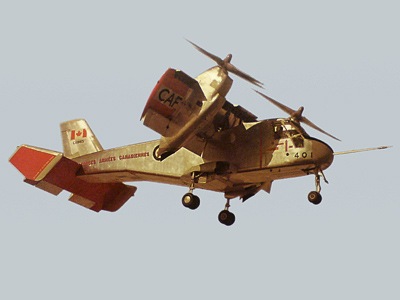
Bager1968The Canadair CL-84 Dynavert
Experimental V/STOL Multi Mission aircraft that was tested in ASW, C-SAR, Ground Support and Transport roles before being cancelled in 1974.
It could have beaten the V-22 Osprey into service by thirty years.
3 prototypes, 700+ flights, successful flight deck evaluation aboard LPH Guadalcanal… including with winds above 40mph!
Oh, what a partner for Harrier!
Bager1968that would have bought into the one fighter type in the mid 90’s instead of after 2020.
F-15C (1979+): AN/APG-63 radar; Pratt & Whitney F100-PW-100/220 turbofans
F-15E (1986+): AN/APG-70 radar; Pratt & Whitney F100-PW-220/229 turbofans (tests conducted with General Electric F110-GE-129 turbofans in 1998+)
The F-15E was internally redesigned from the F-15C/D, with a stronger structure rated for double the flight-hour life.
If the RAAF had waited until 2000, they could have ordered them with the GE engine, foreshadowing the 2002 Korean engine choice for its F-15Ks, the 2005 Singapore engine choice for its F-15SG, and the 2006 Saudi decision to replace the P&W engines in its F-15S fleet with the GE engine.
Bager1968As someone recently said…
Who’d have thought 30 years ago Hermes would still be in active service when Invincible was at the breakers yard?
The Invincible class was built to replace Hermes (and Bulwark, and Ark Royal… but those two were already decommissioned)… ironic, isn’t it?
Bager1968Another example of inter-service non-communication.
F-22 problem may be identical to F/A-18 problem identified and fixed by the USN years ago!
Carbon monoxide suspected in F-22 grounding
By Dave Majumdar – Staff writer
Posted : Thursday Jul 21, 2011 14:17:42 EDTThe prolonged grounding of the Air Force’s F-22 Raptor fleet may be due to carbon monoxide entering the cockpit via the aircraft’s oxygen system, two sources said.
…..
Part of the problem may be the procedures used at Elmendorf Air Force Base, Alaska, where most of the known incidents have occurred. Because of the harsh climate, pilots often start their jet engines inside a hangar before taking off. Investigators suspect that exhaust gases are getting trapped in the building and subsequently sucked back into the engines, where they enter the bleed air intakes that supply the OBOGS, sources said.
…..
If the carbon monoxide is being ingested because the engines are being started in confined spaces, a fix could be as simple as moving the jet outside, Weber said. If the engine must be started inside the hangar, the startup of the oxygen system might be delayed until the jet is out in the open, he said.
…..
The Navy has had similar problems with the OBOGS on its F/A-18 Hornet, which sucked carbon monoxide into its oxygen system during carrier operations.
Between 2002 and 2009, Hornet aviators suffered 64 reported episodes of hypoxia, including two that killed the pilots, according to the July-August 2010 issue of “Approach,” a Navy Safety Center publication.
…..
According to Navy documents, “Prolonged exposure to jet engine exhaust while sitting behind another aircraft waiting to take off and operating with low bleed air pressures can result in carbon monoxide (CO) breaking through … into the pilot’s breathing gas.”
The Navy modified the planes’ OBOGS to fix the problem, has had no recent similar incidents, and is not currently investigating the systems, Naval Air Systems Command officials said.
Bager1968
YAH-61
YUH-61!
Utility, not Attack.
I think that last one is an S-67 Blackhawk rather than YAH-56 Cheyenne.
Nicest shot I’ve seen of the S-67 though and both fully deserve to be on the list.
YAH-56
Bager1968wonder what would have happen had we bought F15’s instead of the classic hornets back in the early eighties
The RAAF F-111s would likely have been replaced in the mid-1990s by F-15Es (instead of the F-111G buy).
Bager1968ATTENTION EVERYONE:
“Mr Ian Davidson (Glasgow South West) (Lab/Co-op): Will the Secretary of State confirm the exact details of the announcement he made in his statement when he said, “I can therefore now give the go-ahead for the procurement of” a list of things, including “the cat and traps for the Queen Elizabeth class carriers”. Does that mean that both carriers will receive cat and traps?
Dr Fox: That is our plan, and I have agreed to my officials now getting involved in contract negotiations. They were not previously able to do so because we were not guaranteed that we would have the budget. When we make decisions of this nature we must ensure that we have the wherewithal to pay for them. Otherwise, as I have said, they are simply a wish list. ”
http://www.publications.parliament.uk/pa/cm/cmtoday/cmdebate/c_06.htm
YAY! Confirmation that both are to be fitted, it seems!!!!!!!!!!!!!!!!!!!!!!!!!!!!!
That link is no longer current.
The Q&A can now be found here: http://www.publications.parliament.uk/pa/cm201011/cmhansrd/cm110718/debtext/110718-0002.htm#11071817000001
Scroll to 18 July 2011 : Column 656.
Bager1968Has any thought been given to using VC-10’s for that? Just curious since they have not been ripped apart and rebuilt as much as the -135’s and Nimrods…and wholly British if that’s one of the issues some are having a fuss about.
In an aircraft, being “ripped apart and rebuilt” is a GOOD thing… as it allows for hidden cracks, corrosion, & fatigue to be corrected, weakened airframe parts to be replaced, and for upgrades in wiring, systems, and so on to be easily and correctly installed.
The VC-10s, not having gone through this, are in much worse shape structurally than these KC-135s, and thus would need far more airframe work to be safe for more years of flight.
The Rivet Joint system is designed around the KC-135 airframe… trying to fit it into a VC-10 would need lots of expensive and time-consuming work, which is exactly what tyhe UK is trying to AVOID through this purchase!
Bager1968Statements from others indicate that while MR.4 was ready to fly airframe-wise, there were problems with the avionics that still needed time and money to work out.
Apparently, significant amounts of both.


 Sign In