 Bager1968
I though it could be connected with ongoing ops over Libya…
No… the USN is not providing any CVNs for Lybian ops.
CVN-65 has been in the Red Sea/Indian Ocean for the last few months… she was just passing through on her way home at the end of her deployment.
http://www.navy.mil/local/cvn65/
Big ‘E’ Pulls Into Palma After 75 Days Underway
USS ENTERPRISE, At Sea (NNS) — Sailors and Marines aboard the aircraft carrier USS Enterprise (CVN 65) arrived in Palma de Mallorca, Spain, June 28 after sailing 75 days in support of maritime security operations in the U.S. 5th and 6th Fleet areas of responsibility (AOR).
http://www.gonavy.jp/CVLocation.html
CVN-65 Enterprise
13Jan2011, departed Norfolk to the 5th and 6th fleet areas of operations, in support of maritime security operations.
13Jan-19Jan2011, Lant
20Jan2011, entered the 6th Fleet Area of Responsibility (AOR)
20Jan-25Jan2011, Lant
26Jan-29Jan2011, Lisbon, Portugal
30Jan2011, Lant
31Jan2011, passed through the Strait of Gibraltar
01Feb-07Feb2011, Med
08Feb-10Feb2011, Marmaris, Turkey
11Feb-14Feb2011, Med
15Feb2011, transited the Suez Canal and entered the 5th Fleet AOR
15Feb-17Feb2011, Red Sea
18Feb2011, transited the Strait of Bab el Mandeb and entered the Gulf of Aden
19Feb-01Mar2011, North Arabian Sea
02Mar-22Mar2011, Red Sea
23Mar-06Jun2011, Arabian Sea
07Jun-20Jun2011, Gulf of Aden
21Jun2011, transited the Strait of Bab el Mandeb and entered the Red Sea
21Jun-23Jun2011, Red Sea
24Jun2011, transited the Suez Canal and entered the Med
25Jun2011, Souda Bay, Crete, Greece
26Jun-27Jun2011, Med
28Jun-01Jul2011, Palma de Mallorca, Spain
02Jul-03Jul2011, Med
04Jul-12Jul2011, Lant
——–[ Schedule to the decommission ]———-
FY2013, decommission
Bager1968You make a good point in that there are widely varied requirements all over the world. For this reason, I believe that the Boeing entry was more suitable for the needs of the USAF than the Airbus entry. If you need more tails, it makes sense (to me at least) to buy larger numbers of a smaller airframes, rather than a larger number of smaller frames. Also, I believe someone posted some statistic showing that a huge number of tanking missions are needed for training and very little fuel is transferred, thus the smaller airplane is more appropriate yet again.
The USAF is buying the same number of Boeing KC-46As as it was going to buy Airbus/NG KC-45As.
Yes… the same number of tails. Not surprising, as the bids both times were within 5% of each other for the same number of aircraft.
Your second point is more pertinent… it seems that many KC-135 refueling missions over Iraq/Afghanistan return with a significant amount of transferable fuel aboard when they land… so a much larger tanker (KC-45A) is not needed to replace the KC-135s.
It was the cargo capacity of the Airbus/NG entry that mattered to the USAF, not the extra fuel (as there would very rarely be a mission where a single KC-45A would off-load more fuel than a KC-46A would have available).
Bager1968Always lots of fun when cousins meet.
😀
Bager1968A favorite “cross-deck aftermath” photo…

Bager1968Thanks for the B-day present.
Here in western Colorado I miss the sea and ships.
Fortunately, the airport here is a refueling stop for USN/USMC fighters & other carrier aircraft, as well as the occasional USAF aircraft (mainly KC-135s).
Yes, those J52s are loud engines… to this day (22 years after I departed the USMC & the A-6E maintenance community) I can tell when an EA-6B is flying over my house… from the inside.
Despite only putting out 12,000 lb.s.t., the sound put out by those J52-P-409s is louder (and crisper) than that put out by 15,000 (22,000) lb.s.t. F414s in F/A-18E/Fs.
Or that put out by the engines on various regional airliners (mostly Bombardiers) that fly regular service here.
Bager1968The escorts aren’t relevent here because, in the Fleet model, the carriers rate of advance dictates the transit. Who cares if the escorts are at full speed and have to UNREP at a specific rendez-vous or, in a pinch, off the carriers bunkers…they would have to after a decent transit regardless. The point being made is that a conventional carrier that tops out at 27knts is not a Fleet carrier and it isnt if it cant maintain Fleet transit speeds.
Apparently you have no clue how carriers (including CVNs) are used in the real world.
So lets educate you.
1. The battle group meets supply ships at pre-designated spots… but in the mean-time the CVN and its escorts are on their own.
The escorts frequently “top off” from the CVN, but they still have to maintain at least a set percentage of their fuel “in the tanks” to insure they can function in an emergency, where they will be moving at top speed.
2. Ships use far more fuel per mile at “near-top speed” than they do at cruise speed… at least twice as much.
In order to operate the way you want, the USN would need to use at least twice as many fuel supply ships to keep those escorts operating at virtually their top speed… meaning the USN would need to own at least twice as many of those ships as they actually do!
3. Operating the way you fantasize, the GTs in those escorts would see 1/3 or less the operating time before they break down or require major overhaul… massively increasing the USN repair & maintenance budget.
The higher hull impacts from hitting waves at high speed would also severely increase wear on the hulls… requiring costly repairs in drydock, and shortening the overall life of the ship.
This would mean reduced availability of escorts, and thus require more escorts in the Navy, and more frequent replacement of those escorts.
4. The only possible time that any USN carrier group might make such a fast transit would be in case of unexpected all-out war… and even then it is 90% probable that the support ships to enable that transit would simply not be available, making that transit impossible.
USN carrier groups make much slower transits than you claim to be “the Fleet model”… a model which only exists in your imagination.
Bager1968In the USA, and just passed 1 year surviving on unemployment.
Bager1968In the USA, and just passed 1 year surviving on unemployment.
Bager1968Speaking of HH-43… Hill AFB, Hill Aerospace Museum 12 July 2009 #4561:
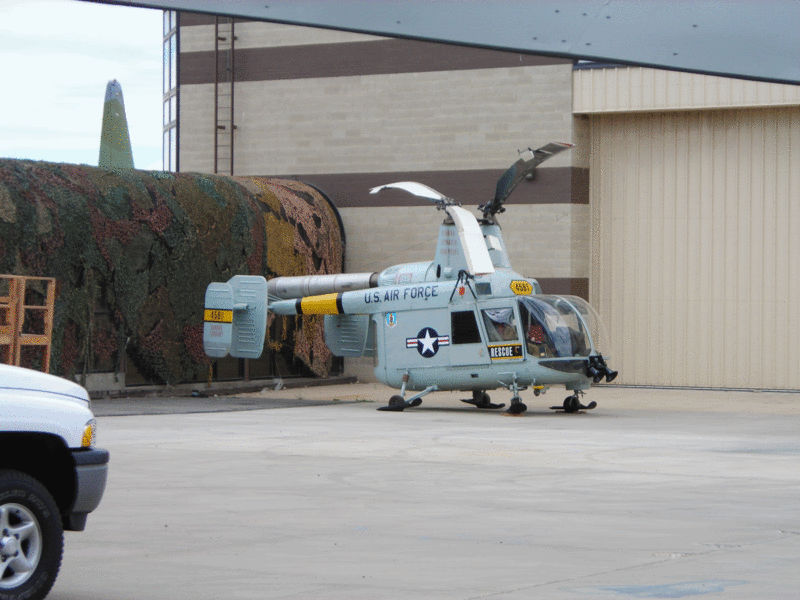
Bager1968Speaking of HH-43… Hill AFB, Hill Aerospace Museum 12 July 2009 #4561:
Bager1968CVF is going to be a modest performer of a ship – the view is 27knts knots topped out. Thats no real surprise as any naval architect will tell you its the last few knots of speed that really requires the engine power to achieve. Installed power costs money and CVF was being built on the cheap…at the time!. Top out of 27knts means she’s cruising at about 20……a good 10knts short of a real fleet carrier.
Interesting way to slant your argument… compare CVF’s cruise speed with USN-CVN’s top speed.
The USN’s CVNs have a top speed* of right about 33 knots.
That means CVF is about 6 knots slower in max speed than USN-CVN… which should come out to ~4 knots slower in cruise.
* In the real world, fully loaded and 3 months into a cruise, this is the “shudder/shake/strain-to-reach speed.
Despite all the internet/”this is no ****” blathering about 40-knot nuke-powered wonder-carriers, this is reality… the USN’s CVNs are designed for right about the same max speed as its oil-burning “supercarriers” were in the late 1950s/1960.
Bager1968Not to go “i said it to you”… But the NAO report proves me right:
Working with the Alliance, the Department has begun to develop its understanding of the costs of converting a carrier. The estimates are still immature but, based on a planning assumption of converting the second carrier during build (which offers the best balance of cost, risk, time and performance), the Department estimates costs will be between £800 million and £1,200 million. Converting the second carrier (Prince of Wales) could allow the Department to use the first carrier (Queen Elizabeth) to mitigate risks by testing the major platform systems (which are common to both ships) and familiarising the crew with the operation of the warship.
It is Prince of Wales that gets converted, not QE. Queen Elizabeth will enter service in 2016 as planned, and work as LPH/training carrier for the deck personnel that will then go on PoW.
Wrong 🙁 you mis-read what it say the Key factor is the word COULD, as from a cost point of view they see savings of using QE to prove the basic design and systems allowing the fully capable PoE to enter Service later.
However they also know there is more than costs involved as there is a certain element of politics & prestige that comes into play and you dont build a ship in honour of the monarch only to have it serve a castrated role for a short period of time and then to be replaced by a ship named after the heir with the the lead ship earmarked for mothballing or possible sale
Exactly… is a this is a proposal*.
If the decision had been made, the word would have been “WILL”!
The SDSR clearly states that IOC for QE (specifically named) will be pushed back from 2016 to 2020. See page 23:
http://www.direct.gov.uk/prod_consum_dg/groups/dg_digitalassets/@dg/@en/documents/digitalasset/dg_191634.pdf
Note that POW was scheduled for IOC in 2018 or 2019… and it is POW whose fate and configuration have been left for future review!
* “Could” is used to express possibility or past ability as well as to make suggestions and requests.
http://www.englishpage.com/modals/could.html
Bager1968And last, but not least, a few months they signed the UK-France Defence Co-operation Treaty, which specifically mentioned “building primarily on maritime task group co-operation around the French carrier Charles de Gaulle – the UK and France will aim to have, by the early 2020s, the ability to deploy a UK-French integrated carrier strike group incorporating assets owned by both countries…”
It doesn’t make any sense to me, nor does it to the British government it seems. But, if you want, you can always send them a letter 😀
Since they say “UK-French integrated carrier strike group”, that would include say… a French carrier, AAW frigate, & SSN with a British AAW destroyer and ASW frigate.
Or a British carrier and ASW frigate with a French AAW destroyer, AAW frigate, & SSN.
It does not necessarily mean aircraft from one nation on the other’s carrier.
Bager1968I would guess that, since the main rotor blades are laminated wood attached to steel roots, that that is to prevent the blades from becoming warped by being allowed to droop over long periods (as well as to prevent people from knocking their heads into the blades).
I know that what is in the pic is different from what is described in this 1958 Flight Global article, but I found this interesting (any clue what is being described?):
http://www.flightglobal.com/pdfarchive/view/1958/1958%20-%200353.html
The blades are supported when at rest or turning slowly by droop stops which ensure the necessary clearance between the blades and the fuselage for starting and stopping in high or gusty winds. When the rotor speed exceeds approximately 100 r.p.m., these stops are withdrawn, leaving the full freedom of movement which is essential for flight. These stops ensure that the minimum clearance between the main rotor blades and the ground is 6ft 10in. The rotor can be started or stopped in winds of at least 50 kt and on board a ship rolling through 24 deg.
Bager1968No… it is NOT.
The USAF/USN already has a fleet of Hawker Beechcraft T-6A trainers… this is to provide armed AT-6Bs (note the “A for Attack” prefix) or EMB-314 Light Air Support aircraft (a “close-in” “light-strike” bird) ( just like the thread title says… imagine that!).


 Sign In







