Bager1968
I suppose the ability to take on fuel from another tanker is in the KC-X specs.
Shouldn’t be hard… all it would take is a receptacle, some piping, a few flow control valves… etc.
And/or the ability to use the “off-load” fuel to fly the tanker itself.
Bager1968At least the USS Intrepid is already preserved in New York and there are a least five battleships also preserved in the US whereas there will never be a Royal Navy battleship preserved now. Britain has now only one (remote) chance to preserve a Falklands War carrier.
USS Texas BB-35 (1914); at San Jacinto State Park, Houston, Texas, 20 April 1948.
USS North Carolina BB-55; in Wilmington, North Carolina, 29 April 1962.
USS Alabama BB-60; at Battleship Memorial Park, Mobile, Alabama, 9 January 1965.
USS Massachusetts BB-59; at Battleship Cove, Fall River, Massachusetts, 14 August 1965.
USS Missouri BB-63; at Ford Island, Pearl Harbor, Hawaii, 29 January 1999.
USS New Jersey BB-62; in Camden, New Jersey, October 2000.
USS Wisconsin BB-64; in Norfolk, Virginia, 16 April 2001.
USS Iowa BB-61; held in Suisun Bay, Concord, California, phase I application submitted 21 November 2010 for museum at Pier 87, San Pedro, Los Angeles, California.
USS Yorktown CV-10; at Patriot’s Point, Mount Pleasant, South Carolina, 13 October 1975.
USS Intrepid CV-11; in New York harbor, New York, New York, August 1982.
USS Lexington CV-16; in Corpus Christi, Texas, 15 June 1992.
USS Hornet CV-12; at former Naval Air Station Alameda, Alameda, California, 17 October 1998.
USS Midway CVB-41; in San Diego, California, 7 June 2004.
USS Ranger CV-61; to be museum in Fairview, Oregon (phase II application submitted 3 Sept. 2010 and approved, work on phase III [final] application underway).
Bager1968Yes, if India pays for the whole development.
The UK won’t pay for development of it and then pay right about the same per airframe as for F-35C.
Yes, the UK paid part development costs for the F-35 in general… but only part… the US paid the bulk, and other partners chipped in a little.
Bager1968sorry to post late, but this belong to news section…
http://ibnlive.in.com/news/indian-na…/141970-3.html
Its already been posted and discussed in the Indian Navy News & Discussion thread… which is the proper place for it.
This thread is for everything not in a specific Navy’s thread.
Bager1968Bridle explanation and parts list
The catapult itself works by connecting to an aircraft via a shuttle on the deck which runs on a single central slot. This stops several feet short of the end of the deck, where during the launch cycle the strop continues forward due to momentum, but begins slowing down so ‘falls off’ the aircraft (it is attached by being hooked over two rearwards facing hooks).
Originally the strop was lost in the sea after each launch, the method dating back to the 1930s when it first introduced by the US aboard their hydraulic catapults on carriers such as the Yorktown class. Strops where relatively cheap and catapult launches were the exception rather than the rule as free takeoffs were standard procedure.
Postwar heavier aircraft and jets in particular meant more frequent use of the catapults, with an increase in required catapult power which lead inevitably to the development of the steam catapult, and lead the Americans to realise the strops would become quite an expense even for them due to the large number of carriers operated.
Two more slots are fitted either side of the shuttle slot, usually slightly raised above the deck, and the strop is attached to runners in these slots at four points (two per slot); two close to the shuttle (short connection) and two more near the ends of the strop (long connection). The catcher slots extend beyond the end of the catapult proper and and drop below deck level at the deck end to pull the strop away from the departing aircraft as it leaves the deck.
When the catapult is reset for the next launch the bridle can separately by pulled back to the start of the catapult track ready for the next aircraft. It is reused a fixed number of times (30-50) before it is detached from the catcher runners and lost on the next launch.
1. fuselage
2. aircraft catapult bridle hooks
3. catapult bridle
4. bridle arrestor lanyard
5. slide lanyard
6. cable guide
7. catapult shuttle
8. catapult track
9. blast screen
10. catapult holdback pendant
11. catapult pendant arrestor bungee
12. aircraft catapult holdback fitting
13. tension bar
14. cleat link
15. deck cleat

More detailed drawings and info can be found here (showing specific components and parts):
photobucket/albums/Bager1968/Carriers/catapult and arresting gear systems/
Bager1968Me 262 Werk Number 501241 was a project that was started by Texas Aircraft Factory Inc. in conjunction with Classic Fighter Industries Inc and completed by the Me 262 Project in Everett, WA. It first flew on December 20th, 2002. It is a Me 262 B-1c which is the 2-seat version of the Me 262.
The Stormbird Me-262s use 2xJ85 turbojets (also used in the T-38 Talon, F-5A/B Freedom Fighter, and F-5E/F Tiger II, Fiat G.91Y, Canadair CL-41 Tutor, Cessna A-37 Dragonfly, and Saab 105Ö {Austrian version}). The civil counterpart, the CJ610, powered the Aero Commander 1121 Jet Commander, HFB-320 Hansa Jet, and Learjet 23/24/25/28/29 models.
According to their site, they built 3 new flying Me-262s, one new static display Me-262, and restored at least one “old” Me-262 for the USN in the late 1990s/early 2000s… which is where they got lots of technical info for the project.
The last update to their site appears to be late 2009.
http://www.collingsfoundation.org/ME262/Pict1LG.jpg
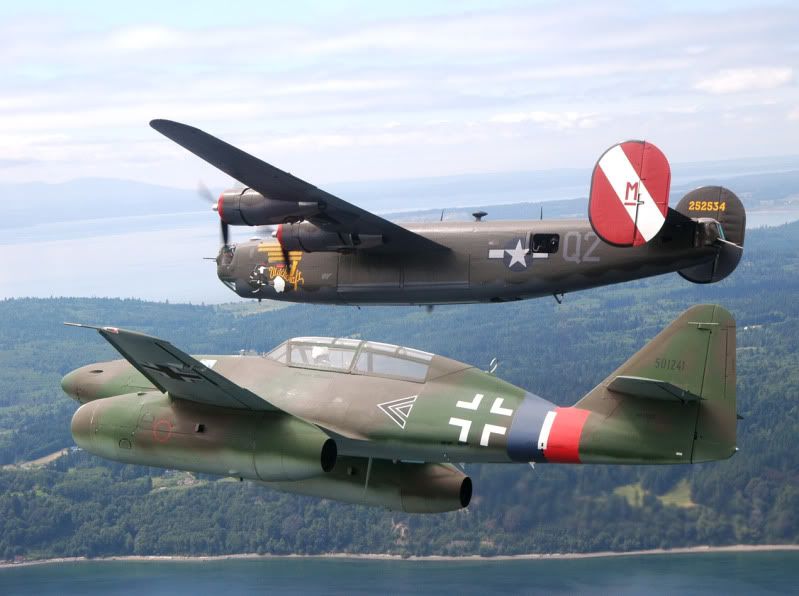
Bager1968As posted by BlauerMax on the previous page in post # 119.
http://forum.keypublishing.co.uk/showpost.php?p=1698309&postcount=119
Bager1968Madrat… there already is a CATOBAR (horrid, inaccurate acronym) version of the F-35… the F-35C, which is what the USN wants the USMC to buy for half its force… and which the USMC is strenuously resisting.
Why do you want to waste even more money modifying the F-35B to be like a lower-payload, shorter-range F-35C?
OK, all.
Since I’m the one that got the F-35B/Egypt thing started, let me make a couple of statements.
1. At this time, the Egyptian people seem to be making a concerted effort to preserve the safety of foreigners in Cairo… a marked contrast to how things were in Tehran in 1978/79. See #5.
2. The Army seems to be acting more as a neutral stabilizing force than as either part of the uprising or as supporter of the government. Witness the recent statement by the leader of the army that they will NOT use force against the demonstrators. See #3 & #4 for why.
3. This is a popular movement aimed at removing and replacing the current government heads, and led by a group of popular figures with ties to both the Egyptian people and to western nations… not a revolution aimed at completely re-making the political, religious, and social structure of the nation, led by a small group of religious fanatics who had spent decades organizing and planning (as was Iran 1978/79).
4. The international community is putting pressure on Mubarak to act with restraint, and to reform how the government works… they are not supporting and aiding him in cracking down on dissent, and thus alienating the general populace, as was the case with the Shah of Iran.
5. The Egyptian people are also more “cosmopolitan” (open-minded, ideologically-flexible, and welcoming of those of other religions and cultures) than Iran’s revolutionaries were.
In short, I have no worries about a Islamic Theocracy taking power in Egypt.
Bager1968I would have thought that the events on the Hudson river 2 years ago with US Airways’ A320 would have erased any doubts on the ditching qualities of podded engined airliners – and then there is MPA320 / MPA319:
Flight 1549: landing in daylight, with clear visibility, and calm winds, on a very smooth river.
Hypothetical MPA: ditching at night, in a rain-squall, with 25-knot variable winds (bf6), on a rough sea (ss5) with 8′-10′ wave heights.
Hmmm… apples to pomegranates comparison, I’d say.
Bager1968There is a complete FW190 production line up for sale.
Or how about bringing back the Boeing Skyfox?
http://en.wikipedia.org/wiki/Boeing_Skyfox
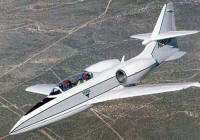
Conceived by the Skyfox Corporation, the Skyfox is a radical development of the Lockheed T-33 trainer, popularly known as the “T-Bird”. The design team’s objective was to produce a modern air combat trainer considerable cheaper than any new plane of comparable performance. To this end the team retained some 70 per cent of the T-33’s structure including the basic wing and fuselage.
However, the machine looks entirely different because of the replacement of the T-33’s single internal turbojet by two turbofans located on the upper fuselage sides between the wing and the tail unit. The tail plane is mounted approximately one-third of the way up the swept vertical surface of the tail unit.
The updated cockpit under a more streamlined canopy has completely modern avionics and tandem ejector seats. The Skyfox prototype flew in August 1983, and in 1985 Boeing acquired a world wide license for the conversion and updating the T-33’s.
At that time, many of the original type were still in service, and some 700 are though to be suitable for conversion. By 1990 no orders had been reported.
Bager1968
A 15th Air Force B-24 Liberator with the top of the fuselage blown out by a flak burst that killed both waist gunners.
I’ll have to drive by 159 Colorado Ave. tomorrow, and see if Capt. Baca’s house is still there… or if something else is there now. I think I’ll drop a copy of the photo by the Daily Sentinel (local newspaper) as well.
Thanks for this.
Bager1968Interesting to see that so many of you* believe that there is nothing between all-out war against a capable adversary and no combat at all!
The main value for the USMC of capability of the AV-8B and its replacement the F-35B to operate from LHA/LHD vessels lies in the area you* guys are so carefully avoiding.
That area is what I brought up in my last post # 385… which is being studiously ignored.
And here we are with another such occurrence brewing… and the Marines are there without a CVN… just LHD-3 and LPD-15: Marines Ready for Egypt Rescue Mission
Posted by Mark Thompson Friday, January 28, 2011 at 5:09 pm
The U.S. Marines have a pair of warships — the USS Kearsarge and the USS Ponce — just hanging around the southern end of the Red Sea waiting to see if they’re needed to rescue U.S. diplomats and citizens from Cairo. They’re half of the Marines’ 26th Marine Expeditionary Unit, a mini-armada that recently dispatched 1,400 of its 2,000 Marines into Afghanistan. But they’ve got a “fair number” of helicopters, and Marines, still aboard. “They’re not in the on-deck circle yet,” a military official says. “They’re kind of getting ready to come out of the dugout.” Meetings in Washington through Friday night and into the weekend will determine if they’re ordered to carry out a NEO — a non-combat (but potentially dicey) evacuation operation.
For proper protection of any such mission, and for a small quick strike to take out terrorists or the like, 4-6 F-35B would be far preferable than a handful of AH-1Zs.
But feel free to continue to ignore the more-frequent missions of the USMC in favor of your* “all-out or nothing” discussion… and I’ll just ignore you* the way you* are ignoring reality.
* meaning those who refuse to accept that the US Marines do things other than all-out war and non-combat humanitarian missions
Bager1968The F-5 was the first fighter designed entirely under the new unified system.
The A-7 Corsair II was the first attack aircraft designed entirely under the new unified system.
The B-1 Lancer was the first bomber designed entirely under the new unified system.
US Army/USAAF/USAF Attack Aircraft Designations
US Navy Attack Aircraft Designations
Here are the existing Navy attack aircraft that were redesignated:
New Designation___________Old Designation
Douglas A-1 Skyraider_______Douglas AD Skyraider
North American A-2 Savage___North American AJ Savage
Douglas A-3 Skywarrior______Douglas A3D Skywarrior
Douglas A-4 Skyhawk________Douglas A4D Skyhawk
North American A-5 Vigilante__North American A3J Vigilante
Grumman A-6 Intruder_______Grumman A2F Intruder
There were four series of USAAC/USAAF/USAF bomber aircraft.
The original series began in 1920 and ended in 1924.
The second series began in 1924 and ended in 1930.
The third series began in 1930 and ended in 1962.
The fourth series began in 1962 and continues to the present day.
US Army/Air Force Bomber Designations
Transports, etc all have their own designations, which can be found ibn the first two links in my previous post.
Bager1968What is it with the US numbering system, after the war they swapped the P for the F and the numbers went up to the century aircraft and culminated in the F111, then the 1 seemed to be dropped and there was stuff like the F14, 16 etc with it all currently on the F35, so why was the F117 numbered so and what happened to the F116 and will there be a f118?
Oh and how does the F5 fit in to all this?
To make it simple, before 1962 the US Army, US Navy, and US Air Force each used their own different designation system.
In 1947, when the USAF was created from the US Army Air Force (USAAF), the Type Symbol of P (pursuit) was changed to F (fighter), but the same model numbers were kept. For example, P-51 became F-51, P-80 became F-80, etc.
The USAF also tried to eliminate the use of “A” (attack) from its aircraft, using it only for aircraft that could not possibly be called fighters… the prop-driven A-1 Skyraider and the jet-powered A-10 Thunderbolt II.
In 1962, a new unified system went into use, with the following effects:
1. the numbers started over from “-1” for all new aircraft.
2. USN aircraft still in active service with old designations were re-designated in the new series.
3. aircraft which were in service with more than one service received designations in the same main number: for example, the USN’s F4H Phantom II and the USAF F-110 Spectre were redesignated F-4B Phantom II and F-4C Phantom II respectively.
Here are some links that should help you understand the systems and figure out which designation matches to what aircraft:
http://www.personal.psu.edu/dob104/aviation/us/system.html
note that the aircraft type names are links to the specific aircraft models using that designation
USAAC/USAAF/USAF Fighter Designations
The only existing USAF aircraft to be redesignated is the afore-mentioned Phantom II.
Here are the existing Navy fighters that were redesignated:
New Designation_________Old Designation
North American F-1 Fury___North American FJ Fury
McDonnell F2 Banshee_____McDonnell F2H Banshee
McDonnell F3 Demon______McDonnell F3H Demon
McDonnell F-4 Phantom II__McDonnell F4H Phantom
Douglas F-6 Skyray_______Douglas F4D Skyray
Convair F-7 SeaDart______Convair F2Y Sea Dart
Vought F-8 Crusader______Vought F8U Crusader
Grumman F-9 Cougar _____Grumman F9F Cougar
Douglas F10 Skyknight____Douglas F3D Skyknight
Grumman F-11 Tiger______Grumman F11F Tiger


 Sign In