 Bager1968
Yes, because, as he has made clear by his actions in the past, Grey Area is himself biased against the F-35, and has no problem letting that bias affect how he moderates threads.
Hence his attempt to prohibit discussion in this thread, when this was (at that time) the only F-35 thread he had not closed down.
This at a time when there are multiple J-20 threads.
Bager1968Well, the Brazilian upgrade used the Italian FIAR Grifo radar.
Bager1968Not “salesman”… con artist.
Bager1968A hint… in 1947 the older John Sowery would have been 53 or 54, while the younger John Adam Sowery would have been 27.
How old (roughly) was the one you met?
Bager1968Is that one of the ‘Million Dollar Valley’ airframes?
http://explorenorth.com/library/aviation/million_dollar_valley.html
It did come from Alaska, but it isn’t one of the airframes in that article. If you check the links, you will find that the 3 airframe numbers were 40-1459, 40-1464, and 40-1501.
The example at Hill is B-26 (s/n 40-1370). It is listed as “under restoration”, but I don’t know how much else Hill has, as I saw nothing recognizable as from a B-26 when I wandered through the “back lot”.
1159 is being restored to flight by the MAPS Air Museum, North Canton, Ohio
1464 is owned by Kermit Weeks, and while still listed as airworthy, hasn’t flown in years.
1501 is restored for display at the Pima Air & Space Museum, Tucson, Arizona.
Bager1968A situation where a small amount of fixed-wing CAS is needed but a CSG isn’t available… Lets duplicate this historic event, but with a small nation with some Mirage III/2000s or Mig-23/29s and some older model USSR-built SAMs:
And note the date… January 1991, What were all the available USN carriers doing in January 1991… I wonder?
Issue Date: December 15, 2003
The Lore of the Corps
4th MEB led evacuation of embassy in SomaliaBy Keith A. Milks
Special to the Marine Corps TimesIn late 1990, the regime of Somali President Mahammad Siad Barre was on its last legs. His attempt at government reform was met with armed resistance, and the Somali capital, Mogadishu, disintegrated into chaos as various factions vied for control of the city, resulting in the deaths of hundreds, if not thousands, of Somalis.
Americans in Mogadishu immediately sought shelter in the sprawling, 160-acre U.S. Embassy compound. When armed looters seized part of the compound Jan. 1, 1991, Ambassador James Bishop requested that the U.S. military evacuate his staff and the civilians, American and others, who had sought refuge there.
The evacuation mission fell to the 4th Marine Expeditionary Brigade, then in the Indian Ocean as the world’s attention was focused on Operation Desert Shield in Kuwait.
The force dispatched from the 4th MEB was embarked aboard the amphibious assault ship Guam and amphibious transport dock Trenton. Its muscle consisted of a composite helicopter squadron with medium- and heavy-lift helicopters; a combat service support element; elements of 1st Battalion, 2nd Marines; a Navy SEAL team; and other support personnel. Upon receiving the call, the ships set sail for the Horn of Africa.
Meanwhile, in Mogadishu the situation was worsening.
Embassy security forces were exchanging fire with encroaching looters, and the compound was in serious threat of being overrun. The situation was relayed to the MEB, still more than 500 miles away, which immediately launched two CH-53E Super Stallions from HMH-461 at 3 a.m. on Jan. 4.
After refueling twice from KC-130 aircraft on the way, the helicopters reached the embassy at 6 a.m. with a 60-man security element of Marines and SEALs. Less than an hour after landing, the Super Stallions carried out the first batch of evacuees and deposited them aboard the Trenton.
During the day, sporadic and inaccurate rifle fire struck the embassy. As the Marines deterred the looters swarming around the compound, potential evacuees continued to stream into the embassy, seeking asylum.
At midnight on Jan. 6 — 36 hours after the first Marines arrived at the embassy — the Guam and Trenton were close enough to launch their CH-46E Sea Knight helicopters. Over the next three hours, four waves of Sea Knights descended in groups of five upon the embassy grounds.
A total of 281 civilians were evacuated from Mogadishu during the 10-day operation.
Keith A. Milks is a gunnery sergeant stationed at Camp Lejeune, N.C.
And for a list (few of any of which had a CSG anywhere near):
25 May–9 January 1991, Liberia: 22d MEU protected US Embassy and evacuated over 2,400 civilians.
(this site has a detailed description of this 8+ month mission, starting about 1/3 of the way down, as well as of the following operation: http://www.globalsecurity.org/military/library/report/1992/BSL.htm)
2-11 January 1991, Somalia: 4th Marine Expeditionary Brigade (MEB) evacuated 260 U.S. and foreign citizens from the American Embassy in Mogadishu.
April 1994, Rwanda: 11th MEU provided force to perform NEO; 241 citizens evacuated.
April-August 1996, Liberia: 22d MEU evacuated U.S. citizens and foreign nationals from Monrovia, Liberia.
March 1997, Tirana, Albania: 26th MEU evacuated 877 American citizens.
April 1997, Kinshasa, Zaire: 26th MEU evacuated American citizens.
30 May-2 June 1997, Freetown, Sierra Leone: 22d MEU evacuated 451 American citizens and 2,058 foreign nationals.
6 June 1998, Asmara, Eritrea: 11th MEU evacuated 105 American citizens and numerous foreign nationals.
June 2003, Liberia: 2d MEB aboard USS Kearsarge evacuated American citizens from Embassy.
February 2004, Port-au-Prince, Haiti: Fifty Marines from a special detachment of the 4th Marine Expeditionary Brigade (MEB) landed in the Haitian capital of Port-au-Prince to secure the U.S. Embassy and help evacuate American citizens.
July-August 2006, Lebanon: Marine Security Force Company, Bahrain and 24th MEU participated in evacuations of American citizens in response to the increased hostilities between the Hezbollah militants and Israeli Army.
Note that the June 1998 evacuation was carried out in the midst of a full-scale war between Eritrea and Ethiopia… both of which were actively flying MiG-29s on combat missions during the evacuation!
The presence of actual fighter aircraft sure would make these missions easier, rather than relying on relatively slow and under-armed Cobras (2xAIM-9 and no A-A radar) for protection of the evacuation mission against other aircraft piloted by either a rebel or a government supporter with a beef against the US evacuation.
Bager1968Hmmmm… now to get these two together and find the other parts (center section, wings, etc).
At Hill Aerospace Museum, Hill AFB, Ogden Utah in July 2009.
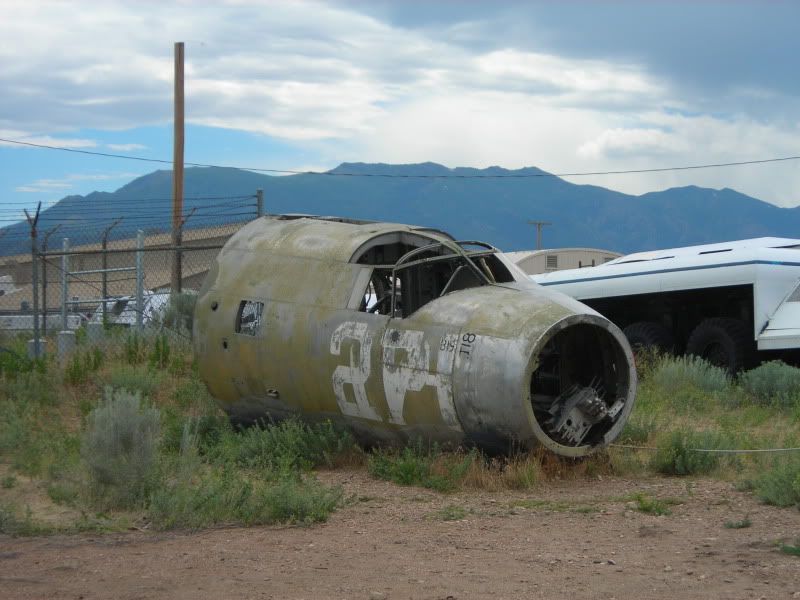
Bager1968Wonderful photos and wonderful work!
Bager1968And the IN already rejected the surplus Sea Harrier FA2s.
Bager1968The fix for the afterburner “screech” was designed, built, and being tested on 2 engines flying in aircraft before the probation decision… and somehow this is “spin?
Bager1968Here is a proper display hood… on the A-6E Intruder. The hood has a handle which extends it so the B/N can look inside easily, and retracts it for normal flight and entry to/egress from the cockpit (note hinged arms on both sides).
A-6E with hood over FLIR display (bombardier/navigator’s station) and joystick for FLIR/laser designator: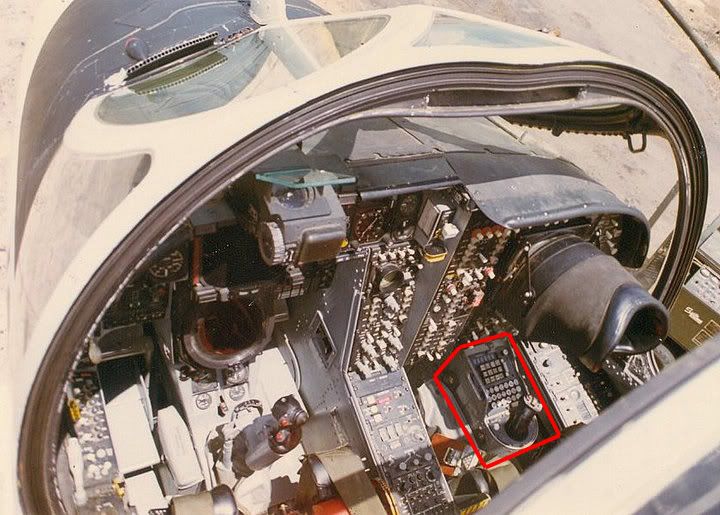
A-6E without hood or joystick: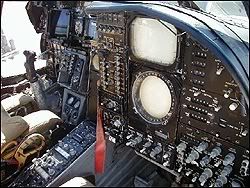
Bager1968I strongly suspect the OP was asking about actual regular use, not “kept around specifically as flying museum pieces”!
Bager1968That proposal was for un-reinforced ice, whereas Habakkuk was to use Pykrete, a wood-pulp and ice mix, which had greater strength, higher resistance to impact, and much slower melting characteristics.
Bager1968Yep… G-ABVP listed here also as “Monospar”.
http://www.flightglobal.com/pdfarchive/view/1933/1933%20-%200011.html
Mfg: General Aircraft Ltd.
http://www.airwaysmuseum.com/General%20Aircraft%20Monospar%20ST.11%20VH-UAZ.htm
http://www.airwaysmuseum.com/aircraft%20images/GAL-Monospar-UAZ-MSC-GG-625.jpg
General Aircraft ST-25 Monospar – Avioneta de Eloy Fernández Navamuel during Spanish Civil War:

Bager1968can i ask what part RR play in the F136?
I mean are they learning from GE or true partners and do they have any commercial rights over the design (or elements of the design) if it didn’t go ahead?
The GE/RR Fighter Engine Team includes GE Aviation in Cincinnati, Ohio, and Rolls-Royce in Bristol, England and Indianapolis, Indiana, USA. The two companies hold 60% and 40% respectively.
Rolls-Royce, with 40 percent of the program, is responsible for the fan, combustor, low-pressure turbines and gearboxes.
GE, with responsibility for 60 percent of the program, is developing the compressor, coupled turbine, controls and accessories, structures and the augmentor.
GE partnered with Turkey’s TUSAS Engine Industries (TEI).
TEI will design and manufacture critical parts for the F136 in conjunction with GE.
TEI’s work-share comes out of GE’s 60%.


 Sign In







