 Bager1968
In 2006 I saw one (188727) at Williamtown, Australia in very bad condition. It looked like the used it for spare parts.
188727 was the last block 13 Canadian F-18, and the 27th CF-18A delivered.
I would say that yes, it was there for spares for the ones Australia bought new for the RAAF in the 1980s.
Bager1968The Stinson L-5 Sentinel was used in the air ambulance role, but the normal method was to load the stretcher in the fuselage. The L-5 had a hatch in the rear fuselage, and the stretcher was fully inside the fuselage.
One hundred modified Piper J-5Cs (US Army designation L-4) were ordered by the USN as HE-1 ambulance aircraft in 1942. These aircraft could accommodate a pilot and one stretcher. The deck of the fuselage from the trailing-edge of the wing to the vertical fin was arranged to hinge up to permit the loading and unloading of one USN standard litter. The hinge was located forward at the rear of the wing.
PA-18 Piper Air Ambulance
OPERATIONAL HISTORY
In USN service, the HE-1/AE-1 aircraft were usually based at small, remote air stations, e.g., Naval Auxiliary Air Stations (NAASs) Brown Field and Holtsville, California; Chase Field, Texas; Martha’s Vineyard, Massachusetts; Oceana, Virginia; Vero Beach, Florida, etc. that were located some distance from major medical facilities.The U.S. Marine Corps (USMC) accepted their first in 1943. By August of that year, the Marines were operating seven aircraft assigned to the Base Air Detachments (BADs) at Marine Corps Air Stations.
I would not be surprised if some were brought along with the USN landing ships for Sicily, etc.
It might be that either he remembers this before they closed the clamshell, or that the aircraft he was flown in had the hatch removed for quicker access.
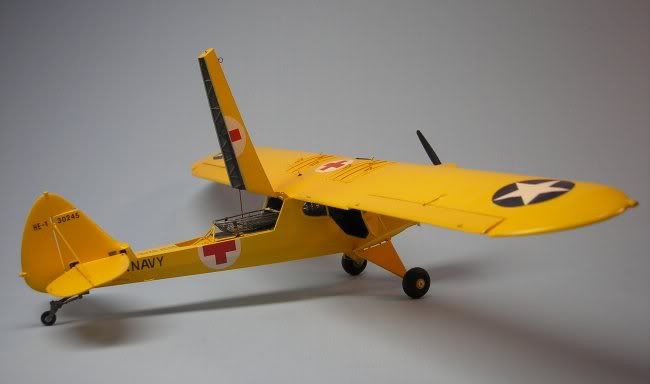
Also, it is possible that various units had begun attaching stretchers beside the fuselage like they would later do with helicopters (TV show M*A*S*H for example), but I haven’t found confirmation of this.
Bager1968No-no, SVR and GRU from our side. KGB went to daisies in 1991.
KGB just got re-organized & renamed, at heart it is still there.
SVR is the official foreign-operations successor to many prior Soviet-era foreign intelligence agencies, ranging from the original ‘foreign department’ of the Cheka under Lenin, to the OGPU and NKVD of the Stalinist era, followed by the First Chief Directorate of the KGB.
…..
The SVR is the successor of the First Chief Directorate (PGU) of the KGB since December 1991.
…..
However SVR is reportedly more influential behind the scenes than GRU or the PGU was, especially with regard to defining Russian foreign policy.
Bager1968From Wired/Axe:
“There was a time, a decade ago, when the Marines had a chance to avoid the current crisis. The Corps could have joined the Navy in purchasing Super Hornets as a bridge to the next generation of fighters.
The Supers have since evolved into impressive jets in their own right, especially with the addition of one of the world’s most advanced airborne radars. The Navy has happily continued buying Super Hornets even as the F-35 progresses. But the Marines wanted only the latest and best technology; no mere upgraded F-18 would do.
That unwavering obsession with high tech painted the Corps into the corner it now finds itself in, waiting around for a much-delayed, over-budget new fighter while its current jets waste away to nothing, deeply eroding the Marines’ famed self-reliance.”
He seems completely unaware that the F/A-18E/F is NOT “a bridge to the next generation of fighters”.
The F-35C is only replacing the USN’s older F/A-18A+/C/Ds.
The Super Hornet is NOT to be replaced by the F-35 in the USN, but will serve beside it (until a possible later replacement by UCAVs)!
Further, when the F-35C is in the fleet, the Super Hornet will be the “second-day” aircraft, only going in after F-35s have “cleared the way”.
If the USMC had bought F/A-18E/Fs, they would be getting no F-35s at all, as only the size of the USMC “all-F-35B” buy justified the cost of the development of the F-35B in the first place.
This would have eliminated their ability to operate fighters from the LHA/LHDs, and made the USMC even more reliant on the USN for combat support.
Bager1968IIRC, didn’t the EH101 win out first time around?
Anyone got any links to the history of the CSAR-X program?
That said, if the USAF wants something bigger, the HH-71 or an S-92 variant looks like the right size, and the winner of these two would be a sure winner of the VXX competition.
Um… you are confusing programs. And you are several years out of date.
CSAR-X (Combat Search and Rescue) was won on 09 November 2006 by the HH-47 (an updated version of the MH-47G helicopter).
Lockheed Martin and Sikorsky subsequently filed and won two rounds of protests with the Government Accountability Office (GAO). Sikorsky and LMSI challenged the evaluation of proposals and resulting source selection.
On 26 February 2007, GAO found that the Air Force’s evaluation of operations and support (O&S) costs was inconsistent with the RFP.
The USAF proposed corrective action in response to GAO’s decision of 26 February 2007, but Lockheed Martin Systems Integration-Owego (LMSI) and Sikorsky Aircraft Company protested the corrective action.
On 30 August 2007 GAO sustained the protest, basically forcing the USAF to allow the entrants to submit revised bids.
After several revisions of program requirements, including removing the requirement for troop insertion/extraction, the revised competition still has not selected a new “winner”.
CSAR-X Program
The VXX program for a new Presidential helicopter was won on 28 January 2005 by the US101 (a joint AgustaWestland/Sikorsky proposal for a US-assembled EH101 Merlin variant), which was then designated VH-71 Kestrel.
Under the proposed Defense budget announced by Secretary Gates 6 April 2009, the VH-71 funding would no longer be included. On 1 June 2009, the United States Navy announced that the contract, signed in 2004, was officially canceled and funds will be reinvested in upgrades to the existing fleet of VH-3D and VH-60N helicopters.
In 2010 an US$8.4 billion contract was issued for upgrade and overhaul of the existing Presidential helicopter fleet, ending any possible revival of the VH-71.
Bager1968Well two things come to mind if the UK had been involved in Vietnam and carriers were deployed to Yankee station.
1) CVA-01 or something similar would probably of survived and entered into service.
2) A push towards even greater commonality with the USN would be certain. So Hawkeye and Greyhound might well of found themselves on a UK carrier deck. Also Phantom and Bucaneer would probably of remained in service to the late 80’s maybe even mid 90’s before being replaced by a Hornet variant – possibly with the input of British industry.
1. yes.
2. Or a “Sea Tornado”* (navalized Tornado ADV… it is possible the MRCA could have had a carrier variant from the start). This likely would have added pressure for improved power from the RB.199 from the start.
* “Waterspout”? “Hurricane II”?
Bager1968Apparently the competition (like the KC-X competition) has been reset… new bids and new competitors as well as the old ones:
Bager1968South Viet Nam AF Grumman Bearcat. THat’s news to me. I knew they operated Skyraiders but not Bearcats.
Wiki says:
Operators:
* French Air Force
* Royal Thai Air Force
* United States Navy
* United States Marine Corps
* Vietnam Air Force
129 were sold to Thailand, and the French aircraft were operated in Indochina… It would be logical for these to be the source of at least some of the South Vietnamese Bearcats.
Bager1968Grumman F8F Bearcat.
The cn# on the tail matches to this one:
http://www.airport-data.com/aircraft/N58204.html
I cannot seem to find any historical data, but this Bearcat was rebuilt to Zero Time standards by Bruce Lockwood / Museum of Flying during 1993-1995. All systems including electrical, radios and avionics, and hydraulics were either new or overhauled. The aircraft was painted in an authentic Bearcat paint scheme and it was placed on display at the Santa Monica Museum of Flying from 1995 until 2000. The Bearcat was then operated by Tony Banta for many years until it was purchased in 2006 by Rod Lewis.
http://www.warbirddepot.com/aircraft_fighters_f8f1-lewis.asp
FAA certification was re-issued in November 2010:
http://www.aviongoo.com/aviongoo/faa_info.php?nnum=58204
Bager1968I still think that the C could possibly do all the jobs that the aircraft has been asked to do, especially if it could take off from a rough airfield that a C130 could with the load of a B, that would keep the Marines happy.
Losing the ability to operate from the 10 or so LHA/LHDs would make the Marines extremely unhappy.
Bager1968Because the F-35 also needs to comply with politicians who want “positive visual ID of the target before weapons release”. This almost guarantees a decent amount of dogfighting.
The stealth of the F-35 is primarily for penetration of radar-controlled air defenses on strike missions, and only secondarily for reducing an enemy fighter’s ability to get a radar lock in A-A combat (although it will do that as well).
The F-35 will be pretty capable in BVR combat… when the pilots are allowed to fight BVR. Most of the time political restraints will limit them to WVR combat.
Bager1968What about this Bager1968?
All registration numbers are hidden/not visable, so the only thing that can be seen is what looks like “USAF” under the port outer wing… indicating that it is a USAF C-46 Commando.
However, it might be some other AF… the first letters are pretty indistinct.
Bager1968http://www.warbirdregistry.org/b17registry/b17-448846.html
Serial #: 44-8846
Construction #: 8246 (-VE)
Civil Registration:
F-BGSP
ZS-DXM
F-AZDX
Model(s):
B-17G
RB-17G
Name: Pink Lady
Status: Airworthy
Last info: 2002
History:
Allocated to 351st BG Polebrook, 19??
Transferred to 305th BG Chelveston, 19??
Institut Geographic National, Creil, Dec. 8, 1954-1985
– Registered as F-BGSP.
– South African survey operations, 1965
— Registration ZS-DXM reserved but not allocated.
IGN/Association GMF/Amicale Jean Salis, May 1985.
– Registered as F-AZDX.
IGN/Forteresse Toujours Volante Association, Paris-Orly, 1988-2002
– Flew as 48846/W/Lucky Lady.
– Flew in movie “Memphis Belle” as “28703*DF-S/Mother & Country”, June 1989.
– Currently flown in camouflage as 22960/Pink Lady.
The tail fin marking matches the 1954-1985 owner.
Bager1968The -C has (with the same engine) a heavier airframe and a larger wing*, so there is no way it will have either the same maneuverability** or acceleration as the -A.
Also, the -A has an internal gun… the -C does not. If The USN wants to do any gun work with the -C it will have to hang the external gun pod from the centerline hardpoint (more weight & drag, and a severe restriction on top speed).
* Needed to keep take-off/landing weight down with the heavier airframe, the added drag from the extra wingspan & surface area meant more fuel was needed (thus the removal of the gun), making take-off even heavier, so the wing had to be even bigger… you see the problem here.
** The larger tail surfaces (for better low-speed approach control) compensate somewhat for the larger wing to keep initial turn rate up, but the increased drag means sustained turn rate drops off quickly.
The wider wing means a slower initial and sustained roll rate.
As both the USAF and most international users of F-35 plan to buy the -A to replace their F-16s, etc… and expect to use it as an A-A fighter as well as a striker, that better maneuverability & acceleration and the internal gun are vital.
Bager1968What about a derivative of the little italian STOVL carrier Garibaldi?
It costed, Garibaldi I mean, new and with all the bells and whistles less than 200 million USD in the late 70’s, and sported 4 LM2500 for 60 MW propulsion power on two axis, 7000 nm range, long range 2D radar, long range 3D radar, surface radar, two eight cells launchers for Sparrows or Aspide missiles and much more….
If Australia got up to 450 millions AUD for the whole project, they could even got some ad hoc change, even an enlarged/elonged hull.
Or maybe Australia could got two brad new of them just keeping the very same general configuration of the original one.
This is the first part of a long article written by a poster on another board, that was posted on that other board in 2006…
Most of this info has probably been on other threads, but here goes.
In 1977 the Australian govt. issued a requirement to replace the HMAS Melbourne, a modified Majestic class light aircraft carrier that had been in service since the mid 50s. Some of the replies were for existing designs, but most were concepts that were never built.
Type length beam depth displ. speed load
Invincible 206m 27.5m 6.38 19500t 28k 14 helos & Harriers.
Spanish SCS 195m 29m 6.63 14814t 24k 16 helos & Harriers.
Garibaldi 180m 23.5m 8.28 13238t 29.5k 16 helos & Harriers.
LHA [Tarawa] 249.9m 31.8m 7.9m 39900t 25k 30 helos & Harriers.
PH75 209m 28.3m ? 18100t 28.4k 20 helos & Harriers.
MACSHIP 181m 32.5m 6.0m 12500t 28k 14 helos & Harriers.
Harrier Carrier 135.65m 21.2m 6.5m 7200t 25k 10 helos & Harriers.
Gibbs&Cox SCS Same as Spanish SCS
Mod.LHA [Tarawa] ~290m 32.2m 9.9m 53800t 24k 50 helos & Harriers.
DD963AC [Spruance Hull] 172m 24.4m 7.44m 12500t 29k 8 helos & Harriers.
McMullen 193.85m 26.82m 7.63m 20801t ? 22 helos & Harriers.
Rosenblatt SCS [var.Sp.SCS] 178m 24.4m 6.7m 14000t ? 16 helos & Harriers.
Protean [3designs] (min) 198.2 27m 6.8m 20000t 25k 14 helos & Harriers. (max) 245m 32m 7.5m 32000t 27.5k 20 helos & Harriers.
LPH [Mod.Iwo Jima] 198m 28.7m 8.7m 21407t 24k 22+ helos & Harriers.Some of these figures are a bit loose, as the breadth of some are wl. & some are oa.; also some of the loads are a bit off, but overall they are reasonably OK.
Three were shortlisted: Spanish SCS, Garibaldi, & mod.Iwo Jima.
The Navy liked the Spanish SCS but there was some doubts over who owned the design.
The three designs shortlisted were costed at $AUD 700million+.
The Garibaldi class proposal was dropped during 1980/81. In January and February 1981 design studies contracts were placed with Ingals (LPH) and Gibbs and Cox (SCS). A Joint RAN/USN project office (PMS 308) was opened in March 1981, the overall cost of the design studies and US project office being $Au 8 million. PMS308 developed Top Level Specifications for the LPH and SCS based on RAN agreed Ship Characteristics.
The initial design studies were completed in July 1981. In August 1981 the Defense Force Development Committee agreed with the baseline characteristics and agreed that construction of the vessel in Australia was not viable.
Final Administrative approvals proceeded during 1981. The Force Structure Committee examined the need for a carrier during August and September. The “Aircraft Carrier Project Evaluation Board Report” was presented to the DSDC. 5 Cabinet submission prepared during November 81. Carrier acquisition formally supported by the Chief of Defence Force Staff, Chief of Naval Staff and Chief of General Staff (Army). A Carrier was formally opposed by the Secretary of the Department of Defence and the Chief of Air Staff.
However, the UK decided to sell the Invincible, and sent a team to brief Australia on the characteristics of the Invincible and the details of any deal in September 1981. The total cost including mods., spares, training etc was to be $AUD478 million.
On the 25th of February 1982 the minister announced that the Invincible was to be acquired by the RAN, but shortly after that the Falklands War started, & the UK kept the Invincible.
In the March 1983 election, there was a change of Govt in Australia & the whole idea was scrapped.
In Combat Fleets 1982/83, under the Australian entry it mentions the U.S. proposal for the replacement of HMAS Melbourne which was based on an Iwo Jima class LPH. The major difference listed was the replacement of the steam single shaft machinery with a gas turbine twin shaft of 50,000shp.


 Sign In







