hopsalot
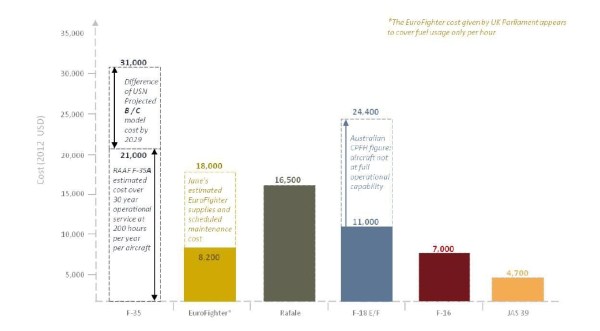
It has 11 pylons/stations, same as Gripen E, which is less than both Rafale and Su35.Price in purchase is slightly lower than Rafale, but it has higher TCO.
And it is interesting that you have information, that is classified, about how good sensors are. What radarbands are the anennas listening to? What is the angular accuracy of the emission detection? Does it have real time sensor fusion between all aircraft in the formation? Does it have beamed datalinks? Does it have “guidance handoff”, meaning one jet can take over the guidance of any missile or precision bomb released by another jet in the formation? Does it have the best missiles (Meteor and Iris-T)?
Unless your answers are “VHF-Ka”, “<1%”, “yes” (with link 16 it is a definitive no), “yes” (but it hasnt), “yes” (but it hasn’t), “yes” (which it hasnt), then the Super Hornet in fact is not ahead of the competition in networking, or weapons. When it comes to the actual sensors the performance is classified so I wont bother going there.
Great, here we go yet again… those operating cost numbers have been debunked over and over again at this point. You can’t simply plug in numbers across different forces with different assumptions and expect to get a useful result.
As for the sensors, networking, etc… just do a little reading, please. I don’t have time for yet another Super Hornet versus the world debate. Do your homework and come back with an intelligent question.
hopsalotWell the how could the faster plane could win? But anyways it’s speed is still fast, but you didn’t mention that the Rafale has a same speed as the Rhino? Anyway speed doesn’t really matter anyway. You need speed when your trying to intercept a aircraft like a TU-95 plane which is the most intercepted aircraft no? But anyways why is it that the Super Hornet has this drag thing? why does it receive drag? Is it it’s heavy payload or it’s aerodynamic features?
There are multiple things that contribute to the Super Hornet’s drag. One obvious factor is the layout of its pylons as mentioned above. This again is something that would be alleviated in an air to air loadout if the Super Hornet eventually receives the conformal fuel tanks and weapons pod. In that configuration the wings would most likely be kept clean with the exception of a couple AIM-9Xs out on the wingtips.
Another factor is that the Super Hornet was designed as a naval fighter, and as such needed good very low speed handling. This is a major factor that lead to the Super Hornet’s relatively large, straight, wings and large control surfaces. Similarly the F-35C variant as received a larger wing and consequently suffers from increased drag.
A final factor is that naval fighters require a more robust structure, landing gear, arresting hook. The Super Hornet also received folding wings. All of these things add weight, and weight adds drag.
On an aviation forum it is easy to look at these features in a purely negative light but that would be like saying that a truck with big knobby tires and a high center of gravity is poorly designed… but you have to pay a price to get where the fight is. The Super Hornet makes concessions to gain the ability to operate from an aircraft carrier, which gives it flexibility in basing that few other aircraft enjoy.
hopsalotWhat do you mean a higher price it performs worse? A Super Hornet cost 60,000,000 dollars and how can it perform worse?
On messageboards most posters put a huge emphasis on perceived air to air performance and more or less assume that every jet is good at “other” missions.
When you read people saying some variation on “the Super Hornet is a poor performer” you know you are talking to someone that is concerned exclusively with a vision of air combat where the fastest plane always wins…
Don’t get me wrong, speed is an asset, but it is not the primary determinant of favorable outcomes.
The charts posted above are worth considering for a few reasons. First they illustrate how different spec sheet numbers can be from reality once you start loading a plane up.
With four air to air missiles and one drop tank the Super Hornet’s theoretical max speed of M1.8 drops to about M 1.5. (This is why many people misunderstand the F-35’s top speed of M 1.6. An F-35 with four air to air missiles and sufficient fuel to fly the same radius would have a max speed of M1.6, faster than the Super Hornet in this comparison.)
If you look at the original Hornet above, it has the same top speed as the Super Hornet, but its speed is limited to M1.2 because of all the tanks it needs to carry to achieve the specified range. (Again this is relevant when you start comparing aircraft like the Gripen to a Super Hornet. A Gripen can fly a long way if you put tanks on it, but these tanks are not without performance penalties.)
So finally returning to the subject of this whole thread, the proposed upgrades to the Super Hornet. If you imagine putting the conformal fuel tanks on the Super Hornet then it could fly farther with less drop tanks. In the above comparison it could go without the centerline tank, reducing its drag and increasing its speed. That would also free up the centerline station for a weapons pod, which would allow the Super Hornet to carry four AMRAAMs with less drag, which again would improve speed and range.
Summing it all up, the conformal tanks, weapons pod, and enhanced engines all work to improve the Super Hornet’s weakest area, its kinematic performance.(with some additional benefits in the way of reduced RCS) If all three upgrades were pursued then the Super Hornet would be substantially quicker and faster in an air to air configuration.
hopsalotUnfortunately there are very few things that the Super Hornet does equally good as the competition, and in most areas it performs worse at a higher price. The only good thing about the Super Hornet is the commonality with the old FA18 meaning you can use basically the same infrastructure.
You could hardly be more wrong. The Super Hornet is very inexpensive compared to other Western 4.5 generation fighters and matches or exceeds their performance in almost all areas. (Sensors, networking, weapons, carrying capacity, operating costs, etc)
The only real area where the Super Hornet is a relatively poor performer is in pure speed and acceleration.
hopsalothttp://www.guardian.co.uk/business/2012/jan/17/airbus-promises-600-new-uk-jobs
Gee, Korean sub-contractors. I guess that is somehow relevant…
hopsalotThings are done much faster in East Asia than in Europe. Half the time to do something = half the cost.
No they aren’t.
There are areas where East Asia is very competitive, but aerospace sure isn’t one of them.
hopsalotThis is incorrect.
Both Boeing and EADS offered to comply with all 53 out of 53 tech transfer/personnel assistance requests. Lockheed offered to comply with only 23 out of 53 and basically got an F in the offset category. This is why the DAPA threatened to disqualify both the Silent Eagle and the F-35 bids if both were offered on FMS terms as originally proposed by the US DoD. The Silent Eagle is offered on the DCS term and thus Boeing can bypass the US DoD and offer whatever the term it sees fit, pending the US congressional approval.
The issue with Boeing’s offer is not the scope of it(100% compliance); but getting the US congressional approval for said technologies.
Boeing is limited in what they can offer by what both the Pentagon and Congress are willing to allow, regardless of the type of sale. Even if they weren’t, they aren’t interested in adding a new competitor to the international fighter market.
That is the huge flaw in the whole Korean plan. They seem to think one of the existing companies in the market would be happy to create a new competitor for their next competition… Korea doesn’t have anything to offer that would be worth shooting yourself in the foot over.
hopsalotTo assess KF-X’s export potential, ADD sought advice last year from two consultants, IHS Jane’s and Strategic Defense Intelligence (SDI). IHS Jane’s believes that 220 to 676 KF-Xs could be exported to countries such as Indonesia, Turkey, Singapore, Israel, Egypt, Saudi Arabia, India and Finland if the aircraft is priced at $70-90 million per copy, presumably without spares or training. The consultancy estimates the price of the best-selling Lockheed Martin F-16 Block 50 at $70 million and the Boeing F/A-18E/F Super Hornet , Eurofighter Typhoon and Dassault Rafale at $83-132 million. SDI offers slightly lower KF-X sales estimates, while adding five Latin American countries as potential customers.
KIDA argues that KF-X’s accessible market is only about 500 units and that the consultancies have been unrealistic in their assumptions of the fighter’s potential market share. It sees the T-50 advanced trainer of Korea Aerospace Industries (KAI) as an example of a project justified by inflated sales estimates . The think tank says Teal Group, a U.S. consultancy commissioned by KAI, estimated sales of 800 T-50s in a market of 3,000 aircraft. Eight years after putting the T-50 on the market , KAI has so far taken only one order, for 16 aircraft for Indonesia. Jeon Young-hoon, the T-50’s former chief engineer, has also criticized the KF-X target price as unrealistically low, saying the fighter would have no cost advantage over the Super Hornet in materials, labor and overhead.
Those numbers sound awfully optimistic. Essentially they seem to think the KFX could sell more jets than the Rafale, Eurofighter, and Super Hornet have managed combined.
They also need the help of one of their competitors to do it…
hopsalotIf the Rokaf has confidence in a SMOOTH program for early 2020’s IOC then they are justified with a 4.5 gen fighter selection for the current program.
Of course this is how pretty much every new program starts. Cheap, fast, on time…
I guess my key question would be why would Korea think it could do it so much faster and cheaper than the Europeans? Sure they have the benefit of some newer technology because their program is starting so much later, but they are also inexperienced and handicapped by being forced to build their design around off the shelf engines and so forth.
Improving on the Eurofighter enough for it to be worth the effort will not be easy. Doing it on such a short timeline and with such a small production run planned does not increase the odds of success.
hopsalotThe IOC is 2021.
Give that they haven’t even picked a layout, engine, etc, there is zero chance it will achieve IOC in 2021.
Well, it is not really Eurofighter sized.
They are pretty darn close. Certainly close enough to put them in head to head competition from a size/weight/capability standpoint.
hopsalotYou’re funny, slowman. The Koreans looking for partners smells of dependency. Isn’t that a negative according to your own past posts?
So basically it looks like the Koreans are hoping to produce a 4.5 generation fighter sometime in the mid to late 2020s, that they then hope to eventually make a “silent” version of either through some kind of a pod or a minimal internal weapons bay.
If they want a twin-engined Eurofighter-sized 4th-generation fighter that can carry four missiles conformally… they should just buy some Eurofighters or SH Internationals (with the weapons pod).
hopsalotThough technically that is what they cost that country and that country’s bean counters will be concerned with this overall figure. They probably also add costs of upgrading legacy fighters to make up for F-35 delay.
It’s not attributable as a generic figure though.
Someone buying F-35s in 2025 will pay a lot less than someone buying F-35s in 2015.
In the end, for each country their concern is what they paid, not what some nebulous average figure is.
Of course the total cost is a valid consideration, but it is at a minimum extremely sloppy to claim that F-35s cost $190+ million each.
Any new purchase would include a wide range of associated equipment that will drive prices up, and he knows this, but of course it doesn’t suit his agenda so he pretends he doesn’t understand.
hopsalotIf you got something to tell me, tell it to my face..
If you just need a round of chat with Spudman about someone else, then use PM. That is what this feature is for.. I am not interested in reading what you think about me because I could not care less, especially concerning you. Neither are other posters on this forum.
Comprende, amigo?
To your internet face? Is that this one? :very_drunk:
Let me spell something fairly basic out for you. If you want people to take you seriously, don’t act like a goofball. If you want to operate in some fantasy world of your own creation that is your choice I suppose, but don’t expect the rest of us to join you there just because you prefer it to reality.
Several different people have taken the time to explain the very simple concepts you keep mixing up. At this point you can only be making the mistakes you are because you refuse to understand.
I understand this logic well, that is why you don’t see me using the $219mil figure for US domestic 2014 LRIP deliveries. As I have said repeatedly before, all I care about is the price my country is being charged. Nothing else… Currently we got a $194mil proposal on the table for each one of the planned birds – these are no LRIP prices even if the higher prices of the initial batches have certainly been accounted for.
Again, you clearly don’t understand even the basics. Your country is not buying jets for $194million each. That price includes a great deal of equipment in additional the the aircraft. What you are doing is dividing most of the costs of modernizing your air force by the number of jets you are buying and trying to claim that that is what they cost. You aren’t going to fool anyone with this lame routine.
I think the example with the car is not a very lucky one because the lion share of the price has been already accounted for. But let me use an example of a vibration measurement frontend – you can buy one for ca $120,000 (with say 32 channels)… This is your “Flyaway” cost.
etc etc
Any aircraft you might buy will require a great deal of associated equipment, facilities, simulators, etc. If you were interested in operating in the real world you could look at the costs associated with other recent contracts worldwide…
hopsalotVery true but even General Bogdan isn’t saying that F-35 price will be as low as $75m.
Furthermore the numbers are in mid-air right now, especially for international customers and are looking to be far lower than initially predicted.
Bogdan has said that prices will be ~$90 million in 2020 dollars. That isn’t that far off of $75million in 2012 dollars depending on assumptions about inflation.
Lt Gen Bogdan said by 2020 a JSF would cost about $US90 million per airplane in 2020 dollars.
hopsalotYou keep making the same mistake that most naysayers do… you are comparing APUC of the current LRIP to Flyaway of a later LRIP batch or more likely an MYB FRP batch.
He has been corrected on this over and over again, but he doesn’t appear to be interested in being accurate, he just wants to gripe and complain. Anything good about the F-35 is propaganda or lies. All bad news is understated. All good news is marketing. etc etc


 Sign In