 hopsalot
you two should get married…
He’s not my type…
hopsalotI am tired of repeating the same. I have stated before that I was not interested in US domestic figures as they do not apply to me or to any other user not ordering 2,400+ airframes and paying development, LRIP and other costs.
Current export proposals are between $180-200mil, not $125. If we account the projected price drop, then we are somewhere at $130-140mil – and that is only when LM indeed adjusts the export price accordingly – which I doubt.
You are wrong again. The price you keep quoting is not simply for F-35s. It includes a wide range of associated equipment, support, spares, etc etc.
This is really not that complicated. Take a look at what Australia is paying for Super Hornets. Take a look at what Switzerland is paying for Gripens. ($100 million+ each)
These contracts are never simply for jets. You should know that by now.
As for whether or not “LM indeed adjust the export price accordingly,” I already explained to you that F-35 program participants all pay the same price.
There is no intent in having an opinion.. You simply have one.. I have not purportedly decided to dislike the F-35, I simply don’t like it and I don’t want a single cent of my taxpayer money to be wasted on that design.
Well it clearly isn’t a product of much study… :rolleyes:
Again, no. These figures are just hypothetical and entirely not applicable to my situation. If my country ever decides to procure the F-35, then it will be a rather ridiculous amount of below 50 – thanks to the outright insane price tag of the aircraft. The price will be nowhere close to $90mil even if the production price was as much.
If your country is a F-35 program partner it will pay the same price for its aircraft as all the other partners, including the US. Your country will need to buy various associated equipment that will make the price look higher if you don’t understand what you are looking at and simply divide the total by the number of planes. :rolleyes:
I know exactly what I have said. And it fits the picture quite nicely. Lockheed has published the images of the 100th F-35 in late January and the 100th fuselage has been delivered to LM almost a month ago – given the current production rate I can assume that the fighter has already been built or is close to be completed.
You are wrong again. F-35s are currently being delivered at a rate of a little over 30 per year and there were 41 total f-35s delivered through the end of last year (including test aircraft).
Given the current production rate I think it is safe to assume the 100th F-35 hasn’t been delivered yet. :rolleyes:
This extreme focus on semantics lets me think that you are simply looking for an argument and this at all cost. Sadly for you, that won’t happen. First, your counterarguments are weak and second, I don’t give damn what you think.
An extreme focus on semantics? You claimed no modern fighter had ever seen its price drop during production. I proved you wrong with multiple examples.
You also claimed that were 100 F-35s completed already. I proved you wrong again.
Now you are claiming that “given the current production rate” that 100th F-35 should be done by now… :rolleyes: … guess what? You are wrong again.
These aren’t semantics. These aren’t opinions. They are facts.
If you can’t even get the most basic facts about the F-35’s production right then you should probably drop the attitude huh amigo?
Given the fact how desperately you want this to be true it almost hurts me to tell you that.. but you have not corrected me in any way. It is simple: I am talking A and you keep repeating your B noone wants to hear. No matter how hard you try to sell me your $80mil price quotes, I am not biting – not when my country gets price proposals for $190mil.
Repeating an error over and over again is foolish. The price you keep quoting is not just for airframes. Get it yet?
I am not desperately hoping anything is true. I don’t -need- to. I actually have some clue what is going on.
That is an extremely childish statement, to be honest. Of course, if an export buyer signed an order for 1,000 aircraft, the prices would be entirely different right in the contract, not only after the aircraft have been built. It is signed contracts which define the production lots and price tag, what else?
You do realize that the F-35s that are being delivered today are the product of contacts signed years ago right? The F-35s being delivered next year and the year after are already well into production… (remember that 100th F-35?) If a hypothetical buyer placed a huge order today, it wouldn’t do a thing to change the contracts that are already funding F-35s on the line.
It would eventually drive down prices of course, but it wouldn’t do a thing to change the price of an F-35 being delivered this year.
MRCA is an order for 126 aircraft with 64(?) options. That is a huge number, significantly more than RSAF numbers. This deal is among the last ones with three digit numbers – we will not see many of these in the future, anymore, not even for cheaper aircraft like FC-1 or Gripen.
Sure, it is a big contract, but it certainly isn’t the deal of the century.
It is not about continuing the program (which noone doubts, anyway) but about adjusting the projected numbers to economic reality. I personally expect at least one major cut in numbers, in few years.
Great, so you can’t even look up the most basic facts of the program but you have opinions about “economic reality.” Good to know we have you on the case. 😀
You again focus on a single goal of arguing at all cost. It won’t happen. Even after this little whining round of yours my views on the design stay solid.
Arguing at all cost? What cost have I suffered?
You are the one who has been proven wrong over and over and over again, and yet doesn’t have the maturity to admit their mistakes.
As for your views remaining “solid” … well lets just say that doesn’t speak well of your schooling given that your views were clearly based on a lot of bad information.
hopsalotThe DoD finally released their 2014 numbers today. Here is what I found.
1. Procurement
The F-35s are getting cheaper (barely) even though the numbers are the same as last years (19/6/4) for F-35-A/B/C.
Here is the breakdown (RED is where component was more expensive than previous year)
Some sites are reporting a 4% increase in procurement cost. This is unrelated to the Flyaway and is due to a new RCS verification facility, higher costs for Simulators, Post-SDD development costs, etc.
2. Upgrades
While the USAF has had upgrade costs in the budget for a year now, the USN has now joined in adding LRIP upgrade costs to the budget. They has also broke it down to a Block specific number. The 2B upgrade costs a few hundred thousand (software only) and the 3i upgrade (to include hardware Tech Refresh2) costs $4.6 million per F-35. Concurrency costs are not included in the above numbers.
http://www.saffm.hq.af.mil/budget/
http://www.finance.hq.navy.mil/fmb/14pres/BOOKS.htm
It is good to see prices continue to come down despite the low production numbers. It will be interesting to see how the next couple lots go as the design continues to stabilize.
hopsalotNope. You have misunderstood my assertion in the first place.. This quote of mine refered to the unprecedented pride drop estimated by Bogdan which you have connected to future increased production rates – which I disagree with.
I am not taking into account price drop from prototypes, pre-series and LRIP compared to series – it is automatically assumed that prototypes and early stage hand-made aircraft are much more expensive – I don’t see the point of highlighting this in media as some kind of advantage for the F-35.
You do realize that even if the F-35 were limited to the ~33% drop the F-18 achieved after exiting LRIP that would still bring it down to $80Million, right? (Current F-35A prices are about $125 million, and that was with a production batch of just 19 F-35As.)
I am not obliged to do research on the point you raise. If you want to persuade someone, do the effort by yourself… Or let me have my negative opinion on the F-35.
Oh it is quite clear you are intent on having a negative opinion of the F-35, but that doesn’t not entitle you to make the numerous flat out false statements that you have. As the saying goes, you are entitled to your own opinion, but not your own facts. Having a negative opinion, even if through ignorance, is your right. You should not be making up facts.
You’re obviously not reading what I write because I have addressed this price drop. Let me quote myself: Based on this data we could expect another price drop by some 30% and the program would reach the current price level back in roughly a decade.
If the F-35 dropped 30% from today’s prices that would bring it close to ~$80 million, Bogdan’s projection. Given that the F-35 is in the very early stages of production with only a few dozen aircraft of three different variants delivered that is conservative.
You are obviously not watching news. LM have received fuselage for the 100th F-35 a month ago. If it’s being assembled, then it already has been ordered, the production lots have been already set at least beyond the 100th aircraft and the price tag has been adjusted accordingly.
You are obviously trying to back out of your previous assertion without having the integrity to admit that you were wrong, again. Here is what you said:
The thing is that the F-35 program is no more at the very beginning of the curve – finally there have been more than 100 units built already.
The link you provided says quite clearly that the 100th F-35 was now on the production line, not “built already.” Even a child would understand the distinction between “built already” and “now starting assembly.”
Even when the 100th F-35 is delivered, it will bring total F-35A production run to under 50 examples, hardly well into manufacturing.
So once again, you are factually wrong and I have had to correct you.
I have already debunked this claim in my response above. For the current price tag ithe number of ORDERED aircraft is important, not actually delivered.
You have not debunked anything, simply tried to wiggle out of yet another false statement. Additionally, the numbered ordered is of course not what is important. If I ordered 1,000 aircraft tomorrow, what would that do to the price of the jets on the line today? Nothing… If it were that simple you would just see the government negotiate and place a giant multi-year order for its ~3,000 F-35s and get the final price starting tomorrow. 😀 Why didn’t they think of that… :rolleyes:
Not quite $30bil as part of it goes to upgrades of previously delivered F-15s. Anyway, what we got here are 84 newly built aircraft distributed to deliveries in 2015-2019 – that makes 16-17 airframes in a year. A far cry from the expected 100+100 for export you put in. Well, unless you expect that countries like Poland or Indonesia would top the Saudi defense expenditures 😉
Yes, that contract includes upgrades. My point was that while the Indian MMRCA deal is big, it is hardly the “deal of the century” that the Indian press likes to portray it as. The export orders for the F-35 are not from any one single buyer, but are spread across many likely customers.
Then you got a problem. The US deliveries are alpha and omega for the fate of the F-35. One major cut in MoD and the programme gets sick because export deals won’t hold it. You won’t find clients even for regular 50 export F-35s yearly, let alone 100, it is the US economy which will need to absorb the losses resulting from the mismanaged program.
Or do you think the domestic cuts won’t come?
OK, let us sit and wait. F-22 had three…
Domestic cuts haven’t come. Domestic cuts haven’t even been proposed, see Obama’s latest proposed budget if you want. Both political parties in the US wish to see the F-35 continue.
The F-22 was cut not because money wasn’t available, but because it simply wasn’t a high priority.
You have not corrected anything, only provided a different interpretation of what is to come. A far more pink colored one, IMHO. Your different opinion by no means debunks the expectations I have put in…
Amigo 🙂
I actually kind of feel bad for you at this point. I suspect on some level you realize you are making a fool of yourself, but instead of just admitting you were wrong like an adult you instead keep trying to find a way to re-define things and claim victory.
You said:
This has never happened in the modern history of jet aviation. Whatever claims might have been made and whatever numbers were quoted, the prices have steadily risen up, never down. Even with 5,000+ sellers like F-4 Phantom II.
Then when I proved that wrong you have tried to claim that your factually inaccurate statement excluded LRIP. Naturally that still leaves you wrong since the F-18 dropped another 33% after exiting LRIP, and most certainly did not “steadily rise up.”
You claimed:
The thing is that the F-35 program is no more at the very beginning of the curve – finally there have been more than 100 units built already.
Of course that is wrong as well. There have only been a few dozen F-35s delivered. Now you have tried to claim that “already built” includes any plane at some stage of production… :rolleyes: I am really looking forward to the next time Boeing or Airbus announces it has “already built” next year’s production run, and without even spending the money yet. :D:rolleyes:
hopsalotExactly why should I bother finding this information? I can assume that if you claimed something several times that you already bothered to check it before you did so.
:rolleyes:
You should have taken the time to find the information because if you had you never would have made your erroneous assertion in the first place:
This has never happened in the modern history of jet aviation. Whatever claims might have been made and whatever numbers were quoted, the prices have steadily risen up, never down. Even with 5,000+ sellers like F-4 Phantom II.
You were wrong, 100%. You could have done some very basic research before making things up, but you didn’t, and so I ended up doing it for you.
That study is indeed good. Should I assume that every dot represents one fiscal year, that means ca 1,250 units built in 19 years?
The graph does not quite tell us everything, the annual production rates represented by dots (very rough estimations) are roughly similar therefore we cannot really assess the price difference between two very different annual rates.. Anyway, what can we see – there is no significant price drop after the LRIP (roughly 50 units built, price drop from $110mil to ca $57mil) which is pretty much what I think will happen with the F-35, as well.
You are wrong again. The price fell from ~$60 million at 50 units to under $40 million per unit. I think most would consider a 33% drop “significant.” Production rates were also not steady. The production rate of the last 6 lots (which is when the price rose again) was substantially lower than in the lots preceding them.
See here:

The thing is that the F-35 program is no more at the very beginning of the curve – finally there have been more than 100 units built already. If we assume the LRIP lot is larger with the F-35 due to larger projected numbers (note that I say projected), then the F-35 program is somewhere at the end of the steep price drop – whatever price reduction potential was there, it has already been largely used up. Based on this data we could expect another price drop by some 30% and the program would reach the current price level back in roughly a decade. That means the export aircraft would cost $180mil in 2023 dollars in the best case when all things run smoothly, no cuts from MoD occur and there are orders to maintain the 200/year production rate – which I do not expect to happen given the economic reality..
You are wrong, again. As of December 2012 Lockheed Martin had delivered only 41 F-35s, including the 12 SDD aircraft. At that time there were only 29 actual production F-35s delivered. This number has climbed some in the first quarter of this year but I think we can agree Lockheed didn’t deliver 70 F-35s in 3 months. :rolleyes:
http://f-35.ca/wp-content/uploads/2012/12/F-35-Fast-Facts-December-11-2012.pdf
You are also wrong about where the F-35 is on its price curve of course. Given that it has in fact delivered only a few dozen planes, of three different versions no less… it is very early in the production learning curve.
I see that as a greatest weakness of the design – that its infrastructure is bloated beyond recognition to support annual production rates it will most likely never see. Whatever price we can assume now ($120-180mil), IMHO the fighter market just isn’t ready to absorb jets of a single type worth $24-36bn yearly – this all in times where we call the $11bn Indian MRCA as the deal of the century.
The “deal of the century” moniker is a product of the Indian press corps… The Saudi F-15 deal was $30 billion.
12/30/2011 – WASHINGTON (AFNS) — Air Force officials announced the next chapter in a partnership with the Royal Saudi Air Force as the Kingdom of Saudi Arabia recently signed a $29.4 billion Foreign Military Sales Letter of Offer and Acceptance solidifying their plans to purchase 84 F-15SA fighter aircraft and upgrade their current fleet of 70 F-15S aircraft to the SA configuration.
http://www.af.mil/news/story.asp?id=123284840
As for what the fighter market can absorb, the US alone plans to purchase in excess of 100 F-35s per year on a long-term basis, essentially one Indian MMRCA contest per year. The F-35 program is structured to deliver a lot of jets because that is how many jets are needed.
As already said, the F-35 is no more at the beginning of the learning curve. Agreed the design is remarkably non-complete given the number of already complete airframes but you gotta
As already said, you are wrong.
Need some time to read this through.. But the question remains – who is gonna buy those 200+ production lots?
The US will account for the large majority of the orders.
Thanks a bunch for the data, anyway.
I have provided you with a lot more than data. I have corrected numerous errors on your part and with more courtesy than you have shown me.
hopsalotDe-coupling of flight critical system was made specifically to make
new integration cheaper & easier, and since SAAB also and unlike LM provide source code,
customers are free to integrate on their own
http://www.saabgroup.com/Global/Documents%20and%20Images/About%20Saab/Events/Farnborough%202012/Gripen%20presentation%20Farnborough.pdf
page 16
That really doesn’t do anything to address what I said. If you only have a fleet of a couple dozen exotic aircraft every time you want something new you are going to have to invest millions to develop the capability, even if you could hypothetically do it yourself.
If Switzerland bought Eurofighters or any other better established design they could take advantage of money spent by other operators.
Every new weapon, new targeting pod, new block of software or fixes to fatigue related issues over the life of the aircraft, every new bit of programming for the EW system… all of that has to be paid for by someone.
hopsalotYou still havent understood it. The development is already funded, the Swedish acquisition is accepted but with funds uncommited (thats a different thing btw). (The government is allowed to reconsider the buy of 60 jets but has payed for the R&D).
The Swiss have accepted the offer, only undecided part is the funding. But politically its a done deal. It’s Gripen or nothing and there will be something so Gripen it is. Getting the cheap early Eurofighters would be a foolish mistake that only Austrians could think of doing (and spend their days regretting it).
…and yet negotiations are on hold. The Gripen makes a lot of sense, but you have to remember that the savings of going with used Eurofighters would cover a lot of operations and the long-term roadmap of the Eurofighter is much more secure than that of the Gripen.
Here is what you don’t seem to get. Even if the Gripen NG actually materializes, it is still in a precarious position with only two backers, neither of which has deep pockets. The Eurofighter has a far larger base of users and will certainly receive more future upgrades over its life than the Gripen.
If you want to go to history, check out how SAAB has delivered on their promises. Did they or did they not deliver the Gripen system on time, with higher than agreed performance at a lower cost than agreed? There are a few arms manufacturers that actually can deliver and SAAB is one of them, General Dynamics and Lockmart are not.
This isn’t about whether or not Saab delivered the original Gripen on time. This is about whether or not buying Gripen NG is a smart decision long term for Switzerland.
hopsalotIt is difficult to imagine that Holland will pick a different jet.
As demonstrated in a previous posting, a SH package will most likely be only marginally cheaper.
Gripen NG will be somewhat cheaper, but even a complete Gripen NG package does not come cheaply (3.3 billion USD for 22 Gripen E to Switzerland). Also, as a close US ally and NATO country the threshold for buying non-US fighters is VERY high.
Thus if they really want to save money they should buy new F-16 instead — then they can keep existing infrastructure. They would save a lot of money that way.
Otherwise, I don’t see an alternative to the F-35. Since it seems F-16 is not on the table, most likely the F-35 will “win” this “competition” just like it “won” in Norway and will “win” in Canada.
Perhaps the politicians don’t realize this yet but once the air force and the MoD explain all this to them, the outcome is a given.
Another serious issue is that the entire Gripen NG program is still in doubt. The Gripen NG’s development is dependent on one single less than fully committed buyer. If the Swiss opt for used Eurofighters the Gripen NG may never be developed.
Even if the Gripen NG is ultimately developed its long term prospects just aren’t that good. Who will fund the next round of Gripen NG upgrades in 10-15 years? Who will pay to integrate new weapons onto the Gripen NG in the 2030s?
These are serious questions for a potential buyer of a new fighter. Once you have picked a jet you are stuck with it for decades. Even if it is current when delivered it won’t stay that way. If you buy a design that currently has an order book of <100 total jets spread across two buyers you risk operating white elephant fleet. (For a perfect example look at the Australian F-111s after the US retired its own.)
hopsalotThe number of “early” aircraft i.e. LRIP wouldn’t be much less if lesser at all in comparison to the early variants of the Rafale. You compare projected total numbers of the F-35 with delivered numbers of the Rafale which is flawed. You need to take into account the number of aircraft delivered in pre-default configuration vs projected or actual total numbers. (Projected numbers are subject to change)
No, it isn’t a completely fair comparison.
Both Rafale and Typhoon programs took a concurrent approach like the F-35 program, but the extend of overlapping is different. Early Rafales and Typhoons were always meant to be upgraded to the “final” configuration reflecting the agreed configuration as laid out in the weapon system performance specification. In case of the Rafale it’s F3, in case of the Typhoon it’s block 5 and in case of the F-35 it’s block 3. Actually not much of a difference at all.
That was my point, that all three embraced concurrency to one extent or another. The F-35 program was built around concurrency to a greater extent than the Eurofighter or Rafale, but all three had some concurrency.
In the F-35’s case the money and upgrade roadmap to bring early production F-35s up to the full production standard is built into the program. This was not the case for the Rafale, though the upgrades are now being carried out.
As far as the Super Hornet is concerned I agree, but I beg to differ on one point, the SH wasn’t a clean sheet design. It greatly benefited from the legacy Hornet with the initial F/A-18E/F block I sharing 90% avionics commonality and avionics account for most of the delays and costs of modern military aircraft programs.
True, an approach that has proven brilliant and that I hope to see repeated in the future. By making the Super Hornet an airframe/engine program reusing existing avionics, and then subsequently upgrading the avionics to a state of the art level Boeing was able to limit complexity and interdependency.
It seems increasingly likely that the Super Hornet will receive a substantial portion of the upgrades first advertised for the Super Hornet International roadmap given the reports that the conformal fuel tanks and weapons pod are going into testing this summer and with the US Navy’s continued interest in the enhanced engines.
Assuming the upgrades come to pass the Navy will have a really outstanding example of what can be achieved with a 4th generation airframe.
hopsalotNo, I will not look at the F-35. Let me make it clear for you one more time:
– in my post #88 I have stated that the widely used claims about how the F-35 would become cheaper with rising numbers had no substance because such price decrease has never happened in the modern history of jet aviation, not even with sellers like F-4 Phantom II.
– in your post #90 you have dismissed this opinion as untrue because, according to you, prices have frequently fallen as production has ramped up
– in my post #106 I have asked for some examples from the histotry to support this claim of yours
– your respoinse #108 has stated – Sure, look at the F-35Once again, I will not look at any F-35. If the history indeed shows frequent occurrence of such price decrease with rising orders, then I think it should not be a problem to provide two-three examples from the past… to show that you indeed know how pricing works (in contrary to me, as you have put in in your post #83).
Your input is greatly appreciated..
Let me start by saying that I suspect this will prove a waste of my time, but I will try giving you the information you can’t be bothered to find yourself, and some context on top of that…
First let me say that you are simply flat wrong when you say:
in my post #88 I have stated that the widely used claims about how the F-35 would become cheaper with rising numbers had no substance because such price decrease has never happened in the modern history of jet aviation, not even with sellers like F-4 Phantom II.
Here is an excellent case study of the F-18:

http://www.ranum.com/editorials/must-read/spinney/spinney_testimony.htm
In this chart what you are seeing are unit costs of F-18s charted against the production quantity produced to date. The circles indicate production years, also graphed against units produced. Where the circles are far apart (on the X-axis), the production rate was high, conversely where they are close together the production rate was low. The solid lines are estimated costs at different points in the program.
As you can see clearly from the graph, the price of the Hornet most certainly did fall as more units were produced, until the very end of the program when production rates were cut sharply, driving up prices.
There are several concepts at play here.
1. Production learning curve: Essentially as something is manufactured you tend to get better at producing it, and prices fall. This is typically expressed as a function of total units produced to date, as in the chart above.
2. Economies of scale: When producing something you will typically gain efficiencies as the pace of production increases. Simply put, with a higher production rate all participants in the supply chain have a greater incentive to search for and invest in greater efficiencies… but there is a catch. (Point 3)
3. Optimal production rate: When a production program is established it is done so with a production rate in mind, this drives fixed costs such as factory floor space, tooling, etc. While greater production rates typically result in improved efficiency, pushing a production rate above the optimal production rate can increase prices. (think war time production)
Running a production line beneath its optimal production rate is the more common problem. The Rafale is currently in production at a rate of ~11 per year, the minimal economic rate. I believe Dassault is on the record saying that that rate could be doubled before additional capital investment would be necessary.
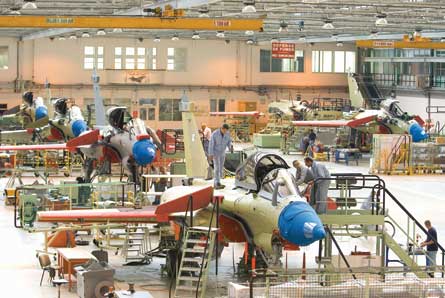
Rafale production line
The F-35 program in contrast is intended to support production rates of greater than 200 aircraft per year. This means that the investment in physical infrastructure, tooling, etc are vastly greater. This infrastructure is also greatly increased by the fact that the three versions of the F-35 are really closer to cousins than identical twins. Structurally there are substantial differences between the three versions, necessitating far more tooling than would be the case if only a single design were being built.

F-35 commonality

F-35 production line- full line is ~1600 meters long
So tying this all together… The F-35 is early in its production and has not yet gained the benefit of the learning curve, nor economies of scale, nor achieved its optimal production rate. This is exacerbated by ongoing design changes due to continuing testing and development and the fact that the F-35 is three similar planes, not one plane.
F-35 production costs will fall as more units are produced, and as the production rate ramps up. Costs will also fall as the design stabilizes. (Evidence of this is already being seen, as per the latest GAO report.)
Returning now to the costs of other aircraft as production has been ongoing you can find prices for the F-15, F-16, and F-18 in the Appendix G of this report:
http://www.dtic.mil/cgi-bin/GetTRDoc?AD=ADA518995
You will see in each case that production costs fell dramatically over time but the rate at which costs fell was dictated largely by the production rate. The F-16 achieved efficient production far more quickly than the F-15 or F-18 because its early production lots were huge, 200+ aircraft.
I hope this helps dispel your misconceptions.
It seems to me that you still have not understood that US are not my primary area of interest. I certainly could not care less about the fact that the 1,000th F-35 might come down to $120mil after US have paid $200-300mil a pop for prototypes and LRIP and $150-180mil for first ten batches. These prices are in no way representative for my situation and cannot be compared to any other customer.
Let me repeat this once again: all I care about is what a country like mine has to pay if it wants to reequip its air force with F-35s. And all I see is a price tag exceeding $180mil per single aircraft. What do I care what USMC will pay for their batches of F-35B in 2025?
As was already explained you/your government will not be paying $180 million per aircraft. Those costs include many other things besides the aircraft itself. Just look at what Australia paid for Super Hornets, etc etc.
Hypothetically you could wait until later to buy cheaper F-35s. Certainly that appears to be a popular option.
The current plan is to start a rapid production ramp after next year. Assuming that happens prices will fall dramatically.
My theories describe exactly how these contracts work.. I’m no rookie in this area and know how cookie crumbles. LM is no way obliged to minimize their profit on export orders just because they may be limited in profit margins in domestic sales.
As a member of the F-35 consortium I believe your government will pay the same price as any other buyer in the same production lot. So actually yes, LM is obligated to hit essentially the same profit margin for you as the US Government, though there is some room to maneuver outside of the hardware itself.
This is how true business works, amigo. And we are talking about activities where the upper case contract barely touch a million EUR threshold. Of course, I have no doubts that when it comes to dozens of billions in case of the F-35 where every fraction of per cent makes a huge stockpile of cash, the mankind will have suddenly civilized itself by working with true 3% margins. Right.. :rolleyes:
I hate to say it, but you are clearly in no position to lecture me. Amigo :rolleyes:
But feel free to continue, I am having quite a bit of fun reading your theories.. I only wonder how much of that you really believe…
I look forward to your well thought out response…
I doubt you will make much use of the information I have provided you, but I hope someone here will.
hopsalotSame wasn’t true for the 48 batch 2 Rafales or the T1 Typhoons pre block as you were talking about European designs. And retrofits for the F-35 might be budgeted for block 3, but not beyond and one of the reasons for reducing LRIP quantities was to avoid costly retrofits for fixing bugs arising from premature production. And in contrast to LM European companies deliver aircraft at relatively stable prices and they did so from the very beginning, even while they had to cope with much smaller orders and production rates that are evena far cry from F-35 LRIP build rates. LM needs to build a few hundred jets first, then several dozen a year to “guarantee” a halfway stable and lower price. If LM had to work with funds and projected numbers that European manufacturers have to work with the F-35 program would be long dead. So much about apples and apples.
Yes, the Europeans produced fewer early production aircraft, but they are much smaller programs in general as well. The 10 Rafales subject to upgrade are something like 10% of the total Rafale production so far.
When you consider that the F-35 program is structured to deliver far greater numbers of aircraft its early production models are not a huge percentage of the total. Additionally, these aircraft were always intended to be upgraded to the full standard. This is a planned part of the program, always was.
As for them only being funded for upgrade to Block III, that is the full production standard. No aircraft design ever stands completely still and the F-35 is no exception. Block III is where they chose to draw the line. I expect eventually they will receive further upgrades, as will all other F-35s.
As for the F-35 being a more expensive program than the European designs… it is. It is also a far more technologically ambitious program of far greater scale. If the US set out to produce a 4th generation fighter in the 90s we know what that program would look like, the Super Hornet, and it came in on time and budget and the Navy is thrilled with its performance.
hopsalotactually the integral rocket-ramjet propulsion technology is much older than that. The 2K12 KUB (SA-6 “Gainful”) SAM was powered by integral rocket-ramjet, and it became operational in 1968.
From Wikipedia – “Top missile speed is approx. Mach 2.8. The combined propulsion system 9D16K included solid fuel rocket motor which, when burned out, forms the combustion chamber for a ramjet in a pioneering design putting this missile far ahead of its contemporaries in terms of propulsion.“
I didn’t say that was the first ever test of a ducted rocket, just that one was being tested for the AMRAAM 15 years ago…
hopsalotCompletely different situation : Rafale F1 were a stop gap solution for ageing crusaders. And they are only ten.
:p
No, it is the exact same situation, only without the upgrade of the early jets built into the program from the start.
It is the nature of fighter programs that it is very difficult to deliver the first aircraft at the same standard as the full production ones. France could have decided to wait until the design was more stable, but instead decided it made more sense to proceed with production. Consequently, the early Rafales were delivered with limited capabilities, and a bunch of what turned out to be obsolescent equipment.
This is the exact same thing that people on this board complain about endlessly with regard to the F-35, the difference with the F-35 is that the necessary upgrades are planned and funded from the start, with Lockheed picking up a portion of the cost.
hopsalotAnd you are aware of the contractual agreements of the European programs? Doubtful! And for someone criticising people for “not knowing about costs” you are surprisingly clueless. Comparing apples with oranges and call it apples with apples.
lol
January 19, 2012
A very good news from LeMamouth : The retrofit process of the 10 first Rafale M has begun at the SIAe (Industrial Aeronautic Service) facilities near Clermont- Ferrand.The Rafale M1 to M10 were delivered between 2000 and 2002 at the early F1 standard with limited capabilities (Mica EM and, Magic 2 missiles for Air defense and buddy-buddy refueling pod)
They were put in storage in 2008 waiting for their retrofit to be funded (€300 millions agreed in 2009). The first aircraft to be upgraded will be the M10. Each retrofit is expected to last 18 months. The final integration work will take place in Bordeaux-Merignac where the airframes will directly be inserted in the Rafale assembly line.
The delivery schedule is the following :
2014 : 2 aircrafts
2015 : 3 aircrafts
2016 : 4 aircrafts
2017 : Rafale M1 (which is currently used as a test bench for carrier trials).
http://rafalenews.blogspot.com/2012/01/new-life-for-rafale-m-f1.html
There you have it, 10 early model Rafale’s were stuck in storage waiting for money to bring them up to current production standard. The money was eventually found, but it was not built into the program as it is for the F-35. (Which as has already been explained in this thread has money built into the budget to upgrade early F-35s, and costs will be split between Lockheed and the Pentagon.)
Think about it, these planes were delivered as late as 2002, flew for only 6 years before being mothballed, and here we are in 2013 and it will still be years before the last of the early production Rafales will be brought up to standard. (Literally 17 years after it was delivered…)
Here are some nice pictures showing the extent of work being done:
http://www.meretmarine.com/fr/content/la-renovation-des-rafale-f1-commence


Clear enough for you? :confused:
hopsalot🙂
Some examples surely wouldn’t hurt.. Care to provide? 🙂
Sure, look at the F-35. :rolleyes: Prices are already down dramatically…
Yes, it will result in cost savings, but unless you grab LM by the balls and squeeze tight, the savings will not flow in price decrease rather than maximizing of profit.
Clearly you have no idea how procurement contracts work in the US. Lockheed is strictly audited by government auditors and can not simply increase its profit margin.
Think logically… If the sales of F-35 go into thousands as advertised even with the price tag of $180mil, then what exactly should motivate Lockheed to cut the price down? Why would they adapt the price to sinking production cost per unit if they can sell for more?
Yes, think logically. I propose you might read the basics of how these contracts work, and only then try to come up with your own theories.
The US system is hardly without flaws, but contractors are not free to simply charge whatever they want and maximize their profit as profit margins are set as part of the contract itself.
Lockheed is also barred by law from exporting F-35’s for less than it sells them to the Pentagon.


 Sign In








