 hopsalot
Guys you just need to replace ‘SPECTRA’ in your discussion with ‘ALR-94’ and then hopsalot will espouse of his own accord how ESM can generate firing solutions on dozens of Sukhois simultaneously. :p
Lets try to keep this discussion above the highschool level shall we?
The same fundamental facts apply to the F-35’s EW system, with the big change being that the F-35’s LO airframe will dramatically reduce the range of its adversary’s radars.
The F-35 will most certainly still use its radar in combat, though again, it will do so judiciously and in cooperation with the other F-35s in the area.
hopsalotYou’re still failing to understand why RWR/EW antennas are so small compared to radar ones. Sensitivity is one thing, but the signal to be picked up is another thing and yet a significant one.
I more than understand the subject. 😉
You are approaching things completely backwards.
You start by assuming that the Rafale must win the comparison. Then you conclude that the RWRs on the Rafale must be sensitive enough to out-detect the Su-35. Then from that you can obviously conclude that they are big enough. :rolleyes:
In the real world of course there is no rule that the Rafale must win every comparison.
The size of the RWRs on the Rafale is limited by many factors. Bigger would be better, but you can only accommodate sensors of a certain size without completely wrecking the aircraft’s other performance requirements.
The same is true of radars. Every pilot would prefer a bigger, more powerful, and more sensitive radar… but you have to find a place for it on the jet. That is why the Rafale has the smallest radar of its competitors, other requirements forced it to accept a small radar.
Returning to the question at hand… the Su-35’s ~1meter diameter radar has an incredible sensitivity advantage over the Rafale’s several centimeter detectors. Without exact data we can’t run the numbers, but it is quite possible that the Su-35 will actually have the detection range advantage.
Even if it doesn’t out-detect the Rafale, the Su-35 and his wingmen will certainly have far more complete and accurate information than the Rafale.
Again, the way people on the internet talk you would think that radars are some kind of secondary sensor that somehow give away more than they reveal. That is absolutely backwards. A powerful radar is a huge asset to a fighter and radars will remain the primary sensor used by fighters for the foreseeable future.
hopsalotIn contrast to F-35 where production rates are being reduced whilst planned orders remain static, implying an elongation of production timeline to the extent that we can expect the first airframes to be retiring before the last roll off the line. :p
This reduction in total Rafale numbers for AdA is precisely the sort of ‘engagement with reality’ that is nowhere to be found in the F-35 program — where Australia is still ordering ‘up to 100’ JSFs, US still 2500, etc. —
The F-35 production ramp has been slowed by a couple years. The real ramp-up will begin soon. Even its current production rate is >3x the Rafale’s.
What you don’t seem to understand is that the Rafale has already been cut back to its absolute minimum possible production rate and now they are cutting 20% of its total orders.
Meanwhile, despite all the talk of gloom and doom, the F-35 has far more orders than are necessary for efficient production for many years into the future.
and is yet another example of the contrast between the responsibly managed program that is Rafale and the complete debacle that is JSF.
:rolleyes:
This “responsibly managed” program’s entire future now rests on one single export client… and in fact is already well into the dreaded death spiral.
Orders have been cut to pay for upgrades, production rates have been cut far below economical levels, and total orders are being cut because it is unaffordable. If that isn’t a death spiral nothing is.
hopsalotYes it does. So can the EW suites installed on the F/A-18G, F-22 & F-35.
There is nothing magical here, passive geolocation has been a subject of intensive research in the last two decades.
What it does require is very accurate interferometer arrays. Without them the error on the tracks generated quickly goes up to +/- 50%, i.e. it’s garbage.
With <1° accuracy, you can go down to <10% error, enough for a low pk shoot (not that it makes sense to take such shot, in most scenarios if yuo’re going to reveal yourself, you ight as well use your radar for a split second).
The way the internet crowd talks about EW systems/RWRs you would think they are little radars themselves, they aren’t.
Again, this is a case of someone who has some “facts” but struggles to put them in context. You can passively locate emitters, but the accuracy and reliability of the track is heavily dependent on number of factors, including range, the relative motion of the emitters and the type of the emitter.
Geolocating a ground radar is fairly straight-forward. Getting a reliable track on an aircraft flying straight and level is harder, but possible with reduced accuracy.
Tracking a maneuvering fighter, emitting only intermittently, and doing it at a useful range… that is a completely different matter.
Radars are going to remain a fighter’s primary sensor for a long time to come.
The radar emits a power P, the waves travel a distance D, are reflected, travel D again and are heard by a receiver with a sensitivity S.
Generally speaking, there is not a big difference between the radar sensitivity and a RWR sensitivity so if the radar can capture a signal that has travelled a distance equal to 2*D, so can a RWR hence the rule of thumb that a RWR can listen to signals at twice the radar range.
😮 😀
Of course not.
Take a look at these two and tell me there isn’t a big difference:

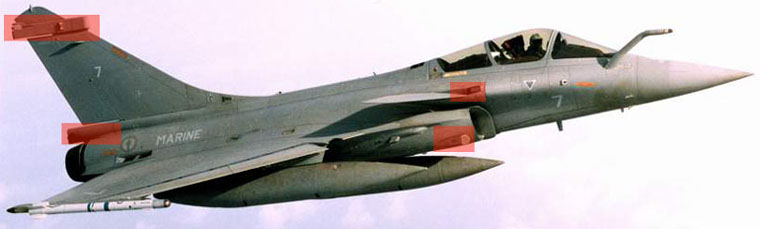
Similar sensitivity? :rolleyes:
I understand how the math works, but that isn’t how it works in the real world. In the real world the radar is far more sensitive than the RWR, often sufficiently so that the radar can track its target before the RWR can detect the radar.
hopsalotModerm EW suites can give good range estimation (good enough to compute BVR firing solution) and also share data through data link to consolidate passive tracks.
What is extremly simplistic is ignoring the fact that a EW system will detect your radar emission 2 times further away than your radar effective range, so you’d better use it with caution, especially when your RCS is something like 20 times higher than your oponent’s.
:rolleyes:
It will never cease to amaze me how far people will go to convince themselves of something they want to believe.
hopsalotThe Japan’s 42 F-35’s are to cost 7-8 Billion dollars
… that cost is inflated because Japan wants to assemble their own.
hopsalota death spiral is what the F-35 should have experienced already: costs rising delays increasing, reduction in numbers of planned orders, new costs increases, until the program gets cancelled…
Should have? The key thing here is that it hasn’t. For all of the talk, and despite the poor world economy the total number of orders has stayed remarkably stable.
the rafale has been in production for some time, has a customer that wants it besides the french government, plus some other prospects… you can’t talk about “death” as the program is running.
A customer that wants it? Like Brazil? Like Morocco?
I think India will ultimately place its order, but as of today it hasn’t.
I see India as similar to several of the F-35’s likely buyers. It is clear they want the plane, but nobody can rest easy until a firm order has been placed.
As of right now any reduction in Rafale orders is a danger to the program.
besides, the present government can envision to cap orders now, but as governments change every five years here (next presidention election in 2017, when the rafales will still be produced), nothing prevents the next one to buy more airframes if the economy allows or if they shift their priorities
Sure, it could happen. I wouldn’t bet any of my personal money on it though.
hopsalot@ hopsalot
your radar gives you away… no way you go around that… once your opponent knows where you are (no need for a pin point location, a bearing is enough at that time) he can maneuver to get out of your way while scanning in your direction with more passive ways. it’s not specific to the rafale… it’s about pilot training and applying the right tactics to get closer
Again, this is extremely simplistic. The Rafale may know that a Su-35 is out there and radiating, and their general bearing, but the Su-35 meanwhile will be able to see -all- the Rafales within its detection range, as well as their precise location, headings, speed, altitude, etc. That data will also be datalinked to other Su-35s, etc in the area.
A good RWR system is an important situational awareness tool for a fighter, but only an extremely foolish pilot would try to rely on one to maneuver against an opponent in the way you describe. Any way you slice it a big powerful radar is an advantage for a fighter. You always have to use it judiciously, but it is an advantage.
Edit: besides, the Rafale has been made to last until at least 2035-2040, if it was already obsolete compared to an aircraft in production today and derived from a 1970’s design, there would be some serious problems @ Dassault right now… to me, it is clear that Indian pilots can be confident about their new aircraft
It all depends how you mean “last.” There are still F-4s, F-5s, and A-4s flying around today…
A Rafale in the 2035-2040 timeframe will no longer be suitable for frontline service. It may still be a useful asset, but it won’t be competitive with the 5th generation fighters that will be prevalent by then.
That said, I think that if India goes ahead with their purchase their pilots will have every reason for confidence in their new fighters. The Rafale is a good aircraft and will be a massive upgrade over what it is replacing.
hopsalotNot good news. Don’t know about a death spiral though. If India orders there will be a nett rise in numbers to produce albeit less to be assembled by Dassault. Unless the process of placing an order takes such a long time that India opts to take more than the projected 18 Dassault-assembled Rafales.
Certainly if the India deal comes through it would be a big boost, but like you already said, only 18 of those are likely to be produced in France.
This could raise long term viability questions for the Rafale… you can only shrink/slow things so much before they just don’t make economic sense anymore.
The EF approach certainly wasn’t ideal, but at least it guaranteed a critical mass of orders.
hopsalotSome seriously bad news for the Rafale if true:
France May Cap Purchases of Rafale Combat Jets -Report
03/22/2013| 01:34pm US/EasternThe French government is considering limiting its purchases of Rafale multi-role combat aircraft, made by Dassault Aviation SA (>> DASSAULT AVIATION), to 225 from the 286 planned over the life of the program, according to a report Friday on financial information website latribune.fr.
Such a move would be part of a general effort by the government to scale back public spending in the coming years, the website reported, without citing sources.
The report said the government hasn’t yet decided on the exact number of aircraft it will purchase.
…
Dassault is manufacturing Rafale planes at a rate of 11 a month, a pace that Dassault Chief Executive Eric Trappier said recently is the bare minimum that is sustainable for the program’s supply chain.
A 20% order cut from a program already operating at its minimum sustainable production rate.
Naturally since this isn’t the F-35 we won’t hear anyone talking about a death spiral, etc etc… :rolleyes:
hopsalotSPECTRA will not be able to pin-point the Su-35 position, it will tell its being radiated from a certain sector, +200km away is quite the distance you know.
Don’t buy into all those adv.. there is nothing magical about SPECTRA. A Radar in general is much more suited for this purpose you know..
Indeed, this whole line of reasoning is pretty silly.
Turning on your radar may indeed alert enemy fighters to your presence, but the idea that they are automatically going to learn more about you than you would about them doesn’t pass the common sense test…
hopsalotthey know it as well, but, as they try to sell it, as any vendor, they claim it’s the best thing out there since the sliced bread.. it’s called “publicity” 😉
Right right, as usual if something doesn’t fit into your limited understanding… well then it is obviously all lies. :rolleyes:
We all know that Israel doesn’t know a thing about designing missiles.
Neither does Lockheed.
It is all just marketing. 😎
hopsalotOh I hit a nerve. Bless you! Do your own research if you want. I posted snippets on this forum a few months ago, fortunately I’ve got better things to do than dig around for the same pieces and post them again, so feel free to search through the 1,700+ posts.
Ta!
I read somewhere that the EF can’t fire air to air weapons while inverted.
I would provide a source but I can’t be bothered. Why don’t you do it for me? 😉
If you are going to make an assertion, you should be prepared to provide some credible backing for it. It isn’t my job to go hunting for some article you think you remember.
hopsalotCUDA is LM concept that has no funding, and which pentagon showed no interest in…
besides, a missile that can only do damage by hitting physically a target is simply a bad idea… already, the missiles that destroy their targets by passing by (proximity fuse) have a very low pk, now imagine if they had to…
to make a parallel with air combat simulations which some here may be familiar with, it would be like being unable to shoot down more than 1 aircraft out of 5 in CFS 1 with the huge hit bubble that is used in it, and then claim to be a killer in IL-2 which had, basically, no hit bubble at all… given a quantum leap in precision that such improvement would need, it is pure nonsense
I guess you know better than Lockheed Martin and Rafael…
:p
hopsalotWell, the report stated that the F-16s managed to get in the merge ‘and’ kill the F-22s in WVR.
:rolleyes:
I simply love these sorts of posts. I think I remember reading somewhere that XYZ happened once…
First off, Red Flag is not some kind of aerial duel for bragging rights. Pilots participating at Red Flag fly against aggressors, trained to simulate enemy tactics and technology. Who do you think the aggressors were? The Poles? Or do you think perhaps the F-22s were spending their time simulating an enemy?
Far more likely, if indeed any part of your remembered article is accurate, is that while at Red Flag the Poles may have had an opportunity to practice BFM against F-22s. There again, the job is typically to achieve training objectives, not simply to “win.” It is certainly possible that an F-16 could defeat an F-22 in a neutral WVR fight, but it isn’t particularly likely, and doesn’t say anything useful about how the two would perform in a real world fight where the F-22 would almost always enter any potential WVR fight with huge advantages.


 Sign In







