hopsalot
Failed or not, it was still combat tested, proven to be ineffective vs fighters
The Iranians claimed quite a few kills against the Iraqis, but then the Iranians do tend to lie a lot… (with their recent stealth fighter being just the latest example)
Nonetheless, I believe most accept that the Iranians scored some kills with the AIM-54.
hopsalotwhat is the range? hopefully it will come to fruition soon
Nothing has been announced yet, but the brochure says “expanded BVR engagement zones.”
Naturally Cuda will be treated with a completely different level of skepticism from any Russian or Chinese design…
hopsalotSo you are not disputing my assumptions, only my conclusions?
No, both.
1 The radar performance (distance) for the Captor C is at N011M-level or 30% higher.
Based on what? Under what circumstances? Radar performance is like anything else… marketing data is awfully hard to use to build an accurate picture of what is going on.
2 In order to not need to go closer than 20 nm in BVR they need to engage the target (firing missiles) at a slightly longer distance.
Several big assumptions there.
As I said before, while that quote isn’t completely clear the impression I got is that the EF pilot was talking about the F-22 never allowing the two get closer than 20NM… that doesn’t say that the EF pilot was engaging or even detecting the F-22 at that range.(The EF pilot did say the F-22’s advantage was “overwhelming.”)
Even if he were detecting the F-22 at that type of range, he certainly doesn’t say with what. (IRST, radar, potentially something off-board, he never says. It could be he never found out how close the F-22s let him get until the debrief…)
Even if he were talking about detecting an F-22 at that range with his radar, we don’t know whether the F-22 was using an RCS enhancer and/or wing tanks, as it almost certainly was. (Standard procedure when exercising with foreigners.)
3 To engage in BVR you need to be able to track the target, if you dont have IRST/FLIR then most likely by radar.
First off, he never said he was able to engage F-22s at BVR. And again, according to at least one source they brought a Typhoon with an IRST.
Finally, it isn’t clear whether the F-22 was using an RCS enhancer.
4 The minimum frontal RCS is different from the general frontal aspect RCS. In the case of the F22 the general frontal RCS is closer to 0,01 than 0,001 aqm. If this is the other way around then the Luftwaffe Eurofighters didnt use their radar but got the lock on by some other means.
5 Assuming the other statements are true we get the range figures I have submitted when the enemy is using Irbis E.
For all we know the F-22s were flying with wing tanks… again, lots of assumptions.
Mkay?
Nope.
hopsalotThat is assuming that the F35 or F22 will have their most optimal RCS footprint. The Germans showed it to be wrong.
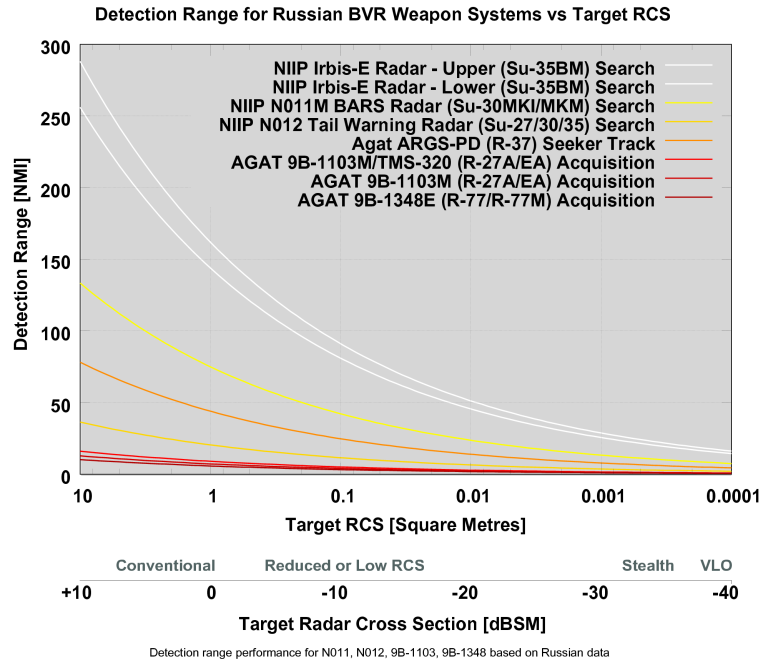
At 100 nm the Captor C can track a “fighter sized target” that usually is 1-5 sqm. This puts Captor C at 100-130% of the range performance in the N011M BARS in the chart. Irbis E has ~200% of the range performance of the N011M.
If a radar in the N011M-class (or with 30% longer range) can be used to engage a F22 at 20nm then the ballpark for the Irbis E will be 55-100% further away.The general frontal RCS-figure for the F22 will be closer to 0,01 sqm than the marketed 0,0001 sqm.
Do note that the basic assumptions are the following: 1: the luftwaffe Eurofighters used their radar since I only know of one Luftwaffe individual with Pirate (twin seat 30-42) and 2: I purposely chose the shortest range given in the quotes. Real tracking range is most likely a bit longer.
There are an awful lot of assumptions there, and those Russian claims need an awful lot of substantiation.
300NM range against a 10sq m target? A large 4th generation fighter can easily be in that range. 150NM+ range against a 1 sq m target? That isn’t even a big fighter signature… just because someone put it on a cute little chart doesn’t make it true.
hopsalotHaha, true story. My interpretation is pretty similar. But this is very relevant for the F35.
This should mean that a F35 has to engage threats like the currently fielded Su35S at distances over 70km to be sure about having the first shoot capability. (I assume that the F35 only is slightly less stealthy than the F22)
Is the Aim120 good enough (considering NEZ and kinematic disadvantage)? And more importantly, is this good enough of a range to counter the coming AESA-upgrades on the Flanker series?
I just try to count on the lower side so the stealth advantage isnt neglected.
I am really not sure how you are reaching that conclusion.
First off, we are talking about the Typhoon’s IRST, not its radar. The F-35 will have a smaller IR signature than an F-22 and a correspondingly shorter detection range.
Second off, 70km? Not a chance…
hopsalotI personally think that in BVR – both F-22 and EF-2000 can detect each other at medium range (EF-2000 thanks to PIRATE) and fire AMRAAM from around 20 miles.
If indeed the PIRATE can detect the F-22 at 50kms under some circumstances that is impressive, but that doesn’t mean the EF is going to get a shot off at anything like medium range.
50km is already well within an AMRAAM’s effective range, especially when launched from an F-22. The F-22 in this scenario would likely have fired its missile before the Typhoon was aware of its presence.
Another issue is that you can’t fire on a target the moment you detect it. You need time to figure out what you are looking out, whether it is hostile, and decide on a course of action. A first detection at 50km does not mean a shot at 50km. It means that if the pilot really has a hair trigger he might pull the trigger some seconds(and miles/kilometers) later.
The bottom line is that while the Typhoon is an excellent aircraft it just isn’t equipped to fight an F-22. (As admitted by the German pilots who took part in the exercise.)
When paired with Meteor, and fighting a target it can reliably detect long range, the Typhoon will likely be an extremely potent aircraft. (Which is to say against the threats it was designed to face…)
hopsalotThe German Eurofighters AFAIK dont use Pirate. The only other way to get a missile lock on should be by radar.
Just expanding the implication of that:
The Captor-C (currently on the Eurofighters) can detect/track fighter sized targets at 185km (100nm) and they should have an equivalent RCS of 1-5sqm.This would put the range performance at 50-65% of the performance in the Irbis E. In other words a Flanker (assuming equal jam resistance) should be abe to get a radar lock on a F22 at up to 31-40nm (57-74km) on a Raptor as long as it isnt a pure “head on” engagement.
Did you read the post a few above this one? He already linked to info saying that the Germans brought one PIRATE equipped Typhoon to the exercise and that they claimed could pick up an F-22 at around 50km under at least some circumstances.
hopsalotContemplate this statement for a moment,
what he is saying here is that IF all data are optimal (head on, supersonic, no off-bore etc)
then and only then he can launch an AMRAAM at >20 miles with decent Pk
That isn’t at all how I read that. I see two possible ways to read it:
1. If I do everything right, I can’t get closer than 20 miles from the Raptor. (Makes sense given that he says the Raptors are not built for [close] combat and that “[it’s] not going to the merge, the Raptor has BVR capabilities that we do not…” It also quotes one of the pilots as saying “its unique capabilities are overwhelming from our first impressions in terms of modern air combat but as soon as you get to the merge, which is a very small spectrum of air combat…”)
2. If I do things right I never get closer than 20 miles from a target I am engaging.
I really don’t see any way to read it that suggests that only under a best case scenario could he launch at greater than 20 miles.

hopsalotCUDA is a CAD design in LM´s computers.
Its not on any Pentagon budget, program, whatever, there´s not even a requirement for it, good luck…Did you read the “low cost weapon” bit?!!!!
Given LM past history, if this CUDA transformed itself into actual hardware (it wont) i am wiling to bet that it would double the cst of one AIM120.
Everything starts somewhere… and given the scale and importance of the F-35 program I expect there to be a great deal of interest in this missile or something very much like it.
hopsalot
360 degree engagement capability, expanded BVR capability, expanded WVR capability, multi-mode seeker…
Yes please, I will take 12. (and throw in 12 more for my buddy) :diablo:
:dev2:
hopsalotI trust that the Canadian DoD and their auditors sort of know what they are doing. All cost estimates so far are assumptions. For all systems. But we can wait 30 years into the future and then forecast what happens in the past.
SwAF and RCAF do their TCO calculations fairly similar.
It will be interesting to see how quickly that changes if they ultimately pick the F-35…
hopsalotSo the Canadian DoD numbers for a 30 year TCO are based on LRIP costs? Allow me to doubt that. I use the TCO costs for 30 years.
The numbers are just as valid for the Gripen as they are for the Rafale.
Based on a simple thing like the amount of electronic systems on the jets and the sheer weight the F35 will never ever be as cheap as a Rafale. Cost and weight goes hand in hand. Thats just how it goes.
A proper comparison would require a complete analysis of costs done with the same assumptions, something that just isn’t available right now and might never be.
It is true that the F-35 is a heavier and more sophisticated aircraft, and that does correlate with higher costs, but at the same time the Rafale is a twin engined jet that will only be produced in small numbers compared to the F-35 program, which favors the F-35.
It will be some time before any real conclusions can be reached on exactly how they compare, but in all likelihood they will be similar and the F-35 may eventually come in significantly cheaper.
hopsalotIts a play with numbers. But if you want it more you can change it for the AGM88E that is 1/3rd cheaper. With a 50/50 mix you get 50 KEPD and 75 AGM88E… PER JET!
And you still save millions of dollars per plane that could give you SHORAD for the airfields, more jets or stealth UCAVs. F35 has some qualities but one of them is not the cost. And thats in the end what matters, just look at the German Tiger tanks during WWII, exceptional in many ways but outproduced by the enemy and to complex for the environment and time.
…and what part of that doesn’t apply to the Typhoon, or Rafale, or any other high-end jet for that matter? The F-35’s price is currently inflated due to the early stage of production it is in, but when all is said and done it will cost similar or less than aircraft like the Typhoon, Rafale, etc.
hopsalotThere is no general “correct number”. It is up to individual requirement.. But it is you who was highlighting this capability as an advantage and likely a selling point, I assume you know what is it good for. I personally don’t..
It is about capability, and flexibility. Not every mission requires that type of payload, but there are cases where fewer planes carrying more is a force multiplier.
An F-35 operator could have a highly stealthy aircraft with a load of 2×2,000lb bombs or 2 JSOW, or 2 NSM, or 8 SDB, etc, but if stealth isn’t a major consideration (essentially it is a case where you could use 4th generation aircraft to do the same job) then the F-35 can carry much more.
If you are striking a target such as an airfield there may be numerous individual aim-points. An aircraft that can carry 6×2,000lb bombs, or various other combinations of bombs including 24 SDBs you can accomplish the mission with fewer planes. That is a force multiplier, that matters.
No. Not when it means going for an aircraft which fails to excel in the primary role for the particular users like Australia, Canada or Netherlands.. which is air defense… I rather get a faster, sleeker, cheaper and more nimble F-3x which only can carry four or two but flies in circles around Flankers and a three squadrons of which cost me $2.9bil, not $6.5bil..
Again, how does that apply for Netherlands, Australia or Canada?:confused:
Again with the “primary role” is air to air business…. :rolleyes: Air to air is one role of many undertaken by modern air forces, and it is one that the F-35 will perform much more capably than the jets it is replacing.
In Canada and Australia’s case their “sleek, fast, etc” fighters are Hornets, a plane the F-35 will handily out perform across the board. If anyone really wants a cheaper multi-role fighter the F-16 is still available…
hopsalotBut who needs to carry 6x 2.000lb load? Netherlands? Canada? Australia?
For what exactly?That reminds me of those early A-10 PR pictures with a bomb or two hanged on every pylon.
:rolleyes:
Who “needs” to carry six? What is the correct number then?
Certainly not every mission will call for 6 2,000lb bombs, but the capability exists, would you rather have it or not?
Besides, tt applies equally well to 6 x JSOW, JSOW-ER, NSM, etc, weapons with a substantial stand-off capability that would be useful in the opening hours of a conflict.


 Sign In