hopsalot
FARNBOROUGH: P&W discusses adaptive cycle upgrade for F-35
GE Details Three-Stream Fighter Engine Test Plan
Meanwhile John McCain ——> http://i.imgur.com/wXts9Yt.gif
Sounds like GE, with the advantages that go with a clean slate design, has found a way to make their variable bypass engine fit in the F-35 while PW’s design would need structural changes to the F-35. Obviously if both designs are otherwise similar in performance this would give GE a big edge.
I hope they go forward with the full flight demo option. The advantages of these engines are potentially immense. I think if they got one flying they would end up moving to full procurement promptly.
hopsalotThe fuel tanks of the Mi-35M are filled with explosion-retardant polyurethane foam..
…and the engines can burn that?
hopsalothttps://www.flightglobal.com/news/articles/farnborough-pratt-whitney-proposes-block-1-engin-427150/
An F-35A with this enhanced engine puts up some pretty darn impressive numbers…
F-35A empty weight : 29,100.
F-35A fuel capacity: 18,500.
Thrust 47,300.
Empty power to weight: 1.63
50% fuel power to weight: 1.23
100% fuel power to weight: .99
Bear in mind that is an aircraft with enough fuel capacity to match a Eurofighter with three tanks…
hopsalotDo you have any idea how few F-35s we’ll have in service ten years from now?
Unless we decide to cut our defence spending to Irish levels, Typhoons will not be retired ten years from now.
It doesn’t need to be every Typhoon all at once. One would expect them to be phased out over a number of years. The T1s would almost certainly be retired sometime in the 2020s.
hopsalotThat’s what one would have ordinarily assumed. Trouble is, the Eurofighter, particularly the T1, due a combination of issues doesn’t appear to have anywhere near the Eagle’s shelf life.
The EF has a nominal airframe life of just 6000 hrs (though its makers say it’ll go past 8000 hrs under lighter usage). Then there are the recently discovered manufacturing defects could end up halving the airframe life of older aircraft and quite likely be a major impediment to life extension efforts. Plus the T1 software architecture also makes upgrading to T3 standards inordinately expensive (only the T2s are being upgraded AFAIK).
To top it all the RAF has been flogging its T1 hard. Really hard.
The UK has accumulated by far the highest number of flying hours with the Eurofighter, compared with partner nations Germany, Italy and Spain. Although the RAF has the largest fleet, it is also achieving a utilisation rate around double that of the other air forces.
“We are looking at about 30h per month on average for each of our airframes at the frontline, whereas the other nations fly at a maximum of about 15h per month per aircraft,” says Bushell.
– Link
That’s over 300 hrs annually!
__________________________________________________________Given their size and economic profiles, it would be quite reasonable to expect the UK’s ideal fighter strength to be near identical to France i.e. ~225 fighter jets/Rafales (as per the latest White Paper). Ordinarily that would mean 160 Eurofighters + 65 F-35Bs. That’s about enough F-35s to fully equip both CVs (4 full squadrons at 75% availability).
The problem is with the 53 T1s in service. Initially they were expected to be retired by 2018. Right now the MoD is looking to push that further. Maybe till 2025. But beyond that its a very iffy proposition which leaves the RAF with a 50 aircraft deficit. Originally they expected all 138 F-35s to be of the ‘Bee’ model but given the disparity in costs, the F-35A is likely to be a more cost effective option while still enjoying extensive compatibility with the Bees.
This…
Here is another article on the issue. I believe the UK has backtracked on retiring the T1 Eurofighters in 2019, but they were seriously considering it not long ago.
The UK’s frontline fast-jet force is set to fall to its lowest numerical strength just ahead of the turn of the decade, with the almost simultaneous retirement of both the Panavia Tornado GR.4 and early model Eurofighter Typhoon fleets, the government disclosed on 21 July.
Answering questions in the House of Commons, Philip Dunne, Minister for Defence Equipment, Support, and Technology said that the retirement of the Tornados is to coincide with that of the Tranche 1 Typhoons in 2019.
Currently, the Royal Air Force (RAF) fields 53 Tranche 1 Typhoons and 87 Tornados which, when coupled with the Tranche 2 and 3A Typhoons now flying, brings its frontline combat inventory up to 192 aircraft. Although the loss of 140 aircraft by 2019 represents a 77% reduction in the current force strength on paper, it should be noted that this will be offset somewhat by the continued delivery of the Tranche 3 Typhoons, as well as the arrival of the first Lockheed Martin F-35B Lightning II Joint Strike Fighters.
hopsalotFirst off, I seriously consider the big white streamers a serious issue. They are more visible than the aircraft and not just a product of keeping formation with a slow tanker/photographic aircraft. They last a considerable period of time.
Once upon a time they really would have warranted some discussion, but in a future where aircraft have sensor suites including things like DAS, etc, it just isn’t going to matter once. Even in an F-35 by the time you get close enough to see streamers coming off the wingtips they will already have detected you by other means.
Secondly, I know you guys have to put up with a lot of stick and it’s nice to be able to get excited, but the F35 replacing the Typhoon is not viable. The F35 will not replace the F22 and neither will it replace the Typhoon.
I don’t even think it will replace German Tornadoes tbh. France will produce a Rafale replacement, the UK will need more than occasional piecework to sustain its aerospace industry and the Germans are consistently desperate to keep European advanced manufacturing alive.
F35 will not be the only game in town and fundamentally its shape does not lend itself to the Air Superiority role required by the RAF to replace Typhoon.
I am very skeptical there will be another major European fighter… I just don’t see any willingness to provide the necessary funding. On the subject of what will replace the Typhoons, it won’t be a dedicated air superiority type. The RAF is a shadow of its former self… a total force of less than 200 jets just doesn’t warrant specialized types.
An F-35 isn’t going to replace the F-22, but a mid-2020s F-35 would have the edge on a Typhoon in almost every respect, but would also be able to offer much more from a multi-role standpoint.
hopsalotPratt & Whitney is proposing a Block 1 upgrade to its F135 engine, with hopes that the programme will be funded in a long-term budget plan starting after 2029, the company’s president of military engines says.
If funded in the 2019 programme objective memoranda, the upgrade could enter service by 2023, Bennett Croswell told FlightGlobal during a pre-Farnborough air show briefing in London on 10 July.
“It’s perfect timing, because that’s when engines start to come in for overhaul,” he says. “So an engine will come in for overhaul with the current capability, we’ll replace those parts that will improve the capability and it will leave the depot a better engine that [when it] came in.”
In April, P&W secured a $1 billion contract to fund the first 66 of the 167 F135 engines contained within the F-35 programme’s next two lots of production. The proposed Block 1 upgrade would improve the baseline F135 engine, with 5-7% better fuel burn and up to 10% more thrust, Croswell says. That could increase the engine’s capability up to a thrust rating of 47,300lb (210kN).
https://www.flightglobal.com/news/articles/farnborough-pratt-whitney-proposes-block-1-engin-427150/
hopsalotThe C was related specifically to converting the carriers. Their is nothing to a purchase of an A beyond your imaginings. And why buy the A so far into the future? if you want one which cannot fly off the carriers then wait till we get a new engine, longer range and better weapon carriage if you think the Tornado needs a direct manned replacement.
Well, there are two things in play here… not only is the F-35A more capable, it is also cheaper. That by itself makes it worth some thought. With one carrier, how many F-35Bs does the UK need? Of course they can operate from land, but if you are operating from land… why pay more for an F-35B?
The second factor is that the F-35A will quite possibly be the UK’s Typhoon replacement down the road. The Typhoon is way too expensive to keep around as a second line fighter. Ten years from now when we are talking about F-35s with laser weapons, variable cycle engines, etc, I expect to see the Typhoons retired.
we can also hope for a less energised wingtip update.
:rolleyes:
I am glad we can move on to discussing serious issues.
hopsalot-Lockheed Martin is spying a possible sale of its F-35 Lightning II Joint Strike Fighter (JSF) to Switzerland as that country looks to reconstitute its aborted fighter replacement programme, a senior company official told reporters on 7 July.
Speaking ahead of the Farnborough International Airshow, Lockheed Martin’s executive vice president and general manager for the F-35 programme, Jeff Babione, said that the company “absolutely” sees potential for a prospective sale to the Swiss.
“The Swiss [fighter replacement programme] will be a great opportunity to offer the F-35 – absolutely it would,” Babione said, adding; “It would do well in any open and transparent competition.”
The Swiss Air Force has an urgent need to replace its outdated Northrop F-5 Tiger II fleet, much of which has already been grounded by cracking issues, and will also need to begin phasing out its ageing Boeing F/A-18 Hornets in the not-too-distant future.
In April 2015 the Swiss Federal Department of Defence, Civil Protection, and Sport (VBS [previously DDPS]) announced that the country is to relaunch its efforts to procure a new fighter type following the decision by the Swiss people on 18 May 2014 to reject the funding for the Saab Gripen E replacement in a referendum not only scuppered air force’s plans to retire its 54 Tiger IIs. Shortly after announcing this, the VBS said that the 31 Hornets would be added to the replacement programme.
The VBS is believed to have begun its preparatory work, with a planning, testing, and procurement preparation report for the procurement of a new fighter, known as a PEB-2017 Credit, due to be submitted to the Swiss parliament in 2017. The VBS plans to select a new fighter type in 2020, with parliamentary approval and the award of funding in 2022 and deliveries from 2025.
The government has previously stated that the new process should include two of the three shortlisted candidates from the previous effort: the Gripen E and the Dassault Rafale.
http://www.janes.com/article/62103/farnborough-2016-lockheed-martin-sees-f-35-potential-in-switzerlandToo much good news overload. This has been a bad couple of weeks for the F-35-contra’s.
Their game is pretty much done. You can only call every F-35 pilot a liar for so long… and soon F-35s will start to show up at exercises.
hopsalot
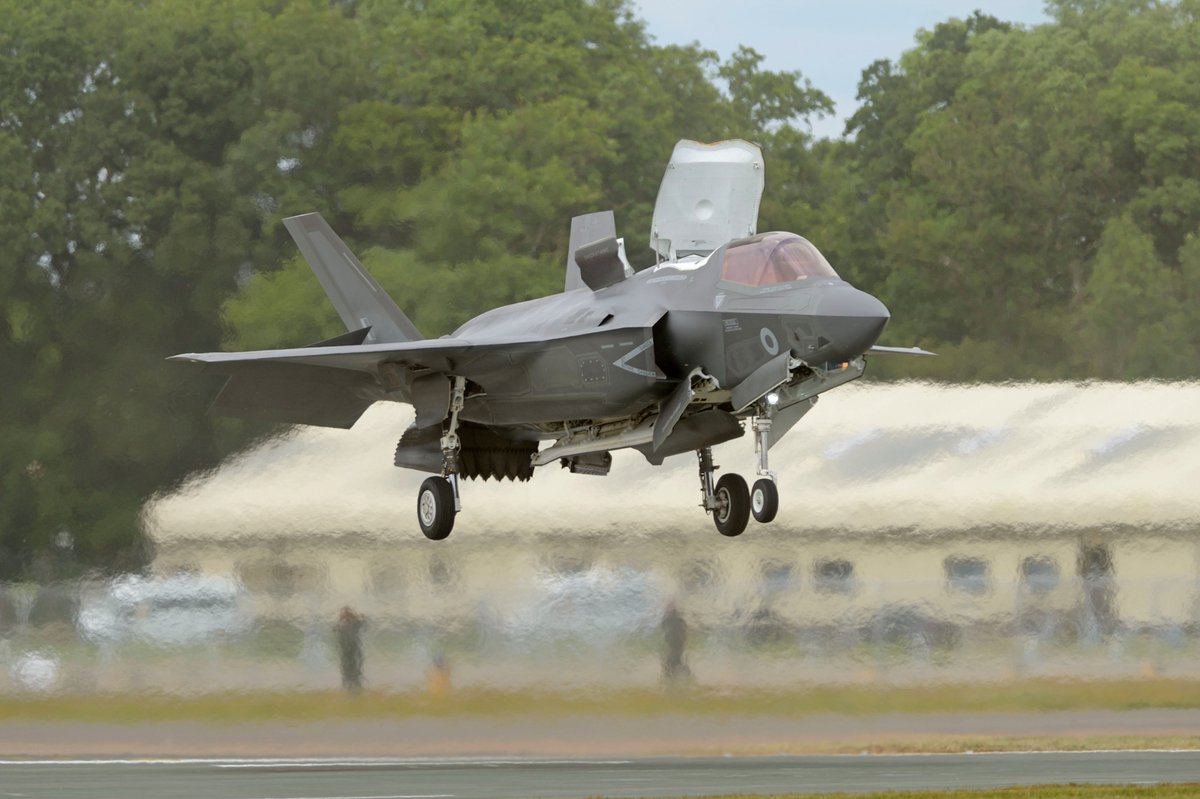
RIAT Practice – Photographer : Jamie Hunter
I can’t tell, is the concrete spalling and killing everyone?
hopsalotIt seems me all so partial: what means narrow search mode?
How +/- degrees in both azimuth and elevation? Or it just means that they keep the antenna dish fixed forward? Or at the contrary given that the Su-35 antenna can gimbal (main reason because Russians still have a crush for PESA) they in that mode emit just an old style narrow beam and adjust it with mechanical steering instead:dev2:?
Why not try google?
And they just cite the Grave Stone radar for S-400? It is just a targeting radar, search functions are made by the 91N6E radar and there will be also Nebo-m above them.
Same with Golf ball and Marble : it was almost a decade that it was revealed such values refers to an ideal angle of reflection.
Because that is the radar that can actually guide a missile… and no, It was not “revealed” that the marble/golf ball values refer to an ideal angle of reflection. They were always presented as the aircraft’s frontal RCS. (an average value, not a minimum value)
hopsalotThey said what they said.
This is what they said:
Graphic1: Large “fourth-generation” fighters such as the F-15, Su-27 and Tornado have radar cross-sections (RCS) of 10-15 m2. The F-16 and “Gen-4.5” fighters—Typhoon, Rafale, Su-35 and Super Hornet—are believed to be in the 1-3-m2 range. The F-35 and F-22 RCSs are said to equal a golf ball and marble, respectively. Based on Sukhoi’s claims that its Su-35 can detect 3-m2 targets at 400 km in a narrow-angle, maximum-power search, Aviation Week estimated how far away it can detect these fighters. Note the detection range in a standard search is half as much.
You were upset when the numbers given didn’t match your expectations. Now that you understand better what they were saying and find the numbers do match your expectations… you still complain.
hopsalotSo, according to this ‘analysis’, PESA radar with a peak-power of 20kW has a longer range of detection than a PESA radar of Megawatt class?! :stupid: TBH, i wouldn’t take seriously any ‘analysis’ which operates only by public claims and basic arithmetics in such a difficult area of science as radiophysics. This is how real analysis should look like: http://radar.dinos.net/content.htm
Until they have something like this, there is nothing to discuss here. BTW, can someone share something similar to this doc i posted above, made by the Western radiophysicists? Would be very interesting to read something more factual and scientific than these TV-shop style loads of BS for housewives, about “metal marble” and “golf ball”.
A closer reading of the Aviation Week explanation would reveal that the numbers given for the Su-35 are “in a narrow-angle, maximum-power search” They included this as well “Note the detection range in a standard search is half as much.”
So no, they aren’t claiming the Su-35’s radar has longer range against an equivalent target when compared to the S-400. (An Su-35 could expect to detect an F-22 once it closed to roughly 11 miles, whereas the S-400 would spot it at 13 miles… )
Interestingly, Aviation Week has chosen to ignore the more recent reports that the F-35 is actually stealthier than the F-22 in favor of the older “golf ball” analogy. (though as shown in these calculations it doesn’t make a great deal of difference in the end… if an Su-35 can’t spot an F-35 until it is 18 miles away it might as well not bother turning its radar on at all)
hopsalotThose ranges are consistent with this Journal of Computations & Modelling article from 2014 I posted on the forum a couple of months back, http://www.scienpress.com/Upload/JCM/Vol%204_1_9.pdf which uses an Air Power Australia 3D model for F-35 RCS calculations (so clearly not bias towards the F-35…).
Sure, but it bears repeating and it is interesting to see Aviation Week finally starting to grasp the concept.
hopsalotLifted from another forum…
Graphic1: “Large “fourth-generation” fighters such as the F-15, Su-27 and Tornado have radar cross-sections (RCS) of 10-15 m2. The F-16 and “Gen-4.5” fighters—Typhoon, Rafale, Su-35 and Super Hornet—are believed to be in the 1-3-m2 range. The F-35 and F-22 RCSs are said to equal a golf ball and marble, respectively. Based on Sukhoi’s claims that its Su-35 can detect 3-m2 targets at 400 km in a narrow-angle, maximum-power search, Aviation Week estimated how far away it can detect these fighters. Note the detection range in a standard search is half as much. Credit: Colin Throm/AW&ST”
Graphic2:”Almaz-Antey says the S-400’s 92N6E “Gravestone” fire-control radar can detect a 4-m2 radar-cross-section target at 250 km. Based on this figure, Aviation Week estimated its detection range against modern fighter aircraft. Credit: Colin Throm/AW&ST”
http://aviationweek.com/defense/measuring-stealth-technologys-performance
So according to Aviation Week’s calculations… in a best case scenario with a cued search and no jamming the latest Russian radars will struggle mightily to detect 5th generation aircraft at tactically useful ranges.


 Sign In