 EN830
EN830That’s easy for you to say, Ian. :diablo:
Not really, I fell asleep after the first line 🙂
EN830That’s easy for you to say, Ian. :diablo:
Not really, I fell asleep after the first line 🙂
EN830I guess it is !!!!
Transvection is an epigenetic phenomenon that results from an interaction between an allele on one chromosome and the corresponding allele on the homologous chromosome. Transvection can lead to either gene activation or repression. Formally (see quote from Lewis, below), it can also occur between nonallelic regions of the genome as well as regions of the genome that are not transcribed.
Edward B. Lewis at Caltech discovered transvection at the bithorax complex in Drosophila in the 1950s. Since then, transvection has been observed at a number of additional loci in Drosophila, including white, decapentaplegic, eyes absent, vestigial, and yellow. As stated by Ed Lewis, “Operationally, transvection is occurring if the phenotype of a given genotype can be altered solely by disruption of somatic (or meiotic) pairing. Such disruption can generally be accomplished by introduction of a heterozygous rearrangement that disrupts pairing in the relevant region but has no position effect of its own on the phenotype” (cited in Wu and Morris 1999). Recently, pairing-mediated phenomena have been observed in species other than Drosophila, including mice, humans, plants, nematodes, insects, and fungi. In light of these findings, transvection may represent a potent and widespread form of gene regulation.
Interestingly, transvection appears to be dependent upon chromosome pairing. In some cases, if one allele is placed on a different chromosome by a translocation, transvection does not occur. Transvection can sometimes be restored in a translocation homozygote, where both alleles may once again be able to pair. Restoration of phenotype has been observed at bithorax, decapentaplegic, eyes absent, and vestigial, and with transgenes of white. In some cases, transvection between two alleles leads to intragenic complementation while disruption of transvection disrupts the complementation.
Transvection is believed to occur through a variety of mechanisms. In one mechanism, the enhancers of one allele activate the promoter of a paired second allele. Other mechanisms include pairing-sensitive silencing and enhancer bypass of a chromatin insulator through pairing-mediated changes in gene structure.
EN830I guess it is !!!!
Transvection is an epigenetic phenomenon that results from an interaction between an allele on one chromosome and the corresponding allele on the homologous chromosome. Transvection can lead to either gene activation or repression. Formally (see quote from Lewis, below), it can also occur between nonallelic regions of the genome as well as regions of the genome that are not transcribed.
Edward B. Lewis at Caltech discovered transvection at the bithorax complex in Drosophila in the 1950s. Since then, transvection has been observed at a number of additional loci in Drosophila, including white, decapentaplegic, eyes absent, vestigial, and yellow. As stated by Ed Lewis, “Operationally, transvection is occurring if the phenotype of a given genotype can be altered solely by disruption of somatic (or meiotic) pairing. Such disruption can generally be accomplished by introduction of a heterozygous rearrangement that disrupts pairing in the relevant region but has no position effect of its own on the phenotype” (cited in Wu and Morris 1999). Recently, pairing-mediated phenomena have been observed in species other than Drosophila, including mice, humans, plants, nematodes, insects, and fungi. In light of these findings, transvection may represent a potent and widespread form of gene regulation.
Interestingly, transvection appears to be dependent upon chromosome pairing. In some cases, if one allele is placed on a different chromosome by a translocation, transvection does not occur. Transvection can sometimes be restored in a translocation homozygote, where both alleles may once again be able to pair. Restoration of phenotype has been observed at bithorax, decapentaplegic, eyes absent, and vestigial, and with transgenes of white. In some cases, transvection between two alleles leads to intragenic complementation while disruption of transvection disrupts the complementation.
Transvection is believed to occur through a variety of mechanisms. In one mechanism, the enhancers of one allele activate the promoter of a paired second allele. Other mechanisms include pairing-sensitive silencing and enhancer bypass of a chromatin insulator through pairing-mediated changes in gene structure.
EN830Taken earlier this year, G-UHIH formerly N41574, not as far as I am aware a Falklands veteran, though G-HUEY was, ex AE-413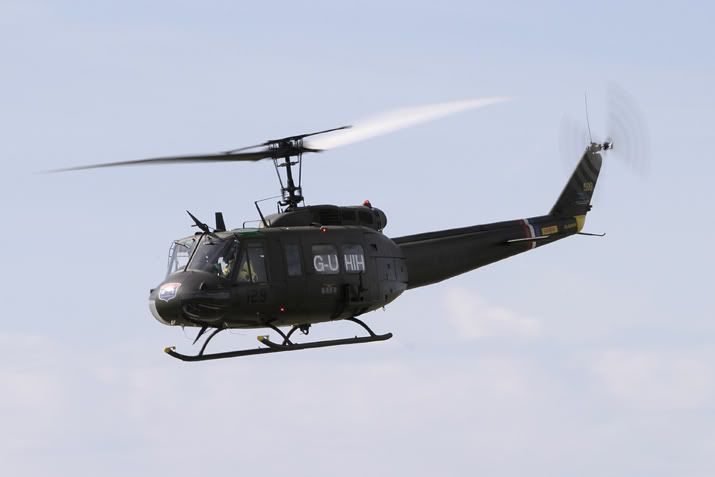
EN830I’ll be late, coz I won’t be able to afford to drive my hugely uneconomical “common rail direct injection” 4×4 ,and you can’t ride a push bike up the M11.
You could always invest in a Toyota Prius and really screw the environment.
EN830I thought the “free loading thread” was closed…. Given that at any Duxford airshow, there are people leaving before the flying starts, (its true I’ve seen it) and that maybe up to a third leave before the flying finishes (true also ,even I do sometimes) and that the area is heavily policed, how many people will either bother, or indeed be allowed to “park up” and free load?
This A/C should, if the collective realists were right ,be ,residing in a “skip” by now,the fact that is not, is maybe down to those much vilified optimists who have put their hands in their pockets; one could argue that if the Vulcan does fly, and people who were aware of the campaign, and had the oportunity to contribute, but didn’t get to see it, they are free loading themselves, so it is their duty to go home early from whichever airshow they are attending.
Get off the soap box Stuart, I think you’ll find the above comments were/are tongue in the cheek comments.
EN830A suggestion pervaded with all the realism we have come to expect.
Moggy
Now be fair, it is “very” practical. All those people forced to leave will make their way to the fields at either end of the runway, and continue to watch the display from there, leaving those who are stupid enough to pay the excess with unimpeded views.
EN830Just mention digging Bader’s Spitfire for a debate on real archaeology. 🙂
I thought the programme was OK, but lacked something.
EN830Not listed on IMDB.com
EN830Watched the film for the first time this evening and thoroughly enjoyed it, good flying shots (including at least one from the BoB), interesting story line, one I didn’t know much about until quite recently.
EN830Yes it does, but not going to be flying then 😉
EN830owfully sorry 🙂 better? 😉
Yes thank you, carry on 😀
EN830Possibly per leg or even per toe!
No, lets be fair an arm and a leg 🙂


 Sign In







